Inside India’s language conundrum
New · District CollectorCan you hold the district for 72 hours?Floods, a heatwave, an outbreak, a grievance queue. Take the decisions, see the consequences.Play →In this note
Practice
6 questions on this article
Check the answer for each question, or reveal all at once.
1. At a Glance
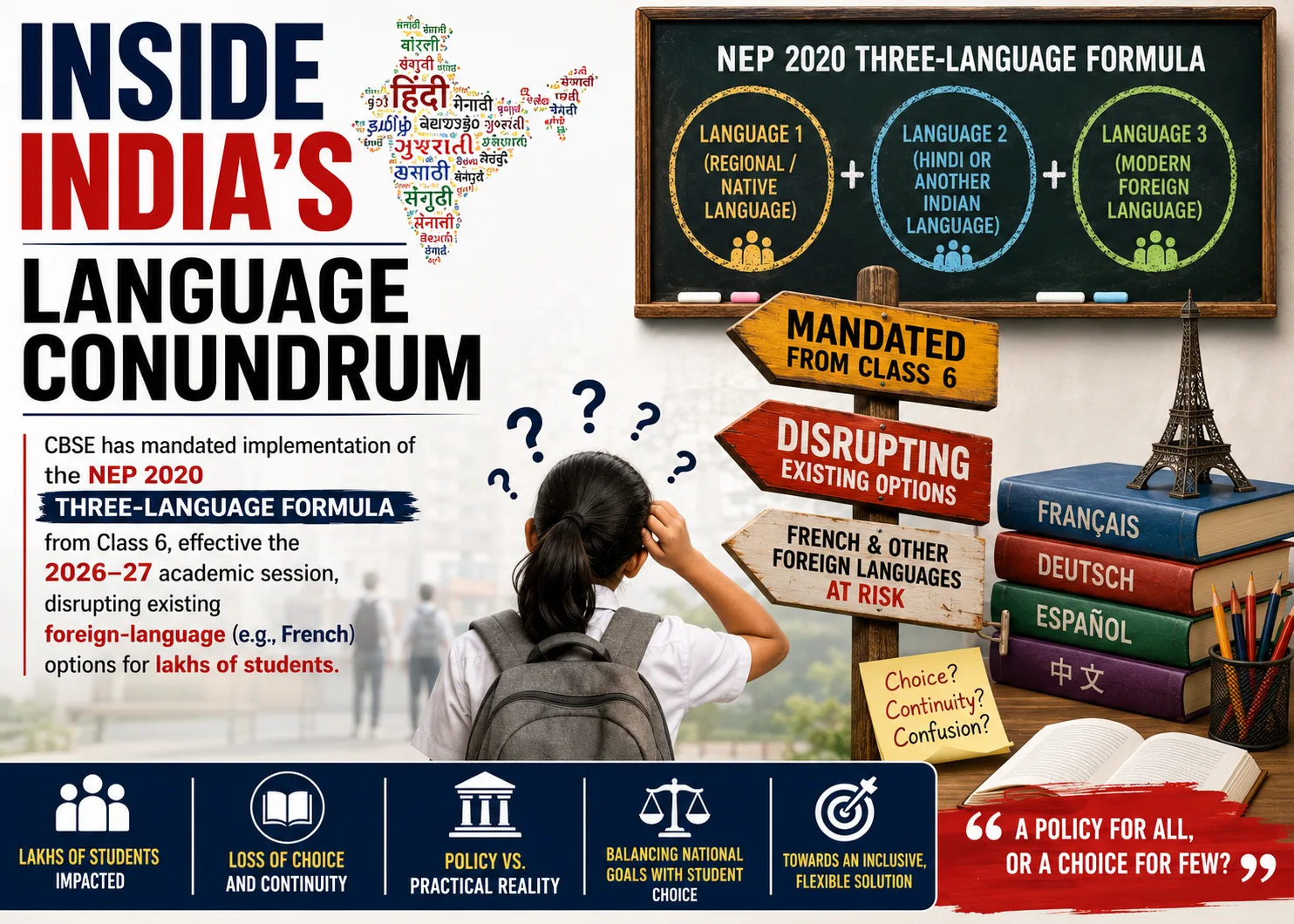
- CBSE has mandated implementation of the NEP 2020 three-language formula from Class 6, effective the 2026–27 academic session, disrupting existing foreign-language (e.g., French) options for lakhs of students [1].
- The policy requires two of three languages to be Indian languages, reigniting the decades-old Centre–State language politics, especially in Tamil Nadu and the Northeast [2][3].
- Tests UPSC aspirants on federalism, education policy, linguistic diversity, and Centre-State fiscal leverage (fund withholding) — a recurring GS-II/GS-I theme [3].
2. Why in the News
- CBSE directed all affiliated schools to roll out the three-language formula from Class 6, effective the 2026–27 session (began April 2026), causing teacher layoffs, curriculum disruption, and parental/student confusion — e.g., a Greater Noida Class 6 student forced to drop French mid-course [1].
- Renewed Centre–Tamil Nadu clash: Union Education Minister Dharmendra Pradhan vs. CM M.K. Stalin over alleged Hindi imposition [2].
- Centre has withheld ₹2,152 crore in Samagra Shiksha funds to Tamil Nadu over its refusal to adopt NEP 2020's formula [2].
- Northeastern states (Nagaland, Mizoram, Manipur) flagged concerns that mandatory "Indian language" choices (often Sanskrit/Hindi) fail to reflect local tribal linguistic identities (e.g., Angami, Konyak communities cited by a Nagaland CBSE principal) [4].
3. Background & Evolution
- Three-Language Formula (TLF) origin: recommended by the Kothari Commission (1964–66) and adopted in the National Policy on Education, 1968, aiming at national integration through multilingualism.
- Reaffirmed in NPE 1986 and now recast under NEP 2020, which envisages flexibility but mandates at least two of three languages be native to India.
- Tamil Nadu has followed a two-language policy (Tamil + English) since the 1960s anti-Hindi agitations, consistently rejecting the third-language mandate [2].
- CBSE's 2026–27 rollout operationalises NEP 2020 at the school-board level, six years after the policy's 2020 release [1].
4. Core Static Facts
| Item | Detail |
|---|---|
| Parent policy | National Education Policy (NEP) 2020 |
| Implementing board (current trigger) | CBSE (Central Board of Secondary Education) |
| Effective class | Class 6 onward, academic year 2026–27 |
| Formula structure | R1, R2, R3 — three languages studied |
| Language rule | At least 2 of 3 must be Indian languages |
| Completion requirement | All three languages must be passed by secondary level (Class 9–10) [1] |
| CBSE student base affected | ~40 lakh students across CBSE schools [4] |
| Scheme linked to compliance | Samagra Shiksha Abhiyan (Centrally Sponsored Scheme, School Education) |
| Funds withheld from Tamil Nadu | ₹2,152 crore [2] |
| Originating commission | Kothari Commission, 1964–66 |
| First policy adoption | National Policy on Education, 1968 |
5. Multi-Dimensional Analysis
Social
- Northeastern tribal communities (Angami, Konyak in Nagaland) fear loss of connection to oral/community languages when a non-native "Indian language" like Sanskrit is imposed as R3 [4].
- English-medium urban students (e.g., in Delhi-NCR) losing access to foreign-language electives like French due to rigid formula compliance [4].
Legal/Constitutional
- Education is in the Concurrent List (7th Schedule); language policy implementation reveals Centre-State friction over a shared subject.
- Fund conditionality (Samagra Shiksha) raises questions of fiscal federalism and coercive use of Centrally Sponsored Scheme funds to enforce policy compliance [2].
Administrative
- Implementation gaps: teacher shortages/losses reported as schools scramble to hire faculty for newly mandated third languages [4].
- Asymmetric burden: southern/non-Hindi states effectively required to teach Hindi as the practical "third Indian language," while Hindi-belt states face no reciprocal southern-language requirement [3].
Ethical/Governance
- Debate over whether "language choice" is genuine or whether Hindi is being covertly mainstreamed under a neutral-sounding "Indian language" clause [2][3].
Historical
- Echoes the 1965 anti-Hindi agitations in Tamil Nadu, showing continuity of language as a political fault line over six decades [2].
6. Recent Developments (last 12–18 months)
- 2026–27 session (April 2026): CBSE three-language formula formally implemented from Class 6; foreign-language options (e.g., French) discontinued mid-stream for some students [4].
- 2026: Renewed public clash between Union Education Minister Dharmendra Pradhan and Tamil Nadu CM M.K. Stalin over the formula [2].
- 2026: Centre continues withholding ₹2,152 crore Samagra Shiksha funds from Tamil Nadu over non-implementation [2].
- May 2026: Commentary pieces (e.g., Countercurrents) critique CBSE's language policy as inconsistent, terming it "language of hypocrisy" [2].
- Reports of a Supreme Court-related controversy around CBSE's Class 9 three-language mandate emerging in 2026 [2].
7. Prelims Hooks
- Three-language formula traces its origin to the Kothari Commission (1964–66).
- First formally adopted in the National Policy on Education, 1968.
- CBSE mandated three-language study from Class 6, effective 2026–27 academic session.
- Under CBSE's rule, at least two of three languages must be Indian languages.
- Students must pass all three languages by secondary school (Class 9–10).
- Approximately 40 lakh students study across CBSE-affiliated schools.
- Tamil Nadu follows a two-language policy (not three), rooted in 1960s anti-Hindi agitations.
- Centre withheld ₹2,152 crore in Samagra Shiksha funds from Tamil Nadu over NEP non-compliance.
- Samagra Shiksha is a Centrally Sponsored Scheme in school education.
- Education falls under the Concurrent List of the Constitution's Seventh Schedule.
- Northeastern states raising concern: Nagaland, Mizoram, Manipur.
- NEP 2020 formula denotes languages as R1, R2, R3.
8. Mains Relevance
- GS-II: Government policies and interventions; issues arising from design/implementation; Centre-State relations; federalism.
- GS-I: Indian society — diversity, linguistic pluralism, regionalism.
- Syllabus headings: "Issues relating to development and management of Social Sector/Services relating to Education"; "Federal structure — devolution of powers and finances"; "Salient features of Indian Society, Diversity of India."
- Plausible Mains stems: 1. "Critically examine the implementation challenges of NEP 2020's three-language formula in India's linguistically diverse federal setup." 2. "Discuss how Centrally Sponsored Schemes can become instruments of policy coercion in Centre-State relations, with reference to recent education funding disputes." 3. "Language policy has historically been a fault line in Indian federalism. Analyse with reference to the Kothari Commission recommendations and their contemporary contestation."
9. Related Topics to Study Next
- NEP 2020 (full policy) — the parent framework driving this reform.
- Samagra Shiksha Abhiyan — the CSS whose funds are being withheld, useful for CSS/federal-fund conditionality questions.
- Anti-Hindi agitations (1937, 1965) — historical roots of Tamil Nadu's language stance.
- Official Languages Act, 1963 & Article 343-351 — constitutional language provisions.
- Cooperative vs. competitive federalism — broader theme of Centre-State fund disputes.
- Eighth Schedule languages — classification of recognised Indian languages relevant to "Indian language" debates.
- National Curriculum Framework (NCF) 2023 — operational document translating NEP language provisions into curricula.
- Linguistic reorganisation of states (1956) — historical precedent for language-based political mobilisation.
10. Common Errors / Trap Areas
- Confusing NEP 2020 (policy) with CBSE's 2026–27 circular (implementation instrument) — the formula is NEP-derived but CBSE-operationalised.
- Assuming the three-language formula is new — it dates to the 1968 policy, not NEP 2020.
- Mixing up Samagra Shiksha (school education CSS) with other schemes when discussing the Tamil Nadu fund freeze.
- Believing NEP 2020 explicitly mandates Hindi — officially it mandates "two Indian languages," not Hindi specifically, though critics argue it functions that way in practice.
- Overlooking that Tamil Nadu's two-language policy predates NEP 2020 by decades and is not a new "rebellion" but a continuing stance.
Sources
- 1CBSE Introduces Three-Language Formula From Class 6, Students Must Pass All By Secondary School Levelthelogicalindian.com · tier 4
- 2Why NEP's three-language formula has sparked a Centre-TN clashthefederal.com · tier 4
- 3The Three-Language Formula in India: Evolution, Implementation, and Contestationeducationforallinindia.com · tier 4
- 4The Hindu — "Inside India's language conundrum"thehindu.com · tier 4
At the end · practice MCQs
6 questions on this article
Check the answer for each question, or reveal all at once.