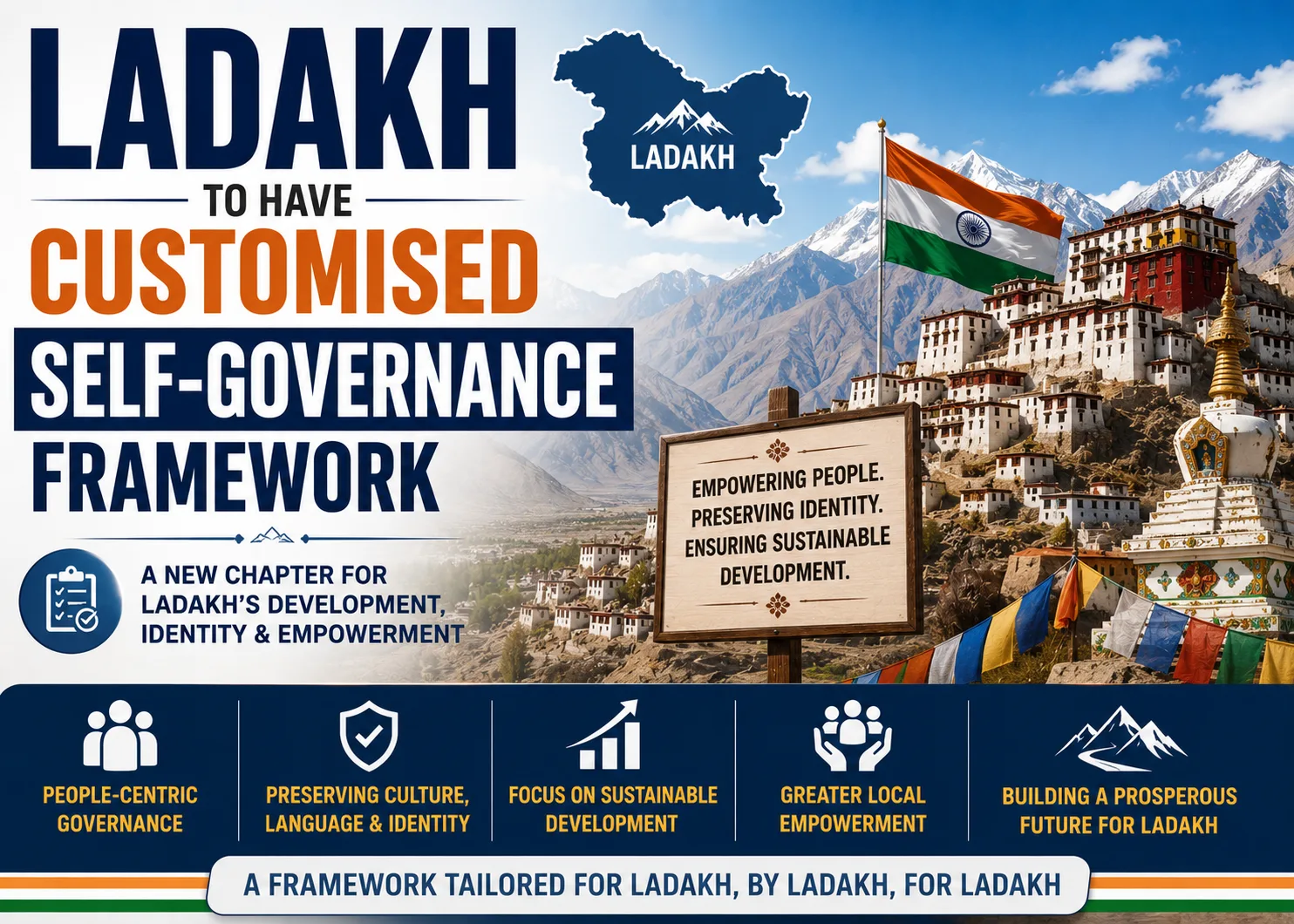
Ladakh to have customised self-governance framework
New · District CollectorCan you hold the district for 72 hours?Floods, a heatwave, an outbreak, a grievance queue. Take the decisions, see the consequences.Play →In this note
Practice
9 questions on this article
Check the answer for each question, or reveal all at once.
1. At a Glance
- Centre and Ladakh civil society bodies have agreed, in principle, on a UT-level elected body with executive, financial, and legislative powers as a "first step" short of full Statehood [1].
- The model draws on Article 371 (371A–371J) special-provision architecture, adapted as a "sui generis" (one-of-a-kind) framework for Ladakh rather than a copy-paste of any existing state's arrangement [1][2].
- Sits at the intersection of Sixth Schedule tribal-autonomy demands and Statehood demands — both raised since Ladakh's 2019 bifurcation from J&K into a UT without a legislature [3][4].
- High-yield UPSC topic: tests Article 371 series, Sixth Schedule, UT governance structures, and Centre-civil society negotiation mechanisms.
2. Why in the News
- Fifth meeting (22 May 2026) of the sub-committee of the High-Powered Committee (HPC) on Ladakh concluded with minutes released by the MHA team, agreed jointly with Leh Apex Body (LAB) and Kargil Democratic Alliance (KDA) leaders — reported 3–4 July 2026 [1].
- Minutes state: Statehood remains the long-term aspiration, but as an immediate step, a customised UT-level elected body will be created; a detailed draft on its powers is to follow [1].
- Described in press as a "breakthrough" in the stalled Centre-Ladakh dialogue [2].
3. Background & Evolution
- 2019: J&K Reorganisation Act splits J&K; Ladakh becomes a Union Territory without legislature (unlike J&K UT, which retains one) — triggering demands for democratic representation and tribal safeguards [3][4].
- Civil society groups (LAB representing Leh, KDA representing Kargil) — historically rival Buddhist/Muslim-majority blocs — unite post-2019 to jointly demand Statehood, Sixth Schedule inclusion, a separate Public Service Commission, and Lok Sabha seats for Leh & Kargil [3][4].
- NCST (National Commission for Scheduled Tribes) formally recommends Sixth Schedule status for Ladakh to the Union Home Minister and Union Tribal Affairs Minister [4].
- MHA constitutes the High-Powered Committee (HPC) chaired by MoS Home Nityanand Rai, mandated to safeguard Ladakh's unique culture, language, and geo-strategic concerns [4].
- Interim confidence-building measures already delivered via HPC dialogue: ST reservation in local councils raised from 45% to 84%; one-third women's reservation in Hill Councils; Bhoti and Purgi declared official languages [4].
- LAB-KDA submit a joint blueprint titled "Sui Generis Model for Protected Statehood and Sixth Schedule", seeking upgrade of existing Autonomous Hill Development Councils (Leh/Kargil) into stronger Autonomous District Councils, plus a ~30-seat legislature [2][3].
- 22 May 2026: 5th HPC sub-committee meeting — consensus that a UT-level elected body (short of Statehood) is the near-term deliverable, structured under an Article 371-type special-provision model [1].
4. Core Static Facts
| Item | Detail |
|---|---|
| Nodal ministry | Ministry of Home Affairs (MHA) [1][4] |
| Mechanism | High-Powered Committee (HPC) on Ladakh, with a sub-committee for detailed negotiation [1][4] |
| HPC Chair | MoS Home Affairs, Nityanand Rai [4] |
| Civil society interlocutors | Leh Apex Body (LAB), Kargil Democratic Alliance (KDA) [1] |
| Constitutional hook proposed | Article 371 series (371A–371J) — special provisions for certain states, being adapted as a template, not directly applicable to a UT [1][2] |
| Parallel demand | Inclusion under the Sixth Schedule (tribal autonomous councils, applicable currently to Assam, Meghalaya, Tripura, Mizoram) [3][4] |
| Proposed new body | UT-level elected body with executive, financial, legislative powers, to work in harmony with Panchayati Raj Institutions (PRIs) [1] |
| Existing local bodies | Autonomous Hill Development Councils, Leh and Kargil (LAHDC) [3] |
| Ladakh's UT status | Created 31 October 2019 under J&K Reorganisation Act, 2019; UT without legislature [3] |
| Recent concessions via HPC | ST reservation 45%→84%; 1/3rd women's reservation in councils; Bhoti & Purgi as official languages [4] |
5. Multi-Dimensional Analysis
- Legal / Constitutional: Article 371 provisions were designed for full-fledged States, not UTs — applying a "sui generis" adaptation to Ladakh is constitutionally novel and may require a fresh constitutional amendment or a bespoke Act of Parliament rather than direct invocation of 371 [1][2].
- Administrative: The proposal must reconcile a new UT-level elected body's powers with pre-existing LAHDC councils and Panchayati Raj Institutions, risking overlapping jurisdictions if not clearly delineated [1].
- Social / Tribal: Ladakh is over 97% Scheduled Tribe population (Bot, Boto, Balti, Beda, Changpa, etc.); Sixth Schedule demand stems from land, resource, and cultural protection concerns post-UT status [4].
- Geopolitical / Strategic: Ladakh borders both Pakistan (LoC) and China (LAC, incl. Aksai Chin/Depsang); MHA's mandate explicitly cites "geographical location and strategic importance" as a rationale for a customised (not standard) governance model [4].
- Governance / Federalism: Reflects a broader trend of asymmetric federalism — UTs and border regions increasingly governed through negotiated, non-uniform arrangements rather than a single template applied nationwide.
- Historical: Mirrors past special-category arrangements (Nagaland's 371A, Sikkim's 371F) where unique historical/ethnic circumstances justified tailored constitutional carve-outs [1].
6. Recent Developments (last 12–18 months)
- Oct 2025: Reports indicate Centre floats Article 371-type safeguards to address Ladakh's concerns [2].
- LAB-KDA submit detailed blueprint demanding "protected Statehood under Article 371 and Sixth Schedule powers" [3].
- 22 May 2026: 5th meeting of HPC sub-committee reaches consensus on UT-level elected body as an interim step [1].
- 3–4 July 2026: MHA releases minutes of the meeting; reported as a "breakthrough" in Centre-Ladakh talks [1][2].
7. Prelims Hooks
- Ladakh became a Union Territory without a legislature on 31 October 2019 under the J&K Reorganisation Act, 2019 [3].
- The High-Powered Committee (HPC) on Ladakh is under the Ministry of Home Affairs, chaired by MoS Nityanand Rai [4].
- Civil society interlocutors in the dialogue: Leh Apex Body (LAB) and Kargil Democratic Alliance (KDA) [1].
- NCST recommended Ladakh's inclusion under the Sixth Schedule to the Union Home Minister [4].
- The Sixth Schedule currently applies to tribal areas of Assam, Meghalaya, Tripura, and Mizoram — Ladakh would be a new addition if included [4].
- HPC dialogue has already raised ST reservation in Ladakh's councils from 45% to 84% [4].
- Bhoti and Purgi were declared official languages of Ladakh through the HPC process [4].
- The 5th HPC sub-committee meeting was held on 22 May 2026 in New Delhi [1].
- The proposed new institution is termed a "sui generis" model — Latin for "of its own kind," i.e., not modeled directly on any existing state/UT structure [1].
- Article 371 (A to J) provides special constitutional provisions for states like Maharashtra, Gujarat, Nagaland, Assam, Manipur, Andhra Pradesh, Sikkim, Mizoram, Arunachal Pradesh, Goa, Karnataka [1].
- Existing local self-government bodies in Ladakh are the Autonomous Hill Development Councils (LAHDC) of Leh and Kargil [3].
- LAB-KDA's joint blueprint title: "Sui Generis Model for Protected Statehood and Sixth Schedule" [3].
8. Mains Relevance
- GS-II: Indian Constitution — Article 371 special provisions; Sixth Schedule; Union Territories and devolution of powers; federalism and Centre-State/UT relations.
- GS-I: Salient features of Indian society — tribal identity and regional aspirations in border areas.
- Possible question stems: 1. "Discuss the constitutional mechanisms available for granting autonomy to Union Territories. Examine their applicability to the case of Ladakh." (GS-II) 2. "Ladakh's demand for Statehood and Sixth Schedule status reflects the tension between strategic control and democratic devolution in border regions. Discuss." (GS-II/GS-I) 3. "What is a 'sui generis' constitutional arrangement? Evaluate its suitability for addressing Ladakh's governance aspirations." (GS-II)
9. Related Topics to Study Next
- Article 371 series (A–J) — the special-provision template being adapted for Ladakh.
- Sixth Schedule of the Constitution — tribal autonomous councils, comparison with proposed Ladakh model.
- J&K Reorganisation Act, 2019 — origin of Ladakh's current UT-without-legislature status.
- Autonomous District Councils (Assam/Meghalaya/Tripura/Mizoram) — functional comparators for any new Ladakh council.
- Panchayati Raj Institutions and 73rd Amendment — how the new body must "harmonise" with existing PRIs.
- Delimitation and Union Territories — related governance-structuring issue currently in the news.
- Special Category Status debates — comparative federal asymmetry discourse.
10. Common Errors / Trap Areas
- Don't confuse Sixth Schedule (tribal autonomous councils in NE states) with Article 371 series (special provisions for specific states) — Ladakh's proposal blends elements of both but is NOT a direct Sixth Schedule extension yet [1][4].
- Ladakh is a UT without a legislature, unlike J&K UT which retains one — don't conflate the two UTs' governance status [3].
- The HPC is an MHA mechanism, not a Ministry of Tribal Affairs body, even though tribal-status issues (Sixth Schedule/ST reservation) are central to its agenda [4].
- The "UT-level elected body" is explicitly framed as an interim/first step, not a substitute for the long-term Statehood demand — don't treat this as a final settlement [1].
- LAB and KDA are two distinct organisations (Leh vs. Kargil) that historically had different religious/political leanings but now act jointly on this issue [1][3].
Sources
- 1Ladakh to have customised self-governance framework, The Hindu, 4 July 2026thehindu.com · tier 4
- 2Centre dangles Article 371 safeguards to address Ladakh's concerns, The Week, 27 Oct 2025theweek.in · tier 4
- 3Ladakh submits detailed blueprint for 'protected Statehood under Art 371, 6th Schedule powers'thenewsnow.co.in · tier 4
- 4NCST recommendation on Sixth Schedule for Ladakh / High Powered Committee press releases, PIB — andpib.gov.in · tier 1
At the end · practice MCQs
9 questions on this article
Check the answer for each question, or reveal all at once.