How the Gaganyaan crew module is built to survive
New · District CollectorCan you hold the district for 72 hours?Floods, a heatwave, an outbreak, a grievance queue. Take the decisions, see the consequences.Play →In this note
Practice
8 questions on this article
Check the answer for each question, or reveal all at once.
1. At a Glance
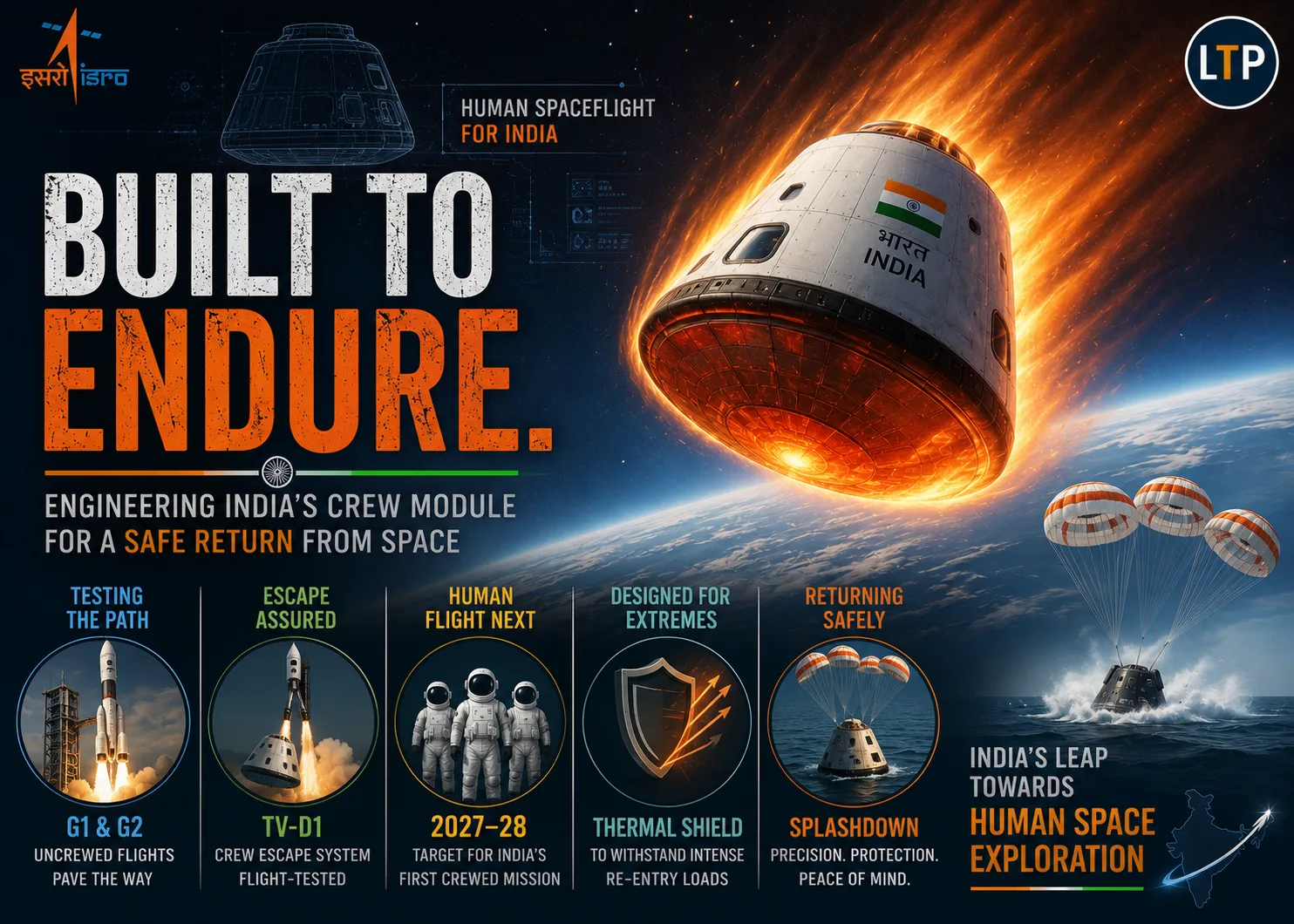
- Gaganyaan is India's maiden human spaceflight programme, designed to send Indian astronauts to space and return them safely to Earth [4].
- Survivability hinges on the crew module (CM), engineered to withstand extreme thermo-structural re-entry loads and splash down safely in the sea [4].
- Tests aspirants on ISRO mission architecture, module-wise engineering, and comparative spacecraft design (India vs Russia/China) — a recurring Science & Tech theme [1][4].
- Target: first crewed mission in 2027-28, preceded by uncrewed missions G1 and G2 [3].
2. Why in the News
- The Hindu (July 15, 2026 edition) published an explainer on crew module survival design, prompted by continued pre-launch testing ahead of the crewed flight [4].
- Recent milestones: integration of Liquid Propulsion Systems on the Crew Module for the uncrewed G1 mission, and completion of Major Qualification Tests of Crew Module systems [1].
3. Background & Evolution
- Gaganyaan approved as India's first human spaceflight programme; PM reviewed mission readiness in recent reviews [3].
- TV-D1 (Test Vehicle Abort Mission-1) successfully validated the Crew Escape System, an early precursor flight test [1][3].
- First Crew Module built for the TV-D1 test flight, demonstrating structural fabrication capability [1].
- Crew Module Recovery divers completed first batch of training for post-splashdown recovery operations [3].
- Ground test programme for human-rating of the Crew Module Propulsion System completed; Service Module Propulsion System testing nearing completion [3].
- HLVM3 (Human Rated Launch Vehicle Mark 3) development and ground testing completed [3].
- Programme now in final phase, progressing toward uncrewed mission G1, then G2, then the crewed flight [3][4].
4. Core Static Facts
| Element | Detail |
|---|---|
| Launch vehicle | HLVM3 (Human-rated Launch Vehicle Mark 3) [4] |
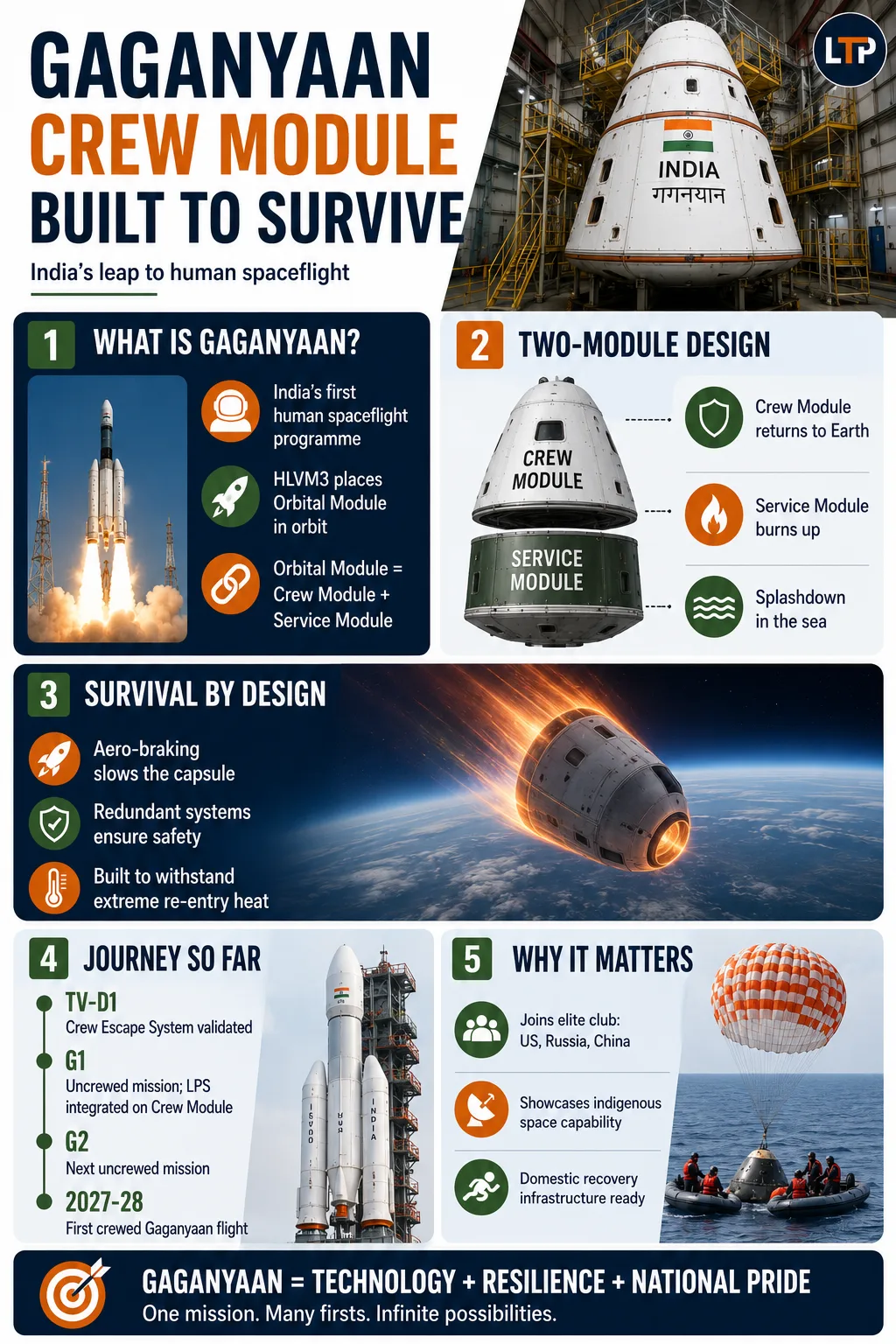
| Payload injected by HLVM3 | Orbital Module (OM) — comprises Crew Module + Service Module joined together [4] |
| Crew Module (CM) | Crew habitat; re-enters atmosphere; survives thermo-structural loads via aero-braking; splashes down in sea [4] |
| Service Module (SM) | Provides on-orbit support (propulsion, power); fires thrusters to de-orbit OM; separates from CM via redundant severance mechanism; burns up on re-entry [4] |
| Separation mechanism | Joint between CM and SM severed via a redundant mechanism (fail-safe design) [4] |
| Descent method | Aero-braking deceleration for crew module [4] |
| Recovery mode | Sea splashdown, with trained recovery divers [3][4] |
| Comparative designs | Russia's Soyuz and China's Shenzhou use a three-module configuration (adds an orbital/living module with docking, cargo, toilet, life support); this third module also separates and burns up during descent [4] |
| Implementing agency | ISRO (Department of Space) [1][3] |
| Target crewed launch | 2027-28 [3] |
| Precursor test flights | TV-D1 (abort/crew escape system test); uncrewed missions G1, G2 planned before crewed flight [1][3] |
5. Multi-Dimensional Analysis
Scientific / Technological
- CM design must balance competing objectives: aerodynamic stability during re-entry, thermal protection against extreme heating, structural integrity under deceleration loads, and mass optimisation [4].
- Redundant separation mechanisms reflect human-rating safety philosophy — single-point failures are unacceptable in crewed systems [4].
- Two-module (India) vs three-module (Russia/China) design reflects trade-off between mission complexity/orbital endurance and simplicity/re-entry risk [4].
Administrative / Governance
- Programme follows a phased test-flight approach (TV-D1 → G1 → G2 → crewed mission) to de-risk human rating incrementally [1][3].
- Human-rating certification of propulsion systems (CM and SM) is a distinct, lengthy ground-test-driven process, indicating high safety-assurance overhead [3].
Strategic
- Places India among a small club of nations (US, Russia, China) with indigenous human spaceflight capability upon success.
- Domestic recovery infrastructure (trained divers, sea recovery) signals full-cycle indigenous capability rather than reliance on international recovery support [3].
Historical
- Builds on decades of ISRO expertise in re-entry technology demonstrators (e.g., earlier Space Capsule Recovery Experiments) preceding Gaganyaan-specific hardware.
6. Recent Developments (last 12-18 months)
- Liquid Propulsion Systems integrated onto the Crew Module for the first uncrewed Gaganyaan mission (G1) [1].
- Major Qualification Tests of Crew Module systems successfully completed [1].
- Ground test programme for human-rating of Crew Module Propulsion System completed; Service Module Propulsion System test programme nearing completion [3].
- Development and ground testing of HLVM3 completed [3].
- Parliament informed that Gaganyaan programme has entered its final phase [3].
- The Hindu explainer (July 15, 2026) detailed the CM/SM survival architecture [4].
7. Prelims Hooks
- Gaganyaan's launch vehicle is called HLVM3 (Human-rated Launch Vehicle Mark 3) [4].
- The Orbital Module (OM) = Crew Module + Service Module, joined and later separated [4].
- The crew module is the only part designed to survive re-entry and splash down; the service module burns up [4].
- Separation between CM and SM uses a redundant severance mechanism [4].
- The crew module decelerates via aero-braking before sea splashdown [4].
- Russia's crewed spacecraft is called Soyuz; China's is called Shenzhou — both use a three-module configuration, unlike India's two-module OM [4].
- The third module in Soyuz/Shenzhou houses docking mechanism, cargo, life-support (including toilet) — it also burns up during re-entry [4].
- Implementing agency for Gaganyaan is ISRO, under the Department of Space [1][3].
- TV-D1 was the Abort Mission-1 test flight validating the Crew Escape System [1][3].
- Uncrewed missions G1 and G2 precede the crewed Gaganyaan flight [3].
- First batch of Crew Module Recovery divers completed training for sea-based recovery [3].
- Target year for India's first crewed spaceflight: 2027-28 [3].
- HLVM3 development and ground testing has been completed as of recent status updates [3].
8. Mains Relevance
- GS-III: Science and Technology — developments in space technology, indigenization of technology.
- GS-III could also touch Awareness in space (achievements of Indians in science & technology).
- Possible question stems: 1. "Discuss the engineering challenges involved in ensuring crew survivability during the re-entry phase of India's Gaganyaan mission." (GS-III) 2. "Compare India's two-module Gaganyaan orbital module architecture with the three-module configurations used by Russia and China. What are the trade-offs?" (GS-III) 3. "Examine the significance of human-rating certification in crewed space missions, with reference to Gaganyaan." (GS-III)
9. Related Topics to Study Next
- ISRO's Chandrayaan and Aditya-L1 missions — compare uncrewed vs crewed mission engineering priorities.
- Space Capsule Recovery Experiment (SRE) — India's earlier re-entry/recovery technology precursor.
- India's Space Policy 2023 & IN-SPACe — regulatory/institutional framework enabling private participation in space.
- Human-rating of launch vehicles — general concept applicable across global space programmes.
- International Space Station (ISS) and Axiom missions — India's astronaut (Gaganyatri) training linkage.
- Comparative crewed spaceflight programmes — NASA (Artemis/Orion), Roscosmos (Soyuz), China (Shenzhou/Tiangong).
- Ablative thermal protection systems — materials science angle relevant to re-entry heat shields.
- Atmanirbhar Bharat in Space sector — indigenous propulsion and human-rating capability as strategic autonomy.
10. Common Errors / Trap Areas
- Confusing the Orbital Module with the Crew Module — OM is the combined crew+service module assembly, not synonymous with the crew module alone [4].
- Assuming the service module also survives re-entry — it burns up; only the crew module splashes down [4].
- Mixing up HLVM3 with GSLV Mk III (LVM3) — HLVM3 is the human-rated variant used specifically for Gaganyaan [4].
- Assuming India uses a three-module design like Soyuz/Shenzhou — India's Gaganyaan OM is a two-module (CM+SM) configuration [4].
- Misattributing implementing ministry — Gaganyaan is under Department of Space/ISRO, not DRDO, despite some overlap in testing/technology support.
Sources
- 1Liquid Propulsion Systems integrated on Crew Module for first uncrewed mission of Gaganyaan (G1)isro.gov.in · tier 1
- 2Successful accomplishment of Major Qualification Tests Crew Module systems of Gaganyaan Missionisro.gov.in · tier 1
- 3PARLIAMENT QUESTION: MAJOR SPACE MISSION BY ISRO / STATUS OF GAGANYAAN MISSION / related PIB releasespib.gov.in · tier 1
- 4"How the Gaganyaan crew module is built to survive," The Hindu, July 15, 2026, Chennai Print Edition, p. 25thehindu.com · tier 4
At the end · practice MCQs
8 questions on this article
Check the answer for each question, or reveal all at once.