Contact lost with Drishti, world’s first OptoSAR satellite
New · District CollectorCan you hold the district for 72 hours?Floods, a heatwave, an outbreak, a grievance queue. Take the decisions, see the consequences.Play →In this note
Practice
12 questions on this article
Check the answer for each question, or reveal all at once.
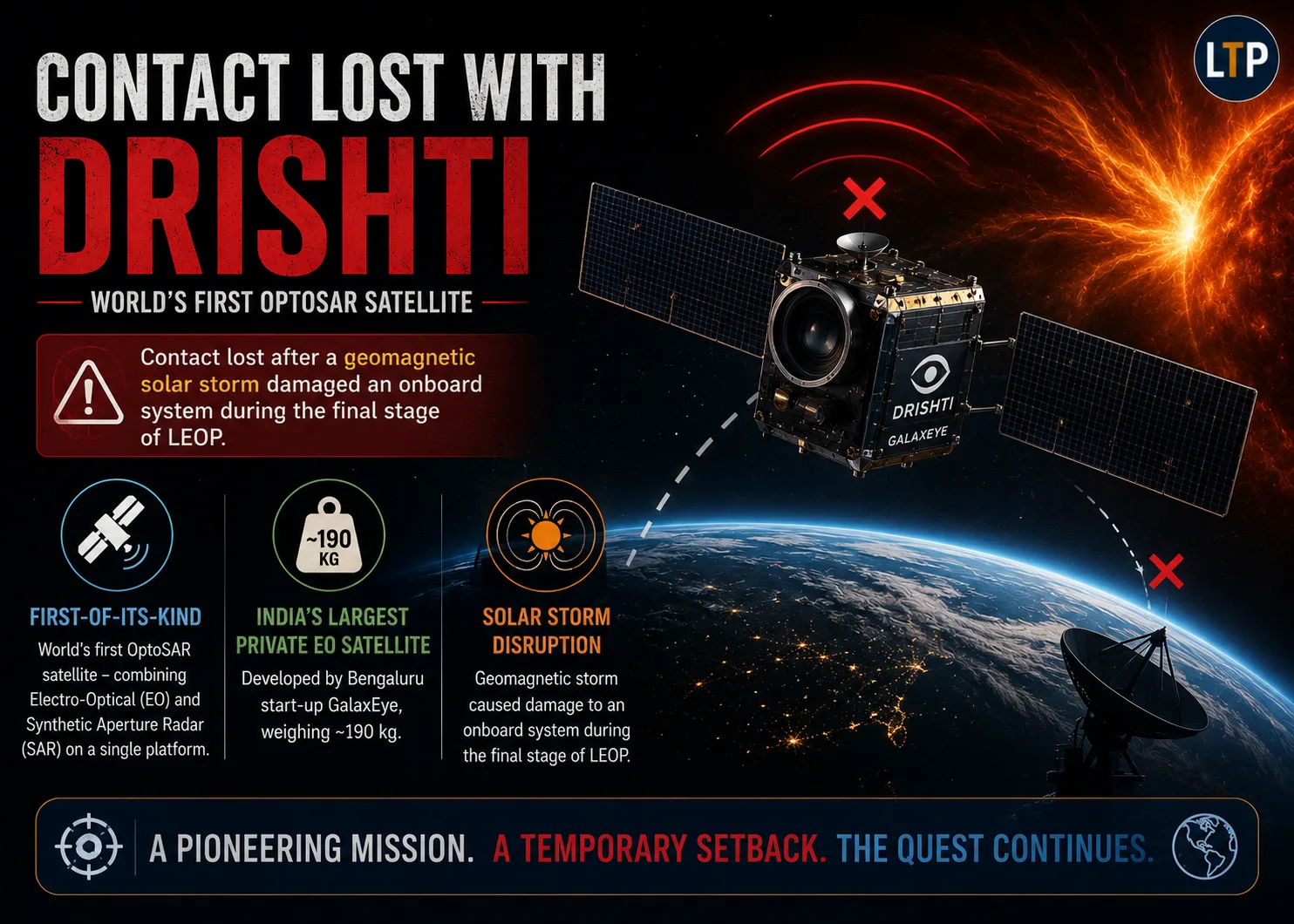
- Mission Drishti, built by Bengaluru start-up GalaxEye, is the world's first OptoSAR satellite — fusing Electro-Optical (EO) and Synthetic Aperture Radar (SAR) sensors on one platform [1][2].
- It is India's largest privately developed Earth observation satellite, at ~190 kg [1][2].
- Contact was lost after a geomagnetic solar storm damaged an onboard system during the final stage of LEOP (Launch and Early Orbit Phase) [1].
- Relevant for UPSC as an example of India's post-2023 New Space private-sector push under the Indian Space Policy 2023, regulated by IN-SPACe [2].
2. Why in the News
- GalaxEye announced on Tuesday (7 July 2026) that it has lost contact with Mission Drishti following a solar-storm-induced anomaly; recovery chances are stated as "currently appears low" [1].
3. Background & Evolution
- GalaxEye founded in 2021 by engineers from IIT Madras [2].
- Mission Drishti launched on 3 May 2026 aboard a SpaceX Falcon 9 from Vandenberg Space Force Base, California [1][2].
- Uses proprietary SyncFused technology to co-locate EO and SAR sensors, capturing aligned data in a single pass [2].
- Envisaged as the first satellite of a planned constellation of 8–12 (reported elsewhere as up to 10) satellites, targeted for completion by 2029/2030 [2].
- Anomaly occurred in the final LEOP stage, attributed by the company to radiation effects from a geomagnetic solar storm impacting a critical onboard system; communication became intermittent before being lost entirely [1].
4. Core Static Facts
| Item | Detail |
|---|---|
| Satellite | Mission Drishti |
| Developer | GalaxEye Space (Bengaluru start-up) |
| Sensor type | OptoSAR — combined EO + SAR on single platform [1] |
| Launch date | 3 May 2026 [1] |
| Launch vehicle | SpaceX Falcon 9 |
| Launch site | Vandenberg Space Force Base, California [1] |
| Approx. mass | ~190 kg [2] |
| Status (as of Jul 2026) | Contact lost; recovery unlikely [1] |
| Governing policy framework | Indian Space Policy 2023 / IN-SPACe [2] |
| Founded | 2021, by IIT Madras engineers [2] |
5. Multi-Dimensional Analysis
- Scientific/Technological: First-ever fusion of optical and radar imaging on one commercial satellite; SAR enables all-weather, night-capable imaging while EO gives true-colour detail [1][2].
- Economic: Signals maturing private Indian space manufacturing capability and investment in New Space start-ups; loss of the satellite is a commercial and reputational setback for GalaxEye.
- Strategic/Administrative: Demonstrates India's growing private launch-and-build ecosystem operating under IN-SPACe authorisation, even while using a foreign (SpaceX) launch vehicle [2].
- Governance: Anomaly highlights space-weather risk management and the need for radiation-hardening standards in India's fast-growing private satellite sector.
6. Recent Developments (last 12-18 months)
- 3 May 2026: Mission Drishti launched via Falcon 9 from Vandenberg [1].
- 7 July 2026: GalaxEye reports loss of contact with the satellite due to a geomagnetic-storm-related anomaly in the final LEOP stage; recovery efforts ongoing but deemed unlikely to succeed [1].
7. Prelims Hooks
- Mission Drishti is the world's first OptoSAR satellite, combining EO and SAR sensors [1].
- It is India's largest privately developed Earth observation satellite [1].
- Built by GalaxEye, a Bengaluru-based space start-up founded in 2021 by IIT Madras engineers [2].
- Launched on 3 May 2026 aboard a SpaceX Falcon 9 rocket.
- Launch site: Vandenberg, California (not an Indian spaceport) [1].
- Contact lost due to an anomaly following a geomagnetic solar storm during the LEOP phase [1].
- LEOP = Launch and Early Orbit Phase.
- Proprietary sensor-fusion technology named SyncFused [2].
- Approx. satellite mass: ~190 kg [2].
- Planned full constellation: 8–12 satellites, targeted by 2029 [2].
- GalaxEye operates under India's New Space regime, governed by the Indian Space Policy 2023 and regulator IN-SPACe [2].
8. Mains Relevance
- GS-III: Science & Technology — indigenization of technology; Space sector reforms and private participation.
- GS-II (peripheral): Governance of emerging sectors — regulatory frameworks (IN-SPACe, Indian Space Policy 2023).
- Possible question stems:
- "Discuss the significance of private participation in India's space sector post the Indian Space Policy, 2023, with reference to recent satellite missions." (GS-III)
- "What are the risks posed by space weather events to satellite operations? Suggest measures for resilience." (GS-III)
- "Examine the role of start-ups in building India's sovereign Earth observation capacity." (GS-III)
9. Related Topics to Study Next
- Indian Space Policy 2023 — the enabling framework for private players like GalaxEye.
- IN-SPACe — the regulator authorising private space activity in India.
- Synthetic Aperture Radar (SAR) technology — relevant to ISRO's RISAT/EOS series.
- Space weather / geomagnetic storms — causes and effects on satellites and infrastructure.
- ISRO's Earth Observation Satellite (EOS) series — for comparison with private EO missions.
- New Space economy in India — broader trend of private space start-ups (Skyroot, Agnikul, Pixxel).
- SpaceX and commercial launch dependency — India's reliance on foreign launch vehicles for private payloads.
10. Common Errors / Trap Areas
- Do not confuse GalaxEye (private start-up) with ISRO — Mission Drishti is privately built and funded, though enabled by government policy (IN-SPACe/Indian Space Policy 2023).
- Do not assume Indian launch site — it was launched from Vandenberg, California via SpaceX, not from Sriharikota.
- OptoSAR refers to sensor fusion (EO + SAR), not a single sensor type — avoid conflating it with plain SAR or plain optical imaging satellites.
- LEOP stands for "Launch and Early Orbit Phase," not "Low Earth Orbit Phase" — a common confusion.
- Note the loss of contact happened due to space weather (solar storm), not a launch failure — the launch itself was successful.
Sources
- 1Contact lost with Drishti, world's first OptoSAR satellite — The Hinduthehindu.com · tier 4
- 2GalaxEye Mission Drishti / eoPortal, Manorama Yearbook, CLAT Gurukul search aggregationtier 4
At the end · practice MCQs
12 questions on this article
Check the answer for each question, or reveal all at once.