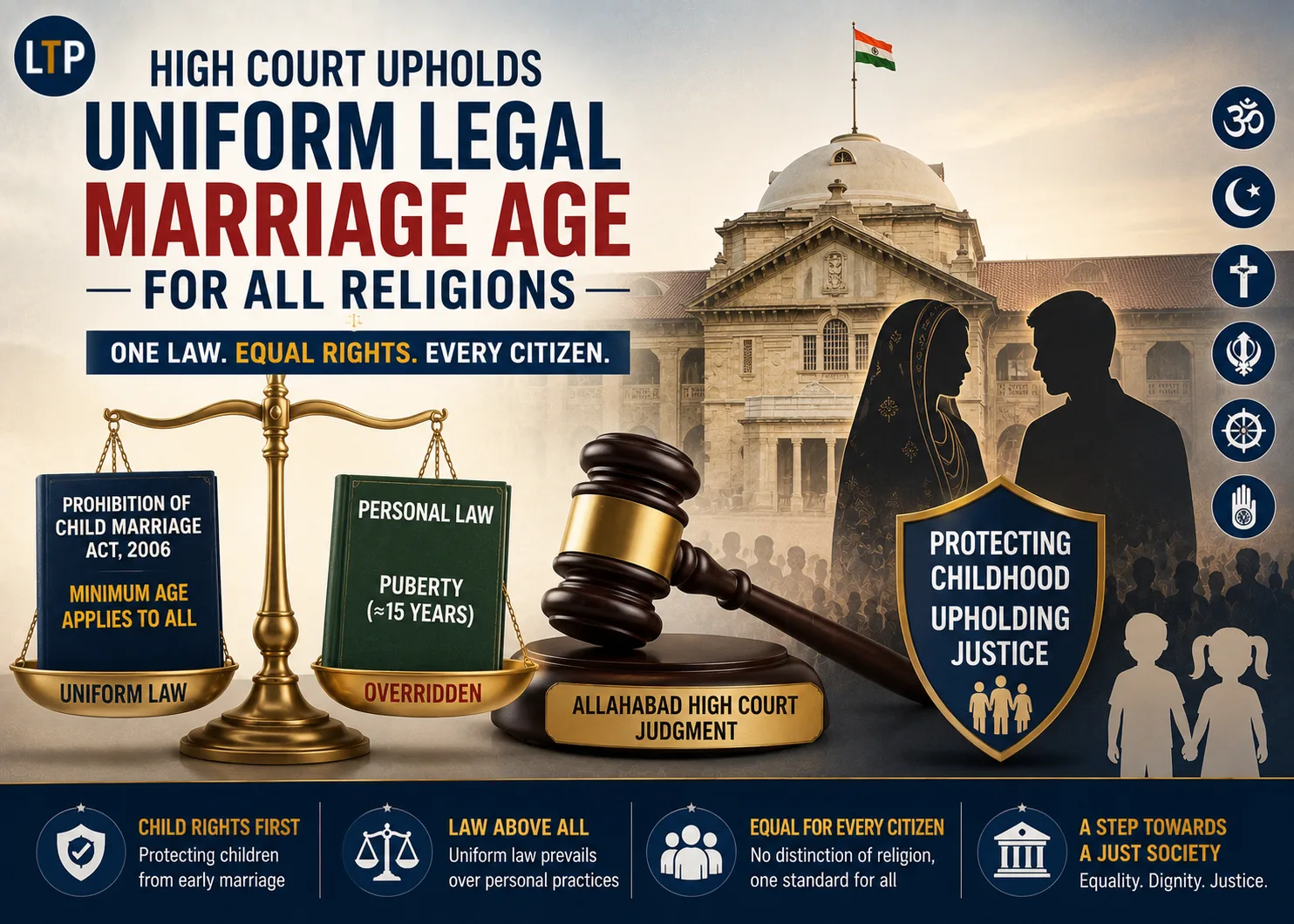
HC upholds uniform legal marriage age for all religions
New · District CollectorCan you hold the district for 72 hours?Floods, a heatwave, an outbreak, a grievance queue. Take the decisions, see the consequences.Play →In this note
Practice
12 questions on this article
Check the answer for each question, or reveal all at once.
1. At a Glance
- Allahabad High Court ruled that the minimum marriage age fixed under the Prohibition of Child Marriage Act (PCMA), 2006 applies uniformly to all citizens regardless of religion, overriding the Muslim personal law principle that puberty (~15 years) confers marriageable competence [1][3].
- Reinforces the primacy of secular criminal/welfare legislation (PCMA, POCSO Act, 2012) over uncodified personal law in matters of child protection.
- Relevant for UPSC as a live illustration of the personal law vs. statutory law conflict, feeding into the larger Uniform Civil Code (UCC) debate — GS-II staple.
- Follows a split among High Courts (Kerala, Punjab & Haryana, Gujarat, Delhi having taken divergent views), making judicial consistency itself a talking point [1].
2. Why in the News
- Judgment pronounced on 1 July 2026 by a Division Bench of Justice J.J. Munir and Justice Achal Sachdev, Allahabad High Court [3].
- Arose from a writ petition by 19 persons seeking to quash an FIR registered over an attempted marriage of a 16-year-old girl in Bulandshahr district, Uttar Pradesh, in February 2026; police/Child Line officials intervened after receiving a tip-off [1][3].
- Petitioners invoked Muslim personal law (puberty as marriageable age), the Indian Majority Act, 1875, and the Muslim Personal Law (Shariat) Application Act, 1937 to argue PCMA does not apply [3].
3. Background & Evolution
- PCMA, 2006 replaced the colonial-era Child Marriage Restraint Act, 1929, and came into force on 1 November 2007 [2].
- Enacted to shift from a purely punitive framework to one emphasising prevention, protection, and rehabilitation of child marriage victims [2].
- POCSO Act, 2012 subsequently criminalised sexual activity with anyone below 18, indirectly reinforcing the child-marriage prohibition regime.
- Courts have long grappled with whether uncodified Muslim personal law (permitting marriage at puberty) survives alongside these central statutes — leading to conflicting HC rulings across states [1].
- Kerala High Court in Moidutty Musliyar v. Sub Inspector, Vadakkencherry Police Station had earlier held personal law cannot dilute the PCMA/POCSO prohibition — the Allahabad HC expressly followed this reasoning [1][3].
4. Core Static Facts
| Item | Detail |
|---|---|
| Act in question | Prohibition of Child Marriage Act, 2006 (No. 6 of 2007) [2] |
| Force from | 1 November 2007 [2] |
| Minimum age (current) | Male: 21 years; Female: 18 years [2] |
| Nodal Ministry | Ministry of Women and Child Development |
| Related criminal law | POCSO Act, 2012 (age of consent: 18) |
| Personal laws cited by petitioners | Muslim Personal Law (Shariat) Application Act, 1937; Indian Majority Act, 1875 [3] |
| Pending reform | Prohibition of Child Marriage (Amendment) Bill, 2021 — proposes raising female age to 21, sent to Parliamentary Standing Committee in Dec 2021 [2] |
| Annulment window (2006 Act) | Within 2 years of attaining majority (up to age 20) [2] |
| Annulment window (2021 Bill, pending) | Extended to 5 years (up to age 23) [2] |
| Key precedent followed | Kerala HC, Moidutty Musliyar v. Sub Inspector, Vadakkencherry PS [1] |
| Bench | Justices J.J. Munir & Achal Sachdev, Allahabad HC [3] |
5. Multi-Dimensional Analysis
Legal / Constitutional
- Tests the doctrine that a secular central statute (PCMA) overrides religious personal law where child protection/public policy is at stake — echoes reasoning used to uphold triple talaq criminalisation.
- Raises Article 25 (freedom of religion) vs. Article 21/15(3) (protection of children, state's special provision for women/children) tension.
- Highlights the absence of a uniform civil code on marriage age as a source of continuing litigation and inter-HC divergence [1].
Social
- Directly impacts prevention of child marriage among minority communities where puberty-based marriage customs persist.
- Intersects with women's health, education continuity, and trafficking/exploitation risks associated with early marriage.
Administrative / Governance
- Illustrates enforcement mechanism: local police + Child Line intervention preventing a marriage in progress, followed by FIR — a template for PCMA implementation on the ground [3].
- Points to continuing inconsistency in HC interpretation nationally, creating uncertainty for law enforcement and Child Marriage Prohibition Officers.
Historical
- Continues a jurisprudential thread from earlier rulings (Kerala HC's Moidutty Musliyar) toward harmonising personal law with codified child-protection statutes [1].
6. Recent Developments (last 12–18 months)
- February 2026: Bulandshahr (UP) police/Child Line prevent marriage of a 16-year-old girl; FIR registered against 19 persons [1][3].
- 1 July 2026: Allahabad HC dismisses the plea to quash the FIR, holding PCMA applies uniformly across religions [3].
- Continuing (2024–26): Multiple High Courts (Kerala, and others per Allahabad HC's own acknowledgment) have issued divergent rulings on whether Muslim personal law or PCMA/POCSO governs marriages of Muslim minors, without Supreme Court settling the question yet [1].
7. Prelims Hooks
- PCMA, 2006 came into force on 1 November 2007, replacing the Child Marriage Restraint Act, 1929 [2].
- Under PCMA, 2006, minimum marriage age is 21 (male) and 18 (female) [2].
- The 2021 Amendment Bill seeks to raise the female minimum age to 21, referred to a Parliamentary Standing Committee by Smriti Irani (then WCD Minister) [2].
- The Allahabad HC judgment (1 July 2026) was delivered by a Division Bench of Justices J.J. Munir and Achal Sachdev [3].
- The case originated from an FIR in Bulandshahr district, Uttar Pradesh [1][3].
- The Allahabad HC relied on the Kerala HC ruling in Moidutty Musliyar v. Sub Inspector, Vadakkencherry Police Station [1][3].
- Petitioners had cited the Indian Majority Act, 1875 and the Muslim Personal Law (Shariat) Application Act, 1937 [3].
- Muslim personal law recognises puberty (generally ~15 years) as competence for marriage — held inapplicable by the court [1].
- The PCMA is enforced alongside the POCSO Act, 2012, which sets the age of consent at 18.
- Under the 2006 Act, annulment of a child marriage may be sought within 2 years of attaining majority; the pending Bill extends this to 5 years [2].
8. Mains Relevance
- GS-II (Polity/Governance): Indian Constitution — features, comparison with other countries; separation of powers; issues arising from design/implementation of statutes; Uniform Civil Code debate; welfare schemes for vulnerable sections.
- GS-I: Role of women, social empowerment, issues related to child marriage as a social evil.
- Possible Mains stems: 1. "Discuss the tension between religious personal laws and secular child-protection statutes in India, with reference to recent High Court rulings on the minimum age of marriage." (GS-II) 2. "Examine the case for and against a Uniform Civil Code in the specific context of marriageable age across religious communities in India." (GS-II) 3. "Child marriage remains a persistent challenge despite legal prohibition. Analyse the socio-legal factors responsible and suggest measures for effective enforcement of the PCMA, 2006." (GS-I/II)
9. Related Topics to Study Next
- Uniform Civil Code (Article 44) — the larger constitutional debate this ruling feeds into.
- Triple Talaq / Shayara Bano case (2017) — earlier precedent on personal law vs. fundamental rights.
- POCSO Act, 2012 — interacts directly with PCMA on age-of-consent questions.
- Prohibition of Child Marriage (Amendment) Bill, 2021 — pending legislative reform raising female marriage age to 21.
- NFHS data on child marriage prevalence — statistical/empirical dimension for Mains answers.
- Sarla Mudgal and Shabnam Hashmi cases — judicial history on personal law harmonisation.
- Kerala HC's Moidutty Musliyar ruling — the precedent directly relied upon.
- Article 25 vs Article 15(3)/21 — constitutional balancing of religious freedom against child protection.
10. Common Errors / Trap Areas
- Do not confuse PCMA, 2006 (child marriage prohibition, ages 18/21) with the 2021 Amendment Bill (still pending, not yet law) — the female age remains 18, not 21, until the Bill is enacted.
- Do not attribute this ruling to the Supreme Court — it is an Allahabad High Court (UP) judgment; the issue remains unsettled nationally due to divergent HC views [1].
- Do not confuse this case with the Kerala HC's Moidutty Musliyar case — that is the precedent relied upon, not the case itself.
- PCMA overrides personal law on the specific issue of minimum marriage age; it does not amount to a full Uniform Civil Code, which remains unenacted at the national level.
- Note the correct nodal ministry is Women and Child Development, not Law and Justice, for PCMA administration.
Sources
- 1Muslim law permitting marriage at puberty violates POCSO; child marriage ban applies to all religions: Allahabad HCbarandbench.com · tier 4
- 2The Prohibition of Child Marriage (Amendment) Bill, 2021 / Prohibition of Child Marriage Act, 2006 (text)prsindia.org · tier 1
- 3HC upholds uniform legal marriage age for all religions, The Hindu, 8 July 2026 (e-Paper)thehindu.com · tier 4
At the end · practice MCQs
12 questions on this article
Check the answer for each question, or reveal all at once.