Will El Niño weaken India’s economy?
New · District CollectorCan you hold the district for 72 hours?Floods, a heatwave, an outbreak, a grievance queue. Take the decisions, see the consequences.Play →In this note
Practice
9 questions on this article
Check the answer for each question, or reveal all at once.
1. At a Glance
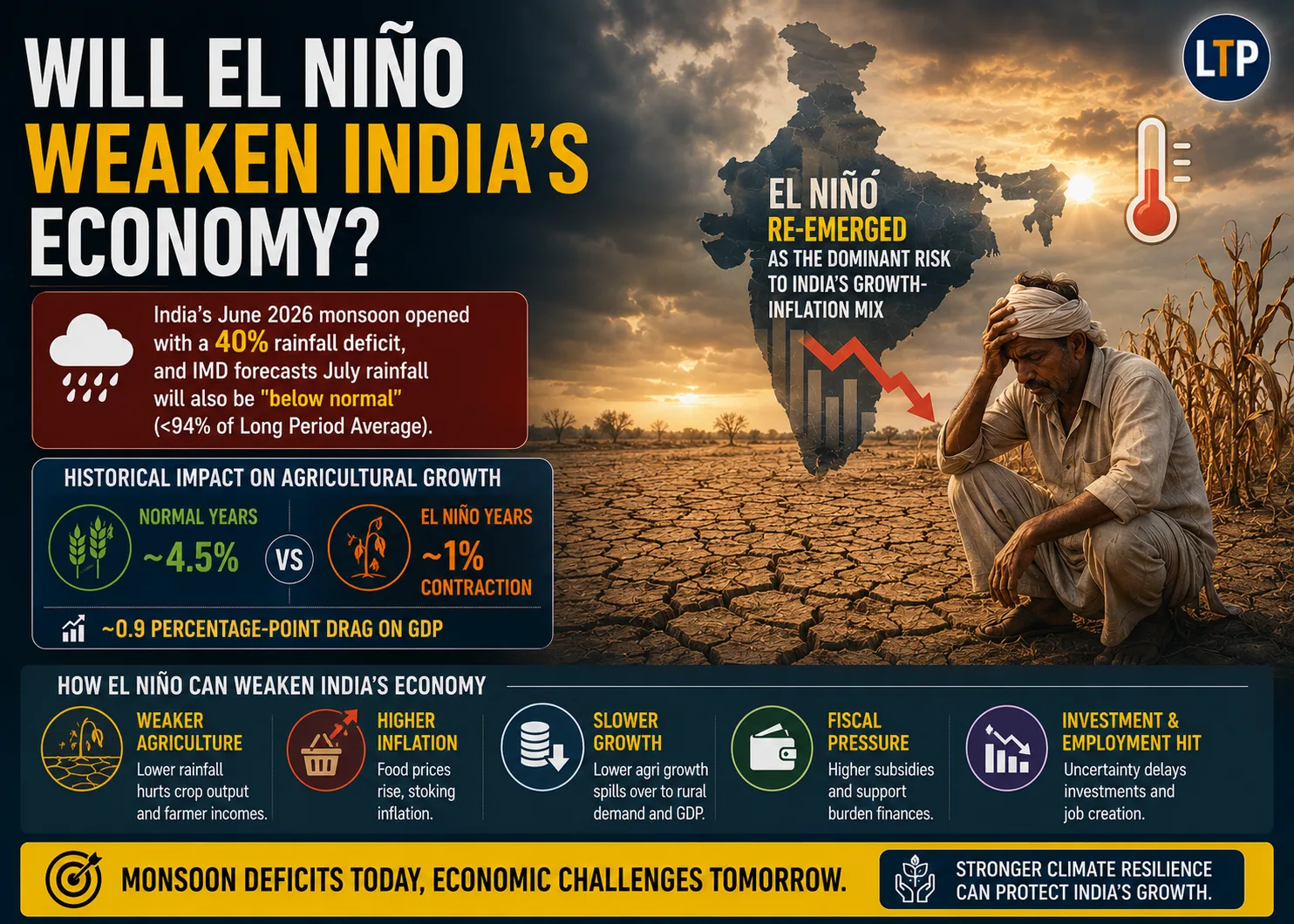
- India's June 2026 monsoon opened with a 40% rainfall deficit, and IMD forecasts July rainfall will also be "below normal" (<94% of Long Period Average) [5].
- El Niño has re-emerged as the dominant risk to India's growth-inflation mix, historically dragging agricultural growth from ~4.5% (normal years) to a 1% contraction in El Niño years — a ~0.9 percentage-point GDP drag [2].
- Tests the classic UPSC triad: monsoon → agriculture → rural demand → food inflation → RBI policy, making it a high-yield GS-III (economy) + GS-I (geography) crossover topic.
- Directly relevant given India entered kharif 2026 "from a position of strength" (record 2024-25 foodgrain output), raising the stakes of a weak-monsoon reversal [5].
2. Why in the News
- NOAA declared El Niño onset on June 11, 2026, with forecasts of possible intensification to a "super" El Niño [4].
- IMD's long-range forecast (May 29, 2026) projected seasonal rainfall at 90% of LPA, with 60% probability of deficient rainfall [4].
- Union Agriculture Minister Shivraj Singh Chouhan publicly warned of a potential "super" El Niño's impact weeks before the deficit materialised [1].
- June 2026 rainfall deficit reported at 41% nationally (4–18 June window), with regional deficits of 67% (central India), 42% (east/northeast), 22% (southern peninsula), 6% (northwest) [2].
3. Background & Evolution
- El Niño (warming of central/east Pacific sea-surface temperatures) has historically disrupted the Indian Summer Monsoon via altered Walker Circulation, suppressing moisture influx.
- India's worst droughts have clustered in El Niño years: 1972, 1982, 2009, 2015 [1].
- ICRIER's historical dataset (from 1951) shows 11 of 15 moderate-to-severe El Niño years produced an agricultural output contraction, averaging a 9.7% monsoon rainfall drop and 5.7% kharif foodgrain fall [3].
- Strong El Niño phases have historically cut national rice production by an average of 3.4 million tonnes [3].
- Post-2015, India built buffer capacity (foodgrain stocks, irrigation expansion, MSP support) partly as a lesson from earlier El Niño droughts.
4. Core Static Facts
| Parameter | Detail |
|---|---|
| Nodal agency for monsoon forecasting | India Meteorological Department (IMD), Ministry of Earth Sciences |
| Nodal ministry for agriculture response | Ministry of Agriculture & Farmers Welfare (Union Minister: Shivraj Singh Chouhan) [1] |
| Kharif 2026 foodgrain production target | ~176 million tonnes [3] |
| 2024-25 foodgrain output (base year) | 357.73 million metric tonnes, up 25.43 MMT year-on-year [1] |
| Vulnerable districts flagged for contingency | 150–200 (reported variously as up to 315) districts under priority watch [3] |
| IMD 2026 seasonal rainfall forecast | 90% of LPA, 60% probability of deficient rainfall (issued 29 May 2026) [4] |
| CPI food weight | Food constitutes roughly two-fifths (~40%) of India's CPI basket [2] |
| Inflation sensitivity | A 10% rainfall deficit can add up to 1 percentage point to headline CPI inflation [2] |
| GDP sensitivity | El Niño years show ~0.9 percentage point drag on GDP growth via agriculture [2] |
5. Multi-Dimensional Analysis
Economic
- Three transmission channels: (i) reduced agricultural output directly cutting sectoral GVA; (ii) hit to rural income denting aggregate/rural demand; (iii) food-price inflation risk [1].
- Weak monsoon has "overtaken crude oil" as India's primary inflation risk per economists [2].
- CRISIL notes paddy acreage still expected to expand in Punjab, Haryana, Bihar despite the deficit, suggesting irrigation-buffered states may partially offset losses [1].
Social
- Rural households dependent on unirrigated kharif cropping face disproportionate income shocks — equity concern for rain-fed regions.
- Drinking water availability directly flagged as at risk by IMD alongside agriculture [1].
Administrative
- Centre has pre-emptively identified 150–315 vulnerable districts for Kharif contingency planning, indicating a shift toward proactive drought-management protocols [3].
- Central-state coordination critical since agriculture (a State subject) needs Centre-driven contingency crop planning and MSP/procurement support.
Environmental
- Compounds concerns over hydropower generation and ecosystem sustainability due to reduced water storage [1].
- Signals a broader climate-variability stress test amid changing ENSO-monsoon teleconnections (per ENSO-monsoon relationship research under global warming) [S1 search set].
Scientific/Technological
- IMD's long-range forecasting model (issued in stages, e.g., 29 May 2026 outlook) is the key predictive tool; accuracy of El Niño-monsoon linkage remains an active research area given a possible weakening ENSO-monsoon relationship under global warming.
6. Recent Developments (last 12–18 months)
- 11 June 2026: NOAA declares El Niño onset in the tropical Pacific, flags potential intensification to moderate/strong ("super") levels [4].
- 29 May 2026: IMD long-range forecast projects 90% of LPA seasonal rainfall with 60% deficiency probability [4].
- June 2026: Monsoon opens with a 40–41% national rainfall deficit; central India worst-hit at 67% deficit [2][1].
- Early July 2026: IMD forecasts July rainfall will also stay "below normal" (<94% of LPA) [1].
- 2026: Centre identifies 150–315 districts as vulnerable, activating Kharif contingency planning [3].
- 2024-25: Foodgrain output hits a record 357.73 MMT, setting the high base now at risk [1].
7. Prelims Hooks
- El Niño-linked Indian droughts occurred in 1972, 1982, 2009, and 2015 [1].
- IMD (under the Ministry of Earth Sciences, not MoEFCC) is India's monsoon-forecasting authority.
- June 2026 rainfall deficit: 40–41% nationally; central India recorded the steepest regional deficit at 67%.
- Food items constitute roughly 40% of India's CPI basket — the transmission link between monsoon and RBI's inflation targeting.
- A 10% rainfall deficit can add up to 1 percentage point to headline CPI inflation.
- Agricultural growth swings from ~4.5% (normal years) to ~1% contraction (El Niño years) — an ~0.9 percentage point GDP growth drag.
- ICRIER data (since 1951): 11 of 15 moderate-to-severe El Niño years saw agricultural output contraction.
- Average kharif foodgrain fall in El Niño years: 5.7%; average monsoon rainfall drop: 9.7%.
- Strong El Niño years have cut national rice output by an average of 3.4 million tonnes.
- Kharif 2026 foodgrain production target: ~176 million tonnes.
- 2024-25 record foodgrain output: 357.73 million metric tonnes (up 25.43 MMT y-o-y).
- NOAA declared El Niño onset on 11 June 2026.
- IMD's 2026 seasonal forecast: 90% of LPA, with 60% probability of deficient rainfall.
- Centre flagged 150–315 vulnerable districts for kharif contingency measures in 2026.
- Union Agriculture Minister during this episode: Shivraj Singh Chouhan.
8. Mains Relevance
- GS-III: Indian Economy — issues relating to planning, mobilization of resources, growth, development; agriculture and its impact on economy; inflation and monetary policy transmission.
- GS-I: Geography — factors responsible for the location of ISM (Indian Summer Monsoon), El Niño/La Niña, distribution of monsoon rainfall.
- Plausible question stems: 1. "Discuss the transmission mechanisms through which a weak monsoon induced by El Niño affects India's growth and inflation trajectory. Suggest policy responses." (GS-III) 2. "Examine the changing relationship between El Niño Southern Oscillation (ENSO) and the Indian Summer Monsoon in the context of climate change." (GS-I/III) 3. "India's food security architecture has evolved to buffer monsoon shocks since the droughts of the 1970s-80s. Critically evaluate its adequacy in the face of a potential 'super' El Niño." (GS-III)
9. Related Topics to Study Next
- RBI Monetary Policy Framework & Inflation Targeting — food-price shocks directly test RBI's flexible inflation targeting mandate.
- MSP & Procurement System — buffers rural income loss from output shocks.
- National Food Security Act, 2013 — safety net relevance during production shortfalls.
- Pradhan Mantri Krishi Sinchayee Yojana (irrigation) — irrigation coverage determines drought resilience (per CRISIL's Punjab/Haryana/Bihar acreage note).
- Drought Management & Contingency Crop Planning — administrative machinery activated for vulnerable districts.
- La Niña vs El Niño dynamics — comparative teleconnection effects on ISM.
- India Meteorological Department & Forecasting Systems — institutional/technical mechanism underpinning early warning.
- Climate Change and ENSO-Monsoon Relationship — evolving scientific understanding under global warming.
10. Common Errors / Trap Areas
- Confusing El Niño (warming, associated with weak Indian monsoon) with La Niña (cooling, generally associated with good monsoon) — reversed causality is a common MCQ trap.
- Attributing IMD to MoEFCC instead of its actual parent, the Ministry of Earth Sciences.
- Assuming El Niño always causes drought in India — historically only 11 of 15 moderate-to-severe El Niño years led to output contraction, not all.
- Mixing up the 2024-25 record foodgrain output figure (357.73 MMT) with the Kharif 2026 target (176 MMT) — the former is total annual/prior-year output, the latter is a kharif-season target.
- Overstating district counts for contingency planning — reported figures vary (150–200 vs. 315) across sources; note as a range, not a fixed number, pending official confirmation.
Sources
- 1Will El Niño weaken India's economy? — The Hinduthehindu.com · tier 4
- 2Why El Niño could become India's next growth and inflation challenge — Business Standardbusiness-standard.com · tier 4
- 3India Braces for El Nino: 200 High-Risk Districts, Weak Monsoon Forecast Puts Agriculture Ministry on Alert — Down To Earthdowntoearth.org.in · tier 4
- 4MD announces El Nino onset: What it means for India's monsoon, Kharif crops & food prices — Business Todaybusinesstoday.in · tier 4
- 5Kharif 2026 Sowing Slows as El Niño Clouds Monsoon Outlook — Down To Earthdowntoearth.org.in · tier 4
At the end · practice MCQs
9 questions on this article
Check the answer for each question, or reveal all at once.