ISRO successfully carries out tests of Gaganyaan systems
New · District CollectorCan you hold the district for 72 hours?Floods, a heatwave, an outbreak, a grievance queue. Take the decisions, see the consequences.Play →In this note
Practice
11 questions on this article
Check the answer for each question, or reveal all at once.
1. At a Glance
- ISRO conducted three major ground qualification tests validating critical Gaganyaan crew-safety and separation systems, announced 12 July 2026 [1][4].
- Tests covered post-splashdown crew module recovery, crew-service module separation, and parachute/apex-cover structural integrity — all direct inputs to human-rating the spacecraft ahead of the first crewed flight [4].
- Relevant for UPSC as a live example of India's indigenous human spaceflight capability development under the Gaganyaan Programme (GS-III Science & Tech, Space).
2. Why in the News
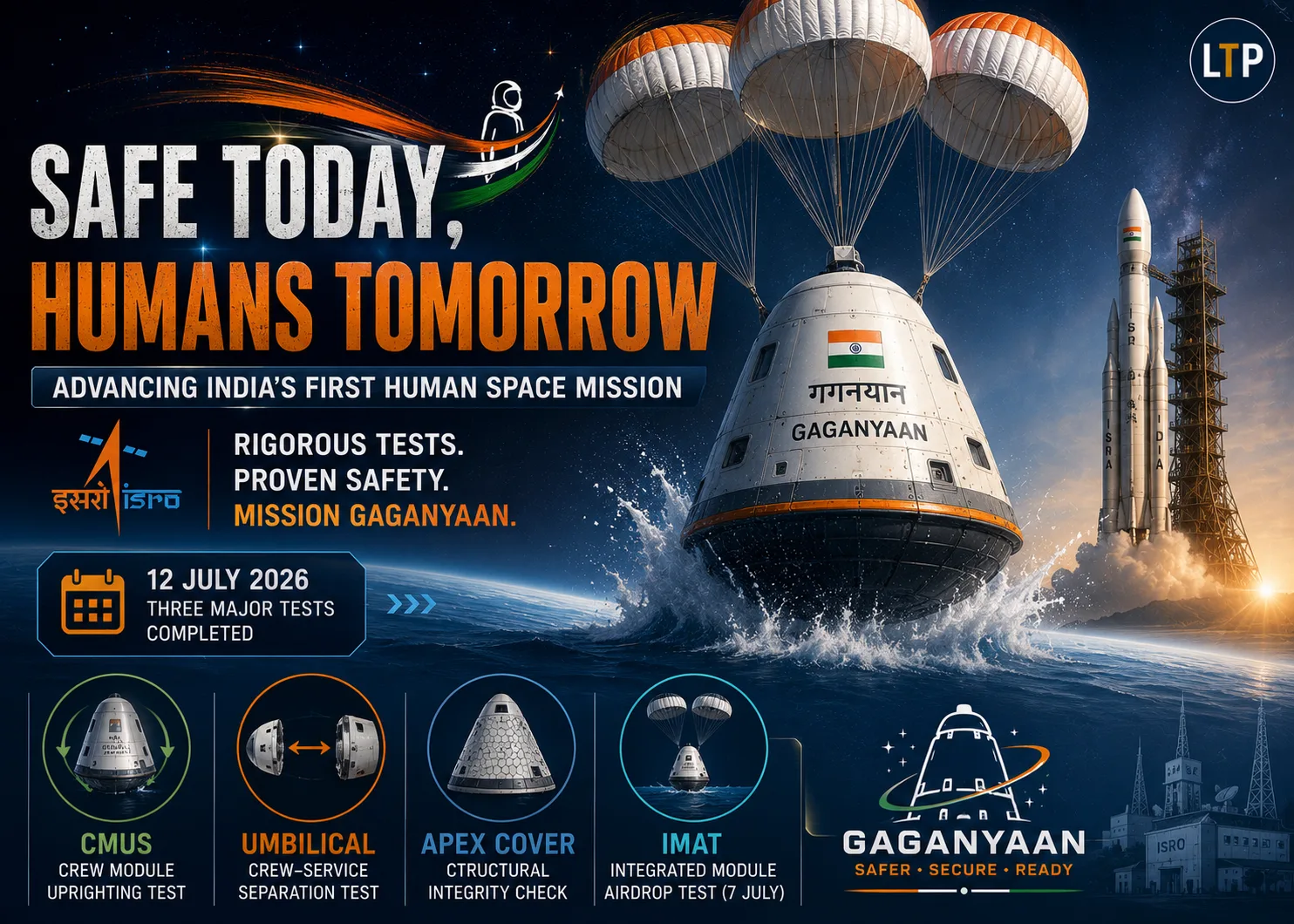
- ISRO announced on Sunday, 12 July 2026, successful completion of three tests: the Crew Module Uprighting System (CMUS), the umbilical (CSU-1/CSU-2) separation mechanism, and tests related to the apex cover [4].
- These follow the Integrated Main Parachute Air Drop Test (IMAT) conducted on 7 July 2026 at ADRDE, Sheopur, Madhya Pradesh [3][5].
3. Background & Evolution
- Gaganyaan is ISRO's programme to demonstrate indigenous human spaceflight capability by sending a crew to low Earth orbit and safely returning them.
- Programme has progressed through uncrewed test flights (TV-D1) and system-level qualification tests of the Crew Module Propulsion System (CMPS) and Service Module Propulsion System (SMPS) [2].
- First uncrewed mission (G1) involved integration of liquid propulsion systems onto the crew module, completed around January 2025 [1].
- Recent milestones (2026) build toward eventual crewed flight: parachute drop tests, uprighting system tests, umbilical separation tests [3][4][5].
4. Core Static Facts
- Nodal agency: Indian Space Research Organisation (ISRO), under Department of Space (DoS).
- Crew Module Uprighting System (CMUS): stored cold-gas-based system that inflates floatation devices to right the crew module after sea splashdown — a key crew-safety requirement [4].
- Umbilical mechanism: link between crew module (where astronauts live) and service module (provides power/propulsion); has two parts — CSU-1 (crew module side) and CSU-2 (service module side) [4].
- Apex cover: protective cover atop the crew module, also tested in this round [4].
- IMAT (Integrated Main Parachute Air Drop Test): conducted 7 July 2026 at ADRDE drop zone, Sheopur, Madhya Pradesh [3][5].
- Earlier flight test: TV-D1 validated the Crew Escape System [1].
5. Multi-Dimensional Analysis
- Scientific/Technological: Validates re-entry separation sequencing, crew recovery flotation systems, and structural qualification of crew module sub-systems — essential steps toward human-rating the launch vehicle and spacecraft [4].
- Strategic: Successful human spaceflight capability places India among a small group of nations (US, Russia, China) with indigenous crewed orbital capability, with implications for space diplomacy and commercial space partnerships.
- Administrative: Reflects staged, incremental testing philosophy (sub-system qualification → integrated tests → uncrewed flight → crewed flight), typical of high-reliability aerospace programmes.
- Economic: Underpins India's growing space economy ambitions and private-sector participation (via NewSpace India Limited/IN-SPACe) riding on Gaganyaan-derived technologies.
6. Recent Developments (last 12-18 months)
- January 2025: Liquid propulsion systems integrated onto crew module for first uncrewed mission (G1) [1].
- 7 July 2026: Integrated Main Parachute Air Drop Test (IMAT) conducted at ADRDE, Sheopur [3][5].
- 12 July 2026: ISRO announces successful completion of three tests — CMUS, umbilical separation (CSU-1/CSU-2), and apex cover structural tests [4].
7. Prelims Hooks
- Gaganyaan's Crew Module Uprighting System (CMUS) uses a stored cold-gas-based mechanism to inflate floatation devices post-splashdown.
- The umbilical mechanism linking crew and service modules has two connectors: CSU-1 (crew module side) and CSU-2 (service module side).
- The service module provides power and propulsion; the crew module is where astronauts live.
- Crew module separates from the service module during the Earth re-entry stage.
- IMAT (Integrated Main Parachute Air Drop Test) was conducted at ADRDE, Sheopur, Madhya Pradesh on 7 July 2026.
- Gaganyaan's first uncrewed test flight programme includes the mission codenamed G1.
- TV-D1 was ISRO's test vehicle mission validating the Crew Escape System for Gaganyaan.
- Gaganyaan falls under the Department of Space, executed by ISRO.
- The apex cover is a protective structural component atop the crew module.
- Crew module uprighting after splashdown is considered one of the most important crew-safety requirements in the mission profile.
8. Mains Relevance
- GS-III: Science & Technology — developments in space technology, achievements of Indians in science.
- Possible linkage to GS-II if discussing institutional governance of India's space sector (IN-SPACe, NSIL).
- Sample question stems: 1. "Discuss the significance of crew-safety subsystems such as the uprighting system and crew escape system in India's Gaganyaan human spaceflight programme." 2. "Trace the evolution of ISRO's Gaganyaan programme from uncrewed test flights to crew qualification tests. What challenges remain before an actual crewed mission?" 3. "Examine how indigenous human spaceflight capability enhances India's strategic and economic standing in the global space sector."
9. Related Topics to Study Next
- TV-D1 Test Vehicle Mission — validated the Crew Escape System, a precursor safety milestone.
- Crew Module Propulsion System (CMPS) & Service Module Propulsion System (SMPS) — core propulsion qualification tests.
- IN-SPACe and NewSpace India Limited (NSIL) — institutional framework enabling private participation in space.
- Chandrayaan and Aditya-L1 missions — broader context of India's space programme achievements.
- Vyommitra — ISRO's humanoid robot for uncrewed Gaganyaan test flights.
- Global human spaceflight programmes (NASA Artemis, China's Shenzhou) — comparative perspective.
- Space Debris and India's Space Policy 2023 — regulatory/governance angle on Indian space activity.
10. Common Errors / Trap Areas
- Confusing the crew module (habitat, life support) with the service module (power, propulsion) — the umbilical connectors CSU-1/CSU-2 bridge exactly these two.
- Assuming Gaganyaan has already had a crewed flight — as of this report, only uncrewed/system-level qualification tests have occurred.
- Mixing up TV-D1 (Test Vehicle mission, crew escape system) with G1 (first uncrewed orbital mission).
- Misattributing the nodal agency — Gaganyaan is executed by ISRO under the Department of Space, not DRDO (though DRDO/ADRDE support specific sub-tests like parachute drops).
- Overlooking that IMAT and the CMUS/umbilical/apex-cover tests are distinct, separate test campaigns conducted days apart in July 2026.
Sources
- 1Liquid Propulsion Systems integrated on Crew Module for first uncrewed mission of Gaganyaan (G1)isro.gov.in · tier 1
- 2Qualification of Crew Module Propulsion System for Gaganyaan Programme completedisro.gov.in · tier 1
- 3ISRO successfully conducts Integrated Main Parachute Air Drop Test (IMAT) for Gaganyaan Programmeisro.gov.in · tier 1
- 4ISRO successfully carries out tests of Gaganyaan systems — The Hindu (Press Trust of India)thehindu.com · tier 4
- 5ISRO conducts main parachute air drop test for Gaganyaan's crew module — Manorama Yearbookmanoramayearbook.in · tier 4
At the end · practice MCQs
11 questions on this article
Check the answer for each question, or reveal all at once.