How DDCs changed local governance in J&K?
New · District CollectorCan you hold the district for 72 hours?Floods, a heatwave, an outbreak, a grievance queue. Take the decisions, see the consequences.Play →In this note
1. At a Glance
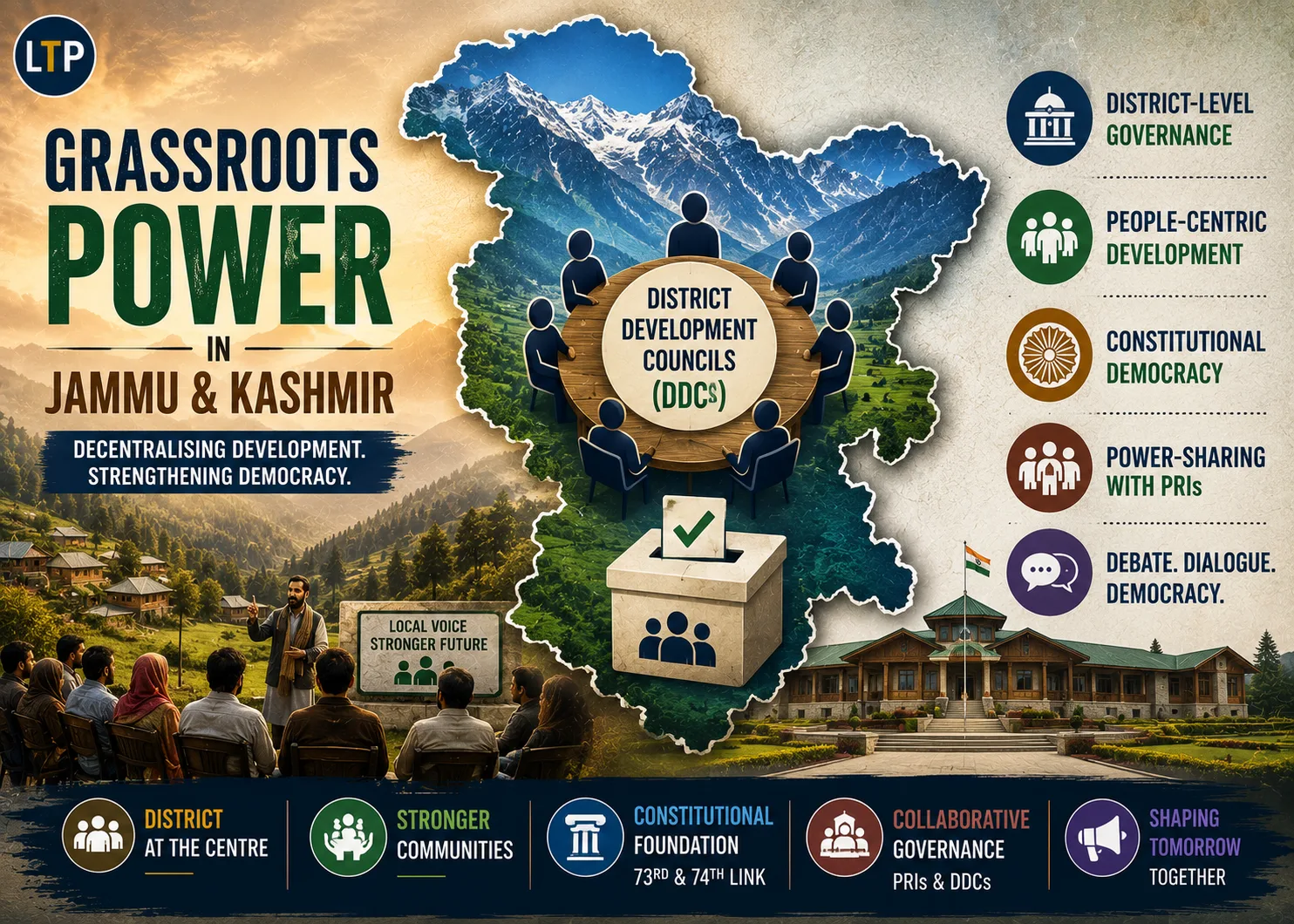
- District Development Councils (DDCs) are the third tier of the Panchayati Raj system introduced in Jammu & Kashmir (J&K) to implement direct, elected district-level local governance, formed in 2021 [4].
- They emerged directly from the post-Article 370 abrogation integration project, extending the 73rd and 74th Constitutional Amendment Acts' rural/urban local body framework to J&K [4].
- The DDCs' five-year term lapsed on February 24, 2026, with no fresh elections held, reviving debate on whether the model strengthened or weakened grassroots democracy in J&K [4].
- High-value topic for GS-II (federalism, local self-government, J&K's special history) and current-affairs Prelims (institution names, dates, amending Acts).
2. Why in the News
- DDCs completed their five-year term on February 24, 2026; no fresh elections have been conducted, and local government institutions have remained largely inactive [4].
- This has reignited a legal and constitutional debate on the relevance, legitimacy, and future of the DDC model as a vehicle for local democracy in J&K [4].
- The J&K Local Bodies Laws (Amendment) Bill, 2024 had already renamed/restructured the underlying institutional architecture — replacing the "District Planning and Development Board" and "District Panchayat Officer" with "District Development Council" and "Assistant Commissioner of Panchayat" in the Panchayati Raj Act — showing the DDC framework was still being legally recalibrated even after the councils' formation [1].
3. Background & Evolution
- 2019: Article 370 abrogated; J&K reorganised into two Union Territories — J&K and Ladakh — under the J&K Reorganisation Act, 2019 (context for subsequent institutional integration).
- Rationale: One core argument for the abrogation was full integration of J&K with the constitutional framework applicable to the rest of India, including extension of the 73rd/74th Amendment Acts providing for elected rural and urban local bodies with mandatory, regular elections [4].
- 2020: J&K Panchayati Raj Act amended to create the District Development Council tier — the first direct elections to this tier were held in 2021 [4].
- 2021: DDCs constituted and elected members took office, intended as a mechanism for direct local democracy at the district level [4].
- 2024: J&K Local Bodies Laws (Amendment) Bill, 2024 substituted "District Planning and Development Board"/"District Panchayat Officer" with "District Development Council"/"Assistant Commissioner of Panchayat" in the Panchayati Raj Act, formalising DDC nomenclature within the statute [1].
- February 24, 2026: Five-year term of the DDCs ends; no fresh elections conducted, institutions left inactive [4].
- Predecessor structures: Ladakh's Autonomous Hill Development Councils (constituted under the J&K Ladakh Autonomous Hill Development Councils Act, 1995) represent an earlier, separate model of district-level development governance in the erstwhile state [2].
4. Core Static Facts
| Aspect | Detail |
|---|---|
| Institution | District Development Councils (DDCs) |
| Tier | Third/apex tier of rural local self-government in J&K, above Panchayats/Block Development Councils |
| Formed | 2021 (first elections) [4] |
| Term completed | February 24, 2026 (5-year term) [4] |
| Constitutional basis (rationale) | 73rd and 74th Constitutional Amendment Acts (rural/urban elected local bodies) [4] |
| Enabling statute | J&K Panchayati Raj Act (as amended); further amended by J&K Local Bodies Laws (Amendment) Bill/Act, 2024 [1] |
| Standard multi-tier structure (rest of India) | Urban: Municipal Corporations, Municipal Councils, Nagar Panchayats; Rural: three-tier — Gram Panchayat, Panchayat Samiti/Block, District/Zila Panchayat [4] |
| Related UT | Ladakh — governed separately via Autonomous Hill Development Councils under the 1995 Act [2] |
| Present status (as of note) | Term expired, no fresh polls held, DDCs and local bodies largely inactive [4] |
5. Multi-Dimensional Analysis
Legal / Constitutional
- DDCs' legitimacy is tied to the post-370 argument of extending the 73rd/74th Amendments to J&K to ensure "regular, mandatory elections" for grassroots bodies [4]; the lapse without re-election raises a constitutional question on whether this mandate is being honoured.
- The 2024 amendment bill shows the local-bodies legal architecture in J&K is still being actively re-engineered by Parliament/UT administration rather than settled [1].
Administrative
- With DDCs' term over and no elections scheduled, decision-making reverts to bureaucratic/UT administration channels, weakening the "elected representative" layer of district planning [4].
- Nomenclature changes (Board → Council, Officer → Commissioner) indicate administrative restructuring is running in parallel with, not necessarily supportive of, electoral continuity [1].
Ethical / Governance (Federalism & Decentralisation)
- Supporters view DDCs as grassroots democratisation; critics argue the model has "impeded rather than strengthened" democratic decentralisation — a live normative debate [4].
- Persistent non-holding of elections after term completion is cited as a governance/accountability concern for genuine devolution of power (a Part IX/IX-A style concern).
Historical
- J&K's local governance evolved from a pre-370 special-status framework (no full 73rd/74th Amendment application) to a post-2019 attempt at constitutional uniformity with the rest of India — DDCs are the flagship instrument of that transition [4].
- Ladakh's separate Hill Council model (1995 Act) predates and diverges from the DDC framework, offering a comparative institutional design within the erstwhile state [2].
Geopolitical / Strategic
- Local governance architecture in J&K carries strategic significance given the region's history of separatist politics and central government's push to demonstrate "normalcy" and democratic integration.
6. Recent Developments (last 12-18 months)
- 2024: J&K Local Bodies Laws (Amendment) Bill passed, updating Panchayati Raj Act terminology to formally embed "District Development Council" as the statutory term [1].
- February 24, 2026: DDCs' five-year term (dating from 2021 elections) lapsed; no fresh elections announced or held [4].
- 2026 (ongoing): Renewed public/legal debate over relevance of the DDC model, coinciding with broader national conversations on delimitation (Delimitation Bill, 2026 and Constitution 131st Amendment Bill, 2026 tracked in Parliament) [3].
7. Prelims Hooks
- DDCs were first elected in 2021 in Jammu & Kashmir.
- DDCs' five-year term ended on February 24, 2026.
- DDCs are linked to the 73rd and 74th Constitutional Amendment Acts, which mandate elected rural and urban local bodies.
- Rural local governance in India's standard model is three-tier: Gram Panchayat → Block/Panchayat Samiti → District/Zila Panchayat; DDC is J&K's equivalent apex/district tier.
- Urban local governance tiers: Municipal Corporation, Municipal Council, Nagar Panchayat.
- The J&K Local Bodies Laws (Amendment) Bill, 2024 renamed "District Planning and Development Board" to "District Development Council" and "District Panchayat Officer" to "Assistant Commissioner of Panchayat."
- One key justification for abrogating Article 370 (2019) was full integration of J&K into India's standard local-governance constitutional framework.
- Ladakh, separated from J&K in 2019, uses a different local model — Autonomous Hill Development Councils under a 1995 Act, not DDCs.
- As of the note's writing, no fresh DDC elections have been held in J&K post-February 2026, leaving local bodies largely inactive.
- The debate over DDCs centres on whether they represent grassroots democratisation or an impediment to democratic decentralisation.
8. Mains Relevance
- GS-II: Polity & Governance — "Devolution of powers and finances up to local levels and challenges therein"; Federalism; Local self-government institutions; Constitutional Amendments (73rd/74th).
- GS-II: Issues arising out of the design and implementation of policies affecting UTs (special reference to J&K).
- Possible Mains stems: 1. "Critically examine whether the District Development Councils have strengthened or weakened grassroots democracy in Jammu & Kashmir since their constitution in 2021." 2. "Discuss the significance of extending the 73rd and 74th Constitutional Amendment Acts to Jammu & Kashmir post-abrogation of Article 370." 3. "The lapse of local body terms without fresh elections undermines the constitutional mandate for local self-government. Comment with reference to J&K's District Development Councils."
9. Related Topics to Study Next
- 73rd and 74th Constitutional Amendment Acts — the core enabling framework DDCs are modelled on.
- Article 370 abrogation and J&K Reorganisation Act, 2019 — the political-constitutional trigger for DDC creation.
- Panchayati Raj Institutions (PRIs) and Panchayati Raj Act variants across states — comparative local governance design.
- Ladakh Autonomous Hill Development Councils — a contrasting district-governance model within the same erstwhile state.
- Delimitation exercise in J&K and Delimitation Bill, 2026 — related electoral-boundary questions affecting local and assembly representation.
- Statehood restoration debate for J&K — broader political context shaping local governance discourse.
- 73rd Amendment and Panchayats (Extension to Scheduled Areas) Act (PESA) — comparative study of special-category local governance carve-outs.
10. Common Errors / Trap Areas
- Do not confuse DDCs with the pre-existing District Planning and Development Boards — the 2024 Amendment Act renamed the latter into the former; they are not two parallel bodies [1].
- Do not assume DDCs apply uniformly across the erstwhile state — Ladakh follows a separate Autonomous Hill Development Council model, not DDCs [2].
- Do not conflate the 73rd Amendment (rural/Panchayats) with the 74th Amendment (urban/Municipalities) — DDCs pertain to the rural three-tier structure's district apex.
- Avoid assuming DDC elections have been regularly held since 2021 — as of February 2026 the term lapsed with no re-election conducted, a key current-affairs nuance.
- Do not mix up the 2026 Delimitation Bill/Constitution (131st Amendment) Bill (a separate, parliamentary electoral-boundary exercise) with the DDC term-lapse issue — they are related in timing/context but are distinct legal matters [3].
Sources
- 1The Jammu and Kashmir Local Bodies Laws (Amendment) Bill, 2024 — )_Bill,2024.pdfprsindia.org · tier 1
- 2The Jammu and Kashmir Ladakh Autonomous Hill Development Councils Act, 1995prsindia.org · tier 1
- 3The Delimitation Bill, 2026 — Lok Sabha (PRS Bill Track)prsindia.org · tier 1
- 4"How DDCs changed local governance in J&K?" by Tikender Singh Panwar — The Hindu, July 13, 2026thehindu.com · tier 4