Why has China banned helium exports?
New · District CollectorCan you hold the district for 72 hours?Floods, a heatwave, an outbreak, a grievance queue. Take the decisions, see the consequences.Play →In this note
Practice
11 questions on this article
Check the answer for each question, or reveal all at once.
1. At a Glance
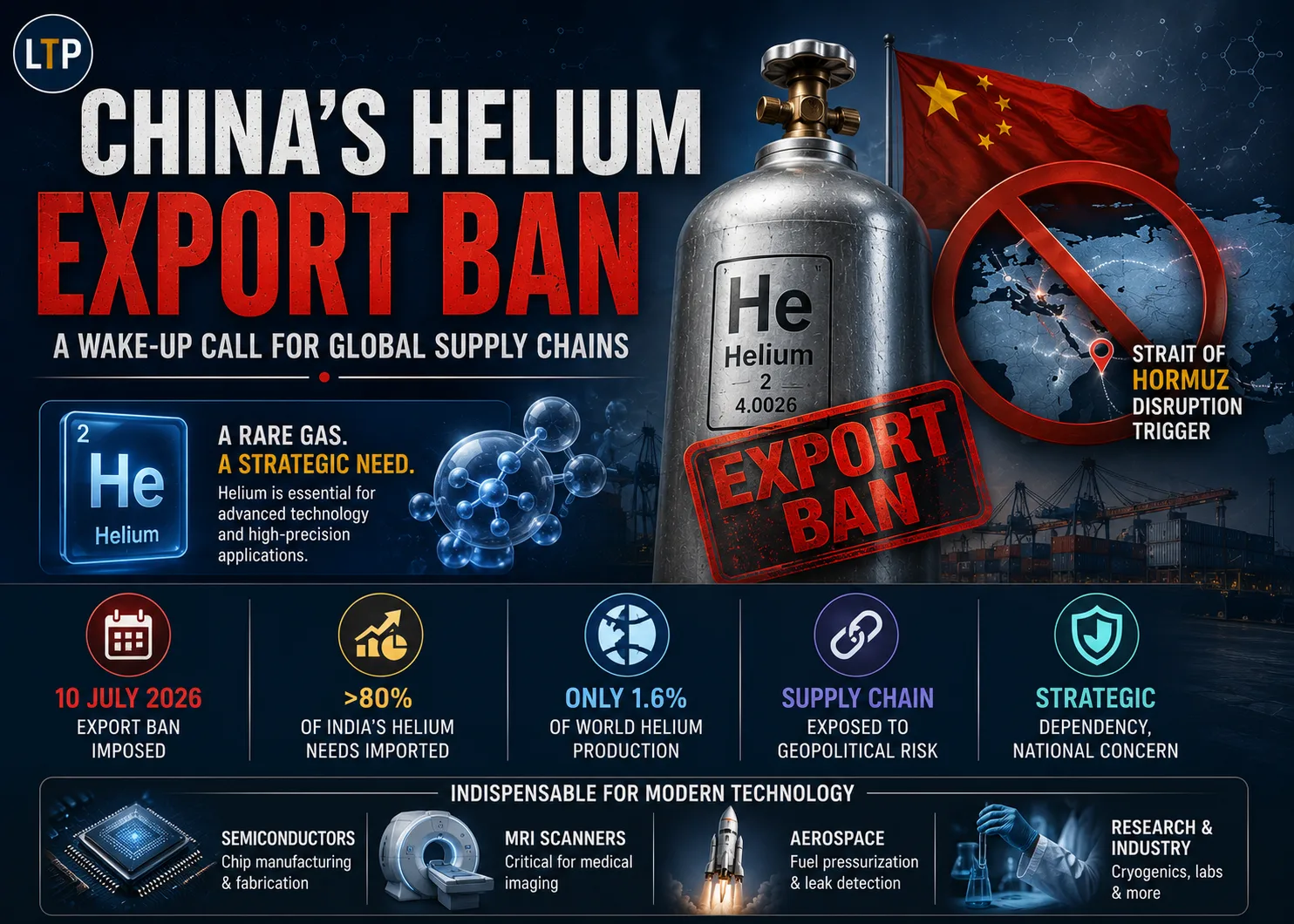
- China temporarily but immediately banned helium exports on July 10, 2026, via joint order of the Ministry of Commerce and General Administration of Customs [1][3].
- Helium is a non-renewable, irreplaceable strategic gas used in semiconductors, MRI machines (medical), aerospace, and cryogenics — making supply shocks geopolitically significant [1][2].
- China itself is helium-import-dependent (imports >80% of its needs, produces only ~1.6% of world helium), so the ban is a domestic-supply-protection measure, not an export-leverage play in the classic sense [3][1].
- UPSC relevance: tests critical-mineral/strategic-resource supply chains, a recurring GS-III theme (critical minerals, semiconductor security, energy/resource geopolitics) [2].
2. Why in the News
- July 10, 2026: China's Commerce Ministry and Customs jointly announced an immediate, temporary ban on all helium exports; no destination or exemption was specified, implying a blanket ban on overseas shipments [1][3].
- Trigger: an acute global helium supply crunch caused by the US-Israel-Iran conflict, which forced closure of a major Qatari helium facility and disrupted shipping through the Strait of Hormuz [1][2].
- Beijing had not, as of the announcement, publicly explained the ban's scope or precise rationale [3].
3. Background & Evolution
- Helium is a by-product of natural gas/LNG extraction, non-substitutable for cryogenic and semiconductor uses [1].
- 2024: The US privatised its Federal Helium Reserve, selling assets to the Messer Group, ending the US government's role as a buffer against supply shocks [3].
- 2025: The US House Committee on Oversight and Government Reform launched an investigation into Messer's Chinese business interests, raising risk of tit-for-tat trade measures [3].
- Ongoing: Russia's export restrictions require Prime Ministerial sign-off for helium shipments through 2027, tightening global supply even before the China ban [3].
- 2026: US-Israel strikes on Iran intensify West Asia tensions, disrupting Qatari supply and Strait of Hormuz shipping, culminating in China's July 10 export ban [1][2][3].
4. Core Static Facts
| Item | Detail |
|---|---|
| Ban date | July 10, 2026 [3] |
| Issuing bodies | Ministry of Commerce + General Administration of Customs, China [1][3] |
| China's helium import dependence | >80% (one report cites >85%) [1][3] |
| China's share of world helium production | ~1.6% [3] |
| Top global helium producer | United States — ~43% of world supply [3] |
| Other major producers | Qatar (~33%), Russia, Canada, Algeria [3] |
| Key end-uses | Semiconductor wafer cooling/manufacturing, MRI/medical equipment, aerospace, cryogenics [1][2] |
| Transport constraint | Only transportable via vacuum-jacketed stainless-steel vessels, made by very few global manufacturers [Article excerpt] |
| US policy shift | Federal Helium Reserve privatised in 2024; sold to Messer Group [3] |
| Russia's export control | PM sign-off required for shipments through 2027 [3] |
5. Multi-Dimensional Analysis
Economic
- Semiconductor and chip manufacturing (a high-value, strategic industry) is directly exposed since helium is essential for wafer cooling [1][2].
- Privatisation of the US Federal Helium Reserve (2024) removed a state-run shock absorber, shifting supply resilience to private markets (Messer Group) [3].
Geopolitical/Strategic
- Supply chain is concentrated in a handful of producers (US, Qatar, Russia, Canada, Algeria), creating chokepoint vulnerability similar to rare earths/critical minerals [3].
- The Strait of Hormuz and Qatari facilities are frontline chokepoints — Iran-Israel-US conflict directly disrupts helium flows [1][2].
- Russia's export sign-off regime and US Congressional probe into Messer's China ties signal a broader pattern of weaponised critical-resource trade [3].
Scientific/Technological
- Helium's role in semiconductor fabrication (an irreplaceable coolant/inert gas) ties this to India's own semiconductor mission and chip self-reliance debates [1].
Administrative/Governance
- Ban's opacity (no stated duration, scope, or exemptions) reflects a "protect domestic industry first" administrative posture typical of Chinese trade interventions [3].
6. Recent Developments (last 12-18 months)
- 2025: US House Oversight Committee investigates Messer Group's Chinese business links [3].
- 2026 (early): US-Israel military action against Iran escalates tensions in West Asia [1][2].
- Consequent disruption: Qatari helium facility closure; Strait of Hormuz shipping affected [1][2].
- July 10, 2026: China imposes temporary, immediate helium export ban [1][3].
7. Prelims Hooks
- China's helium export ban was announced on July 10, 2026 by the Ministry of Commerce and General Administration of Customs [3].
- China imports more than 80% of its helium requirement but produces only ~1.6% of global helium [3].
- The United States is the world's largest helium producer, supplying ~43% of global output [3].
- Qatar is the second-largest helium supplier globally (~33% share cited) [3].
- The US Federal Helium Reserve was privatised in 2024, with assets sold to the Messer Group [3].
- Russia requires Prime Ministerial approval for helium export shipments, a restriction extending through 2027 [3].
- Helium is a by-product of natural gas/LNG extraction, not independently mined [1].
- Helium must be transported in vacuum-jacketed stainless-steel vessels, manufactured by only a handful of companies worldwide [Article excerpt].
- The immediate trigger for the ban was global supply strain from the Israel-US-Iran conflict disrupting Qatari supply and the Strait of Hormuz [1][2].
- Helium is critical for semiconductor wafer cooling, MRI machines, and aerospace applications [1][2].
- China's ban did not specify destination markets or exemptions, implying a blanket restriction on all overseas shipments [1].
- Canada and Algeria are also listed among the world's major helium producers [3].
8. Mains Relevance
- GS-III: Infrastructure/Science & Technology — "Critical minerals and resource security"; "Indigenization of technology and developing new technology"; Economy — supply chain resilience.
- GS-II: International relations — impact of West Asia conflict on global trade/resource flows; geo-economics of critical resource nationalism.
- Possible question stems: 1. "Discuss how geopolitical conflicts in West Asia have exposed vulnerabilities in global critical-resource supply chains, with reference to helium." (GS-III) 2. "Examine the strategic significance of helium as a critical resource for semiconductor and medical technologies. What lessons does China's 2026 export ban hold for India's resource security?" (GS-III) 3. "'Resource nationalism is becoming a tool of geopolitical leverage.' Analyse with recent examples." (GS-II/III)
9. Related Topics to Study Next
- Critical Minerals & India's National Critical Mineral Mission (NCMM) — parallel framework for resource security [2].
- Semiconductor Mission/India Semiconductor Mission — helium's role in chip manufacturing ties directly to India's chip ambitions.
- Rare Earth Elements and China's export controls — comparable precedent of China weaponising resource exports.
- Strait of Hormuz geopolitics — chokepoint vulnerability affecting oil, gas, and now helium.
- Israel-Iran-US conflict (2026) — the proximate geopolitical driver.
- US Federal Helium Reserve privatisation (2024) — case study in state divestment of strategic reserves.
- Qatar's LNG and helium production — key global supplier profile.
- India's LNG/natural gas import dependence — comparative resource-security angle.
10. Common Errors / Trap Areas
- Do not confuse China's export ban with China being a major helium producer — it produces barely ~1.6% but consumes/imports the bulk [3].
- Do not attribute the ban solely to US-China trade tensions — the immediate trigger is the West Asia (Iran) conflict disrupting Qatari supply, not a direct bilateral dispute [1][2].
- Avoid confusing the Federal Helium Reserve privatisation (US, 2024) with an ongoing US government helium stockpile — it was sold to a private firm (Messer Group) [3].
- Do not mix up helium producer rankings — US (~43%) > Qatar (~33%), not the reverse [3].
- The ban is explicitly described as "temporary" — avoid treating it as a permanent policy shift in answers [1][3].
Sources
- 1China issues temporary helium export ban as Iran war strains global suppliesscmp.com · tier 4
- 2Middle East war: After oil and gas, concerns grow over minerals crunch — UN Newsnews.un.org · tier 2
- 3Why has China banned helium exports? — The Hindu Businessline (article excerpt)thehindu.com · tier 4
At the end · practice MCQs
11 questions on this article
Check the answer for each question, or reveal all at once.