Explained: can the ED attach a firm’s assets after it enters insolvency?
New · District CollectorCan you hold the district for 72 hours?Floods, a heatwave, an outbreak, a grievance queue. Take the decisions, see the consequences.Play →In this note
Practice
12 questions on this article
Check the answer for each question, or reveal all at once.
1. At a Glance
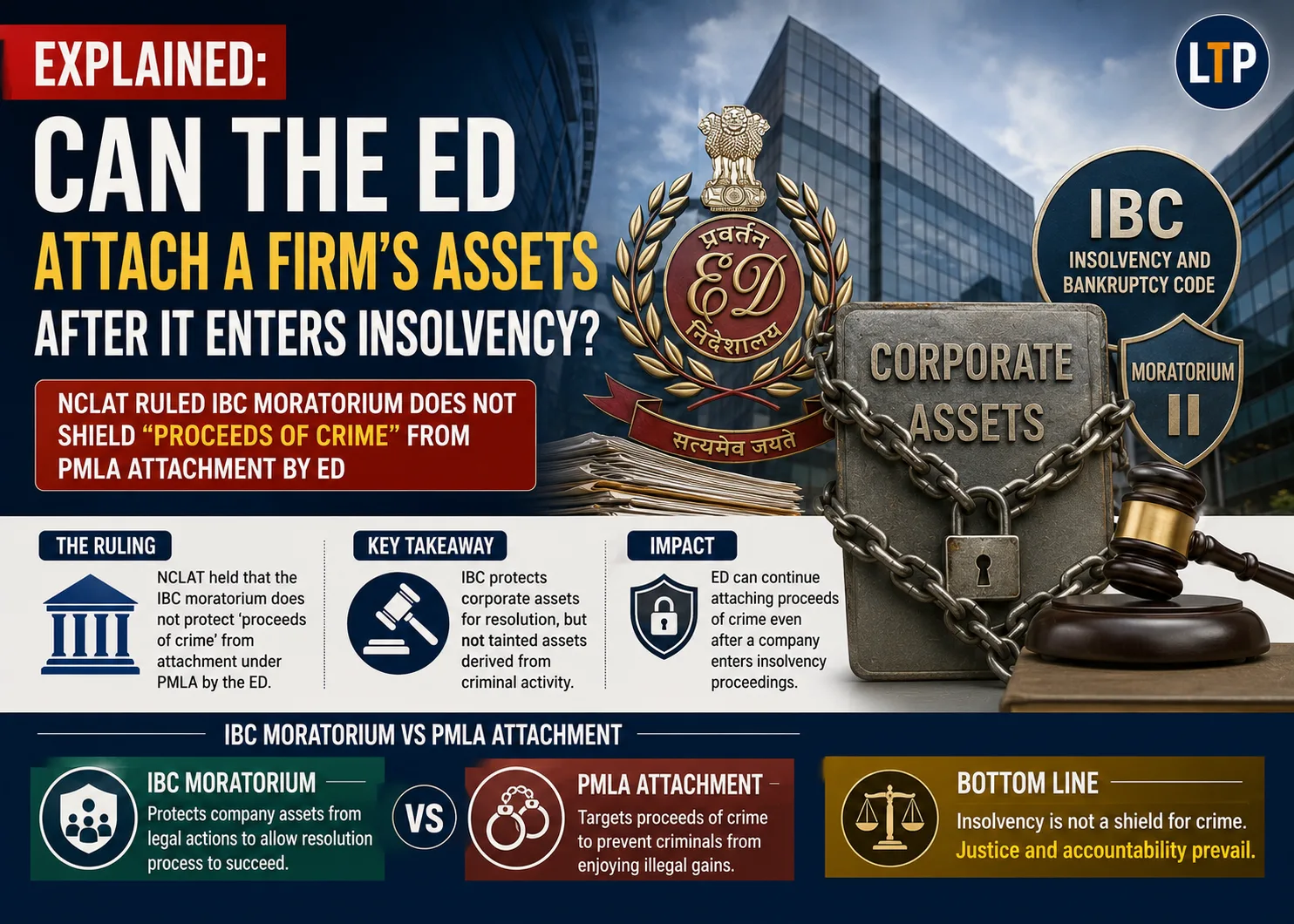
- NCLAT ruled IBC moratorium does not shield "proceeds of crime" from PMLA attachment by ED [3].
- Tests core UPSC theme: interplay of economic law (IBC) vs penal/public law (PMLA) — jurisdiction, federalism, rule of law.
- Builds on prior SC ruling in PNB v. Kalyani Transco — insolvency tribunals lack jurisdiction over PMLA actions [2].
2. Why in the News
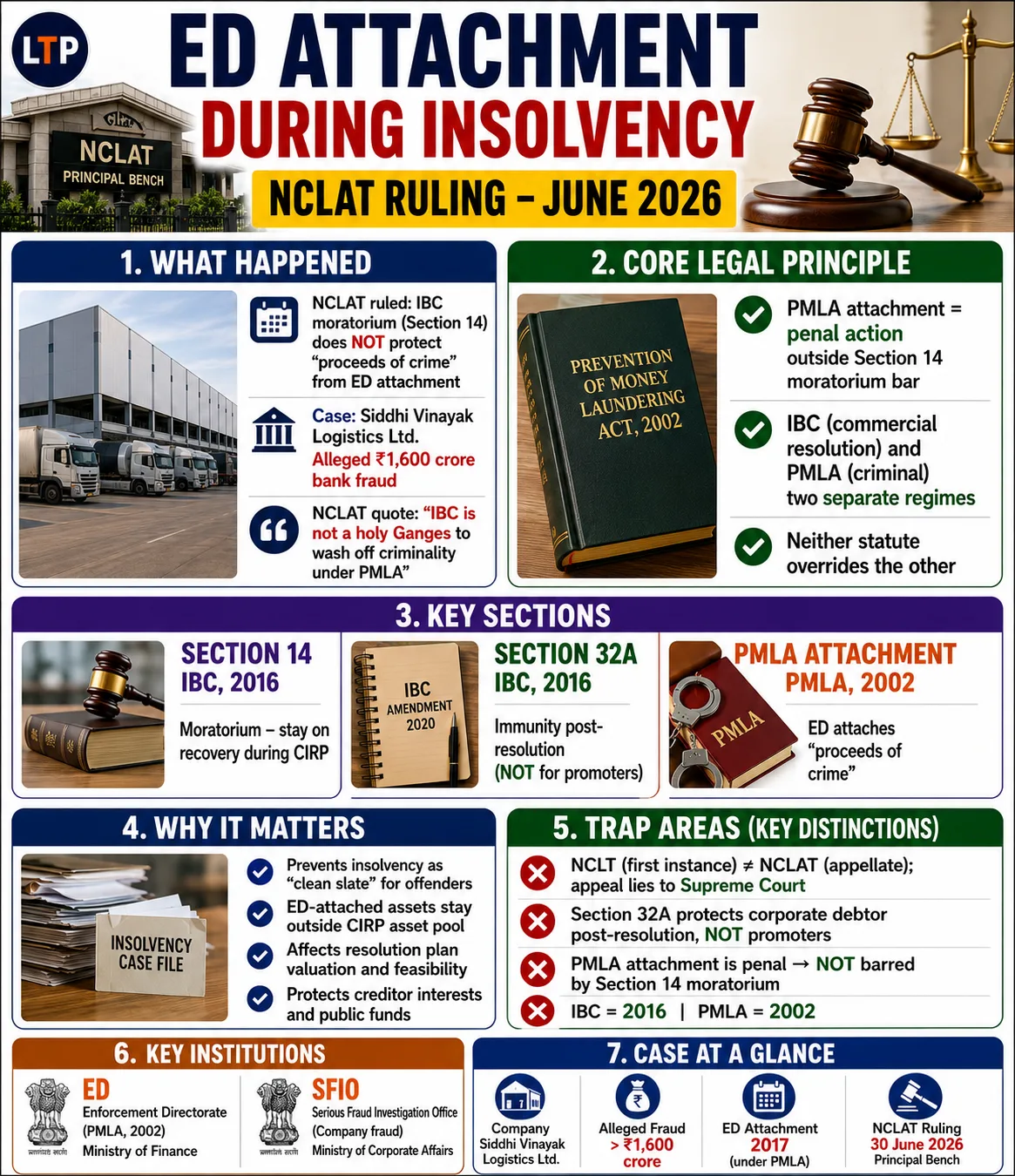
- NCLAT Principal Bench, 30 June 2026, ruled in case of Siddhi Vinayak Logistics Ltd. [1].
- Held IBC not meant to be "holy Ganges" washing corporate debtor's criminal sin under PMLA [1][3].
3. Background & Evolution
- ED provisionally attached Siddhi Vinayak Logistics' assets in 2017 under PMLA over alleged bank fraud, forgery, criminal conspiracy, loan-fund diversion >₹1,600 crore [1].
- Company entered Corporate Insolvency Resolution Process (CIRP) months after attachment [1].
- Section 14 IBC moratorium: statutory stay on suits/recovery once CIRP admitted [2].
- Section 32A IBC (added by 2020 amendment): grants immunity to corporate debtor/assets post resolution-plan approval with change in management; does NOT cover erstwhile promoters [2].
- PNB v. Kalyani Transco (SC, 2025): insolvency tribunals can't review/invalidate PMLA actions; challenges go to PMLA forums/High Courts [2].
- Courts (incl. Delhi HC) consistently held PMLA attachment is penal, not a "recovery mechanism" — hence outside Section 14 bar [2].
4. Core Static Facts
| Item | Detail |
|---|---|
| Enabling Acts | Insolvency and Bankruptcy Code, 2016; Prevention of Money Laundering Act, 2002 |
| Key Sections | IBC Sec 14 (moratorium), Sec 32A (immunity); PMLA attachment provisions |
| Adjudicating body (this case) | NCLAT Principal Bench [1][3] |
| Enforcement agency | Enforcement Directorate (ED) |
| Case | Siddhi Vinayak Logistics Ltd. |
| Alleged fraud amount | >₹1,600 crore [1] |
| Attachment year | 2017 [1] |
| Ruling date | 30 June 2026 [1] |
| Related SC precedent | PNB v. Kalyani Transco (2025) [2] |
5. Multi-Dimensional Analysis
Legal/Constitutional
- Reaffirms doctrine of separate statutory regimes — IBC (commercial resolution) vs PMLA (penal, proceeds-of-crime) [2][3].
- NCLAT explicitly lacks power to adjudicate PMLA validity — reinforces tribunal jurisdictional limits [2].
Economic
- Protects creditor value-maximisation objective of IBC while preventing laundering of criminal proceeds through insolvency route [3].
- Raises resolution-applicant risk: attached assets may stay outside CIRP asset pool, affecting resolution plan valuation.
Governance/Ethical
- Prevents insolvency law being used as a "clean slate" for economic offenders — anti-abuse safeguard [1][3].
- Balances investor certainty (IBC finality) against anti-money-laundering enforcement.
Administrative
- Highlights coordination gap between Resolution Professional/NCLT and ED during CIRP — parallel proceedings continue simultaneously.
6. Recent Developments (last 12-18 months)
- PNB v. Kalyani Transco, Supreme Court, 2025 — insolvency tribunals barred from invalidating PMLA action [2].
- NCLAT ruling, 30 June 2026, Siddhi Vinayak Logistics case — moratorium doesn't bar PMLA attachment [1][3].
- Continuing debate on IBC (Amendment) Bill, 2025 timelines for NCLAT appeals (context, not directly PMLA-linked) [S2-search].
7. Prelims Hooks
- IBC moratorium under Section 14.
- Immunity to corporate debtor post-resolution: Section 32A, added by 2020 amendment.
- Section 32A immunity does NOT cover erstwhile promoters/management.
- PMLA enforcement agency: Enforcement Directorate (ED), under Ministry of Finance (Dept. of Revenue).
- NCLAT = National Company Law Appellate Tribunal, appellate over NCLT.
- Key case: PNB v. Kalyani Transco — SC held insolvency tribunals can't review PMLA actions.
- Siddhi Vinayak Logistics fraud amount alleged: >₹1,600 crore.
- ED's provisional attachment in this case: 2017, before company's CIRP admission.
- NCLAT phrase: IBC not "holy Ganges" to wash criminality under PMLA.
- Ruling delivered by Principal Bench of NCLAT, 30 June 2026.
8. Mains Relevance
- GS-II: Statutory/regulatory bodies, jurisdiction of tribunals, separation of powers between economic and criminal law.
- GS-III: Economy — insolvency resolution, financial sector regulation, money laundering.
- Sample stems:
- "Discuss interplay between Insolvency and Bankruptcy Code and Prevention of Money Laundering Act. Does moratorium under IBC override ED's power to attach assets?"
- "Examine Section 32A of IBC as safeguard against misuse of insolvency process by economic offenders."
- "Critically analyse role of NCLAT/NCLT vis-à-vis specialised statutes like PMLA."
9. Related Topics to Study Next
- Insolvency and Bankruptcy Code, 2016 (full architecture) — CIRP, RP, CoC — foundational law here.
- Prevention of Money Laundering Act, 2002 — ED powers, attachment, adjudication.
- Fugitive Economic Offenders Act, 2018 — parallel asset-attachment regime for economic offenders.
- Banking regulation & NPA resolution — root cause of many such fraud cases.
- Tribunal reforms in India — NCLT/NCLAT structure, pendency, amendment bills.
- Section 32A IBC & "clean slate" doctrine — deep dive on scope/limits.
- PNB v. Kalyani Transco (SC 2025) — precedent shaping this ruling.
10. Common Errors / Trap Areas
- Confusing NCLT (first instance) with NCLAT (appellate) — this ruling is NCLAT's.
- Assuming Section 32A immunity protects promoters — it protects only debtor company post-resolution, not erstwhile management.
- Treating PMLA attachment as a "recovery" action barred by Section 14 — courts hold it's penal, hence not barred.
- Mixing up ED (PMLA, Dept. of Revenue) with SFIO (company fraud, MCA) — different agencies, different Acts.
- Assuming this ruling is final — NCLAT is appellate tribunal; further appeal lies to Supreme Court.
Sources
- 1Explained: can the ED attach a firm's assets after it enters insolvency? — The Hinduthehindu.com · tier 4
- 2Multiple: PNB v. Kalyani Transco analysis / Section 32A analysis / Delhi HC ruling — via web search (ibclaw.in, cyrilamarchandblogs.com, lexology.com, knallp.com, mondaq.com)tier 4
- 3IBC is not Holy Ganges to wash off criminality: NCLAT — Bar and Benchbarandbench.com · tier 4
At the end · practice MCQs
12 questions on this article
Check the answer for each question, or reveal all at once.