What new NPS withdrawal rules mean for retirement
New · District CollectorCan you hold the district for 72 hours?Floods, a heatwave, an outbreak, a grievance queue. Take the decisions, see the consequences.Play →In this note
Practice
11 questions on this article
Check the answer for each question, or reveal all at once.
1. At a Glance
- PFRDA cut mandatory annuity from 40% to 20% of NPS corpus for non-govt subscribers via Dec 2025 amendment — lump sum withdrawal cap raised 60%→80% [1][2].
- Small-corpus subscribers (≤₹8 lakh) get full lump sum, no annuity mandatory [2].
- New Systematic Unit Redemption (SUR) drawdown option introduced as middle path between lump sum and annuity [3].
- UPSC angle: tests PFRDA regulatory powers, exit/withdrawal Regulations 2015 amendments, tax interplay (Income Tax Act Section 10(12A)) — recurring Prelims/Mains fusion topic (pension reform + governance).
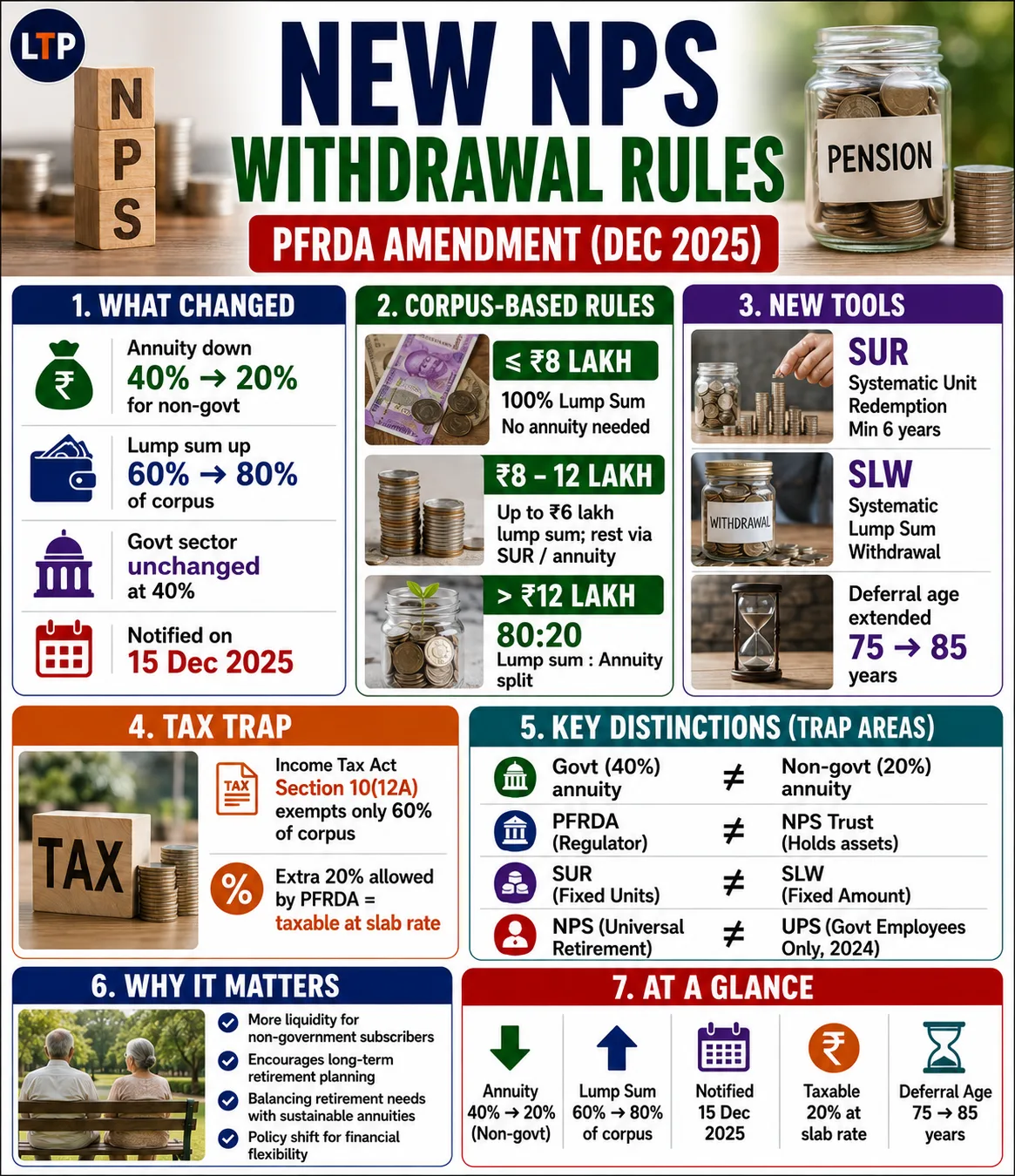
2. Why in the News
- PFRDA notified PFRDA (Exits and Withdrawals under NPS) (Amendment) Regulations, 2025 on 15 December 2025 [1][2].
- Preceded by Exposure Draft dated 16 September 2025 inviting public comments [4].
- Article (The Hindu Business Line, 6 July 2026) analyzes practical/tax implications of new norms for retirees [6].
3. Background & Evolution
- NPS launched 2004 (govt employees), extended to all citizens 2009; regulated under PFRDA Act, 2013.
- Original exit norms mandated 40% annuitization, 60% lump sum withdrawal, criticized as rigid vs EPF/mutual fund options.
- Sept 2025: PFRDA Exposure Draft floated proposed changes [4].
- Dec 15, 2025: Amendment Regulations notified — annuity mandate cut to 20% for non-govt subscribers (govt sector retains 40%) [1][2].
- Deferral age for lump sum/annuity purchase extended 75 → 85 years [1].
4. Core Static Facts
| Item | Detail |
|---|---|
| Regulator | PFRDA (Pension Fund Regulatory and Development Authority), est. under PFRDA Act 2013 |
| Governing regs | PFRDA (Exits and Withdrawals under NPS) Regulations, 2015 — amended 2025 |
| Old rule | Max 60% lump sum, min 40% mandatory annuity |
| New rule (non-govt) | Max 80% lump sum, min 20% mandatory annuity |
| Govt sector | Annuity mandate unchanged at 40% [1] |
| Corpus ≤ ₹8 lakh | 100% lump sum, no annuity needed [2][6] |
| Corpus ₹8-12 lakh | Up to ₹6 lakh lump sum; balance via SUR/annuity/mix [2][6] |
| Corpus > ₹12 lakh | 80:20 lump sum:annuity split applies [6] |
| New drawdown tool | Systematic Unit Redemption (SUR) — min 6-year staggered redemption [1][2] |
| Related tool | Systematic Lump Sum Withdrawal (SLW) — fixed periodic amount [3] |
| Deferral age | Up to 85 years (from 75) for lump sum/annuity purchase [1] |
| Tax provision | Section 10(12A), Income Tax Act — exempts only 60% of withdrawn corpus; extra 20% now permitted taxed at slab rate unless law amended [6] |
5. Multi-Dimensional Analysis
Economic
- Higher lump sum flexibility boosts NPS attractiveness vs EPF/PPF, may raise voluntary NPS subscriptions among non-govt/private/informal-sector workers [1][2].
- Tax mismatch (Sec 10(12A) exemption capped at 60%) creates disincentive for full 80% lump sum uptake until Income Tax Act amended [6].
Social
- Small-corpus subscribers (mass low-income investors, ≤₹8 lakh) get outright full withdrawal — targets informal sector/gig workers building thin pension pots [2][6].
Legal/Constitutional
- Amendment exercised under PFRDA's rule-making power (PFRDA Act, 2013) — subordinate legislation, not primary Act change; laid before Parliament per usual regulatory practice.
- Tax exemption ceiling still governed by unamended Income Tax Act Section 10(12A) — regulatory vs tax law lag [6].
Administrative/Governance
- Reform follows structured consultative process: Exposure Draft (Sept 2025) → stakeholder comments → final notification (Dec 2025) [4].
- Implementation involves fund managers/CRA (Central Recordkeeping Agency) recalibrating withdrawal/annuity processing systems.
Ethical/Governance
- Balances subscriber autonomy ("accessible sans being reckless") against retirement income security ("flexible sans being chaotic") — core annuitization-vs-liquidity policy debate [6].
6. Recent Developments (last 12-18 months)
- 16 Sept 2025: PFRDA Exposure Draft on exit/withdrawal regulation changes [4].
- 15 Dec 2025: PFRDA Amendment Regulations 2025 notified — annuity mandate cut 40%→20%, lump sum cap raised 60%→80% [1][2].
- Dec 2025 onward: Rollout of SUR/SLW systematic withdrawal facilities as alternatives to annuity [1][3].
- 6 July 2026: Media analysis (Hindu BusinessLine) flags unresolved tax mismatch under Section 10(12A) [6].
7. Prelims Hooks
- PFRDA notified NPS Exit/Withdrawal Amendment Regulations on 15 December 2025.
- Mandatory annuity portion for non-govt NPS subscribers cut from 40% to 20%.
- Max lump sum withdrawal raised from 60% to 80% of corpus (non-govt subscribers).
- Corpus ≤ ₹8 lakh: full 100% lump sum withdrawal permitted, no annuity mandatory.
- Corpus ₹8-12 lakh: up to ₹6 lakh lump sum, rest via SUR/annuity.
- Corpus > ₹12 lakh: standard 80:20 lump sum:annuity split applies.
- Government sector subscribers still face 40% mandatory annuity (unchanged).
- New drawdown mechanism introduced: Systematic Unit Redemption (SUR), minimum 6-year tenure.
- Related existing facility: Systematic Lump Sum Withdrawal (SLW).
- Deferral age for annuity/lump sum purchase extended from 75 to 85 years.
- Income Tax Act Section 10(12A) exempts only 60% of withdrawn NPS corpus — extra 20% permitted by PFRDA is taxable at slab rate.
- Regulator: PFRDA, established under PFRDA Act, 2013.
- Amendment preceded by Exposure Draft dated 16 September 2025.
- NPS extended to all citizens in 2009 (originally for govt employees from 2004).
8. Mains Relevance
- GS-II: Governance — Welfare schemes for vulnerable sections; Statutory/regulatory bodies (PFRDA); social security architecture.
- GS-III: Indian Economy — Mobilisation of resources, pension reforms, financial inclusion.
- Possible stems:
- "Discuss how the 2025 amendments to NPS exit/withdrawal regulations attempt to balance liquidity needs of retirees with long-term income security. Examine the unresolved tax anomaly under Section 10(12A) of the Income Tax Act." (GS-II/III)
- "Critically examine PFRDA's evolving role in India's pension architecture since the PFRDA Act, 2013." (GS-II)
- "How does the National Pension System compare with EPF and APY in addressing old-age income security in India?" (GS-II/III)
9. Related Topics to Study Next
- Atal Pension Yojana (APY) — compares informal-sector pension coverage.
- EPFO/EPF Act, 1952 — alternate retirement savings vehicle, contrast withdrawal flexibility.
- PFRDA Act, 2013 — statutory basis of pension regulation.
- Income Tax Act Section 80CCD — NPS contribution tax benefits, linked to Sec 10(12A) exemption gap.
- Unified Pension Scheme (UPS) — 2024 alternative for govt employees, contrast with NPS.
- Social security for unorganised/gig workers — e-Shram, Code on Social Security 2020.
- Financial inclusion indices — pension coverage as component.
10. Common Errors / Trap Areas
- Confusing NPS annuity mandate for govt (40%, unchanged) vs non-govt (20%, new) — commonly mixed up.
- Assuming full corpus is tax-exempt on withdrawal — only 60% exempt under Sec 10(12A), remainder (up to 20% extra now permitted) is taxable.
- Confusing PFRDA (regulator) with NPS Trust (which holds/manages assets) — different entities.
- Mixing up NPS (market-linked, individual account) with Unified Pension Scheme (assured payout, govt employees only) — different design.
- Assuming SUR and SLW are same — SUR redeems fixed units (NAV-dependent payout), SLW pays fixed amount periodically.
Sources
- 1New NPS exit rules notified: PFRDA allows 80% withdrawal — Upstoxupstox.com · tier 4
- 2PFRDA (Exits and Withdrawals under NPS) (Amendment) Regulations, 2025 — PFRDA officialpfrda.org.in · tier 1
- 3Exits & Withdrawals from NPS for All Citizen Model FAQs — PFRDApfrda.org.in · tier 1
- 4Exposure Draft, 16 Sept 2025 — Proposed changes to PFRDA Exit Regulationspfrda.org.in · tier 1
- 5Key amendments in PFRDA (Exits and Withdrawals under NPS) Regulations, 2015 — PIBpib.gov.in · tier 1
- 6What new NPS withdrawal rules mean for retirement — The Hindu BusinessLine, 6 July 2026thehindu.com · tier 4
At the end · practice MCQs
11 questions on this article
Check the answer for each question, or reveal all at once.