Possible Sangam-age irrigation structure unearthed in Tiruchi
New · District CollectorCan you hold the district for 72 hours?Floods, a heatwave, an outbreak, a grievance queue. Take the decisions, see the consequences.Play →In this note

1. At a Glance
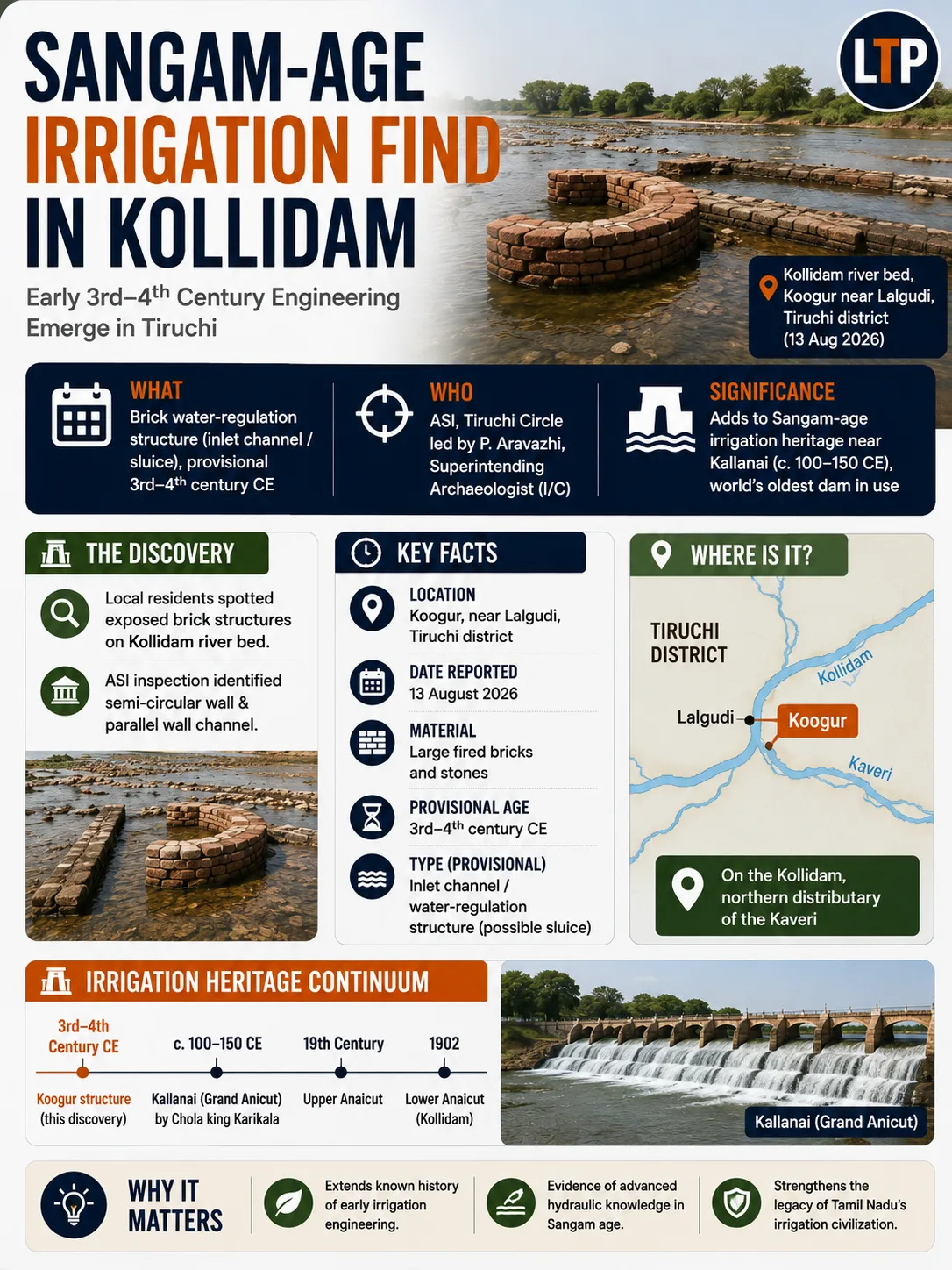
- Brick/stone masonry remains found on the Kollidam river bed near Koogur (Lalgudi taluk, Tiruchi district), provisionally dated to the 3rd–4th century CE, close to the Sangam age [3].
- ASI has tentatively identified the find as an inlet channel / water-regulation structure (possible sluice) — evidence of early historic irrigation engineering on the Kaveri-Kollidam system [3].
- Located near the ancient Kallanai (Grand Anicut) dam, built by Chola king Karikala (c. 100–150 CE), the "oldest water-diversion structure still in use in the world" — situating this find within Tamil Nadu's continuous irrigation heritage [1], [3].
- Relevant for Prelims (Ancient India, Art & Culture, Geography) and Mains GS-I (Indian culture, ancient history) and GS-III (water management history).
2. Why in the News
- Local residents discovered exposed brick structures on the Kollidam river bed at Koogur, near Lalgudi, Tiruchi district, "a few days ago" (reported 13 August 2026) [3].
- ASI's Tiruchi Circle inspected the site and provisionally identified the remains as an early historic-period irrigation/water-regulation structure [3].
3. Background & Evolution
- The structures lie ~500 metres south of the Moongil Karuppar Temple, close to the historic Kallanai dam on the Kaveri [3].
- Two brick features were identified: a semi-circular brick wall (only two courses visible above water) and a fully submerged second structure with two parallel walls with a gap — interpreted as an entrance/channel opening [3].
- ASI documented an exposed linear masonry structure built with large bricks and stones; based on construction characteristics, it was provisionally dated to the early historic period (3rd–4th century CE) [3].
- This period corresponds broadly to the Sangam Age in Tamil history, an era already associated with major hydraulic works such as the Kallanai dam attributed to Chola king Karikala [1].
- The Kaveri delta region has a long-documented irrigation lineage: Kallanai (2nd century CE) → later anicuts including the Upper Anaicut and colonial-era Lower Anaicut (1902) on the Kollidam [1], [2].
4. Core Static Facts
| Element | Detail |
|---|---|
| Discovery location | Koogur, near Lalgudi, Tiruchi district, on Kollidam river bed [3] |
| Nearby landmark | Moongil Karuppar Temple (~500 m north); Kallanai dam nearby [3] |
| Investigating agency | Archaeological Survey of India (ASI), Tiruchi Circle [3] |
| Official quoted | P. Aravazhi, Superintending Archaeologist (in-charge), ASI Tiruchi Circle [3] |
| Provisional dating | 3rd–4th century CE (early historic/Sangam period) [3] |
| Structure type (provisional) | Inlet channel / water regulation structure — possible sluice or inlet/outlet channel [3] |
| Construction material | Large-sized fired bricks and stones [3] |
| River | Kollidam — northern distributary of the Kaveri, splitting at Srirangam island [2] |
| Related historic structure | Kallanai (Grand Anicut) — built by Chola king Karikala, c. 100–150 CE, oldest functioning water-diversion structure in India [1] |
5. Multi-Dimensional Analysis
Historical
- Extends the known chronology of organized irrigation engineering in the Kaveri delta beyond the Kallanai dam, into a comparable early historic time bracket [3], [1].
- Corroborates Sangam-era Tamil literary references to advanced hydraulic management by the Cholas.
Archaeological/Scientific
- Discovery method: incidental exposure due to river-bed conditions, followed by ASI's underwater/field documentation — highlights the role of chance finds in supplementing excavation-led archaeology (cf. Keeladi excavations) [3].
- Dating is "provisional," pending detailed excavation, stratigraphy and scientific dating (e.g., OSL/radiocarbon) — a reminder that Prelims facts here are preliminary, not settled.
Administrative/Governance
- Jurisdiction: ASI Tiruchi Circle — illustrates ASI's regional-circle structure for heritage protection and reporting.
- Raises questions on riverine heritage-site protection amid active water bodies, encroachment, and modern irrigation works.
Geographical
- Site sits on the Kollidam, the Kaveri's northern distributary, within Tamil Nadu's historic delta irrigation network — links geography (river system) with human settlement/engineering history.
Cultural
- Reinforces Tiruchi-Thanjavur belt's identity as a continuous "irrigation civilization" cluster, spanning Sangam-era works through the Chola imperial period to colonial anicuts.
6. Recent Developments (last 12-18 months)
- 13 August 2026: The Hindu reports ASI's on-site inspection and provisional identification of the Koogur brick structures as a possible Sangam-age irrigation/water-regulation feature [3].
- (No further ASI excavation timeline or dating results reported yet in available sources.)
7. Prelims Hooks
- Brick structures found at Koogur, near Lalgudi, Tiruchi district, on the Kollidam river bed [3].
- Investigating body: ASI, Tiruchi Circle [3].
- Provisional dating: 3rd–4th century CE, early historic/Sangam period [3].
- Structure provisionally identified as an inlet channel / water regulation structure (possible sluice) [3].
- Found ~500 m south of Moongil Karuppar Temple, near ancient Kallanai dam [3].
- Two brick features found: a semi-circular wall (partly exposed) and a fully submerged structure with parallel walls suggesting a channel/entrance [3].
- Kollidam is the northern distributary of the Kaveri, branching off at Srirangam island [2].
- Kallanai dam (Grand Anicut) was built by Chola king Karikala, c. 100–150 CE, across the Kaveri near Tiruchirappalli [1].
- Kallanai is described as the oldest water-diversion/regulator structure still in use in India [1].
- Lower Anaicut on the Kollidam was built in 1902 by the colonial administration to irrigate the erstwhile South Arcot district [2].
- Do not confuse this Koogur find with Keeladi (Sivagangai district) — a separate, more extensively excavated Sangam-era urban settlement site [S4 background].
8. Mains Relevance
- GS-I: Indian Culture — "Salient aspects of Art Forms, literature and Architecture from ancient to modern times"; Ancient Indian history (Sangam Age polity and economy).
- GS-III: Infrastructure/Water management (historical antecedents of irrigation engineering, relevant to river water management discussions).
- Possible Mains stems: 1. "Discuss the significance of Sangam-age hydraulic engineering in shaping the agrarian economy of the Kaveri delta." (GS-I) 2. "Examine the role of the Archaeological Survey of India in protecting riverine archaeological heritage amid developmental and environmental pressures." (GS-I/GS-II) 3. "Trace the evolution of irrigation infrastructure in the Kaveri basin from the Sangam period to the present." (GS-I/GS-III)
9. Related Topics to Study Next
- Kallanai (Grand Anicut) dam — the benchmark ancient irrigation structure on the same river system.
- Sangam Age polity and economy — literary and archaeological evidence of early Tamil states.
- Keeladi excavations — another ASI-linked Sangam-era discovery in Tamil Nadu, useful for comparison/contrast.
- Chola dynasty (Sangam-era vs. Imperial Cholas) — distinguishing early Cholas (Karikala) from medieval imperial Cholas (Rajaraja I, Rajendra I).
- Cauvery/Kaveri river system and inter-state water dispute — geography-cum-current affairs linkage.
- ASI's organizational structure (circles, directorates) — administrative/governance angle.
- Ancient Indian irrigation systems (tanks, anicuts, step-wells) — comparative static topic for GS-I/III.
10. Common Errors / Trap Areas
- Do not confuse Koogur/Lalgudi find with the well-known Keeladi site — different locations, different scale of excavation.
- The 3rd–4th century CE dating is provisional ("possible," "provisionally identified") — avoid stating it as confirmed fact in answers.
- Do not conflate this new find with the Kallanai dam itself — Kallanai is a separate, already well-documented structure; the new find is a distinct, nearby feature.
- Remember Kollidam is a distributary of the Kaveri, not the main river — a common geography mix-up.
- ASI circle responsible is Tiruchi Circle, not the Chennai or Bengaluru circle — precise jurisdictional detail examiners may test.
Sources
- 1Kallanai Damen.wikipedia.org · tier 4
- 2Kollidam River / Lower Anaicuten.wikipedia.org · tier 4
- 3"Possible Sangam-age irrigation structure unearthed in Tiruchi," The Hindu, 13 August 2026thehindu.com · tier 4