A.P. and the next El Niño challenge
New · District CollectorCan you hold the district for 72 hours?Floods, a heatwave, an outbreak, a grievance queue. Take the decisions, see the consequences.Play →In this note
Practice
11 questions on this article
Check the answer for each question, or reveal all at once.
1. At a Glance
- El Niño — periodic warming of central/eastern tropical Pacific sea surface temperatures — disrupts India's monsoon and intensifies heatwaves in vulnerable states like Andhra Pradesh (A.P.) [2].
- A.P. sits at the intersection of climatology, disaster management institution-building, and state-level governance capacity — a recurring UPSC theme (GS-I geography + GS-III disaster management).
- The Andhra Pradesh State Disaster Management Authority (APSDMA) was itself born out of the catastrophic 2015 heatwave, making this a good example of "policy response following disaster" [1].
2. Why in the News
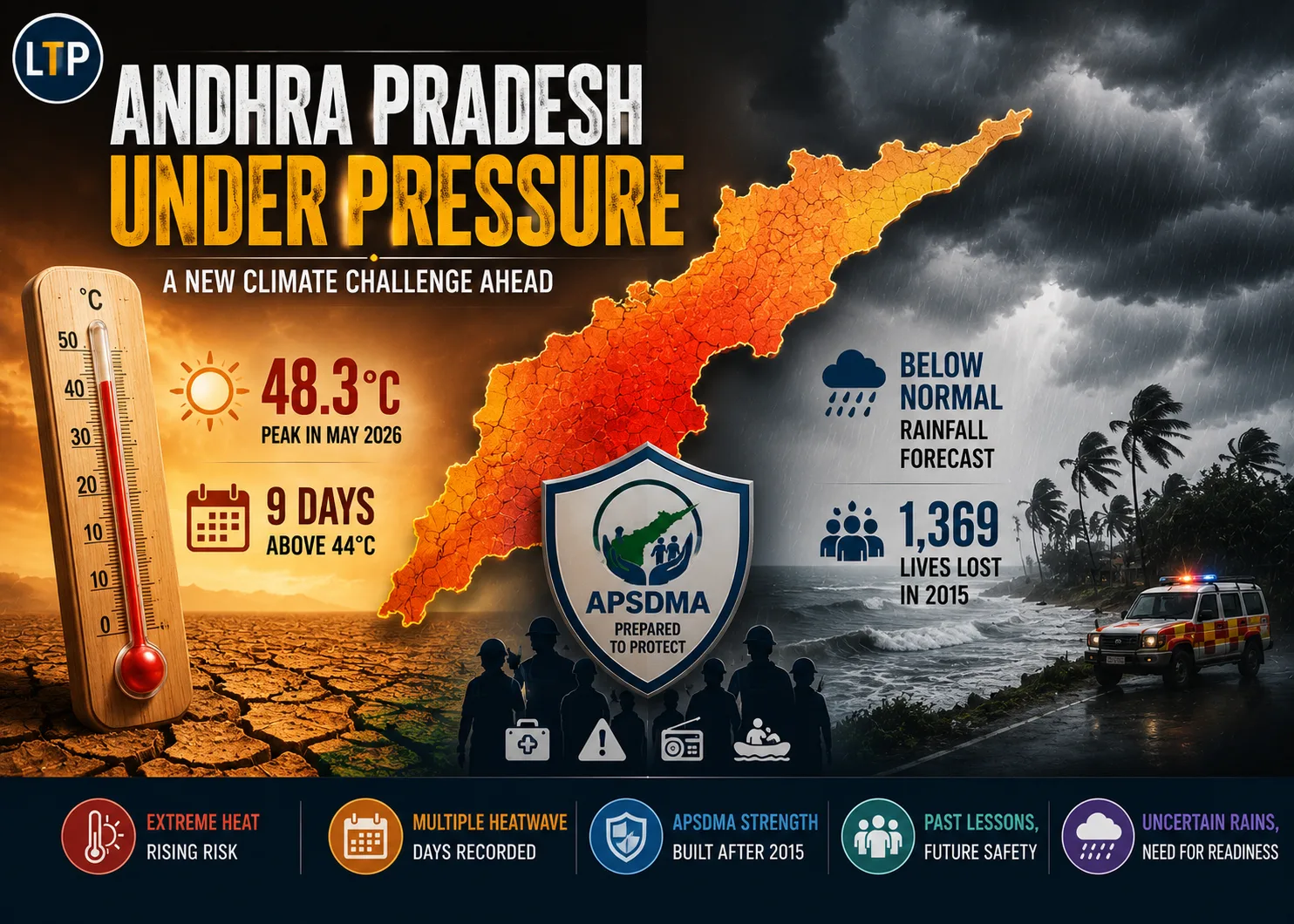
- In May 2026, A.P. recorded daytime temperatures above 44°C for nine consecutive days, peaking at 48.3°C, before the formal onset of an El Niño event over the Pacific [Article excerpt].
- On July 12, 2026, IMD Amaravati issued fresh heatwave alerts for the state [Article excerpt].
- An overall below-normal monsoon has been forecast for A.P. this year, raising concern about a repeat of the 2015/2023 pattern [Article excerpt].
3. Background & Evolution
- 2015: A very strong El Niño year; heatwaves killed ≥2,300 people nationally, with A.P. alone recording 1,369 deaths — the worst state toll in the country [Article excerpt] [1].
- This tragedy directly led to the formation of APSDMA [Article excerpt] [1].
- Post-2015, heatwave deaths in A.P. declined sharply — 723 (2016), 236 (subsequent year) — attributed to APSDMA's early-warning and mitigation measures [1].
- 2023: Second major El Niño/heatwave stress-test of the state's preparedness [Article excerpt].
- 2026: Third such test in a decade, per the article's framing [Article excerpt].
4. Core Static Facts
| Aspect | Detail |
|---|---|
| Phenomenon | El Niño — warm phase of ENSO (El Niño–Southern Oscillation), warming of central/eastern tropical Pacific SSTs [2] |
| "Very strong" El Niño threshold | Pacific SST anomaly > 2°C above normal, per weather experts/IMD framing [Article excerpt] |
| Very strong El Niño years (1951–2025) | 1972, 1982, 2015, 2023 — four occurrences [Article excerpt] |
| Nodal state agency | Andhra Pradesh State Disaster Management Authority (APSDMA), formed after 2015 heatwave [Article excerpt] |
| Nodal meteorological agency | India Meteorological Department (IMD), regional office at Amaravati [Article excerpt] |
| 2015 national heat deaths | ≥2,300 [Article excerpt] |
| 2015 A.P. heat deaths | 1,369 [Article excerpt] [1] |
| 2016 A.P. heat deaths | 723 [1] |
| Post-APSDMA A.P. heat deaths (subsequent year) | 236 [1] |
| May 2026 A.P. heatwave | 44°C+ for 9 consecutive days; season high 48.3°C [Article excerpt] |
| 2026 monsoon forecast for A.P. | Below normal [Article excerpt] |
5. Multi-Dimensional Analysis
- Environmental: El Niño weakens monsoon moisture influx, causing rainfall deficits and compounding heatwave severity in peninsular India, including A.P. [Article excerpt] [2].
- Social: Heatwave mortality disproportionately affects outdoor/agricultural labourers, the elderly, and urban poor lacking cooling access — reflected in the 2015 death toll concentration in A.P. [Article excerpt].
- Administrative: APSDMA's creation illustrates reactive institution-building — a disaster management authority formed after a mass-casualty event rather than pre-emptively [Article excerpt].
- Scientific/Technological: IMD's SST threshold-based classification (>2°C anomaly = "very strong" El Niño) exemplifies climate monitoring feeding into public health/disaster alerts [Article excerpt].
- Governance: Declining death tolls (1,369 → 723 → 236) despite recurring El Niño events show measurable institutional learning and early-warning effectiveness [1].
- Historical: Comparative trajectory across three El Niño-linked heatwave episodes (2015, 2023, 2026) allows evaluation of disaster-preparedness maturity over a decade [Article excerpt].
6. Recent Developments (last 12-18 months)
- May 2026: A.P. heatwave with 9 consecutive days above 44°C; peak 48.3°C [Article excerpt].
- July 12, 2026: IMD Amaravati issues heatwave alerts amid a forecast below-normal monsoon [Article excerpt].
- 2026 monsoon season: Meteorologists flag high likelihood of a fresh strong El Niño event [Article excerpt].
7. Prelims Hooks
- El Niño is the warm phase of ENSO (El Niño–Southern Oscillation) [2].
- "Very strong" El Niño = Pacific SST anomaly exceeding 2°C [Article excerpt].
- Very strong El Niño years between 1951–2025: 1972, 1982, 2015, 2023 [Article excerpt].
- APSDMA = Andhra Pradesh State Disaster Management Authority, formed after the 2015 heatwave disaster [Article excerpt].
- 2015 heatwave: ≥2,300 deaths nationally, 1,369 in Andhra Pradesh alone [Article excerpt].
- A.P.'s regional IMD office is located at Amaravati [Article excerpt].
- May 2026: A.P. recorded 9 consecutive days above 44°C, peak 48.3°C [Article excerpt].
- Heatwave deaths in A.P. fell from 1,369 (2015) → 723 (2016) → 236 (following year) [1].
- This is the third time in a decade (2015, 2023, 2026) A.P.'s disaster preparedness is being tested by El Niño-linked extremes [Article excerpt].
- A below-normal monsoon has been forecast for A.P. in 2026 [Article excerpt].
8. Mains Relevance
- GS-I: Geography — climatology, El Niño/ENSO and Indian monsoon dynamics.
- GS-III: Disaster Management — institutional mechanisms (APSDMA), early warning systems, heatwave action plans.
- Possible question stems: 1. "Discuss the mechanism through which El Niño affects the Indian monsoon and examine its implications for heatwave preparedness in peninsular states like Andhra Pradesh." 2. "Institutional responses to disasters are often reactive rather than anticipatory in India. Critically examine with reference to the formation of State Disaster Management Authorities." 3. "Evaluate the effectiveness of early warning systems in reducing heatwave mortality in India, citing state-level examples."
9. Related Topics to Study Next
- ENSO and La Niña — the counterpart cooling phase, for contrast in monsoon impact.
- Indian Ocean Dipole (IOD) — interacts with ENSO to modulate monsoon outcomes.
- National Disaster Management Authority (NDMA) and the Disaster Management Act, 2005 — the parent legal/institutional framework for state authorities like APSDMA.
- Heat Action Plans (HAPs) — city/state-level heatwave mitigation frameworks (e.g., Ahmedabad's pioneering HAP).
- NCRB heat-related mortality data — for comparative statistics across states.
- Climate change and extreme weather events in India — broader environment GS-III linkage.
- Monsoon forecasting methodology (IMD) — technical backdrop to seasonal rainfall predictions.
10. Common Errors / Trap Areas
- Confusing El Niño (Pacific warming) with Indian Ocean Dipole (Indian Ocean phenomenon) — they are distinct though interacting.
- Assuming El Niño always causes drought in India — historically some El Niño years had near-normal monsoons due to IOD offsetting effects.
- Misattributing APSDMA's formation year or trigger — it was catalysed by the 2015 heatwave, not a cyclone or flood event.
- Confusing NDMA (national) with APSDMA (state-level) mandates and jurisdiction.
- Treating "very strong El Niño" as a fixed calendar-year list without noting it is SST-anomaly-threshold-based (>2°C), not a subjective label.
Sources
- 1Andhra Pradesh: Deaths due to heatwave decline drastically in 5 yearsthehansindia.com · tier 4
- 2El Nino, Southern Oscillation, equatorial eastern Pacific sea surface temperatures and summer monsoon rainfall in India — MAUSAM Journal, IMDmausamjournal.imd.gov.in · tier 1
- 3A.P. and the next El Niño challenge, The Hinduthehindu.com · tier 4
At the end · practice MCQs
11 questions on this article
Check the answer for each question, or reveal all at once.