Five crore Indians wait when the courts take a break
New · District CollectorCan you hold the district for 72 hours?Floods, a heatwave, an outbreak, a grievance queue. Take the decisions, see the consequences.Play →In this note
Practice
12 questions on this article
Check the answer for each question, or reveal all at once.
1. At a Glance
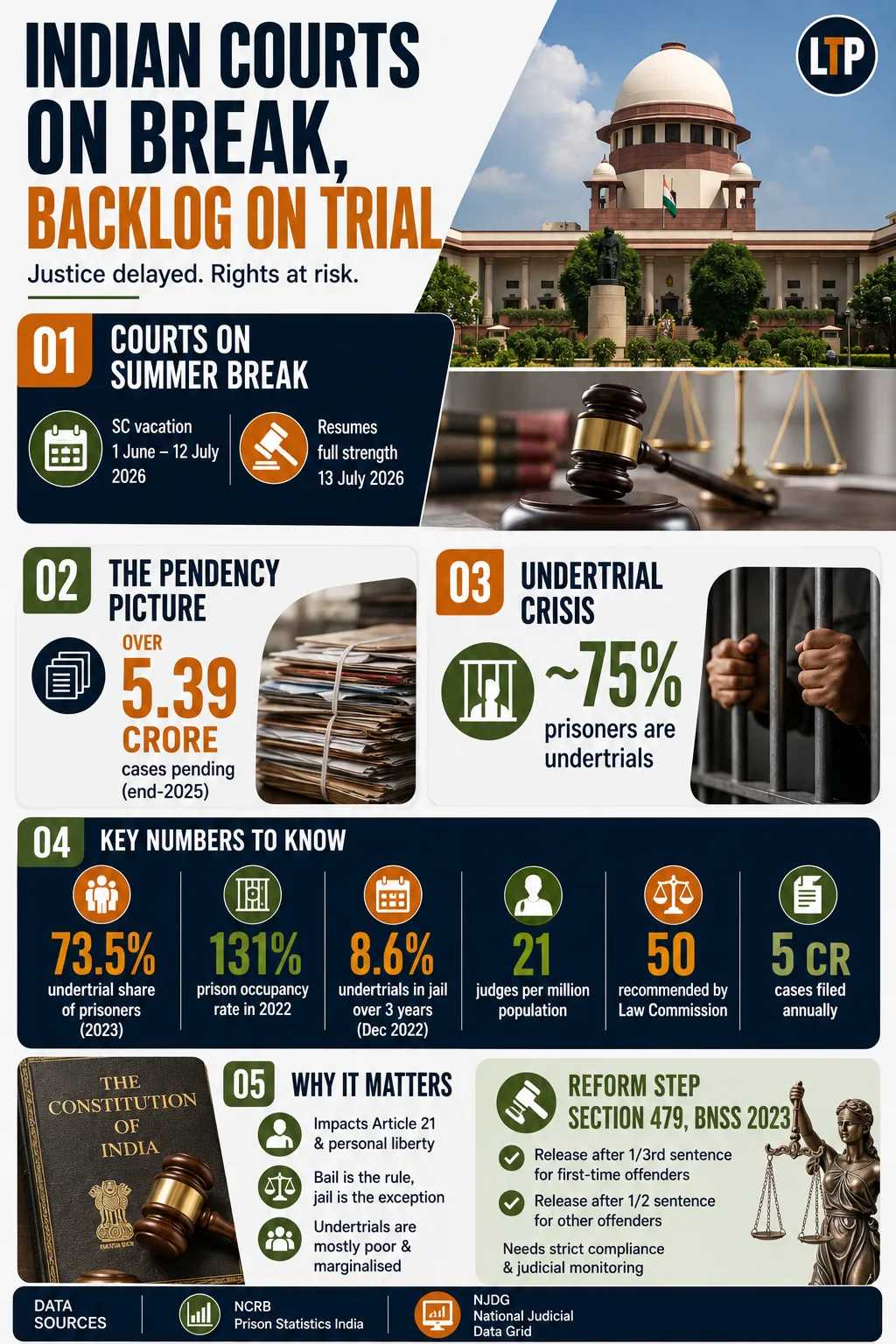
- India's judiciary faces a dual crisis: ~5+ crore pending cases across all court levels and ~75% of prisoners are undertrials — unconvicted persons awaiting trial, often in custody longer than the sentence they would eventually receive [1][2].
- Annual court vacations (Supreme Court summer break, High Court recess) reduce working Benches to a fraction of full strength for weeks, compounding delays for litigants and undertrials alike [3].
- High relevance for UPSC: tests governance, judicial reform, Article 21 (personal liberty), and administration-of-justice themes recurring across GS-II and GS-IV.
- Sits at intersection of judicial accountability, prison reform (BNSS Section 479), and access-to-justice debates.
2. Why in the News
- The Supreme Court was on its summer vacation from June 1 to July 12, 2026, operating with only three to four Benches a week instead of the full court, resuming in earnest on July 13, 2026 (per the article's dateline) — prompting commentary on the cost of judicial breaks to over five crore litigants [4].
- As of end-2025, more than 5.39 crore cases were reported pending, per the article, framing the vacation-period slowdown against this backlog [4].
- Parallel 2025 data shows Supreme Court pendency itself rose to ~88,417 cases by August 2025 despite full sanctioned strength of 34 judges, with the post-vacation resumption in July 2025 unusually failing to reduce pendency as it had in past years [3].
3. Background & Evolution
- Court vacations are a colonial-era holdover, originally designed for judges and lawyers to escape the heat in the pre-air-conditioning era; the practice has persisted despite modern conditions [3].
- Undertrial overcrowding has been a chronic, decades-old concern flagged repeatedly by the Law Commission of India and the Supreme Court itself.
- Bharatiya Nagarik Suraksha Sanhita (BNSS), 2023, replacing the CrPC, introduced Section 479, mandating release of undertrials who have served a specified portion (one-third for first-time offenders, one-half otherwise) of the maximum sentence for their alleged offence [1].
- NCRB's annual "Prison Statistics India" reports have tracked undertrial share and prison occupancy for years, showing consistent overcrowding (occupancy rate of 131% in 2022) [1].
4. Core Static Facts
| Parameter | Detail |
|---|---|
| Total pending cases (all courts, NJDG 2025) | ~4.9–5+ crore [3][4] |
| Supreme Court pendency (Aug 2025) | 88,417 cases; Sanctioned strength 34 judges [3] |
| Cases filed annually vs disposed | ~5 crore filed; ~2 crore disposed [3] |
| Undertrial share of total prisoners (2023) | 73.5% [1] |
| Undertrial share (2022, NCRB) | 75.8% (4,34,302 of total) [1] |
| Prison occupancy rate (2022) | 131% (5,73,220 inmates vs capacity 4,36,266) [1] |
| Undertrials in custody >3 years (2022) | 8.6% of all undertrials [1] |
| Judges per million population (India) | 21 (Law Commission recommends 50) [1] |
| Key statute for undertrial release | Section 479, BNSS, 2023 [1] |
| Nodal data source | NCRB (Prison Statistics India); NJDG (case pendency) |
| SC summer vacation period referenced | June 1 – July 12, 2026 [4] |
5. Multi-Dimensional Analysis
Legal / Constitutional
- Prolonged undertrial detention implicates Article 21 (right to life and personal liberty) and the presumption of innocence — "bail is the rule, jail is the exception."
- Section 479 BNSS operationalises undertrial release but implementation depends on jail authorities' compliance and judicial monitoring [1].
Administrative
- Court vacations reduce operational capacity: SC drops to 3–4 Benches/week during summer break instead of full-court functioning [4].
- Judge-population ratio (21/million) far below the Law Commission's 50/million benchmark, worsening backlog irrespective of vacations [1].
Social
- Undertrials disproportionately come from poor, marginalised, and often Dalit/Adivasi/Muslim backgrounds who cannot afford bail or quality legal representation — an equity dimension frequently highlighted in prison-reform literature.
- Extended pre-trial incarceration disrupts livelihoods and families of the accused, despite no conviction.
Governance / Ethical
- Raises accountability questions: should a public institution funded by taxpayers "shut down with vacation Benches" while other essential services function continuously [4]?
- Debate on whether court vacations should be curtailed or restructured (staggered leave) rather than eliminated, to balance judicial rest with public access to justice.
Historical
- Vacation practice traces to colonial administrative convenience, now criticised as anachronistic given electronic case management and video-conferencing capabilities.
6. Recent Developments (last 12-18 months)
- August 2025: SC pendency reached 88,417 cases despite full judge strength of 34 [3].
- July 2025: Monthly pendency figure recorded at 87,115 cases; unusually, post-vacation resumption (mid-July) did not reduce pendency as in prior years [3].
- 2026 (article's reference year): SC summer break ran June 1–July 12, 2026, with reduced Bench functioning; total national pendency cited at over 5.39 crore as of end-2025 [4].
- Continued rollout and monitoring of Section 479, BNSS for undertrial release remains an active administrative process across states [1].
7. Prelims Hooks
- NCRB reported 75.8% of Indian prisoners were undertrials in 2022; this fell slightly to 73.5% by end-2023 [1].
- Prison occupancy rate stood at 131% in 2022 (Prison Statistics India, NCRB) [1].
- India has 21 judges per million population, against the Law Commission's recommended 50 per million [1].
- 8.6% of undertrial prisoners (as of Dec 31, 2022) had been incarcerated for more than three years without conviction [1].
- Section 479 of the BNSS, 2023 (which replaced the CrPC) governs mandatory release of long-held undertrials [1].
- Supreme Court pendency touched 88,417 cases by August 2025 despite full sanctioned strength of 34 judges [3].
- India's courts collectively face ~5 crore cases filed annually, of which only ~2 crore are disposed [3].
- Total pending cases across all Indian courts (NJDG, 2025) stood at nearly 4.9 crore; the referenced article cites 5.39 crore as of end-2025 [3][4].
- The Supreme Court's 2026 summer vacation ran June 1 to July 12, with only 3–4 Benches functioning weekly instead of the full court [4].
- NJDG (National Judicial Data Grid) is the primary real-time database for tracking case pendency across Indian courts [3].
- BNSS 2023 replaced the Code of Criminal Procedure (CrPC), 1973 as India's principal criminal procedure code.
8. Mains Relevance
- GS-II: Polity & Governance — "Structure, organization and functioning of the Judiciary"; "Issues relating to development and management of Social Sector/Services relating to Health, Education, Human Resources" (undertrial welfare); Statutory bodies.
- GS-III: Internal Security / Governance — links to prison reform and criminal justice system efficiency.
- GS-IV: Ethics in governance — accountability of public institutions, empathy for the marginalised undertrial population.
- Possible Mains question stems: 1. "Discuss how prolonged court vacations affect the administration of justice in India. Suggest reforms to balance judicial workload with the constitutional right to a speedy trial." 2. "Examine the causes behind the disproportionately high share of undertrial prisoners in India. How far can Section 479 of the BNSS address this issue?" 3. "Judicial pendency in India is as much a structural problem as a resource problem. Critically analyse with reference to recent data."
9. Related Topics to Study Next
- Undertrial Review Committees (URCs) — statutory mechanism under Model Prison Manual for periodic undertrial case review.
- National Judicial Data Grid (NJDG) — the data infrastructure underpinning pendency statistics.
- All India Judicial Services (AIJS) proposal — a reform idea to address judge shortage.
- Fast Track Courts / Fast Track Special Courts (FTSCs) — mechanism to reduce case backlog for specific offence categories.
- Bharatiya Nyaya Sanhita (BNS) & BNSS, 2023 — the broader criminal law overhaul replacing IPC/CrPC/Evidence Act.
- Right to Speedy Trial (Article 21 jurisprudence) — landmark SC rulings (e.g., Hussainara Khatoon case) on undertrial rights.
- Law Commission of India reports on judicial strength and vacations — historical recommendations context.
- e-Courts Mission Mode Project — digitisation initiative aimed at reducing pendency via technology.
10. Common Errors / Trap Areas
- Confusing undertrial prisoners (awaiting trial, presumed innocent) with convicts — a common conceptual trap in Prelims MCQs.
- Mixing up CrPC provisions with the newer BNSS Section 479 — BNSS has replaced CrPC since 2023; older notes may cite CrPC Section 436A (the predecessor provision) instead.
- Confusing NCRB (publishes Prison Statistics India — undertrial/prison data) with NJDG (tracks case pendency) — different nodal data sources for different metrics.
- Assuming court vacations are unique to India — comparative examples exist (e.g., UK, US courts also have recesses), but the debate here is India-specific on scale/impact.
- Treating "5 crore" figures as a single fixed number — pendency figures vary by source/date (4.9 crore per NJDG 2025 vs 5.39 crore cited in the July 2026 article); always attribute the figure to its specific reporting date.
Sources
- 1Undertrial Prisoners — PIB / NCRB-derived analysis (Prison Statistics India data, judges-per-million, BNSS Section 479)pib.gov.in · tier 1
- 2State of Undertrial Prisoners in India — Drishti IASdrishtiias.com · tier 4
- 3July 2025: Pendency soars to a staggering 87,000 cases — Supreme Court Observerscobserver.in · tier 4
- 4Five crore Indians wait when the courts take a break — The Hindu BusinessLinethehindu.com · tier 4
At the end · practice MCQs
12 questions on this article
Check the answer for each question, or reveal all at once.