Milk production in Gangetic plains has nosedived due to climate change
New · District CollectorCan you hold the district for 72 hours?Floods, a heatwave, an outbreak, a grievance queue. Take the decisions, see the consequences.Play →In this note
Practice
7 questions on this article
Check the answer for each question, or reveal all at once.
1. At a Glance
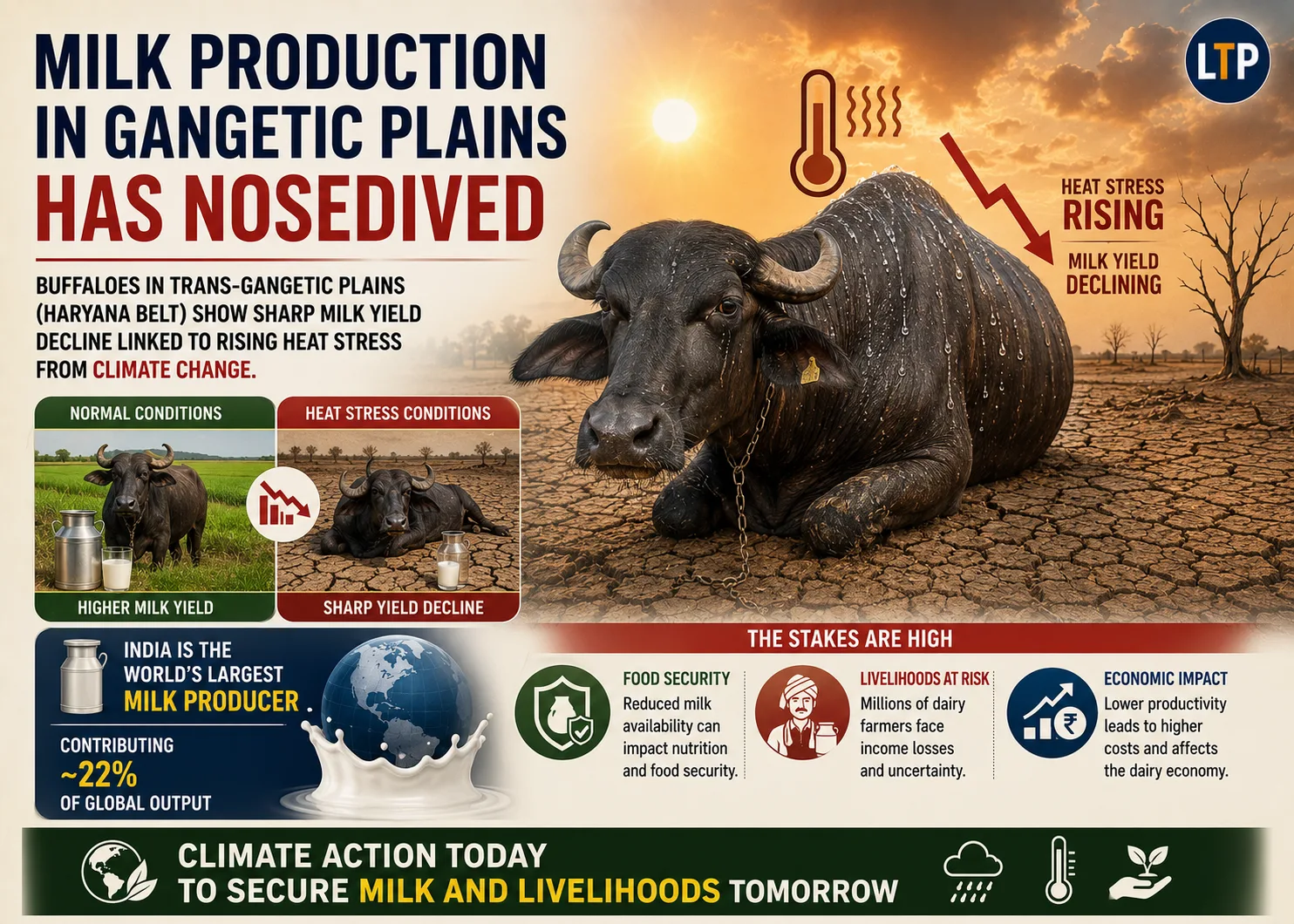
- Buffaloes in trans-Gangetic plains (Haryana belt) show sharp milk yield decline linked to rising heat stress from climate change [1].
- India is world's largest milk producer, contributing ~22% of global output — any dairy productivity shock has outsized food-security/livelihood stakes [2].
- Study (published in Scientific Reports) frames Haryana as "high milk production tract" acutely hit by warming [1].
- Tests GS-III (agriculture, climate impact on livelihoods) + GS-I (geography of agriculture) — recurring UPSC theme: climate change → agri/livestock productivity.
2. Why in the News
- New study (reported 6 July 2026, The Hindu) finds 20–30% decline in milk yield among lactating buffaloes/cattle in trans-Gangetic plains due to heat stress diverting energy from lactation to thermoregulation [1].
- Study published in journal Scientific Reports; highlighted by Environmental Defense Fund (EDF) India advisor Abhinav Gaurav, warning of risk to livelihoods and nutrition of millions [1].
3. Background & Evolution
- India's White Revolution (Operation Flood, launched 1970) built dairy cooperative structure (NDDB, Anand pattern) making India world's top milk producer — context for why any productivity dip matters nationally.
- Trans-Gangetic plains (Haryana, Punjab, western UP) historically a core buffalo-milk belt (Murrah buffalo breed) feeding NCR demand.
- Climate science on livestock heat stress well-established globally (Temperature-Humidity Index research); this study localizes impact to India's Global-South dairy systems [1].
- FAO notes rising temperatures already threaten dairy viability in affected regions worldwide — India flagged as consequential given its herd size [2].
4. Core Static Facts
| Item | Detail |
|---|---|
| Journal | Scientific Reports (Nature group) [1] |
| Region studied | Trans-Gangetic plains, esp. Haryana [1] |
| Species affected | Buffaloes (bovine), also cattle [1] |
| Yield decline | 20–30% [1] |
| Mechanism | Heat stress → energy diverted from lactation to body-temperature regulation [1] |
| Secondary stressors | Reduced fodder/feed availability, water scarcity, pest & disease attacks [1] |
| India's global rank | Largest milk producer & consumer worldwide; ~22% of global milk output [1][2] |
| Commentator | Abhinav Gaurav, Lead Advisor, Environmental Defense Fund (EDF) India [1] |
| Nodal domestic bodies (context, not in article) | Dept. of Animal Husbandry & Dairying (DAHD); NDDB |
5. Multi-Dimensional Analysis
Economic
- Dairy is India's largest agri-sub-sector by value; Haryana belt feeds NCR liquid-milk demand — yield loss threatens farmer incomes and urban milk supply chains [1].
- Threatens rural livelihoods dependent on dairying as supplementary income (smallholders, landless).
Social
- Milk = key protein/nutrition source for poor households; yield crash raises malnutrition risk for "millions" per EDF advisor [1].
- Disproportionately hits smallholder/marginal dairy farmers with limited climate-proofing capacity (no cooling infrastructure).
Environmental
- Feedback loop: livestock sector itself major GHG emitter (enteric methane); climate change now degrading same sector's productivity — mutual causality [2].
- Compounding stressors: fodder/water scarcity, pest/disease spread with warming [1].
Scientific/Technological
- Heat stress physiology: lactating animals redirect metabolic energy to thermoregulation, reducing milk synthesis — established bio-mechanism now empirically mapped to Indian data [1].
- Adaptation tech gap: cooling systems, heat-tolerant breeding, THI (Temperature-Humidity Index) monitoring underused in smallholder systems.
Administrative/Governance
- Raises question of whether dairy/livestock extension services (state animal husbandry depts) are climate-proofing schemes — gap between climate science and ground extension.
6. Recent Developments (last 12–18 months)
- 6 July 2026: The Hindu reports new Scientific Reports study quantifying 20–30% milk yield decline in Haryana/trans-Gangetic buffalo belt due to climate-driven heat stress [1].
- EDF India flags nutrition/livelihood risk to "millions" given India's status as top global milk producer/consumer [1].
7. Prelims Hooks
- India is world's largest milk producer, ~22% of global milk output [2].
- Trans-Gangetic plains (Haryana) identified as "high milk production tract" hit hardest by heat stress [1].
- Milk yield decline quantified: 20–30% in affected buffalo herds [1].
- Mechanism: lactating animals divert energy from milk synthesis to thermoregulation under heat stress [1].
- Compounding factors: reduced fodder/feed, water scarcity, rising pest/disease incidence [1].
- Study published in journal Scientific Reports (Nature Portfolio) [1].
- Commentary sourced from Environmental Defense Fund (EDF) India [1].
- Buffalo (not just cattle) specifically flagged as most heat-vulnerable dairy species in study [1].
- "Global South" framing — study says warming acutely affects dairy production across Global South generally, India as prime case [1].
- India's dairy White Revolution (Operation Flood) historically built the very production base now under climate threat (background static fact).
8. Mains Relevance
- GS-III: Agriculture — issues relating to animal-rearing economy; effects of climate change on agriculture/livestock; food security.
- GS-I: Geographical factors, distribution of agro-based industries (dairy belt geography).
- Possible question stems:
- "Climate change is undermining the very agricultural systems that ensured India's food security. Discuss with reference to the dairy sector." (GS-III)
- "Examine the mechanisms by which rising temperatures affect livestock productivity in India. Suggest adaptive measures for smallholder dairy farmers." (GS-III)
- "India's White Revolution built a dairy economy now vulnerable to climate change. Critically analyse." (GS-I/III)
9. Related Topics to Study Next
- Operation Flood / White Revolution — historical base of India's dairy dominance now under threat.
- Heat stress index / Temperature-Humidity Index (THI) — scientific tool measuring livestock climate vulnerability.
- Enteric methane emissions from livestock — reverse causality; India's National Livestock Mission and methane mitigation.
- National Action Plan on Climate Change (NAPCC) — Mission for Sustainable Agriculture — policy umbrella for climate-agri adaptation.
- Rashtriya Gokul Mission / National Livestock Mission — breeding and productivity schemes that could integrate heat-resilience.
- Food security & PDS nutrition linkages — downstream impact of protein source disruption.
- Climate change and Indian agriculture (wheat, rice yields) — parallel crop-side climate impact for comparative Mains answers.
10. Common Errors / Trap Areas
- Don't confuse Operation Flood/NDDB (est. 1970, Verghese Kurien) with this current climate study — they're unrelated in origin but linked in background.
- Don't assume yield decline affects only cattle — study specifically emphasizes buffaloes in trans-Gangetic belt.
- Avoid citing EDF India as a government body — it's an international NGO, not a ministry.
- Don't misstate India's global milk share — commonly tested figure is ~22-24%, varies by year; verify against latest FAO/DAHD figures before exam.
- Geographic trap: "trans-Gangetic plains" = Punjab-Haryana-western UP tract, distinct from "middle/lower Gangetic plains" (Bihar-Bengal) — don't conflate.
Sources
- 1Milk production in Gangetic plains has nosedived due to climate change, Divya Gandhi — The Hinduthehindu.com · tier 4
- 2OECD-FAO Agricultural Outlook 2023-2032 — FAOopenknowledge.fao.org · tier 2
At the end · practice MCQs
7 questions on this article
Check the answer for each question, or reveal all at once.