Citizenship decisions must be ‘fair, reasoned’, says SC
New · District CollectorCan you hold the district for 72 hours?Floods, a heatwave, an outbreak, a grievance queue. Take the decisions, see the consequences.Play →In this note
Practice
8 questions on this article
Check the answer for each question, or reveal all at once.
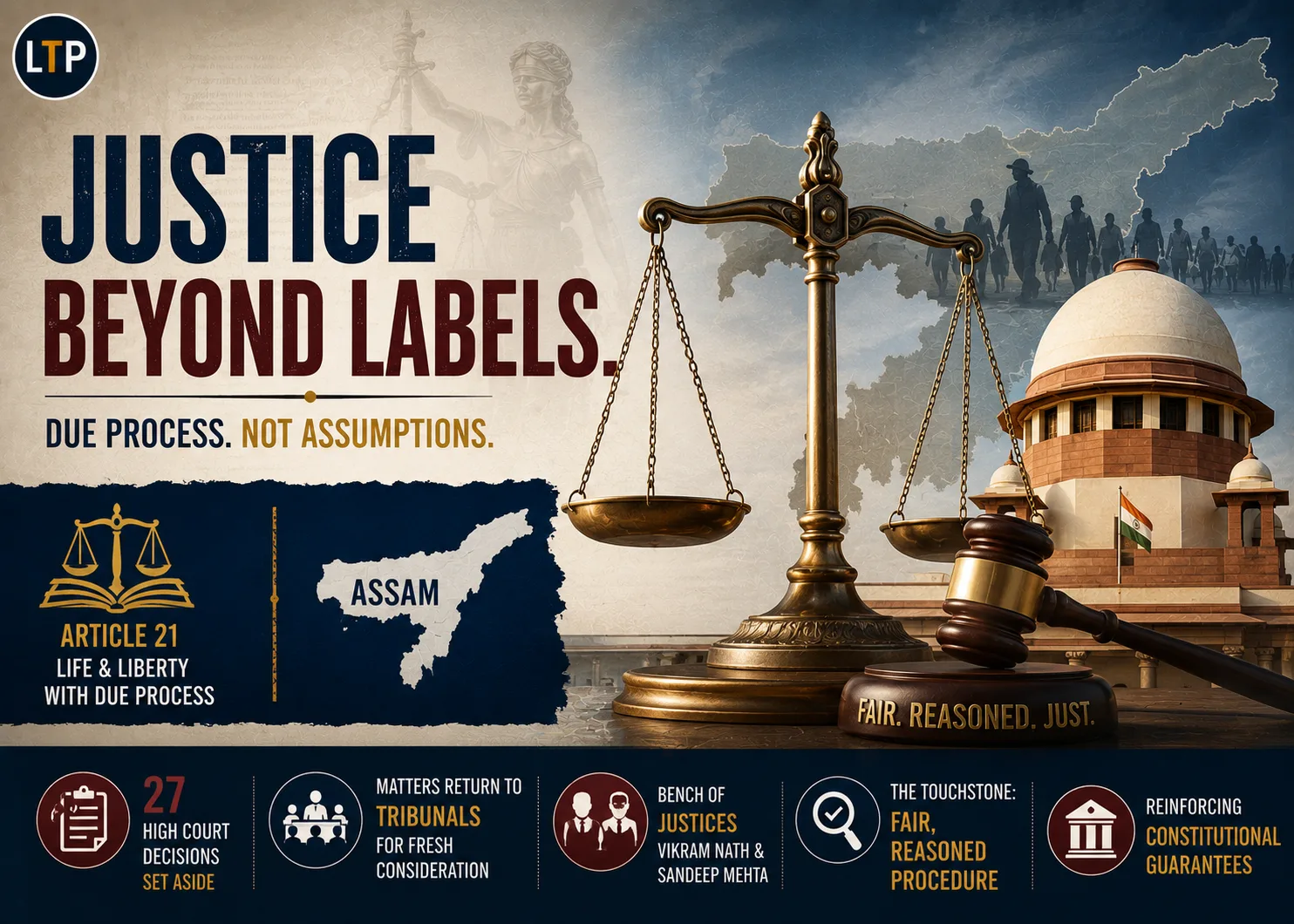
1. At a Glance
- Supreme Court (Justices Vikram Nath and Sandeep Mehta) ruled that determination of citizenship/foreigner status must follow a "fair, lawful, and reasoned" process, setting aside 27 Gauhati High Court judgments declaring appellants foreigners [1].
- Cases remanded to the Foreigners' Tribunals for fresh adjudication — reaffirms that mechanical, one-sided procedures cannot sustain a foreigner declaration [1].
- High relevance for UPSC: intersects Assam citizenship crisis, NRC, statelessness, due process under Article 21, and Centre–State/judicial federalism in border-state administration.
2. Why in the News
- On Monday (13 July 2026), the SC set aside 27 Gauhati HC verdicts upholding Foreigners' Tribunal orders declaring persons foreigners, holding the "grave consequence" of such a declaration demands adherence to constitutional guarantees [1].
- Judgment authored by Justice Nath: "A proceeding which may result in a person being declared a foreigner cannot be sustained if the procedure adopted is mechanical, one-sided, or devoid of application of mind" [1].
3. Background & Evolution
- Foreigners Act, 1946 — Section 9 places the reverse burden of proof on the proceedee to establish Indian citizenship, not on the state to prove foreign origin [2].
- Foreigners (Tribunals) Order, 1964 — issued under Section 3 of the Foreigners Act, 1946, establishing quasi-judicial Tribunals (mainly in Assam) to adjudicate citizenship/foreigner status [2].
- Citizenship Act, 1955, Section 6A — special provision inserted post-Assam Accord (1985) governing citizenship for persons who entered Assam before 1 January 1966 / between 1966–1971 [2].
- Precedent: Md Rahim Ali alias Abdur Rahim vs State of Assam (2024) — SC (Justices Nath and Amanullah) restored citizenship of an Assam man after 12 years, overturning Tribunal and Gauhati HC findings, calling minor documentary discrepancies insufficient grounds for foreigner declaration [1].
- The Court had earlier directed that judgments on procedural fairness be circulated to all Tribunals constituted under the 1964 Order via the Gauhati HC Registrar General [1].
4. Core Static Facts
| Element | Detail |
|---|---|
| Adjudicating body | Foreigners' Tribunals (quasi-judicial) [2] |
| Enabling framework | Foreigners Act, 1946 (Section 9); Foreigners (Tribunals) Order, 1964; Citizenship Act, 1955 (Section 6A) [2] |
| Burden of proof | Reverse burden — lies on the individual, not the state [2] |
| Appellate route | Foreigners' Tribunal → Gauhati High Court → Supreme Court [1] |
| Current bench | Justices Vikram Nath and Sandeep Mehta [1] |
| Judgments set aside | 27 Gauhati HC rulings [1] |
| Geographic scope | Primarily Assam (D-voter/border-police referred cases) [2] |
5. Multi-Dimensional Analysis
Legal / Constitutional
- Court invoked Article 21-style due process reasoning: state action "clothed in statutory form" is still void if arbitrary [1].
- Reinforces natural justice principles — right to disclosure of grounds, fair hearing, evidence-based conclusions [1].
Social
- Disproportionately affects poor, often illiterate, riverine (char) populations in Assam lacking generational documentation [2].
- Risk of statelessness and detention for those wrongly declared foreigners.
Administrative
- Highlights systemic issues: Tribunals relying on vague "D-voter" tags or border police references rather than robust evidence [2].
- Raises capacity/quality-of-adjudication concerns — many Tribunal members and time-bound disposal pressures.
Governance / Ethical
- Reverse burden of proof under a colonial-era statute (1946 Act) sits uneasily with modern due-process norms — recurring tension flagged by courts and civil society [2].
- Balances state's legitimate interest in weeding out "false claims" against individual rights.
Historical
- Rooted in post-Partition migration control (1946 Act) and Assam Accord-driven cut-off dates (Section 6A, 1985) — a legacy structure still adjudicating disputes in 2026.
6. Recent Developments (last 12–18 months)
- October 2024: SC judgment on Section 6A of Citizenship Act (Assam cut-off date matter) [2].
- 2024: SC restored citizenship of Md Rahim Ali after 12-year legal battle, criticizing Tribunal's reliance on minor discrepancies [1].
- 13 July 2026: SC sets aside 27 Gauhati HC judgments, remands to Tribunals for fresh, reasoned adjudication [1].
7. Prelims Hooks
- Foreigners' Tribunals were constituted under the Foreigners (Tribunals) Order, 1964, not a standalone Act.
- The 1964 Order derives power from Section 3 of the Foreigners Act, 1946.
- Under Section 9 of the Foreigners Act, 1946, burden of proof lies on the person alleged to be a foreigner (reverse burden).
- Section 6A of the Citizenship Act, 1955 was inserted following the Assam Accord (1985).
- The 13 July 2026 SC ruling set aside 27 Gauhati High Court judgments in one stroke.
- Bench: Justices Vikram Nath and Sandeep Mehta; judgment authored by Justice Nath.
- Appeal route for citizenship disputes in Assam: Foreigners' Tribunal → Gauhati HC → Supreme Court.
- Md Rahim Ali case (2024) is a key precedent on citizenship restoration after Tribunal/HC error.
- Foreigners' Tribunals operate mainly in Assam, distinct from the rest of India's ordinary citizenship-verification mechanisms.
- The term "D-voter" (Doubtful voter) is used by Assam's Election Commission machinery to flag suspected non-citizens for Tribunal reference.
8. Mains Relevance
- GS-II: Polity & Governance — "Separation of powers, Judiciary structure & functions"; "Government policies and interventions"; fundamental rights (Article 21, due process).
- GS-I: Post-independence consolidation — Assam Accord, migration/demographic issues in Northeast India.
- Possible question stems: 1. "Discuss the constitutional and due-process concerns arising from the reverse burden of proof under the Foreigners Act, 1946, in the context of recent Supreme Court rulings." 2. "Examine the functioning of Foreigners' Tribunals in Assam and the challenges they pose to the right to fair hearing under Article 21." 3. "The determination of citizenship cannot be reduced to a mechanical exercise.' Discuss in light of recent Supreme Court observations on Foreigners' Tribunals."
9. Related Topics to Study Next
- Assam Accord (1985) — origin of Section 6A cut-off dates central to these disputes.
- National Register of Citizens (NRC), Assam — parallel citizenship-verification exercise with overlapping disputes.
- Citizenship (Amendment) Act, 2019 — related citizenship-eligibility debate, contrasted with Foreigners Tribunal mechanism.
- Article 21 & Due Process of Law — constitutional basis invoked by the Court.
- D-Voter system & Election Commission's role in Assam — trigger mechanism for many Tribunal references.
- Statelessness and international law (UNHCR conventions) — comparative angle on consequences of foreigner declarations.
- Natural justice principles (Audi alteram partem) — administrative law doctrine underlying the ruling.
10. Common Errors / Trap Areas
- Confusing the Foreigners Act, 1946 (parent statute, Section 9 reverse burden) with the Foreigners (Tribunals) Order, 1964 (subordinate legislation constituting Tribunals) — they are not the same instrument.
- Assuming NRC and Foreigners' Tribunals are the same mechanism — NRC is a registry exercise; Tribunals are quasi-judicial adjudicatory bodies, though outcomes interlink.
- Misattributing Section 6A to the Foreigners Act instead of the Citizenship Act, 1955.
- Assuming the burden of proof in these cases follows ordinary criminal jurisprudence (prosecution must prove guilt) — here it is reversed onto the individual.
- Conflating this SC ruling with CAA-related citizenship-grant provisions — this case concerns citizenship-determination/adjudication, not citizenship-acquisition under CAA.
Sources
At the end · practice MCQs
8 questions on this article
Check the answer for each question, or reveal all at once.