What did SCOTUS rule on birthright citizenship?
New · District CollectorCan you hold the district for 72 hours?Floods, a heatwave, an outbreak, a grievance queue. Take the decisions, see the consequences.Play →In this note
Practice
9 questions on this article
Check the answer for each question, or reveal all at once.
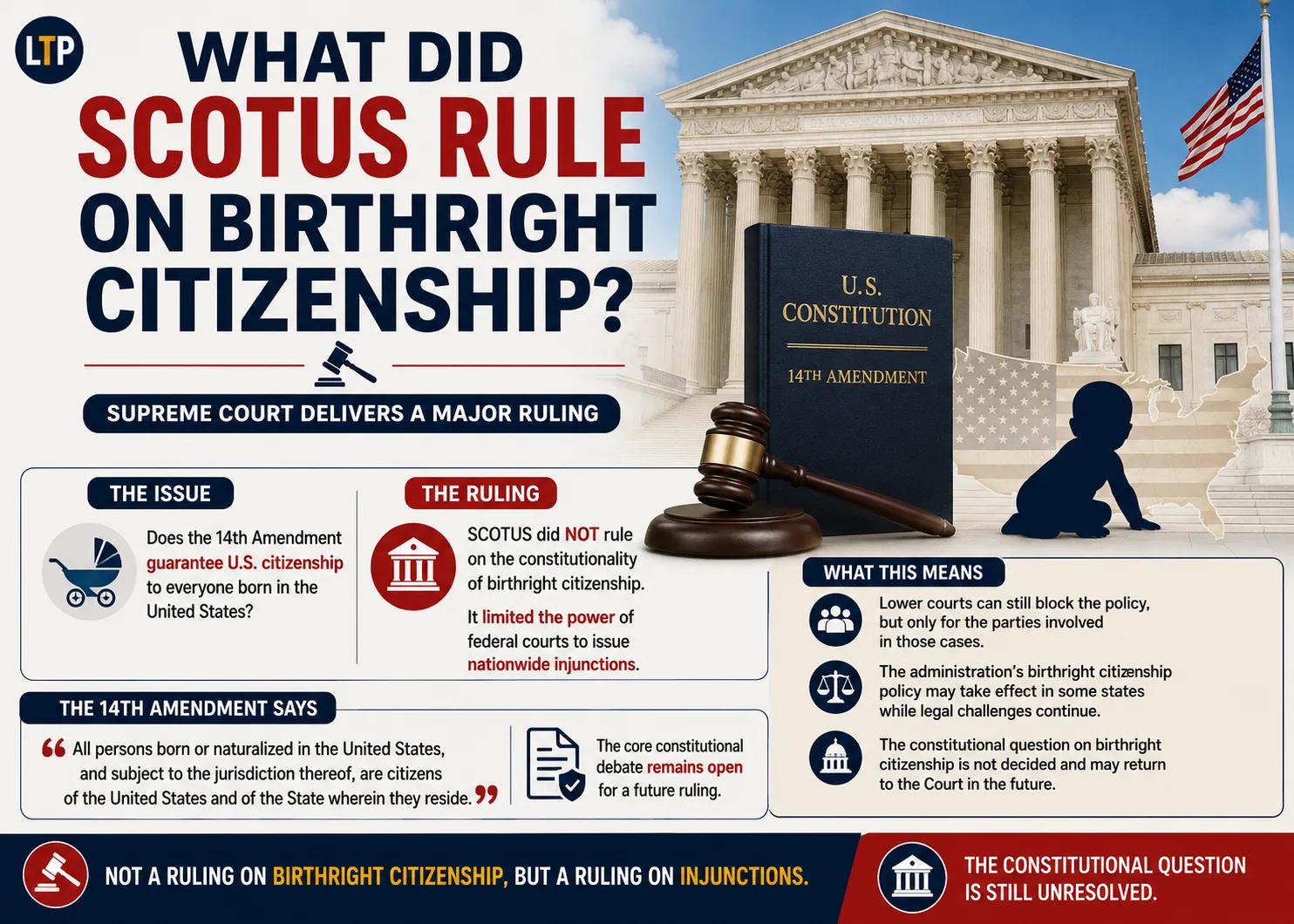
1. At a Glance
- The US Supreme Court (SCOTUS) upheld birthright citizenship under the 14th Amendment, striking down President Trump's Executive Order 14160 in a 6–3 ruling on June 30, 2026 [1][2].
- Reaffirms that anyone born on U.S. soil is a citizen "subject to the jurisdiction thereof," regardless of parents' immigration status, barring narrow exceptions [2].
- Relevant for UPSC GS-II (comparative constitutions, citizenship provisions) and as a case study in judicial review vs. executive overreach [2].
- Offers a comparative lens against India's own citizenship provisions (Articles 5–11, Citizenship Act 1955, CAA 2019) for Mains answer-writing.
2. Why in the News
- On June 30, 2026, SCOTUS struck down Trump's Executive Order 14160, which sought to deny citizenship documents (Social Security numbers, passports) to children born after February 19, 2025 to (i) unlawfully present mothers when the father was not a citizen/lawful permanent resident, or (ii) lawfully-but-temporarily present mothers (students, tourists, guest workers) under similar father conditions [2][1].
- The ruling was 6–3 overall, with a 5–4 split specifically on the constitutional question [1].
3. Background & Evolution
- 1868: 14th Amendment ratified, stating "all persons born or naturalised in the United States, and subject to the jurisdiction thereof, are citizens" — enacted primarily to overturn Dred Scott v. Sandford, which had denied citizenship to Black Americans, including formerly enslaved persons [2][3].
- 1898: United States v. Wong Kim Ark — SCOTUS held that a child born in the U.S. to Chinese immigrant parents (themselves barred from naturalisation under the 1882 Chinese Exclusion Act) was a citizen by birth; established that the Citizenship Clause applies broadly, not only to freed slaves [3].
- Wong Kim Ark recognised narrow exceptions: children of foreign diplomats/ministers, of enemy combatants/invading militias, of tribal members not taxed, and persons born on foreign public ships [3].
- 2025 (Jan 20/Feb 19): Trump signs EO 14160 attempting to restrict birthright citizenship for children of undocumented/temporary-status parents, effective for births after February 19, 2025 [2].
- June 30, 2026: SCOTUS decision strikes down EO 14160, reaffirming automatic birthright citizenship [1][2].
4. Core Static Facts
- Constitutional provision: 14th Amendment, Citizenship Clause (ratified 1868) [2].
- Key precedent case: United States v. Wong Kim Ark, 169 U.S. 649 (1898) [3].
- 2026 case/order struck down: Executive Order 14160 (Trump administration) [2].
- Verdict: 6–3 (5–4 on the core constitutional question) [1].
- Majority opinion author: Chief Justice John Roberts, joined by Justices Sotomayor, Kagan, Barrett, Jackson [1].
- Dissents: Lead dissent by Justice Clarence Thomas (91 pages), joined in substance by Alito and Gorsuch; Kavanaugh dissented in part, agreeing only that a 1950s federal statute (not the Constitution) grants automatic citizenship [1].
- Recognised exceptions to birthright citizenship: children of foreign diplomats and of invading/enemy militaries [2]; Wong Kim Ark additionally listed tribal members and persons on foreign public ships [3].
5. Multi-Dimensional Analysis
- Legal/Constitutional: Confirms judicial supremacy over executive orders that conflict with a constitutional amendment; reaffirms "subject to the jurisdiction thereof" covers nearly all U.S.-born children [2][1].
- Historical: Direct doctrinal continuity from Dred Scott (1857, denial of citizenship) → 14th Amendment (1868, correction) → Wong Kim Ark (1898, broad application) → 2026 ruling (reaffirmation against restrictive executive action) [2][3].
- Social: Impacts children of undocumented immigrants and temporary visa holders (students, tourists, guest workers), a politically salient immigration-policy fault line in the U.S. [2].
- Geopolitical/Governance: Illustrates separation of powers — an executive order cannot override a constitutional guarantee absent a formal amendment process; relevant to checks-and-balances discourse [1].
- Comparative/Ethical: Useful contrast with India's citizenship regime, which since the 1986/2003 amendments to the Citizenship Act, 1955, has moved away from pure jus soli toward conditional citizenship based on parents' status — opposite trend to the U.S. position reaffirmed here.
6. Recent Developments (last 12-18 months)
- February 19, 2025: Cut-off date set by EO 14160 for applying restricted citizenship rules to new births [2].
- June 30, 2026: SCOTUS delivers 6–3 ruling striking down EO 14160 and upholding unconditional birthright citizenship [1][2].
- Post-ruling: Reports of celebrations by activists on Capitol Hill, and of reactions among Trump's MAGA support base to the setback [2].
7. Prelims Hooks
- SCOTUS ruling on birthright citizenship delivered on June 30, 2026 [2].
- Vote margin: 6–3 overall verdict [1].
- Executive Order struck down: EO 14160 [2].
- Constitutional basis: 14th Amendment, ratified 1868 [2].
- 14th Amendment's original purpose: to overturn Dred Scott v. Sandford and grant citizenship to former slaves [3].
- Key precedent case establishing broad birthright citizenship: United States v. Wong Kim Ark (1898), 169 U.S. 649 [3].
- Wong Kim Ark was born to Chinese immigrant parents barred from naturalisation under the 1882 Chinese Exclusion Act [3].
- Exceptions to birthright citizenship: children of foreign diplomats and invading militaries/enemy combatants [2][3]; also tribal members and those on foreign public ships (per Wong Kim Ark) [3].
- Majority opinion authored by Chief Justice John Roberts [1].
- Lead dissent authored by Justice Clarence Thomas (91 pages), arguing the 14th Amendment applies only to former slaves and descendants [1].
- Justice Kavanaugh dissented in part, citing a 1950s federal statute (not the Constitution) as the basis for automatic citizenship [1].
- EO 14160 targeted children born after February 19, 2025 to specified categories of non-citizen parents [2].
8. Mains Relevance
- GS-II: Comparative Constitution, Polity — separation of powers, judicial review, citizenship provisions in federal democracies.
- Possible question stems:
- "Examine how the U.S. Supreme Court's 2026 ruling on birthright citizenship illustrates the limits of executive power vis-à-vis constitutional guarantees. Compare with India's experience of judicial review of executive/legislative action." (GS-II)
- "Trace the evolution of birthright citizenship jurisprudence in the United States from Dred Scott to the 2026 SCOTUS ruling. What lessons does it hold for citizenship law reform elsewhere?" (GS-II)
- "Contrast the jus soli principle underlying U.S. birthright citizenship with India's shift toward conditional (jus sanguinis-influenced) citizenship since 1986." (GS-II)
9. Related Topics to Study Next
- Citizenship Act, 1955 (India) and its amendments (1986, 2003, 2019/CAA) — contrast with U.S. jus soli approach.
- Articles 5–11 of the Indian Constitution — India's own citizenship framework.
- Separation of powers and judicial review — comparative constitutional law theme.
- Dred Scott v. Sandford (1857) — foundational case necessitating the 14th Amendment.
- United States v. Wong Kim Ark (1898) — core precedent for birthright citizenship.
- Executive Orders and their limits — comparative study of U.S. presidential vs. Indian executive ordinance powers (Article 123).
- NRC/CAA debate in India — parallel domestic discourse on citizenship determination.
10. Common Errors / Trap Areas
- Confusing the overall 6–3 vote with the 5–4 split specifically on the constitutional question — these are distinct figures cited in the same ruling [1].
- Misattributing the 14th Amendment's "main purpose" — it was primarily to grant citizenship to freed slaves post-Dred Scott, not a general immigration measure, though it was interpreted broadly in Wong Kim Ark [3].
- Mixing up EO 14160 (2025 Trump order) with the SCOTUS case name — the order was struck down, not upheld.
- Assuming birthright citizenship in the U.S. has no exceptions — diplomats' children and children of invading militaries (and per Wong Kim Ark, tribal members/foreign public ship-born persons) are excluded [2][3].
- Assuming India follows the same jus soli principle as the U.S. — India's citizenship law has become progressively conditional since 1986, unlike the U.S. position reaffirmed here.
Sources
- 1Supreme Court upholds birthright citizenship on constitutional grounds — NPRnpr.org · tier 4
- 2What did SCOTUS rule on birthright citizenship? — The Hinduthehindu.com · tier 4
- 3United States v. Wong Kim Ark — Wikipedia / Constitution Centeren.wikipedia.org · tier 3
At the end · practice MCQs
9 questions on this article
Check the answer for each question, or reveal all at once.