What are ICC’s ‘Return to Play Post-Pregnancy’ guidelines?
New · District CollectorCan you hold the district for 72 hours?Floods, a heatwave, an outbreak, a grievance queue. Take the decisions, see the consequences.Play →In this note
Practice
8 questions on this article
Check the answer for each question, or reveal all at once.
1. At a Glance
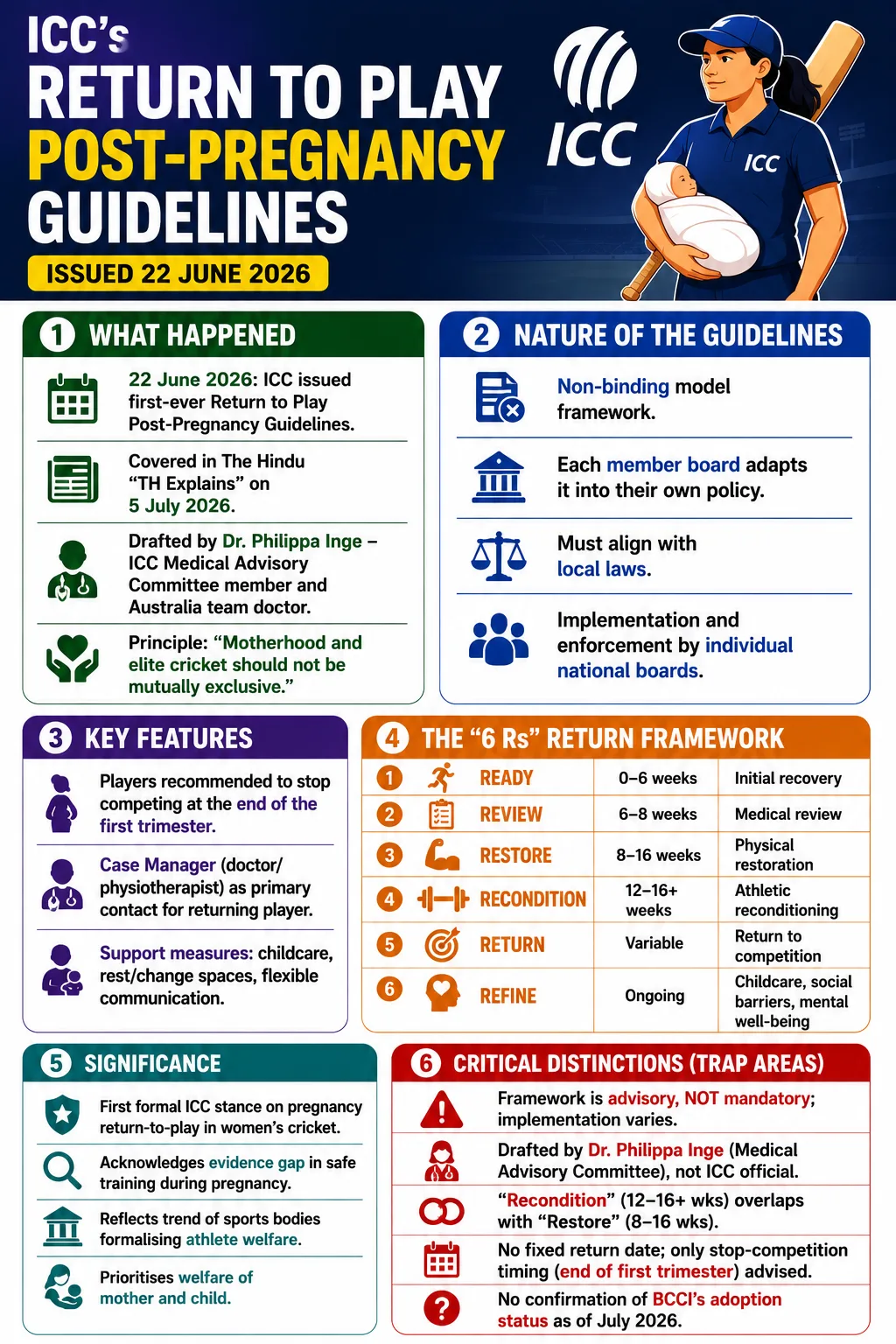
- The ICC issued its first-ever "Return to Play Post-Pregnancy" Guidelines on June 22, 2026, a framework to help elite women cricketers resume playing after pregnancy/childbirth [1].
- It is a non-binding model framework — member boards adapt it into their own domestic policies per local laws [1].
- Relevant for UPSC as a case study in sports governance, gender equity in athletics, and international federation policy-making (GS-I/II/III cross-cutting).
2. Why in the News
- ICC announced the guidelines via press release on June 22, 2026; covered in The Hindu's "TH Explains" on July 5, 2026 [1].
3. Background & Evolution
- Guidelines drafted by a team led by Dr. Philippa Inge, ICC Medical Advisory Committee member and Australia team doctor [1].
- Motivated by the principle that "motherhood and elite cricket should not be seen as mutually exclusive" — an official ICC spokesperson statement [1].
- Represents the ICC's first formal, codified stance on pregnancy-related return-to-play protocols for women's cricket [1].
4. Core Static Facts
- Issuing body: International Cricket Council (ICC) [1].
- Date of announcement: June 22, 2026 [1].
- Drafting lead: Dr. Philippa Inge (ICC Medical Advisory Committee, Australia Team Doctor) [1].
- Nature of instrument: Guidance framework (not a binding rule) — member boards design their own policies "in line with local laws" [1].
- Key mechanism: Mandates appointment of a case manager (usually a doctor/physiotherapist) as the primary point of contact for the returning player [1].
- Pregnancy-phase rule: Players recommended to stop competing at the end of the first trimester [1].
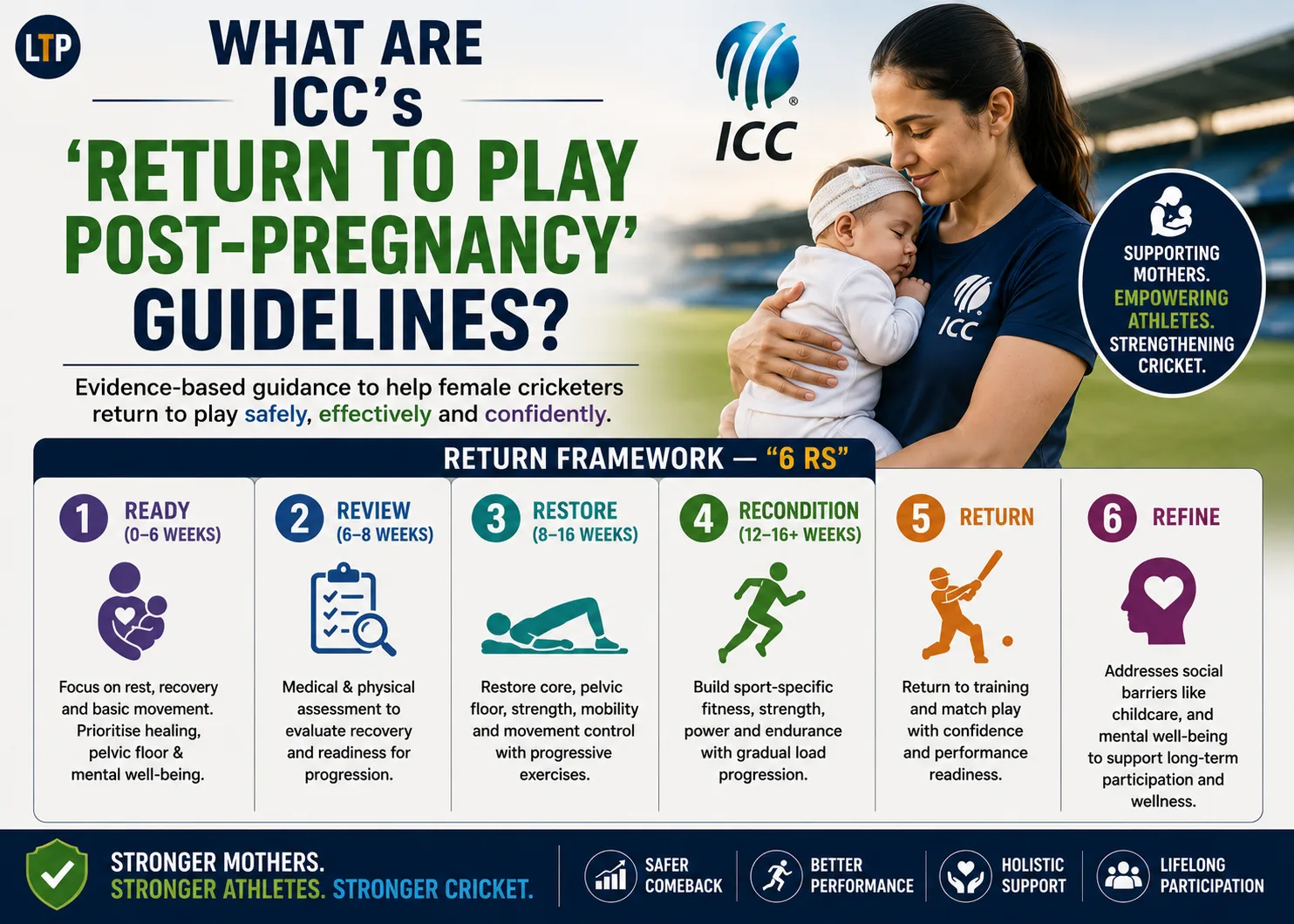
- Return framework — "6 Rs" [1]:
- Ready (0–6 weeks)
- Review (6–8 weeks)
- Restore (8–16 weeks)
- Recondition (12–16+ weeks)
- Return
-
Refine (addresses social barriers like childcare, and mental well-being)
-
Support measures: Access to childcare facilities, spaces to change/rest the baby, flexible communication [1].
5. Multi-Dimensional Analysis
- Social/Gender: Institutionalises the idea that motherhood and professional sporting careers are compatible; addresses childcare and psychological barriers unique to women athletes [1].
- Administrative: Framework is advisory only — implementation and enforcement rest with individual national cricket boards, creating potential variance in application across ICC's member countries [1].
- Scientific/Medical: Explicitly acknowledges an evidence gap — lack of research on designing safe exercise/training programmes for elite athletes during pregnancy — signalling need for further sports-medicine research [1].
- Governance: Reflects a broader trend of international sports federations formalising athlete welfare policy via medical advisory committees rather than purely administrative bodies [1].
- Ethical: Centres the "welfare of mother and child" as the guiding ethic, prioritising health over premature return-to-competition pressures [1].
6. Recent Developments (last 12-18 months)
- June 22, 2026: ICC formally announces the Return to Play Post-Pregnancy Guidelines [1].
- July 5, 2026: The Hindu publishes explainer analysing the guidelines' structure and rationale [1].
7. Prelims Hooks
- ICC's Return to Play Post-Pregnancy Guidelines were announced on June 22, 2026 [1].
- Drafting team led by Dr. Philippa Inge, a member of the ICC Medical Advisory Committee [1].
- Dr. Inge is the Australia team doctor [1].
- The guidelines recommend stopping competitive play at the end of the first trimester [1].
- The return-to-play model is called the "6 Rs" framework [1].
- The 6 Rs are: Ready, Review, Restore, Recondition, Return, Refine [1].
- "Ready" phase spans 0–6 weeks post-childbirth [1].
- "Review" phase spans 6–8 weeks [1].
- "Restore" phase spans 8–16 weeks [1].
- "Recondition" phase spans 12–16+ weeks [1].
- The "Refine" phase specifically addresses childcare/social barriers and mental well-being [1].
- The guidelines mandate appointment of a "case manager" — typically a doctor or physiotherapist [1].
- The framework is advisory, not mandatory — implementation is left to individual ICC member boards [1].
- The guidelines are the ICC's first-ever formal post-pregnancy return-to-play policy [1].
8. Mains Relevance
- GS-I: Role of women in society; issues related to women (motherhood, workplace re-entry challenges).
- GS-II: Governance — welfare policies by international bodies; issues relating to development and management of Social Sector/Services.
- Possible question stems: 1. "Discuss the significance of the ICC's Return to Play Post-Pregnancy Guidelines in mainstreaming gender-sensitive sports governance. What structural barriers do such frameworks seek to address?" 2. "International sports federations are increasingly institutionalising athlete welfare policy through medical advisory bodies. Critically examine this trend with reference to a recent example." 3. "Advisory frameworks issued by international federations often lack binding enforcement. Discuss with reference to the ICC's post-pregnancy return-to-play guidelines."
9. Related Topics to Study Next
- Maternity Benefit Act, 1961 (India) — domestic legal comparator for maternity-related workplace protections.
- BCCI's own maternity/pregnancy policies for women cricketers — how India's board may adapt the ICC framework.
- Women's sport governance and pay parity (e.g., BCCI match-fee parity, 2022) — related gender-equity-in-sport theme.
- ICC governance structure (Full Members, Associate Members, Medical Advisory Committee) — institutional context.
- Sports medicine and athlete rehabilitation frameworks — scientific dimension underlying the "6 Rs" model.
- Global Sports/Olympic policies on maternity (e.g., IOC's approach) — comparative international benchmarking.
- Gender mainstreaming in policy-making — broader GS-II governance theme.
10. Common Errors / Trap Areas
- Do not confuse this ICC guideline with a binding rule — it is only a model framework; actual enforcement depends on individual member boards' domestic policies [1].
- Do not misattribute drafting leadership — it was led by Dr. Philippa Inge (ICC Medical Advisory Committee/Australia team doctor), not an ICC administrative official [1].
- Do not confuse the "6 Rs" sequence order or timelines — note "Recondition" (12–16+ weeks) overlaps with "Restore" (8–16 weeks); they are distinct sequential-but-overlapping phases [1].
- Avoid assuming the guidelines mandate a fixed return date — the recommendation is only to stop competing at end of first trimester; no fixed return date is specified beyond the phased "6 Rs" model [1].
- Do not confuse this ICC policy with any BCCI-specific or India-specific pregnancy/maternity policy — the source article does not confirm BCCI's adoption status.
Sources
At the end · practice MCQs
8 questions on this article
Check the answer for each question, or reveal all at once.