India-U.K. FTA: FinMin notifies rules for origin of goods
New · District CollectorCan you hold the district for 72 hours?Floods, a heatwave, an outbreak, a grievance queue. Take the decisions, see the consequences.Play →In this note
Practice
12 questions on this article
Check the answer for each question, or reveal all at once.
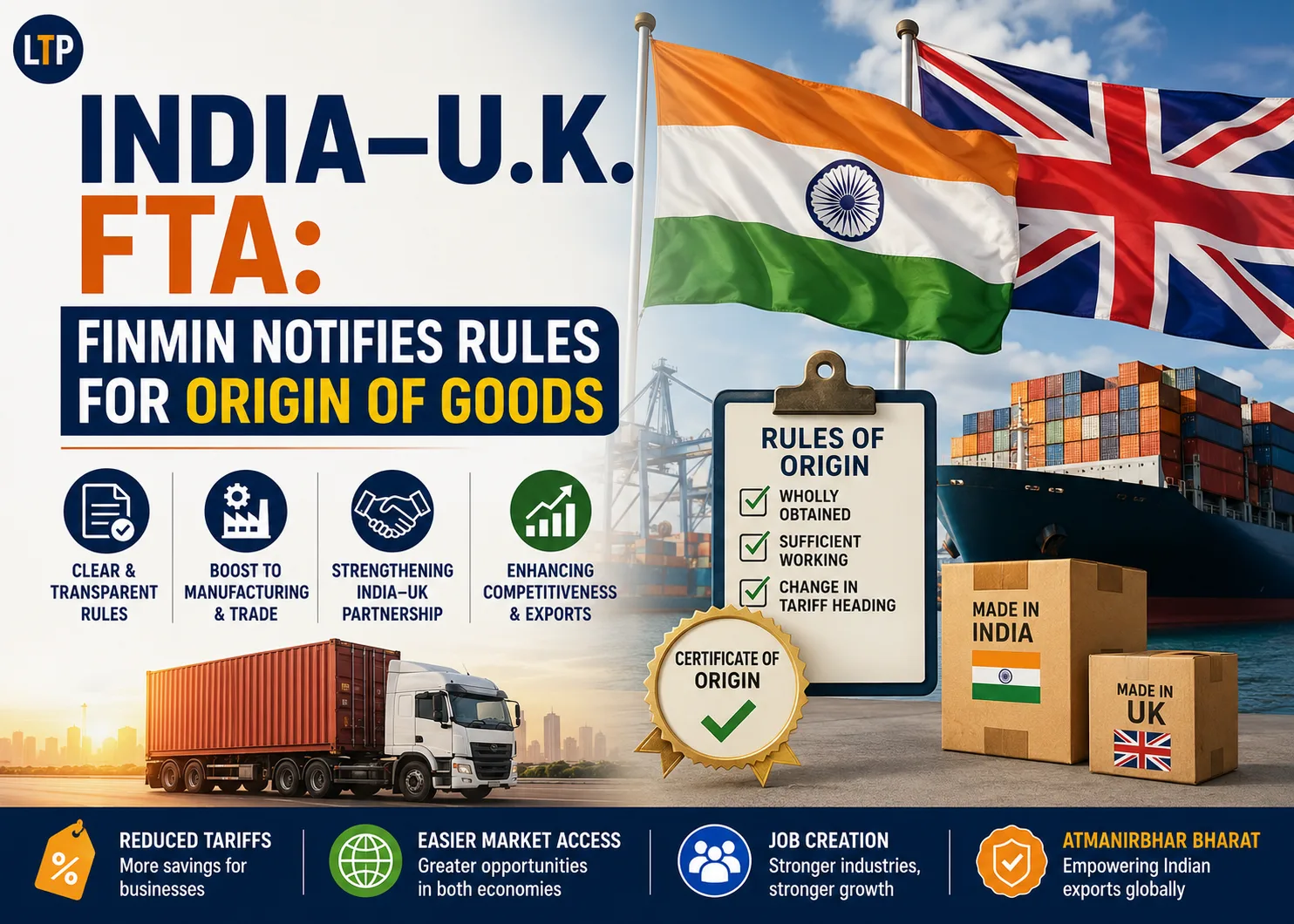
1. At a Glance
- CETA (Comprehensive Economic and Trade Agreement) between India and the U.K. enters into force on 15 July 2026; the Finance Ministry has notified rules of origin ahead of rollout [3][4].
- Rules of origin are the technical gatekeeping mechanism of any FTA — they decide which goods genuinely qualify as "made in India/UK" to avail preferential tariffs, preventing tariff circumvention by third countries.
- High-frequency UPSC theme: India's FTA architecture, CBIC's regulatory role, and trade-facilitation vs. revenue-leakage prevention.
- Also tied to a parallel Agreement on Social Security Contributions (Double Contribution Convention) entering force the same date [2].
2. Why in the News
- Central Board of Indirect Taxes and Customs (CBIC), under the Finance Ministry, notified the Customs Tariff (Determination of Origin of Goods under India-UK CETA) Rules, dated 3 July 2026, clearing the compliance framework needed before the pact's 15 July 2026 entry into force [1][3][4].
- This is an implementation/procedural step following the CETA's earlier signing; it operationalises the treaty's tariff-preference machinery.
3. Background & Evolution
- India–UK FTA negotiations were launched in January 2022.
- The CETA was signed by India and the U.K. (Commerce Minister and U.K. counterpart) — covered under PIB release on signing [5].
- Both governments completed internal ratification/legal procedures, culminating in the announcement that CETA and the associated Social Security Agreement will enter into force on 15 July 2026 [2].
- FinMin/CBIC subsequently issued the origin-determination rules (notified 3 July 2026) as subordinate legislation needed to operationalise preferential tariff claims from day one of implementation [1][3][4].
4. Core Static Facts
| Item | Detail |
|---|---|
| Agreement | India–U.K. Comprehensive Economic and Trade Agreement (CETA) |
| Entry into force | 15 July 2026 [2][3] |
| Notifying authority | Central Board of Indirect Taxes and Customs (CBIC), Department of Revenue, Ministry of Finance [1][6] |
| Notification date | 3 July 2026 [3][4] |
| Instrument | Customs Tariff Rules on determination of origin of goods |
| Key document | Certificate of Origin — required to avail duty benefits on exports under India's trade agreements [6] |
| Tariff coverage | Duty-free access on 99% of tariff lines under CETA [1] |
| Certificate issuers | Entities authorised by both governments in their respective countries [6][4] |
| Validity of origin certificates/declarations | Generally 12 months from issuance/completion [4] |
| Importer record-keeping | Minimum 4 years [4] |
| Exporter/manufacturer record-keeping | Minimum 5 years [4] |
| Related parallel pact | Agreement on Social Security Contributions (Double Contribution Convention), also effective 15 July 2026 [2] |
| Related steel understanding | India–U.K. consensus on bilateral steel trade following UK steel safeguard measures effective 1 July 2026 [1] |
5. Multi-Dimensional Analysis
Economic
- Rules of origin prevent trade deflection — goods routed via UK/India from third countries (e.g., China) falsely claiming preferential tariffs [6].
- 99% tariff-line duty-free access is expected to boost India's labour-intensive exports (textiles, leather, gems & jewellery) to the UK [1].
Geopolitical/Strategic
- CETA is part of India's broader FTA diversification strategy (post EU-EFTA, UAE, Australia deals) toward developed-economy markets.
- Parallel steel-trade consensus shows FTA implementation requires continuous bilateral management of non-tariff frictions (UK steel safeguards from 1 July 2026) [1].
Legal/Administrative
- Rules are issued as subordinate legislation (Customs Tariff Rules) by CBIC under Ministry of Finance — illustrates delegated legislative power in trade-tariff administration.
- Compliance burden: differentiated record-retention timelines (importers 4 years vs. exporters/manufacturers 5 years) signal administrative asymmetry aspirants should note [4].
Governance
- Mutual recognition of "authorised entities" issuing certificates in each country reflects administrative cooperation clauses typical of modern FTAs, reducing unilateral certification disputes.
6. Recent Developments (last 12–18 months)
- 3 July 2026: CBIC notifies rules for determination of origin of goods under India-UK CETA [3][4].
- 15 July 2026 (scheduled): CETA and Social Security Agreement formally enter into force [2].
- 1 July 2026: UK steel safeguard measures took effect; India-UK reached consensus to manage bilateral steel trade disruption [1].
7. Prelims Hooks
- CETA = Comprehensive Economic and Trade Agreement, India's terminology for the India-UK FTA.
- Rules of origin notified by CBIC, not DGFT or Commerce Ministry — nodal body is Ministry of Finance (Department of Revenue).
- CETA's entry into force date: 15 July 2026.
- Rules of origin notification date: 3 July 2026.
- Certificate of Origin is required to avail duty benefits on exports under India's trade agreements [6].
- India's CETA offers duty-free access on 99% of tariff lines [1].
- Origin certificates/declarations valid for 12 months typically [4].
- Importers must retain preferential-claim records for 4 years; exporters/manufacturers for 5 years [4].
- A companion pact — Agreement on Social Security Contributions (Double Contribution Convention) — enters force the same day as CETA [2].
- Certificates can be issued by authorised entities in either country, not a single centralised body [6].
- India-UK FTA negotiations formally began in January 2022.
- UK steel safeguard measures affecting bilateral trade took effect 1 July 2026 [1].
8. Mains Relevance
- GS-II: International relations — bilateral agreements affecting India's interests (India-UK relations, trade diplomacy).
- GS-III: Indian economy — effects of liberalisation on the economy; changes in industrial policy; infrastructure of trade facilitation (Customs, CBIC role).
- Possible question stems: 1. "Rules of origin are often called the 'silent gatekeepers' of Free Trade Agreements. Discuss their significance with reference to the India-UK CETA." (GS-III) 2. "Examine how India's recent FTAs with developed economies (UK, EU, EFTA) differ in their approach to non-tariff issues like labour mobility and social security." (GS-II/III) 3. "Critically analyse the institutional and compliance challenges in implementing preferential rules of origin under India's trade agreements." (GS-III)
9. Related Topics to Study Next
- India-EFTA TEPA (2024) — comparable recent FTA with investment commitments, useful for comparative FTA analysis.
- India-Australia ECTA — earlier developed-economy FTA, comparison of tariff coverage and rules of origin design.
- WTO Rules of Origin Agreement — multilateral benchmark against which bilateral ROO frameworks are assessed.
- CBIC and Customs Act, 1962 — statutory backbone for tariff/customs notifications.
- Double Taxation Avoidance Agreements (DTAA) vs Social Security Agreements — distinguishing tax treaties from social security totalisation pacts (relevant given the parallel India-UK Social Security pact).
- UK's post-Brexit trade policy (CPTPP accession) — context for UK's independent FTA strategy post-EU exit.
- Non-tariff barriers & safeguard measures (e.g., UK steel safeguards) — recurring friction point in FTA implementation.
10. Common Errors / Trap Areas
- Confusing CBIC (Finance Ministry) with DGFT (Commerce Ministry) as the notifying authority for rules of origin — this notification is a Finance Ministry/CBIC action, not Commerce.
- Mixing up signing date of CETA vs. entry-into-force date (15 July 2026) vs. rules notification date (3 July 2026) — three distinct dates.
- Assuming "Certificate of Origin" is issued by a single government body — it is issued by multiple authorised entities in each country.
- Conflating the Social Security Agreement (labour/pension contributions) with the trade agreement (CETA) — they are two separate but co-timed instruments.
- Overstating tariff coverage as "100%" — the correct figure cited is 99% of tariff lines duty-free, not full coverage [1].
Sources
- 1India and the United Kingdom Unleash a Next Generation Economic Corridor: CETA and Agreement on Social Security Contributions Set to Enter into Force on 15th July 2026pib.gov.in · tier 1
- 2India–UK CETA (Press Note)pib.gov.in · tier 1
- 3Govt Notifies Customs Tariff Rules For India-UK Trade Pact, Clears Way For July 15 Rollout — Outlook Businessoutlookbusiness.com · tier 4
- 4India-UK trade pact origin rules notified ahead of July 15 rollout — Business Standardbusiness-standard.com · tier 4
- 5India and UK Sign Comprehensive Economic and Trade Agreement (CETA)pib.gov.in · tier 1
- 6India-U.K. FTA: FinMin notifies rules for origin of goods — The Hindu BusinessLine, 5 July 2026thehindu.com · tier 4
At the end · practice MCQs
12 questions on this article
Check the answer for each question, or reveal all at once.