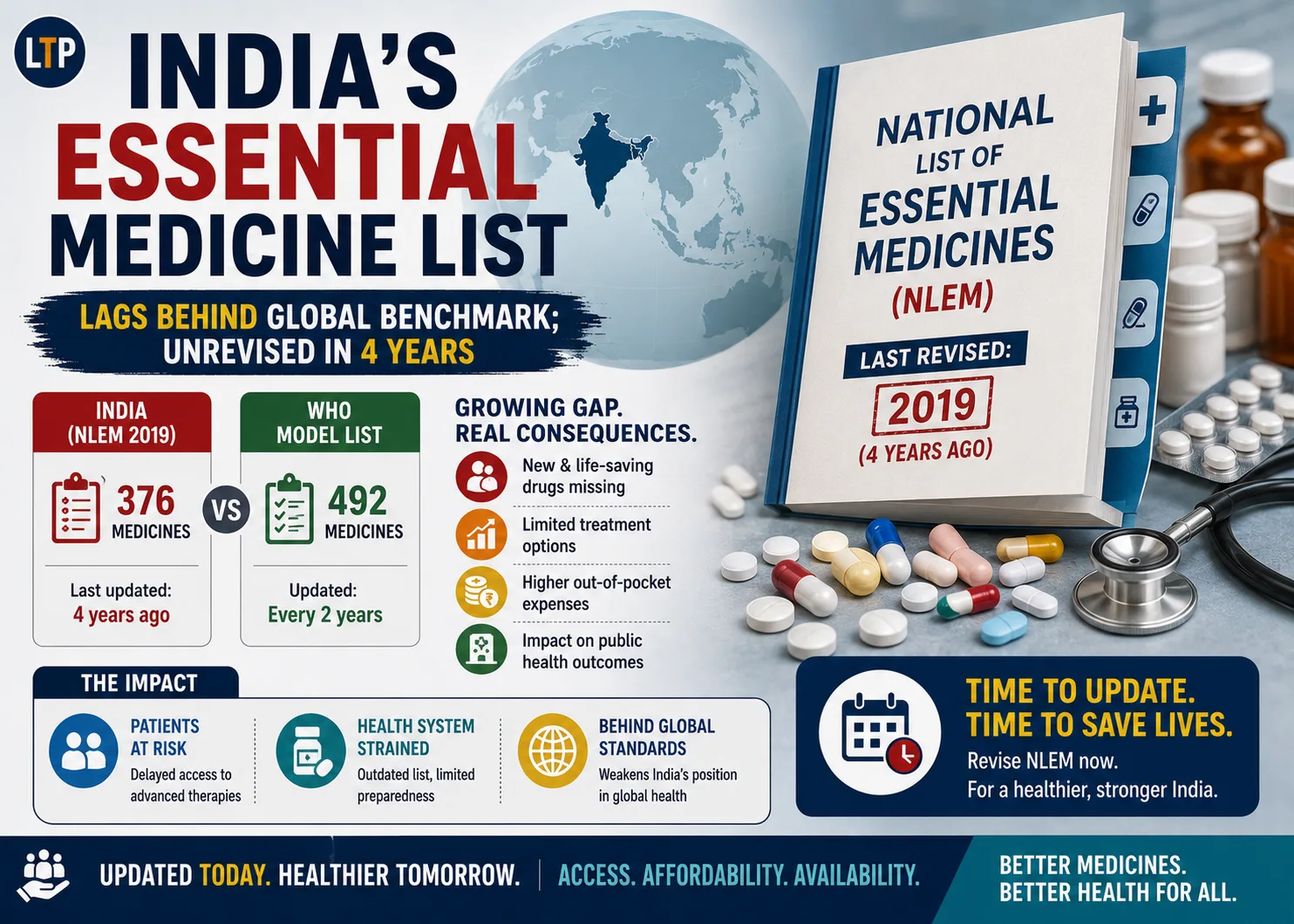
India’s essential medicine list lags behind global benchmark; unrevised in 4 years
New · District CollectorCan you hold the district for 72 hours?Floods, a heatwave, an outbreak, a grievance queue. Take the decisions, see the consequences.Play →In this note
Practice
10 questions on this article
Check the answer for each question, or reveal all at once.
1. At a Glance
- NLEM (National List of Essential Medicines) is India's curated list of essential drugs prioritised for public health need; it anchors price control via the NPPA. [4]
- India's list has not been revised since 2022, while WHO revised its global benchmark list twice (2023, 2025) in the same window — a live "governance lag" story with Prelims + Mains value. [3][6]
- Tests both static pharma-policy architecture (NLEM–DPCO–NPPA linkage) and current affairs (civil society advocacy, 2026). [3]
2. Why in the News
- The Working Group on Access to Medicines and Treatments, a civil society network, wrote to the Union government (letter dated Friday, per report) demanding urgent NLEM revision, noting India's list (384 medicines, last updated 2022) trails the WHO Model List (523 medicines, updated 2023 and 2025). [3]
3. Background & Evolution
- NLEM first formulated in 1996. [1]
- Revised in 2003, 2011, 2015, then 2022 — four revisions after the original list. [1]
- Standing National Committee on Medicines (SNCM) constituted by the Union Health Ministry in 2018 to review and revise NLEM 2015. [1]
- NLEM 2022 notified operational on 13.09.2022; launched by Union Health Minister Dr Mansukh Mandaviya. [1][2]
- WHO Model List of Essential Medicines: 23rd list (2023); 24th list (2025, updated September 2025), following the 25th WHO Expert Committee meeting (Geneva, 5-9 May 2025) which reviewed 59 applications. [5][6]
4. Core Static Facts
| Item | Detail |
|---|---|
| Full name | National List of Essential Medicines (NLEM) |
| Nodal ministry | Ministry of Health and Family Welfare (MoHFW) [3] |
| Current edition | NLEM 2022 (7th edition-equivalent), 384 medicines, 27 therapeutic categories [1] |
| Enforcement body | National Pharmaceutical Pricing Authority (NPPA) — fixes/revises ceiling prices of NLEM drugs [3] |
| Governing regulation | Drug Price Control Order (DPCO), under the Essential Commodities Act framework (price control mechanism for NLEM-listed drugs) |
| Advisory body | Standing National Committee on Medicines (SNCM), constituted 2018 [1] |
| Net financial impact (2022 revision) | ~17% average price reduction; ~₹3,788 crore estimated annual savings to patients [1] |
| WHO benchmark (current) | 24th WHO Model List of Essential Medicines (2025), 523 medicines [3][6] |
| Global review cycle | WHO EML revised biennially (2-year cycle) [6] |
5. Multi-Dimensional Analysis
- Economic: NLEM inclusion triggers price caps under DPCO, directly affecting pharma industry margins and patient out-of-pocket spending; 2022 revision alone saved patients an estimated ₹3,788 crore annually. [1]
- Social: Free dispensation of NLEM drugs at government hospitals is a key equity lever for low-income patients; an outdated list excludes newer essential therapies (e.g., for cancer, diabetes) now on WHO's list. [3][6]
- Governance/Administrative: A 4-year gap versus WHO's 2-year revision cycle (with 2 WHO updates in the interim) signals institutional delay — highlights coordination gaps between MoHFW, SNCM, and NPPA. [3]
- Legal/Regulatory: NLEM has no standalone statutory backing itself, but operationalises price control via DPCO — an administrative rather than legislative instrument, a common Prelims trap.
- Ethical/Access to healthcare: Civil society intervention (Working Group on Access to Medicines and Treatments) reflects right-to-health advocacy, tying into Article 21 discourse on access to affordable medicine.
- Scientific/Technological: Delay means newer evidence-based essential drugs (cancer, diabetes treatments added to WHO's 2025 list) remain outside India's price-controlled ambit. [6]
6. Recent Developments (last 12-18 months)
- May 2025: 25th WHO Expert Committee meets in Geneva; reviews 59 applications for EML inclusion. [5]
- September 2025: WHO publishes updated 24th EML and 10th EMLc, adding key cancer and diabetes treatments, taking the list to 523 medicines. [6]
- July 2026: Working Group on Access to Medicines and Treatments writes to the Indian government flagging that NLEM (384 medicines, last revised 2022) now lags the WHO benchmark by two revision cycles. [3]
7. Prelims Hooks
- NLEM first formulated in 1996. [1]
- NLEM has been revised in 2003, 2011, 2015, 2022 — five editions total. [1]
- Current NLEM (2022) contains 384 medicines across 27 therapeutic categories. [1]
- NLEM 2022 was notified operational on 13 September 2022. [1]
- NLEM 2022 added 34 drugs and dropped 26 drugs compared to NLEM 2015. [1]
- Standing National Committee on Medicines (SNCM) was set up in 2018 by MoHFW to revise NLEM. [1]
- Nodal ministry for NLEM: Ministry of Health and Family Welfare (not NITI Aayog or Dept. of Pharmaceuticals). [3]
- Price enforcement of NLEM drugs is done by the National Pharmaceutical Pricing Authority (NPPA), not the Ministry itself. [3]
- Average price reduction from NLEM 2022 revision: ~17%, saving patients an estimated ₹3,788 crore/year. [1]
- WHO's 23rd Model List of Essential Medicines was published in 2023. [6]
- WHO's 24th Model List was published in 2025 (updated September 2025), containing 523 medicines. [3][6]
- WHO revises its Model List of Essential Medicines on a biennial (2-year) cycle. [6]
- The 2026 demand for NLEM revision came from the Working Group on Access to Medicines and Treatments, a civil society network. [3]
- WHO's 2025 EML update added new cancer and diabetes treatments. [6]
8. Mains Relevance
- GS-II: Health — Government policies and interventions for development in health sectors; issues relating to development and management of Social Sector/Services relating to Health.
- GS-III: Indigenous pharmaceutical industry, drug pricing regulation, and Science & Technology governance.
- Plausible question stems:
- "The National List of Essential Medicines has not kept pace with global revisions. Examine the institutional and administrative reasons for this lag and its implications for healthcare affordability in India." (GS-II)
- "Discuss the mechanism through which the NLEM influences drug pricing in India. What reforms are needed to ensure timely revision of the list?" (GS-II/III)
- "Essential medicine lists are a tool for balancing public health needs with pharmaceutical market realities. Comment with reference to India and WHO frameworks." (GS-II)
9. Related Topics to Study Next
- Drug Price Control Order (DPCO), 2013 — the legal instrument that operationalises NLEM price caps.
- National Pharmaceutical Pricing Authority (NPPA) — enforcement body for medicine pricing.
- Pharma PLI Scheme / Bulk Drug Parks — India's push for API self-reliance, linked to essential medicine availability.
- Ayushman Bharat / PM-JAY — health financing scheme intersecting with affordable drug access.
- Jan Aushadhi Scheme (PMBJP) — generic medicine access programme, complementary to NLEM.
- Right to Health debates / Article 21 — constitutional angle on affordable healthcare access.
- WHO Essential Medicines Programme — global framework India benchmarks against.
- Compulsory licensing & Patents Act, 1970 (Section 84) — IP-health tension relevant to essential drug affordability.
10. Common Errors / Trap Areas
- Confusing NLEM (list of essential medicines) with NPPA (the pricing enforcement authority) — they are distinct bodies with distinct functions.
- Assuming NLEM revision happens on a fixed statutory timeline — it doesn't; revisions have been irregular (1996, 2003, 2011, 2015, 2022).
- Mixing up NLEM's nodal ministry (MoHFW) with the Department of Pharmaceuticals (Ministry of Chemicals and Fertilizers), which handles PLI schemes and Jan Aushadhi.
- Confusing WHO's EML (Essential Medicines List, adults) with EMLc (for children) — India's NLEM covers both in a single unified list.
- Assuming NLEM inclusion means "free for all" — it primarily triggers price ceilings; free dispensation is specifically at government hospitals.
Sources
- 1National List of Essential Medicines (NLEM), 2022 launch — PIB Press Releasepib.gov.in · tier 1
- 2NLEM 2022 price reduction/savings — PIB Press Releasepib.gov.in · tier 1
- 3"India's essential medicine list lags behind global benchmark; unrevised in 4 years" — The Hinduthehindu.com · tier 4
- 4MoHFW official notice on NLEM 2022mohfw.gov.in · tier 1
- 525th WHO Expert Committee on Selection and Use of Essential Medicines (May 2025)who.int · tier 2
- 6"WHO updates list of essential medicines to include key cancer, diabetes treatments" (Sept 2025)who.int · tier 2
At the end · practice MCQs
10 questions on this article
Check the answer for each question, or reveal all at once.