DAC approves capital acquisition proposals worth Rs 52,000 crore to enhance combat readiness of Defence Forces
New · District CollectorCan you hold the district for 72 hours?Floods, a heatwave, an outbreak, a grievance queue. Take the decisions, see the consequences.Play →In this note
Practice
12 questions on this item
Check the answer for each question, or reveal all at once.

1. At a Glance
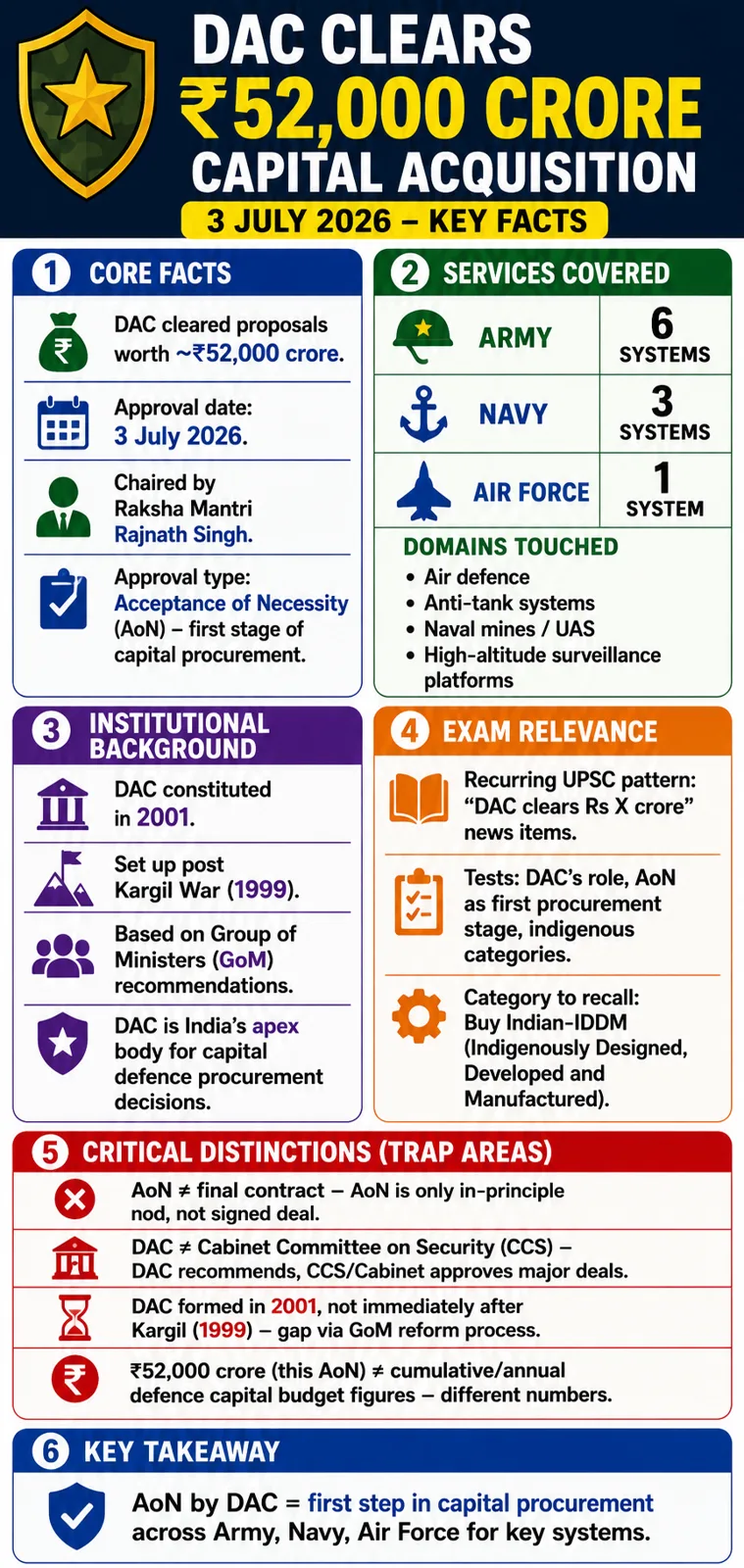
- Defence Acquisition Council (DAC), India's apex body for capital defence procurement, cleared proposals worth ~Rs 52,000 crore on July 3, 2026 [1].
- Covers Army, Navy, and Air Force modernization — air defence, anti-tank, naval mines/UAS, and high-altitude surveillance platforms [1].
- Tests aspirants on: DAC's institutional role, AoN as the first procurement stage, and current indigenous defence procurement categories (Buy Indian-IDDM etc.) [1][3].
- Fits the recurring UPSC pattern of "DAC clears Rs X crore" news — comparative numbers across years are a favourite prelims trap [2][3][4].
2. Why in the News
- On July 3, 2026, DAC under Raksha Mantri Rajnath Singh granted Acceptance of Necessity (AoN) — in-principle administrative approval — for capital acquisition proposals worth Rs 52,000 crore [1].
- Approvals span Army (6 systems), Navy (3 systems), and Air Force (1 system) [1].
3. Background & Evolution
- DAC was constituted in 2001 in the aftermath of the Kargil War (1999), based on the Group of Ministers (GoM) recommendations on defence management reforms, to streamline capital procurement decision-making. (General/institutional knowledge; not separately re-verified via a Tier-1 URL in this search — treat as background context only.)
- Procurement is governed currently by the Defence Acquisition Procedure (DAP) 2020, effective from 30 September 2020, which replaced the earlier Defence Procurement Procedure (DPP) [5].
- MoD has since initiated a comprehensive review of DAP 2020 to align it with wider national reforms [6].
- Recent comparable DAC clearances for context: Rs 54,000+ crore (Mar 2025) [2]; Rs 21,772 crore (2025) [3]; Rs 1,44,716 crore (Sept 2024) [4]; Rs 1.05 lakh crore under Buy (Indian-IDDM) category [7]; Rs 2.23 lakh crore (2021-cycle release) [8].
4. Core Static Facts
| Item | Detail |
|---|---|
| Body | Defence Acquisition Council (DAC) [1] |
| Chair | Raksha Mantri (Defence Minister) — currently Shri Rajnath Singh [1] |
| Approval stage | Acceptance of Necessity (AoN) — in-principle administrative approval, first stage of capital acquisition [1] |
| Governing framework | Defence Acquisition Procedure (DAP) 2020 [5] |
| Value approved (this round) | ~Rs 52,000 crore [1] |
| Date | July 3, 2026 [1] |
Approved systems (July 3, 2026 round) [1]:
- Army: AKASH TARANG (anti-UAV EW system), MPATGM (Man Portable Anti-Tank Guided Missile), MRSAM (Medium Range Surface-to-Air Missile), V-SHORADS (Very Short Range Air Defence System), Active Protection System for Tanks, Jet Based Kamikaze Drone System.
- Navy: Multi Influence Ground Mine (MIGM), Naval Shipborne Unmanned Aerial System (NSUAS), Land Based Testing Facility (LBTF) for electric propulsion.
- Air Force: Fixed-Wing Based High Altitude Pseudo Satellite (FW-HAPS).
5. Multi-Dimensional Analysis
Geopolitical / Strategic
- Anti-UAV (AKASH TARANG) and anti-tank (MPATGM) systems address evolving battlefield threats seen in Ukraine and West Asia conflicts — drone warfare and precision anti-armour weapons [1].
- Naval mine and unmanned aerial system approvals bolster maritime domain awareness amid Indian Ocean Region (IOR) competition [1].
Scientific / Technological
- FW-HAPS (High Altitude Pseudo Satellite) represents a shift toward persistent, satellite-like aerial surveillance without orbital launch costs [1].
- Land Based Testing Facility for electric propulsion signals a push toward next-gen naval propulsion technology [1].
Economic
- Rs 52,000 crore capital outlay feeds into the broader defence capital budget and domestic defence-industrial ecosystem, especially if procured under indigenous categories [1].
Administrative / Governance
- AoN is only the first of multiple procurement stages (AoN → RFP → trials → contract negotiation → CCS approval for high-value deals) — actual induction is years away [1][5].
- Procurement category (Buy Indian-IDDM, Buy & Make, etc.) for this specific round was not specified in the release, unlike some past rounds explicitly tagged "Buy (Indian-IDDM)" [1][7].
6. Recent Developments (last 12-18 months)
- March 20, 2025: DAC cleared capital acquisition proposals worth over Rs 54,000 crore [2].
- 2025: DAC approved 5 capital acquisition proposals worth Rs 21,772 crore [3].
- July 3, 2026: Current round — Rs 52,000 crore AoN for Army/Navy/Air Force systems [1].
- MoD undertaking a comprehensive review of DAP 2020 to modernize procurement procedures [6].
7. Prelims Hooks
- DAC is chaired by the Raksha Mantri (Defence Minister) [1].
- AoN (Acceptance of Necessity) is the first, in-principle stage of capital defence acquisition, not final contract approval [1].
- Current procurement framework: Defence Acquisition Procedure (DAP) 2020, effective 30 September 2020 [5].
- July 3, 2026 DAC round: Rs 52,000 crore approved [1].
- AKASH TARANG — Anti-UAV Electronic Warfare System (Army) [1].
- MPATGM — Man Portable Anti-Tank Guided Missile System [1].
- MRSAM — Medium Range Surface-to-Air Missile [1].
- V-SHORADS — Very Short Range Air Defence System [1].
- MIGM — Multi Influence Ground Mine (Navy) [1].
- NSUAS — Naval Shipborne Unmanned Aerial System [1].
- FW-HAPS — Fixed-Wing High Altitude Pseudo Satellite (Air Force) — persistent surveillance platform [1].
- Sept 2024 DAC round approved proposals worth Rs 1,44,716 crore — highest recent single-round figure among cited releases [4].
- DAP 2020 replaced the earlier Defence Procurement Procedure (DPP) [5].
8. Mains Relevance
- GS-III: Security — "Various security forces and agencies and their mandate," Science & Technology developments in indigenization of defence production.
- GS-II (peripherally): Governance aspects of institutional decision-making in defence procurement.
- Possible question stems: 1. "Discuss the role of the Defence Acquisition Council in India's capital defence procurement process. How does 'Acceptance of Necessity' differ from final contractual approval?" 2. "Examine how emerging technologies like anti-UAV systems, high-altitude pseudo satellites, and unmanned naval systems are reshaping India's defence modernization strategy." 3. "Critically analyze the Defence Acquisition Procedure (DAP) 2020 as a tool for promoting self-reliance (Aatmanirbharta) in defence manufacturing."
9. Related Topics to Study Next
- Defence Acquisition Procedure (DAP) 2020 — the procedural backbone governing all such DAC approvals [5].
- Aatmanirbhar Bharat in Defence / Positive Indigenisation Lists — links to "Buy Indian-IDDM" category seen in earlier DAC rounds [7].
- DRDO's role in indigenous weapon systems — relevant to systems like AKASH TARANG and MPATGM.
- Integrated Theatre Commands & higher defence management reforms — institutional context alongside DAC's own post-Kargil origin.
- India's Anti-Drone/Counter-UAS policy — directly connects to AKASH TARANG procurement.
- Maritime domain awareness & Indian Navy modernization — connects to MIGM, NSUAS, LBTF approvals.
- High Altitude Platform Systems (HAPS) globally — technological comparison point for FW-HAPS.
- Defence Budget & Capital Outlay trends (Union Budget) — fiscal context for these approvals.
10. Common Errors / Trap Areas
- Confusing AoN (Acceptance of Necessity) with final contract signing — AoN is only an in-principle nod, not procurement completion [1].
- Mixing up DAC approval values across different years/rounds (Rs 52,000 crore vs Rs 54,000 crore vs Rs 1,44,716 crore vs Rs 1.05 lakh crore) — these are frequently confused in MCQs [1][2][3][4][7].
- Assuming DAC approvals always specify a procurement category (e.g., Buy Indian-IDDM) — some rounds, including this one, do not explicitly state the category in the press release [1][7].
- Attributing DAC chairmanship to the Chief of Defence Staff (CDS) instead of the Raksha Mantri [1].
- Confusing DAP 2020 with its predecessor DPP (Defence Procurement Procedure) in terms of applicability dates [5].
Sources
- 1DAC approves capital acquisition proposals worth Rs 52,000 crore to enhance combat readiness of Defence Forcespib.gov.in · tier 1
- 2DAC clears capital acquisition proposals worth over Rs 54,000 crore to enhance defence capabilitiespib.gov.in · tier 1
- 3DAC approves 05 capital acquisition proposals worth Rs. 21,772 Crores to augment defence preparednesspib.gov.in · tier 1
- 4Press Release (DAC, ~Rs 1,44,716 crore round)pib.gov.in · tier 1
- 5Defence Acquisition Procedure (DAP) 2020mod.gov.in · tier 1
- 6MoD Initiates Comprehensive Review of Defence Acquisition Procedure 2020 to Align with National Reformspib.gov.in · tier 1
- 7DAC clears 10 capital acquisition proposals worth approx. Rs 1.05 lakh crore under Buy (Indian-IDDM) categorypib.gov.in · tier 1
- 8Defence Acquisition Council approves capital acquisition proposals worth Rs 2.23 lakh crore to enhance the operational capabilities of the Armed Forcespib.gov.in · tier 1
At the end · practice MCQs
12 questions on this item
Check the answer for each question, or reveal all at once.