India's High-Speed Rail Future:Building a Standardised Path for Expansion
New · District CollectorCan you hold the district for 72 hours?Floods, a heatwave, an outbreak, a grievance queue. Take the decisions, see the consequences.Play →In this note
1. At a Glance
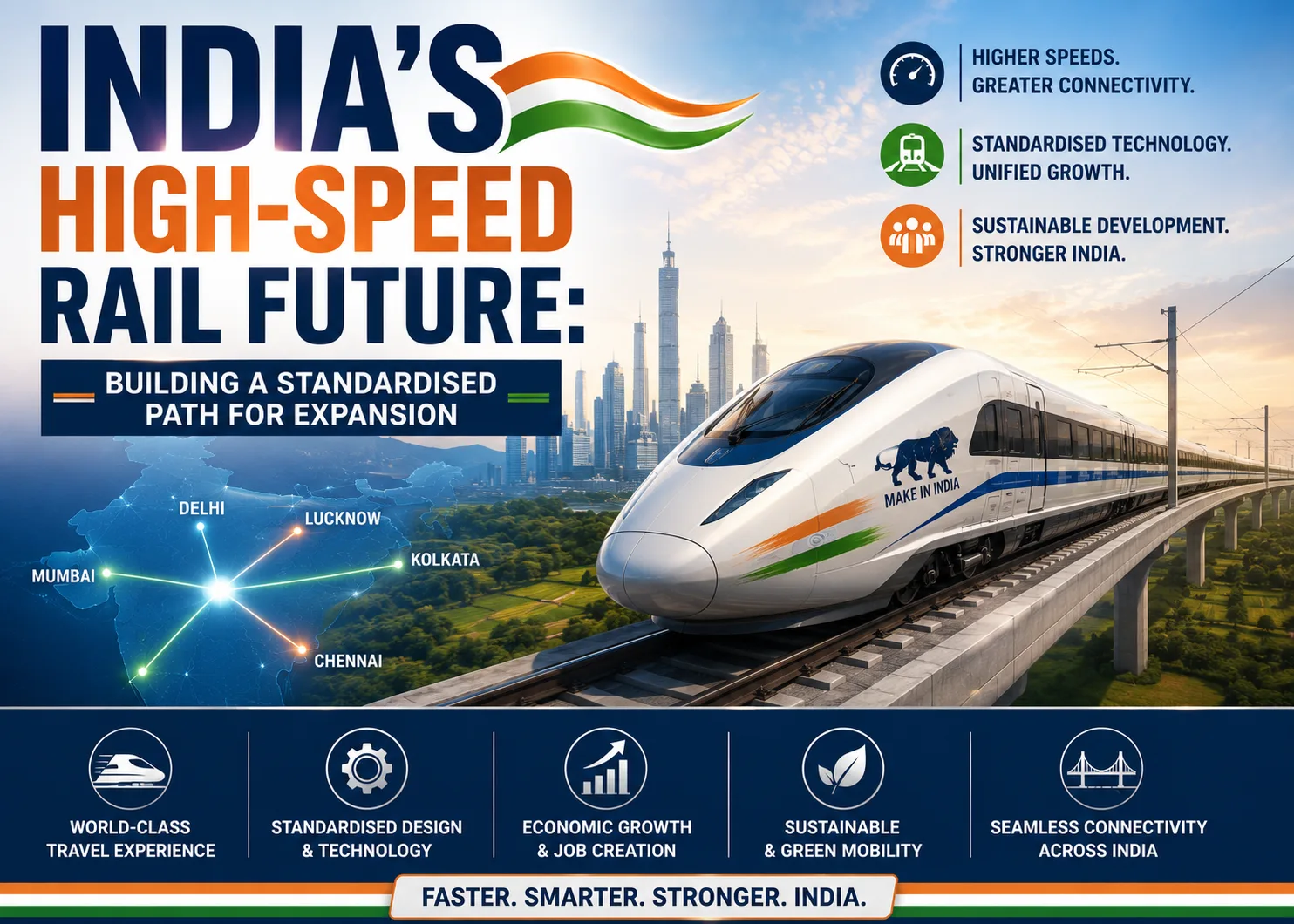
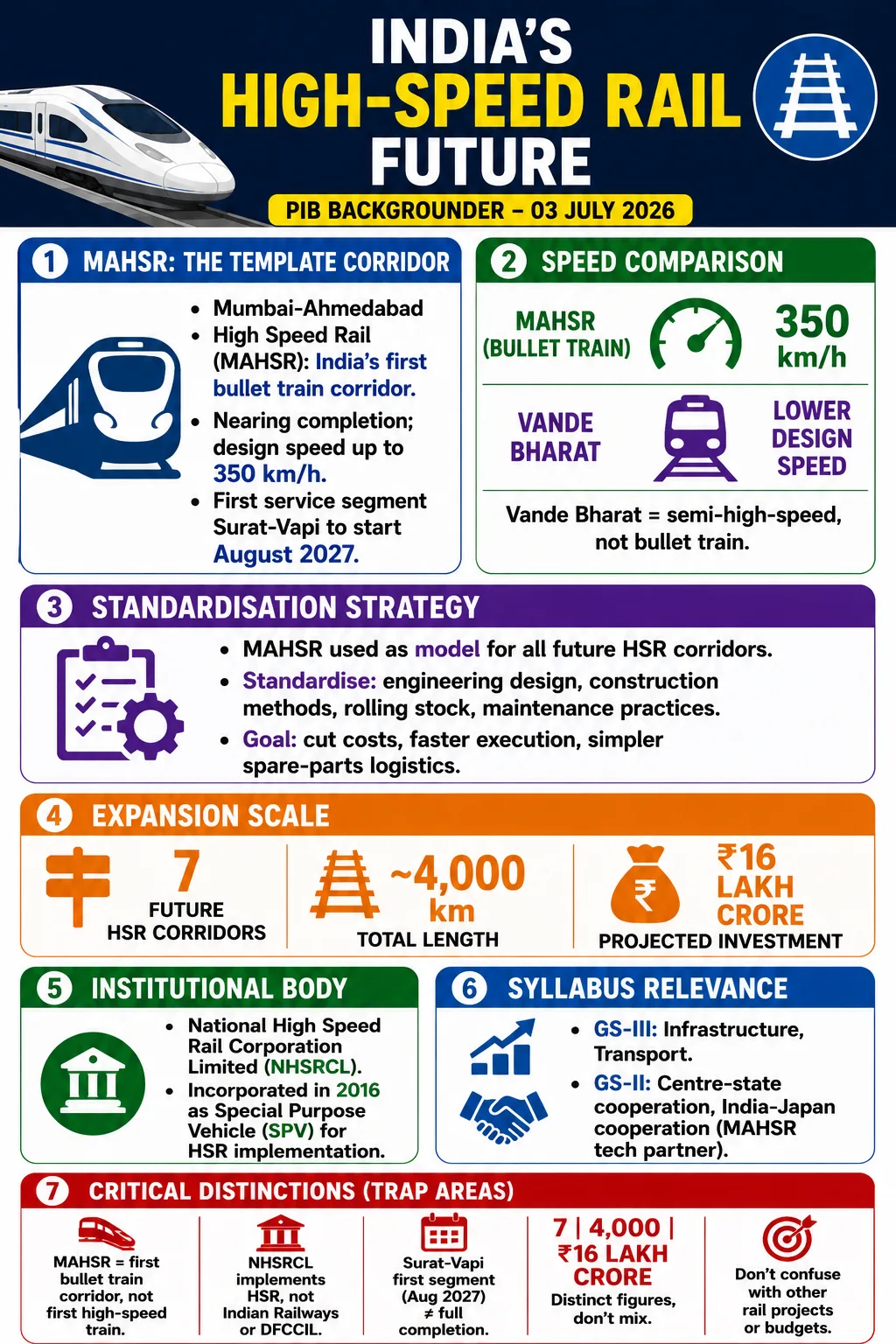
- India's first bullet train corridor, the Mumbai-Ahmedabad High Speed Rail (MAHSR), is nearing completion and is being used as a template/model for all future high-speed rail (HSR) corridors in India [1][2].
- The strategy: standardise engineering designs, construction methods, rolling stock, and operational/maintenance practices across future corridors to cut costs, speed up execution, and simplify spare-parts logistics [1].
- Seven future corridors (~4,000 km) are envisaged at a projected investment of ₹16 lakh crore, making this a high-value infrastructure and economic-geography topic for Prelims and Mains [2][3].
- Relevant to GS-III (infrastructure, transport) and GS-II (federal cooperation, India-Japan ties) — a live, dateable "in the news" topic for 2026.
2. Why in the News
- PIB Backgrounder dated 03 July 2026 titled "India's High-Speed Rail Future: Building a Standardised Path for Expansion," framing MAHSR's near-completion as the basis for a standardised national HSR template [1].
- MAHSR's first service segment (Surat–Vapi) is slated to commence in August 2027, making this the near-term trigger event [1].
3. Background & Evolution
- National High Speed Rail Corporation Limited (NHSRCL) was incorporated in 2016 as a Special Purpose Vehicle to implement HSR projects in India [2].
- MAHSR (508 km) launched with technical and financial assistance from the Government of Japan, using Shinkansen technology [1][2].
- Key milestones: full land acquisition of 1,389.5 Ha completed [2]; foundation works completed at 8 of 12 stations (Vapi, Bilimora, Surat, Bharuch, Anand, Vadodara, Ahmedabad, Sabarmati) [2]; PM Modi reviewed progress at Surat station site [2].
- Building on MAHSR's execution experience, the government has now identified seven additional corridors spanning ~4,000 km for future HSR expansion [2][3].
4. Core Static Facts
| Item | Detail |
|---|---|
| Flagship project | Mumbai–Ahmedabad High Speed Rail (MAHSR) [1] |
| Length | ~508 km, passing through Gujarat, Maharashtra, and Dadra & Nagar Haveli [1][2] |
| Design speed | 350 km/h; Operational speed: 320 km/h [1][2] |
| Comparator | Vande Bharat design speed: 180 km/h [1] |
| Stations | 12 — Mumbai, Thane, Virar, Boisar, Vapi, Bilimora, Surat, Bharuch, Vadodara, Anand, Ahmedabad, Sabarmati [2] |
| Travel time (Mumbai–Ahmedabad) | ~1 hr 58 min (vs 8–9 hrs road, 4–5 hrs air) [1][2] |
| Implementing agency | National High Speed Rail Corporation Limited (NHSRCL) [2][3] |
| Technology partner | Government of Japan (Shinkansen system) [1][2] |
| Track technology | J-Slab ballastless track — first use in India [1] |
| Traction system | 2×25 kV overhead electrification; 12 traction + 2 depot traction + 16 distribution substations; 20,000+ OHE masts [1] |
| Rolling stock depots | Sabarmati, Surat, Thane [1] |
| Indigenous manufacturing | ICF-BEML high-speed train sets (280 km/h); Aditya complex, Bengaluru, for coach development [1] |
| First service segment | Surat–Vapi, expected August 2027 [1][2] |
| Employment | ~4,000 direct + 35,000–40,000 indirect jobs [2] |
| Future corridors | 7 corridors, ~4,000 km total: Delhi–Varanasi; Varanasi–Patna–Siliguri; Chennai–Bengaluru; Bengaluru–Hyderabad; Chennai–Hyderabad; Mumbai–Pune; Pune–Hyderabad [3] |
| Future corridor speed standard | 250+ km/h operating speed [3] |
| Projected investment (future corridors) | ~₹16 lakh crore [2][3] |
5. Multi-Dimensional Analysis
Economic
- ₹16 lakh crore projected investment signals a massive capital-goods and construction-sector stimulus; standardisation is explicitly aimed at reducing per-corridor cost and execution time via economies of scale in components/spares [1][3].
- Direct/indirect job creation (~40,000 for MAHSR alone) demonstrates HSR's employment multiplier in construction, manufacturing, and operations [2].
Geopolitical/Strategic
- MAHSR is a flagship India-Japan strategic and technological partnership project, using Japanese Shinkansen technology and financing — a marker of bilateral infrastructure diplomacy [1][2].
Scientific/Technological
- Introduction of J-Slab ballastless track technology for the first time in India signals technology transfer and localisation efforts [1].
- Indigenous manufacturing push via ICF-BEML (280 km/h train sets) and the Aditya coach-development complex indicates a "Make in India" trajectory in rail rolling stock [1].
Administrative
- The "standardised template" approach — replicating MAHSR's designs, construction methods, and maintenance practices — is meant to overcome the fragmented, corridor-specific execution bottlenecks typically seen in Indian infrastructure projects [1].
- NHSRCL functions as a single implementing SPV across multiple state jurisdictions (Gujarat, Maharashtra, UT of Dadra & Nagar Haveli for MAHSR), a model likely to extend to future multi-state corridors [2].
Social
- Drastic travel-time cuts (e.g., Mumbai–Pune in 48 minutes, Chennai–Bengaluru in 1 hr 13 min) could reshape inter-city commuting and regional economic integration once the seven corridors materialise [3].
6. Recent Developments (last 12-18 months)
- PIB Backgrounder "India's High-Speed Rail Future: Building a Standardised Path for Expansion" published 03 July 2026, formalising the standardisation strategy [1].
- PIB press note "Redefining Inter-City Mobility: High-Speed Rail Corridors in India" (2026) detailing the seven future corridors and ₹16 lakh crore investment estimate [3].
- Continued progress on MAHSR: full land acquisition completed; foundation work finished at 8 of 12 stations; PM Modi's site visit to Surat bullet-train station reviewing project progress [2].
- MAHSR project positioned as "laying a strong foundation for India's future high-speed rail network," per dedicated PIB press release [1][2].
7. Prelims Hooks
- MAHSR corridor length: 508 km, connecting Mumbai and Ahmedabad via Gujarat, Maharashtra, and Dadra & Nagar Haveli [1][2].
- MAHSR design speed: 350 km/h; operational speed: 320 km/h — compare to Vande Bharat's design speed of 180 km/h [1].
- MAHSR uses Shinkansen technology with technical/financial assistance from Japan [1][2].
- Implementing agency for all HSR projects in India: National High Speed Rail Corporation Limited (NHSRCL) [2][3].
- MAHSR has 12 stations; foundation work completed at 8 as of the latest update [2].
- First HSR service segment (Surat–Vapi) expected to commence August 2027 [1][2].
- MAHSR track technology: J-Slab ballastless track, first introduction in India [1].
- Total land acquired for MAHSR: 1,389.5 hectares [2].
- Seven future HSR corridors span approximately 4,000 km at a projected cost of ₹16 lakh crore [3].
- Fastest projected future-corridor travel time: Mumbai–Pune in 48 minutes [3].
- Future corridors identified: Delhi–Varanasi, Varanasi–Patna–Siliguri, Chennai–Bengaluru, Bengaluru–Hyderabad, Chennai–Hyderabad, Mumbai–Pune, Pune–Hyderabad [3].
- Future HSR corridors target operating speeds of 250+ km/h [3].
- Indigenous high-speed train sets (ICF-BEML) designed for 280 km/h [1].
- MAHSR expected to generate ~4,000 direct and 35,000–40,000 indirect jobs [2].
- Rolling stock depots for MAHSR: Sabarmati, Surat, and Thane [1].
8. Mains Relevance
- GS-III: Infrastructure — Energy, Ports, Roads, Airports, Railways etc.
- GS-II (secondary): Bilateral relations — India-Japan cooperation in infrastructure/technology transfer.
- Possible Mains question stems: 1. "High-speed rail is often criticised as capital-intensive and elitist. Critically examine whether standardisation of HSR corridors, as attempted post-MAHSR, can make such projects more cost-effective and equitable in India." (GS-III) 2. "Discuss how technology transfer partnerships, such as India's collaboration with Japan on the Mumbai-Ahmedabad High Speed Rail, can be leveraged for building indigenous manufacturing capacity in strategic sectors." (GS-II/III) 3. "Examine the administrative and federal challenges in executing multi-state high-speed rail corridors in India, drawing lessons from the MAHSR project." (GS-II/III)
9. Related Topics to Study Next
- Vande Bharat Express / semi-high-speed rail — contrast in speed, technology, and cost with true HSR [1].
- India-Japan bilateral relations — ODA loans, technology partnerships beyond rail (e.g., defence, connectivity).
- Dedicated Freight Corridors (DFC) — another major rail infrastructure standardisation/PPP case study.
- National Rail Plan 2030 — broader railway modernisation vision within which HSR sits.
- Make in India in Railways — indigenous manufacturing of rolling stock (Vande Bharat, Vande Metro, ICF-BEML sets).
- Land acquisition issues in infrastructure projects — RFCTLARR Act, 2013, relevant to MAHSR's land acquisition process.
- Sagarmala and Bharatmala — comparative national standardised-infrastructure programmes for ports/roads.
10. Common Errors / Trap Areas
- Confusing MAHSR's design speed (350 km/h) with its operational speed (320 km/h) — commonly conflated in MCQs [1][2].
- Assuming Vande Bharat is a "bullet train" — it is semi-high-speed (180 km/h design speed), distinct from true HSR corridors like MAHSR [1].
- Misattributing the implementing agency — it is NHSRCL, not Indian Railways or the Railway Board directly [2][3].
- Miscounting the number of future corridors (seven) or their aggregate length (~4,000 km, not to be confused with MAHSR's own 508 km) [3].
- Overlooking that MAHSR passes through a Union Territory (Dadra & Nagar Haveli) in addition to two states, relevant for federal/administrative-dimension questions [2].
Sources
- 1India's High-Speed Rail Future: Building a Standardised Path for Expansionpib.gov.in · tier 1
- 2Mumbai–Ahmedabad High-Speed Rail: Advancing India's Rail Modernisationpib.gov.in · tier 1
- 3Redefining Inter-City Mobility: High-Speed Rail Corridors in Indiapib.gov.in · tier 1