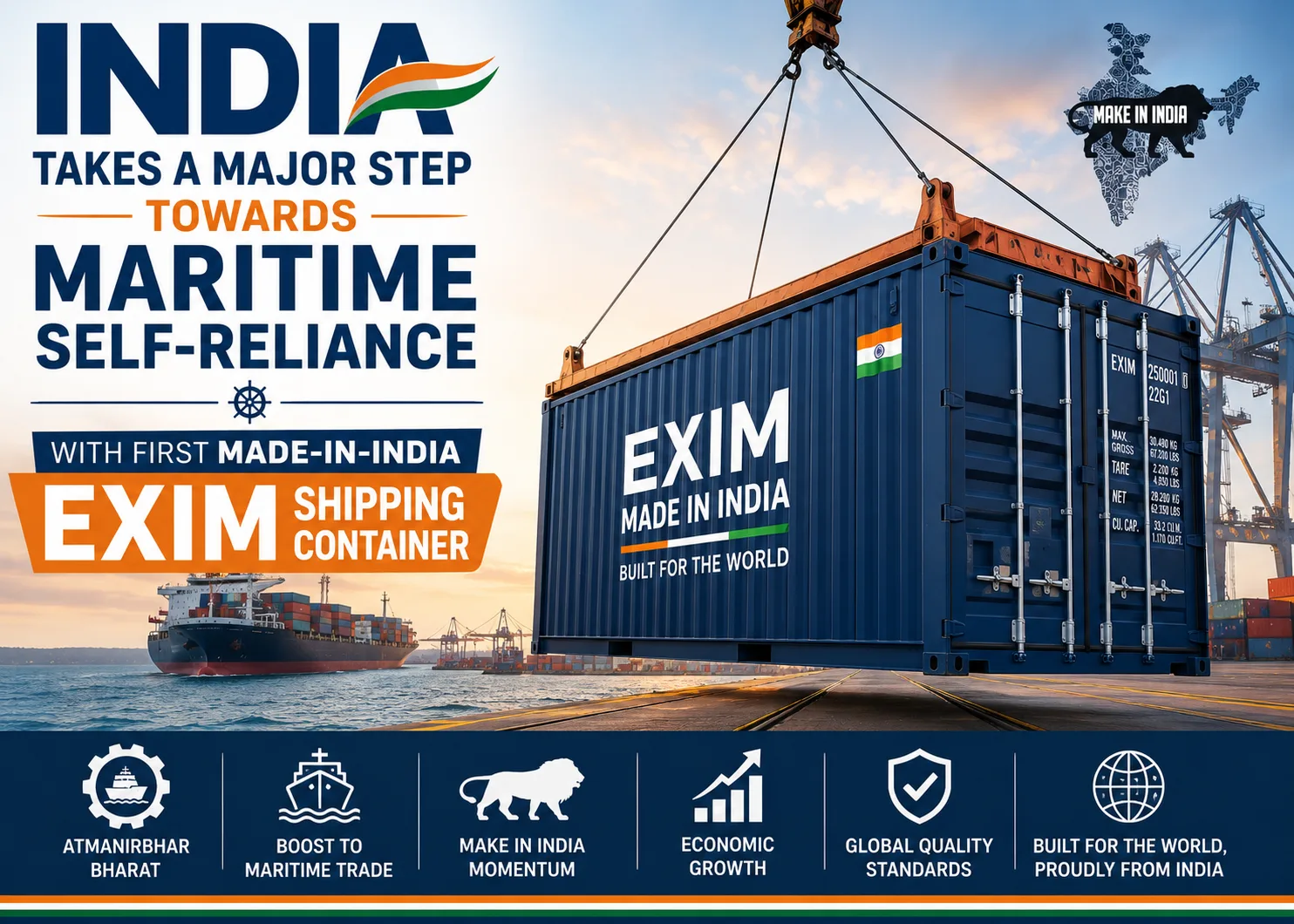
India Takes a Major Step Towards Maritime Self-Reliance with First Made-in-India EXIM Shipping Container: Sarbananda Sonowal
New · District CollectorCan you hold the district for 72 hours?Floods, a heatwave, an outbreak, a grievance queue. Take the decisions, see the consequences.Play →In this note
Practice
11 questions on this item
Check the answer for each question, or reveal all at once.
1. At a Glance
- India unveiled its first indigenously manufactured EXIM (export-import) shipping container for global shipping major A.P. Moller–Maersk, marking a milestone in maritime manufacturing self-reliance under Atmanirbhar Bharat [1].
- Maersk simultaneously placed an order for 1,000 additional Made-in-India containers, signalling confidence in India's domestic container ecosystem [1].
- Relevant for Prelims (scheme names, ministry, numbers) and Mains GS-III (manufacturing, logistics, port infrastructure).
2. Why in the News
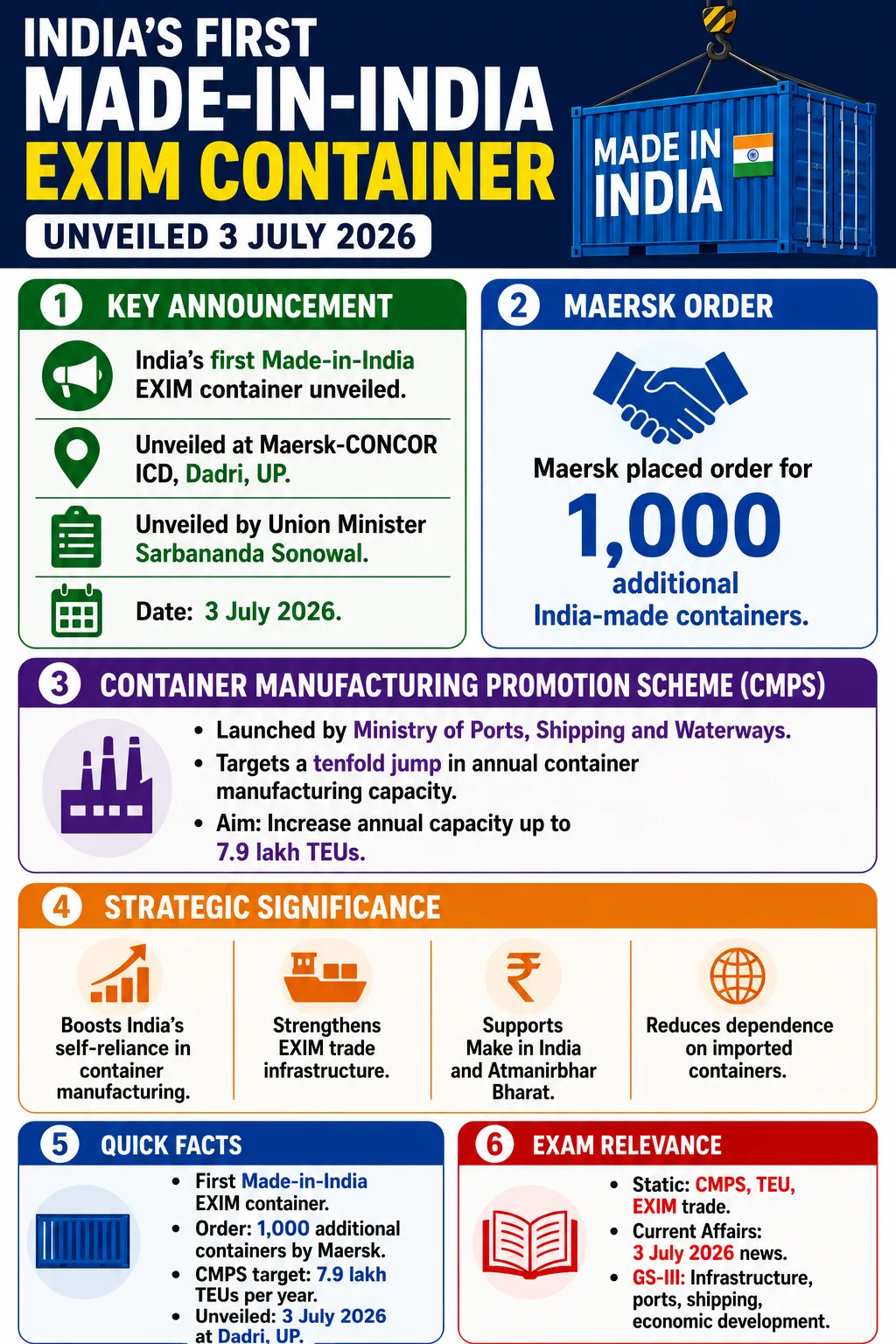
- On July 3, 2026, Union Minister of Ports, Shipping and Waterways Sarbananda Sonowal unveiled the first India-made EXIM container at the Maersk-CONCOR Inland Container Depot, Dadri, Uttar Pradesh [1].
- Maersk placed a fresh order for 1,000 additional India-manufactured containers at the same event [1].
- The event also flagged the Container Manufacturing Promotion Scheme (CMPS) target of a tenfold jump in annual container manufacturing capacity, up to 7.9 lakh TEUs (per PIB release headline) [1].
3. Background & Evolution
- February 2025: PM Modi's interaction with Robert Maersk Uggla (Maersk leadership) is cited as the catalyst encouraging container manufacturing investment in India [1].
- Union Budget 2026-27: Announced the Container Manufacturing Assistance Scheme (CMAS), outlay ₹10,000 crore over five years, targeting annual domestic manufacturing capacity of roughly one million TEUs within a decade [2].
- Bharat Container Shipping Line (BCSL): An MoU was signed to establish BCSL, aligned with CMAS, aimed at anchoring India's container trade in Indian hands [2].
- July 3, 2026: First Made-in-India EXIM container physically rolled out and handed over to Maersk, ~16 months after the PM-Maersk interaction [1].
- Predecessor initiative: Earlier PIB releases had flagged "Container Production under Make in India to be facilitated for cargo transportation" as a precursor policy push [1].
4. Core Static Facts
| Item | Detail |
|---|---|
| Nodal Ministry | Ministry of Ports, Shipping and Waterways (MoPSW) [1] |
| Minister | Sarbananda Sonowal [1] |
| Manufacturing partner | DCM Shriram Group [1] |
| Depot operator/venue | CONCOR (Container Corporation of India), Inland Container Depot, Dadri, Uttar Pradesh [1] |
| Shipping line involved | A.P. Moller–Maersk [1] |
| Related domestic shipping line | Bharat Container Shipping Line (BCSL) [2] |
| Governing scheme (Budget) | Container Manufacturing Assistance Scheme (CMAS), Union Budget 2026-27, outlay ₹10,000 crore/5 years [2] |
| Scheme referenced in this event | Container Manufacturing Promotion Scheme (CMPS) — targets tenfold jump in annual capacity to 7.9 lakh TEUs [1] |
| Long-term capacity target | ~1 million TEUs annual domestic manufacturing capacity within a decade [2] |
| Maersk fresh order | 1,000 additional India-made containers [1] |
| Import dependence being addressed | India currently imports nearly 2 million empty containers annually [2] |
| Employment projection | ~3,000 direct jobs, 50,000+ indirect jobs [2] |
| Market value projection | ~₹1.07 lakh crore [2] |
| Related capital support | Shipbuilding Financial Assistance Package, ₹70,000 crore [1] |
| Quality standard | ISO specifications + International Convention for Safe Containers (CSC) [1] |
| Global benchmark cited | 3 Indian ports ranked in global top 30, Container Port Performance Index 2025 [1] |
5. Multi-Dimensional Analysis
Economic
- Reduces import dependence on foreign (largely Chinese-dominated) container manufacturing, saving forex outflow on ~2 million imported containers/year [2].
- Projected ₹1.07 lakh crore market value and ancillary industry growth (corner castings, wooden frames, specialised steel, water-based paints) [2].
Strategic/Geopolitical
- Reduces India's exposure to global supply-chain shocks (e.g., pandemic-era container shortages) by localising a critical logistics input [2].
- Aligns with "China+1" diversification trend, positioning India as an alternate container manufacturing hub for global shipping lines like Maersk [1].
Administrative/Governance
- Multiple overlapping scheme names in circulation (CMPS vs CMAS) suggest evolving nomenclature — aspirants should track the latest official terminology [1][2].
- Involves coordination between MoPSW, CONCOR (under Ministry of Railways historically, now logistics-linked), and private industry (DCM Shriram) [1].
Scientific/Technological
- Containers must meet international ISO and CSC (Convention for Safe Containers) standards for global interoperability [1].
Employment/Social
- Direct and indirect job creation (3,000 direct; 50,000+ indirect) in manufacturing and ancillary sectors [2].
6. Recent Developments (last 12-18 months)
- Union Budget 2026-27: Announcement of CMAS with ₹10,000 crore outlay [2].
- MoU signed for establishment of Bharat Container Shipping Line (BCSL) [2].
- February 2025: PM Modi's engagement with Maersk leadership catalysing investment [1].
- July 3, 2026: Unveiling of first Made-in-India EXIM container at Dadri, UP; Maersk's 1,000-unit order [1].
7. Prelims Hooks
- First Made-in-India EXIM shipping container unveiled on July 3, 2026 [1].
- Unveiled by Sarbananda Sonowal, Union Minister of Ports, Shipping and Waterways [1].
- Venue: Maersk-CONCOR Inland Container Depot, Dadri (Uttar Pradesh) [1].
- Manufacturing partner: DCM Shriram Group [1].
- Maersk ordered 1,000 additional India-made containers [1].
- CMPS (Container Manufacturing Promotion Scheme) targets a tenfold jump in annual container manufacturing capacity, up to 7.9 lakh TEUs [1].
- CMAS (Container Manufacturing Assistance Scheme) announced in Union Budget 2026-27, outlay ₹10,000 crore over 5 years [2].
- Long-term target: ~1 million TEUs annual domestic capacity within a decade [2].
- India currently imports nearly 2 million empty containers annually [2].
- Projected market value from the scheme: ~₹1.07 lakh crore [2].
- Job creation estimate: ~3,000 direct + 50,000+ indirect jobs [2].
- New domestic shipping line proposed: Bharat Container Shipping Line (BCSL) [2].
- Related capital scheme: Shipbuilding Financial Assistance Package worth ₹70,000 crore [1].
- Containers must comply with ISO specifications and the International Convention for Safe Containers (CSC) [1].
- 3 Indian ports featured in the global top 30 of the Container Port Performance Index 2025 [1].
8. Mains Relevance
- GS-III: Infrastructure — Ports, Shipping; Indigenisation of technology; Effects of liberalisation on the economy; Employment generation.
- GS-II (secondary): Government policies and interventions for development in various sectors.
- Possible question stems: 1. "Discuss the significance of domestic container manufacturing for India's maritime and trade self-reliance. Examine the role of schemes like CMAS/CMPS in reducing import dependence." (GS-III) 2. "India's container shortage during global supply-chain disruptions exposed vulnerabilities in logistics infrastructure. Critically evaluate government measures to address this." (GS-III) 3. "Examine how public-private partnerships (e.g., Maersk-CONCOR-DCM Shriram) can accelerate India's manufacturing self-reliance goals." (GS-II/III)
9. Related Topics to Study Next
- Sagarmala Programme — broader port-led development initiative under the same ministry.
- Atmanirbhar Bharat Abhiyan — overarching self-reliance policy umbrella.
- Make in India — manufacturing policy framework container scheme is nested under.
- Shipbuilding Financial Assistance Policy — ₹70,000 crore package, complementary to container manufacturing push.
- CONCOR (Container Corporation of India) — PSU role in inland container logistics.
- Major Port Authorities Act, 2021 — legal/administrative framework for Indian ports.
- Great Nicobar International Container Transhipment Port (ICTP) — related strategic port infrastructure project.
- Union Budget 2026-27 maritime sector announcements — fiscal context for CMAS.
10. Common Errors / Trap Areas
- Confusing CMPS (Container Manufacturing Promotion Scheme) with CMAS (Container Manufacturing Assistance Scheme) — both relate to container manufacturing but appear as distinct/evolving nomenclature in PIB releases; verify current official name before answering.
- Assuming CONCOR falls under the Ministry of Ports, Shipping and Waterways — it is historically linked to Indian Railways' logistics arm, though this event was hosted at a CONCOR depot.
- Mixing up the ₹10,000 crore CMAS outlay with the ₹70,000 crore Shipbuilding Financial Assistance Package — these are separate schemes with separate budgets.
- Misattributing the "first Made-in-India EXIM container" milestone to a shipbuilding achievement rather than container (box) manufacturing — ships and containers are distinct components of maritime infrastructure.
- Assuming Maersk is an Indian company — it is a Danish (A.P. Moller–Maersk) global shipping major.
Sources
At the end · practice MCQs
11 questions on this item
Check the answer for each question, or reveal all at once.