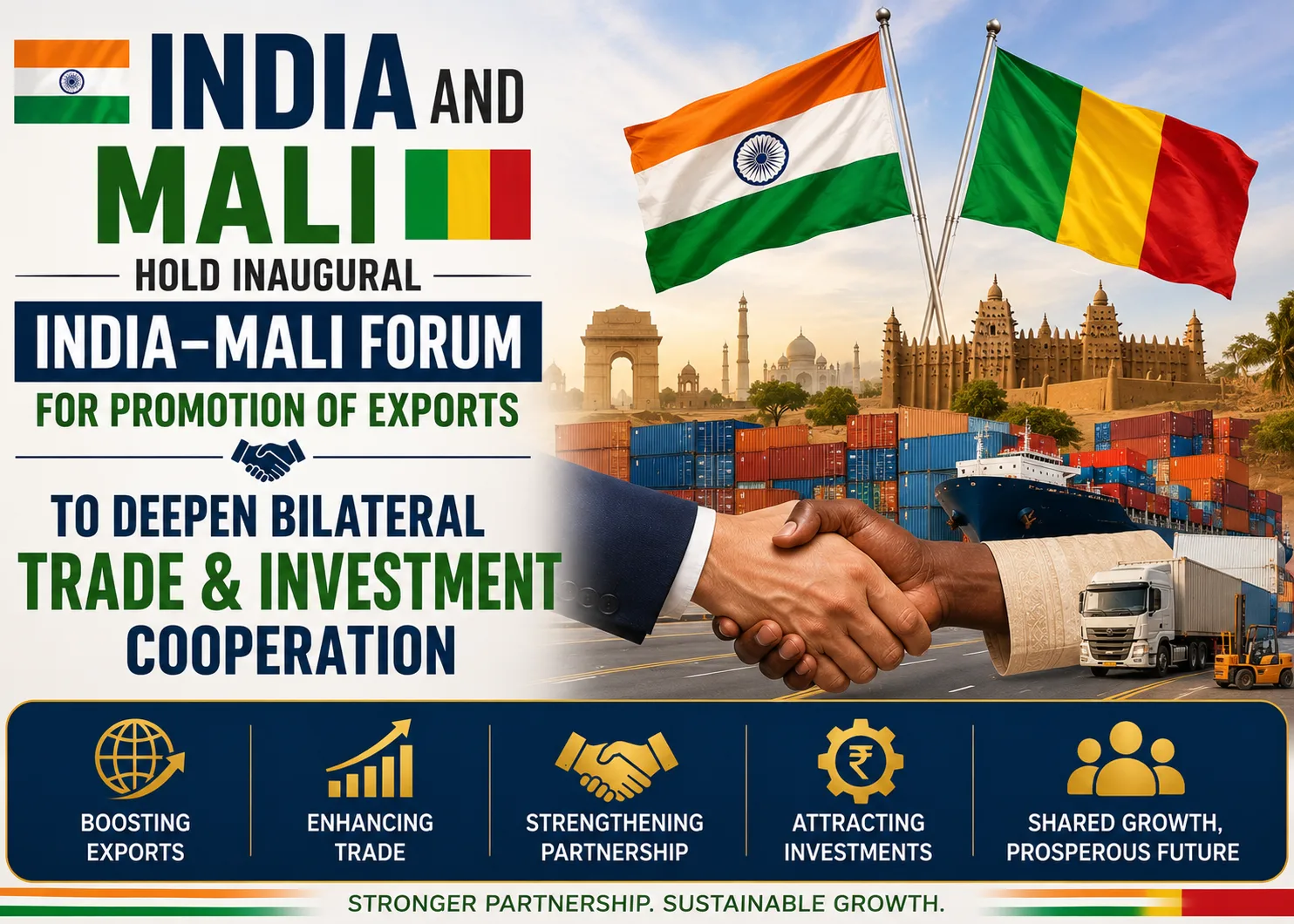
India and Mali Hold Inaugural India–Mali Forum for Promotion of Exports to Deepen Bilateral Trade and Investment Cooperation
New · District CollectorCan you hold the district for 72 hours?Floods, a heatwave, an outbreak, a grievance queue. Take the decisions, see the consequences.Play →In this note
1. At a Glance
- India–Mali Forum for Promotion of Exports, the first-ever such bilateral forum, was held to institutionalise and deepen trade/investment ties between India and a landlocked West African state. [1]
- Reflects India's broader Africa outreach strategy — using sector-focused, ministry-to-ministry forums to unlock trade beyond traditional partners. [1]
- Relevant for Prelims (facts/figures) and Mains GS-II (India–Africa relations) and GS-III (external trade). [1]
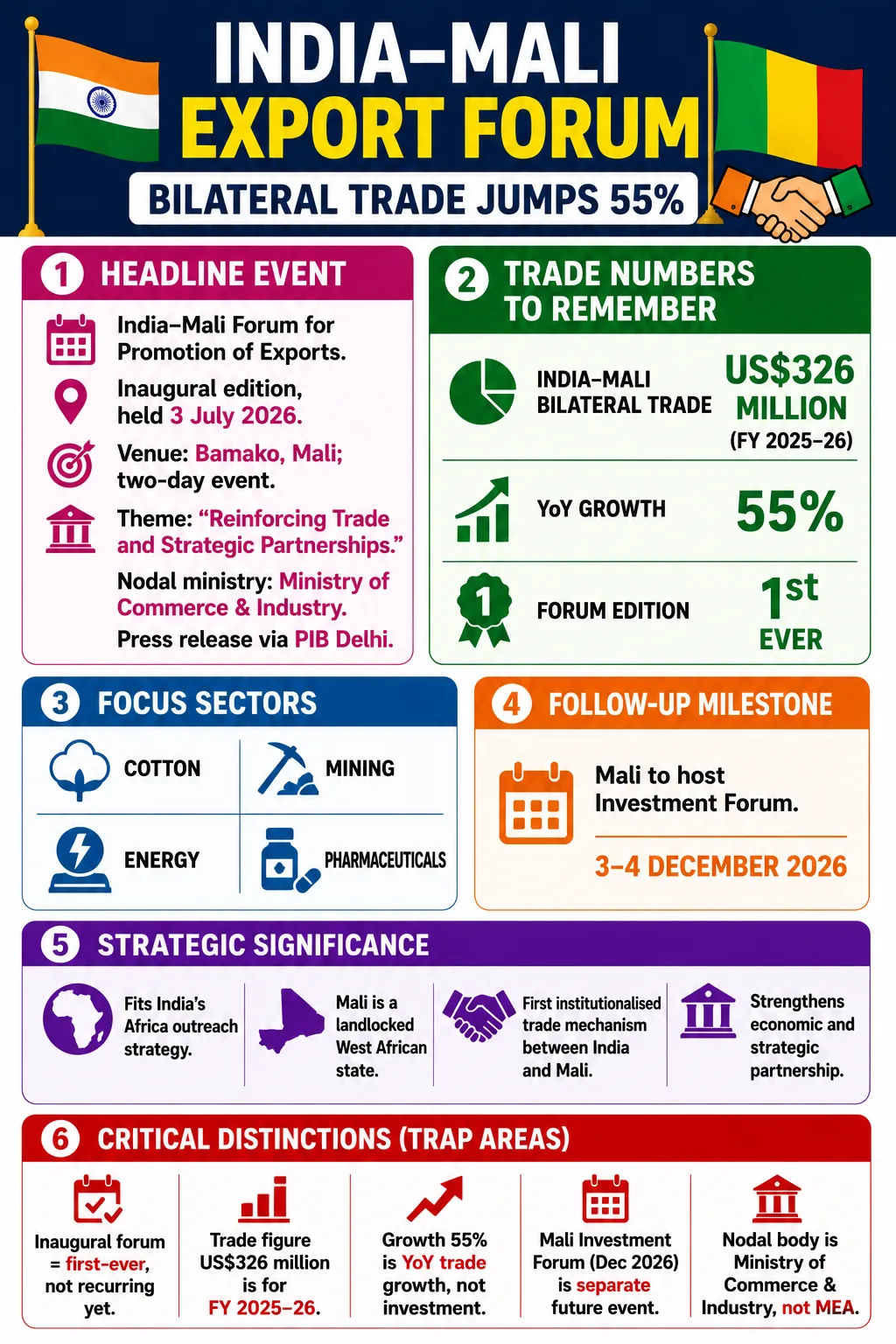
- Bilateral trade crossed US$326 million in FY 2025–26, growing 55% YoY — a strong current-affairs statistic. [1]
2. Why in the News
- India and Mali held the inaugural India–Mali Forum for the Promotion of Exports in Bamako, Mali, a two-day event under the theme "Reinforcing Trade and Strategic Partnerships". [1]
- Press release dated 3 July 2026 (PIB Delhi), under the Ministry of Commerce & Industry. [1]
- Mali announced it will host an Investment Forum in December 2026 (3–4 December 2026). [1]
3. Background & Evolution
- India–Mali diplomatic relations are long-standing under MEA's Africa engagement framework, but formal export-promotion institutional mechanisms were historically thin. [1]
- This Forum is described as the first institutionalised trade mechanism between the two countries, following India's pattern of setting up similar bilateral trade/export forums with African nations. [1]
- Presided over on the Mali side by the Prime Minister of the Transition Government, H.E. Major General Abdoulaye Maïga. [1]
4. Core Static Facts
| Item | Detail |
|---|---|
| Forum name | India–Mali Forum for the Promotion of Exports (inaugural edition) [1] |
| Venue | Bamako, Mali [1] |
| Duration | Two-day forum [1] |
| Theme | "Reinforcing Trade and Strategic Partnerships" [1] |
| Nodal Indian ministry | Ministry of Commerce & Industry [1] |
| Indian delegation lead | Shri Amit Kumar, Joint Secretary (FT-Africa) [1] |
| Indian Ambassador to Mali | Dr. N. Nandakumar [1] |
| Mali counterpart ministry | Ministry of Industry and Trade, Mali [1] |
| Mali Trade Minister | Mr. Moussa Alassane Diallo [1] |
| Mali export body | Malian Agency for the Promotion of Exports (APEX-Mali) [1] |
| Bilateral trade (FY 2025–26) | US$326.61 million [1] |
| YoY growth | 55% [1] |
| Mali's total global exports | ~US$4 billion [1] |
| Untapped market potential for India | ~US$3.96 billion [1] |
| Upcoming Mali Investment Forum | 3–4 December 2026 [1] |
5. Multi-Dimensional Analysis
Economic
- Trade growth of 55% signals a low-base but rapidly expanding relationship; sectors identified (cotton, mining, energy, pharma) match India's comparative export/import strengths. [1]
- Mali's exports to India (raw cotton, leather, cashew, lead, gum arabic, sesame) are largely raw/primary goods, while India exports value-added goods (pharma, cotton fabrics, vehicles) — a classic North–South-style complementary trade pattern despite both being developing economies. [1]
Geopolitical/Strategic
- Part of India's wider Africa policy of deepening ties with West African, Sahel-region states amid competition from China, Russia, and Gulf states for African markets/resources. [1]
- Mali is under a Transition Government (military-led since 2020-21 coups), so India engaging it reflects pragmatic, non-interference-based diplomacy. [1]
Administrative
- Institutional architecture: Embassy of India (Bamako) + Ministry of Commerce & Industry (India) + APEX-Mali + Mali's Ministry of Industry and Trade — a multi-agency coordination model typical of India's export promotion diplomacy. [1]
Social
- Focus sectors include social infrastructure (health, education), indicating trade cooperation extended into developmental/humanitarian dimensions, not just commodities. [1]
6. Recent Developments (last 12–18 months)
- 3 July 2026: PIB announces the inaugural India–Mali Forum outcomes and trade statistics. [1]
- Forum held in Bamako under theme "Reinforcing Trade and Strategic Partnerships" (2026). [1]
- Mali announces a follow-up Investment Forum for 3–4 December 2026. [1]
7. Prelims Hooks
- The inaugural India–Mali Forum for the Promotion of Exports was held in Bamako, Mali. [1]
- Forum theme: "Reinforcing Trade and Strategic Partnerships." [1]
- India–Mali bilateral trade surpassed US$326 million in FY 2025–26. [1]
- Trade growth recorded: 55% year-on-year. [1]
- Nodal Indian ministry: Ministry of Commerce & Industry (not MEA). [1]
- Mali's PM (Transition Government): H.E. Major General Abdoulaye Maïga. [1]
- Mali's Trade Minister: Moussa Alassane Diallo. [1]
- India's Ambassador to Mali: Dr. N. Nandakumar. [1]
- Mali's export promotion agency: APEX-Mali (Malian Agency for the Promotion of Exports). [1]
- Priority sectors for cooperation: cotton/textiles, mining, energy, agro-industry (shea processing), pharmaceuticals, social infrastructure. [1]
- Mali's key exports to India: raw cotton, finished leather, cashew, lead, gum arabic, sesame. [1]
- India's key exports to Mali: pharmaceuticals, cotton fabrics, two/three-wheelers, bicycles. [1]
- Mali is a landlocked West African / Sahel-region country (background knowledge, not in press release).
- Mali to host an Investment Forum in December 2026 (3–4 December). [1]
- Untapped Indian market opportunity in Mali estimated at ~US$3.96 billion, against Mali's total global exports of ~US$4 billion. [1]
8. Mains Relevance
- GS-II: International Relations — India's bilateral relations with African/West African nations, India–Africa engagement strategy. [1]
- GS-III: Indian Economy — external trade, export promotion mechanisms, trade diversification with Africa. [1]
- Possible question stems:
- "Discuss the significance of India's growing trade engagement with West African nations, with reference to the recent India–Mali Forum for Promotion of Exports." (GS-II)
- "Examine the complementarities and challenges in India–Africa trade relations, taking cotton, mining and pharmaceutical sectors as case studies." (GS-III)
- "India's Africa policy is transitioning from aid-based diplomacy to trade-and-investment-based partnership. Critically examine with recent examples." (GS-II)
9. Related Topics to Study Next
- India–Africa Forum Summit (IAFS) — the broader multilateral framework under which bilateral efforts like this fit. [1]
- Export Promotion Mission (Cabinet-approved, Rs. 25,060 crore outlay) — India's domestic export-boosting scheme referenced in related PIB releases. [1]
- Duty Free Tariff Preference (DFTP) Scheme for LDCs — Mali as a Least Developed Country may benefit from this India scheme.
- India–Africa Trade Agreement / preferential trade arrangements — commerce.gov.in framework for Africa trade.
- Sahel security crisis and India's diplomacy — context for engaging a Transition Government.
- Cotton diplomacy / Technical Cooperation in cotton sector with African LDCs (India–Africa Cotton Technical Assistance Programme).
- Line of Credit (LoC) diplomacy via EXIM Bank — typical financing tool India uses in African infrastructure/trade deals.
10. Common Errors / Trap Areas
- Do not confuse the nodal ministry — this is led by Ministry of Commerce & Industry, not MEA (though MEA/Embassy plays a coordinating role). [1]
- Do not confuse the Investment Forum (December 2026, Mali-hosted) with the Export Promotion Forum (July 2026, Bamako) — two distinct events. [1]
- Trade figure US$326 million pertains to FY 2025–26, not calendar year — avoid date confusion in Prelims. [1]
- Mali's PM title is "Prime Minister of the Transition Government", reflecting its current military-transition political status — don't state it as a normal constitutional government. [1]
- Don't conflate APEX-Mali (Mali's export promotion agency) with any Indian agency of similar name.
Sources
- 1Press Release Page | Press Information Bureau, Ministry of Commerce & Industrypib.gov.in · tier 1