Prime Minister shares an article on how e-Jagriti digitises the entire lifecycle of a consumer complaint
New · District CollectorCan you hold the district for 72 hours?Floods, a heatwave, an outbreak, a grievance queue. Take the decisions, see the consequences.Play →In this note
1. At a Glance
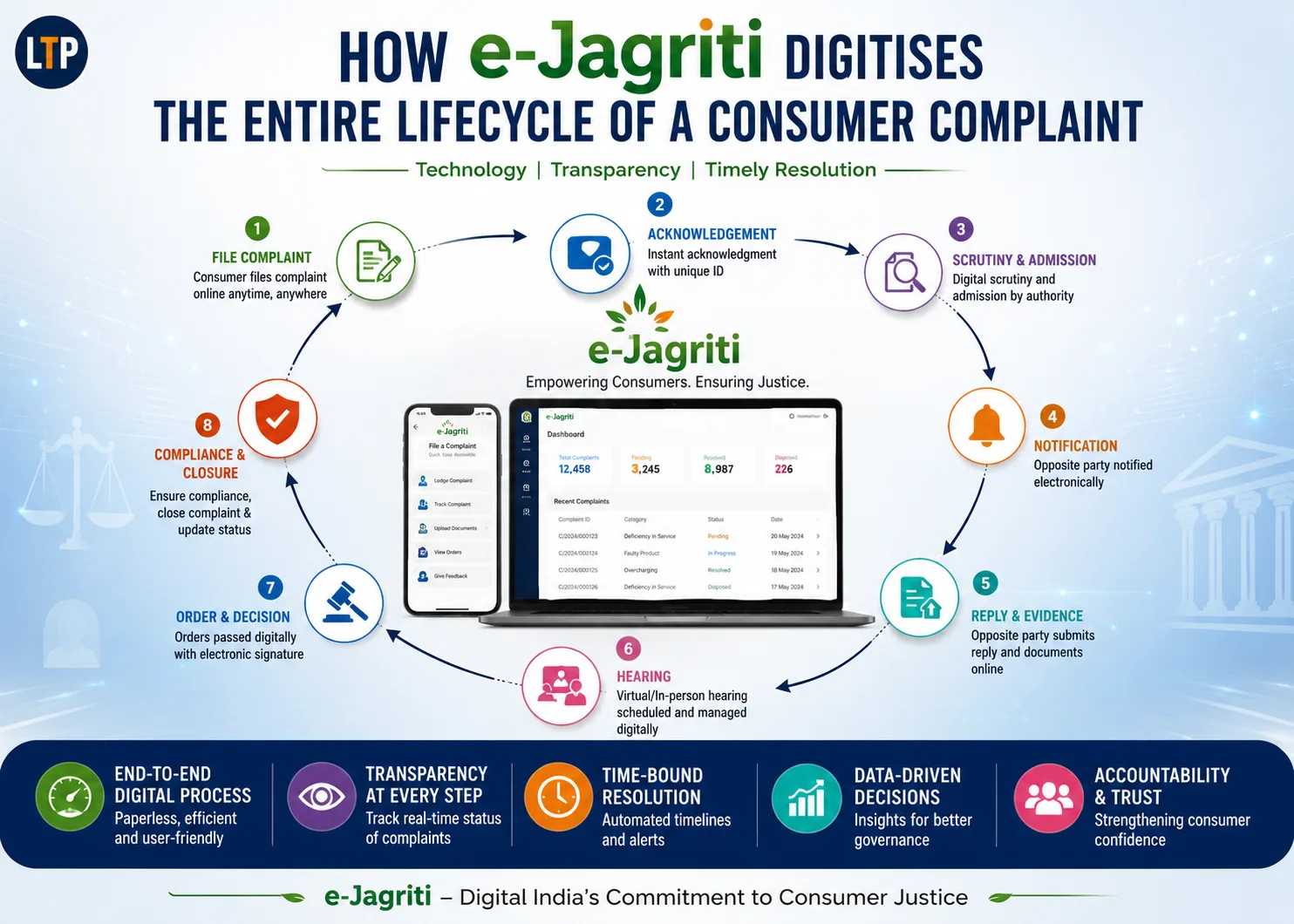
- e-Jagriti is the Department of Consumer Affairs' unified digital platform that digitises the entire lifecycle of a consumer complaint — filing, payment, hearing, tracking, resolution [1].
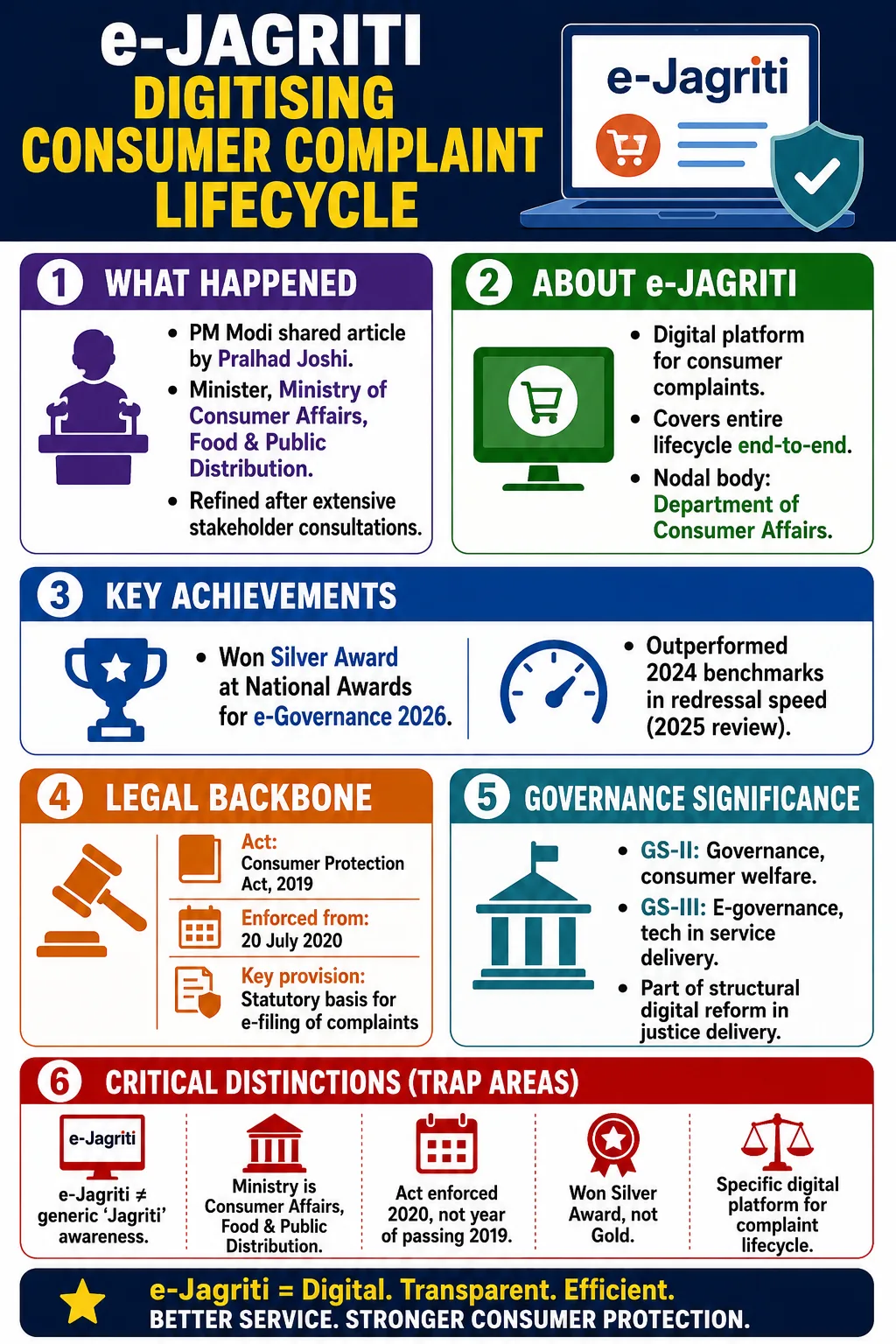
- PM Narendra Modi (4 July 2026) shared an article by Union Minister Pralhad Joshi (Ministry of Consumer Affairs, Food & Public Distribution) explaining how e-Jagriti resolves multiple structural challenges in consumer grievance redressal [1].
- Relevant for UPSC as a e-governance + consumer protection convergence topic — tests both GS-II (governance/welfare schemes) and GS-III (technology in public service delivery).
- Positioned by the government as part of a broader "structural digital reform" push across justice-delivery sectors [1].
2. Why in the News
- 4 July 2026: PM Modi posted on X endorsing Pralhad Joshi's article on e-Jagriti, noting it was refined after "extensive consultations with stakeholders" [1].
- e-Jagriti won the Silver Award at National Awards for e-Governance 2026 [2].
- 2025 performance review release claims e-Jagriti "outperformed 2024 benchmarks" in redressal speed [3].
3. Background & Evolution
- Consumer Protection Act, 2019 notified/enforced from 20 July 2020; it introduced statutory provision for e-filing of complaints and online fee payment [4].
- e-Daakhil portal launched by NCDRC on 7 September 2020 for online filing; rolled out across all States/UTs subsequently [5].
- CONFONET (Computerisation and Computer Networking of Consumer Fora) was the earlier case-monitoring software backbone; e-Jagriti emerged as its "modernised" version, discussed in a capacity-building workshop [6].
- e-Jagriti launched 1 January 2025 as a next-generation unified platform, integrating legacy systems — CONFONET, e-Daakhil, OCMS, NCDRC-CMS — into one interface [3][7].
4. Core Static Facts
| Item | Detail |
|---|---|
| Implementing Department | Department of Consumer Affairs, Ministry of Consumer Affairs, Food and Public Distribution [1] |
| Enabling law | Consumer Protection Act, 2019 (effective 20 July 2020) [4] |
| Apex adjudicatory body | National Consumer Disputes Redressal Commission (NCDRC) [5] |
| Launch date of e-Jagriti | 1 January 2025 [3] |
| Systems integrated | CONFONET, e-Daakhil, OCMS, NCDRC-CMS [3][7] |
| Geographic coverage | NCDRC + all 36 States/UTs [3] |
| Registered users (mid-Nov 2025) | Over 2.81 lakh, including ~1,400 NRIs [7] |
| Complaints filed nationwide (as of 13 Nov 2025) | 1,30,550 [3] |
| Top adopting states | Gujarat (14,758), Uttar Pradesh (14,050), Maharashtra (12,484) [3] |
| NRI complaints filed | 466, led by USA (146), UK (52), UAE (47), Canada (39), Australia (26), Germany (18) [3] |
| Recognition | Silver Award, National Awards for e-Governance 2026 [2] |
5. Multi-Dimensional Analysis
Social
- Improves access to justice for consumers regardless of geography — enables NRIs and rural consumers to file/track cases remotely [3][7].
- Voice-to-text and multilingual features specifically aid visually challenged and elderly users, advancing inclusive design in e-governance [3].
Legal/Constitutional
- Operationalises the e-filing/online-payment provisions embedded in the Consumer Protection Act, 2019, giving statutory teeth to digitisation [4].
- Reduces jurisdictional friction consistent with the Consumer Protection (Jurisdiction of District/State/National Commission) Rules, 2021 [8].
Scientific/Technological
- Uses OTP-based authentication, encrypted digital document exchange, virtual hearings, real-time SMS/email alerts, chatbot assistance [3][7].
- Consolidates four legacy IT systems (CONFONET, e-Daakhil, OCMS, NCDRC-CMS) into one interface — a case study in legacy system rationalisation [3][7].
Ethical/Governance
- Marketed as making redressal "paperless, contactless" — advances transparency and reduced discretion/corruption in quasi-judicial forums [7].
- Real-time tracking increases accountability of Consumer Commissions for disposal timelines [3].
Administrative
- Federal rollout challenge: platform had to be extended across all 36 States/UTs, requiring capacity-building workshops at state Consumer Commission level [6].
- Disposal-rate reporting (state-wise) surfaces uneven state capacity in judicial digitisation [9].
6. Recent Developments (last 12-18 months)
- Dec 2024: DoCA announced launch of 'Jago Grahak Jago App,' 'Jagriti App,' and 'Jagriti Dashboard' on National Consumer Day (24 Dec 2024) to target "dark patterns" [10].
- 1 Jan 2025: e-Jagriti platform formally launched [3].
- July 2025: NCDRC along with 10 states achieved over 100% disposal rate of consumer cases in a single month [9].
- Nov 2025: e-Jagriti crosses 1.3 lakh complaints and 2.81 lakh registered users milestone [3][7].
- 2026 (National Consumer Day review): PIB document titled "Efficient and Speedy Disposal through Digital Justice" highlights e-Jagriti's role [11].
- 2026: e-Jagriti wins Silver Award at National Awards for e-Governance [2].
- 4 July 2026: PM Modi amplifies Pralhad Joshi's article on e-Jagriti digitising the complaint lifecycle [1].
7. Prelims Hooks
- e-Jagriti is administered by the Department of Consumer Affairs under the Ministry of Consumer Affairs, Food and Public Distribution — not Ministry of Law [1].
- e-Jagriti launched on 1 January 2025 [3].
- e-Jagriti integrates four legacy systems: CONFONET, e-Daakhil, OCMS, and NCDRC-CMS [3][7].
- e-Daakhil was launched earlier by NCDRC on 7 September 2020 — a precursor, not the same as e-Jagriti [5].
- CONFONET stands for Computerisation and Computer Networking of Consumer Fora — the original backend platform later modernised into e-Jagriti [6].
- The Consumer Protection Act, 2019 came into force on 20 July 2020, replacing the 1986 Act [4].
- The 2019 Act statutorily provides for e-filing of complaints and online fee payment [4].
- As of Nov 2025, e-Jagriti recorded 1,30,550 complaints nationwide [3].
- Top three adopting states by case volume: Gujarat, Uttar Pradesh, Maharashtra [3].
- 466 NRI complaints filed via e-Jagriti; USA tops the list with 146 [3].
- e-Jagriti won the Silver Award at the National Awards for e-Governance 2026 [2].
- The Consumer Protection (Jurisdiction of District, State and National Commission) Rules, 2021 govern pecuniary jurisdiction under the new consumer regime [8].
- The article that PM Modi shared on 4 July 2026 was authored by Union Minister Pralhad Joshi [1].
- e-Jagriti now operates across NCDRC and all 36 States/UTs [3].
8. Mains Relevance
- GS-II: Governance — e-governance applications, models of delivery of civil supplies/consumer services; Government policies and interventions for development in various sectors (consumer welfare).
- GS-III: Science & Technology — application of IT for e-governance, digitisation of public service delivery.
- Possible question stems:
- "Discuss how digitisation of consumer grievance redressal mechanisms (e.g., e-Jagriti) strengthens consumer justice in India. What structural challenges remain in scaling such platforms across states?" (GS-II)
- "Examine the evolution of e-governance in India's judicial/quasi-judicial dispute redressal system, using CONFONET-to-e-Jagriti as a case study." (GS-II/III)
- "Critically evaluate the effectiveness of the Consumer Protection Act, 2019 in addressing new-age consumer challenges including e-commerce and cross-border grievances." (GS-II)
9. Related Topics to Study Next
- Consumer Protection Act, 2019 — the statutory backbone enabling e-filing and product liability provisions.
- Central Consumer Protection Authority (CCPA) — regulatory body under the same Act, tackles unfair trade practices/misleading ads.
- National Consumer Helpline (NCH) / INGRAM — grievance intake system feeding into consumer commissions.
- Digital India initiative — broader e-governance umbrella under which e-Jagriti sits.
- E-courts Mission Mode Project — parallel judicial digitisation effort, useful for comparison.
- Dark patterns regulation — DoCA guidelines against deceptive design in e-commerce, linked via Jagriti App/Dashboard.
- National Awards for e-Governance — recognises best digital governance practices, relevant for institutional awards-based prelims questions.
10. Common Errors / Trap Areas
- Confusing e-Jagriti (unified platform, launched 2025) with e-Daakhil (earlier NCDRC filing portal, launched 2020) — they are related but distinct, with e-Jagriti absorbing e-Daakhil.
- Misattributing the nodal ministry as Ministry of Law and Justice instead of the correct Ministry of Consumer Affairs, Food and Public Distribution.
- Confusing CONFONET (legacy backend software) with e-Jagriti (the modernised, unified successor).
- Assuming the Consumer Protection Act, 2019 replaced the 1986 Act on the year of passage (2019) rather than the correct enforcement date, 20 July 2020.
- Mixing up the Jagriti App/Dashboard (Dec 2024 launch, consumer-facing awareness tools against dark patterns) with e-Jagriti (the case-management/filing platform for Consumer Commissions).
Sources
- 1Prime Minister shares an article on how e-Jagriti digitises the entire lifecycle of a consumer complaintpib.gov.in · tier 1
- 2e-Jagriti Wins Silver Award at National Awards for e-Governance 2026pib.gov.in · tier 1
- 3e-Jagriti Revolutionizes Consumer Justice in 2025: Delivering Swifter Redressal and Outperforming 2024 Benchmarkspib.gov.in · tier 1
- 4Centre safeguards consumer rights via various provisions under Consumer Protection Act, 2019pib.gov.in · tier 1
- 5E-Daakhil portal, launched by NCDRC on 7th September, 2020pib.gov.in · tier 1
- 6One Day Capacity Building Workshop on Modernized CONFONET software called e-Jagritipib.gov.in · tier 1
- 7I. Consumer Protection a) e-Jagriti – Transforming Consumer Justice in India (PIB document)static.pib.gov.in · tier 1
- 8Centre notifies rules for Consumer Protection (Jurisdiction of the District Commission, the State Commission and the National Commission) Rules, 2021pib.gov.in · tier 1
- 9National Consumer Disputes Redressal Commission along with 10 States Achieve Over 100% Disposal Rate of Consumer Cases in July 2025pib.gov.in · tier 1
- 10Department of Consumer Affair's to launch 'Jago Grahak Jago App,' 'Jagriti App,' and 'Jagriti Dashboard'pib.gov.in · tier 1
- 11National Consumer Day "Efficient and Speedy Disposal through Digital Justice"static.pib.gov.in · tier 1