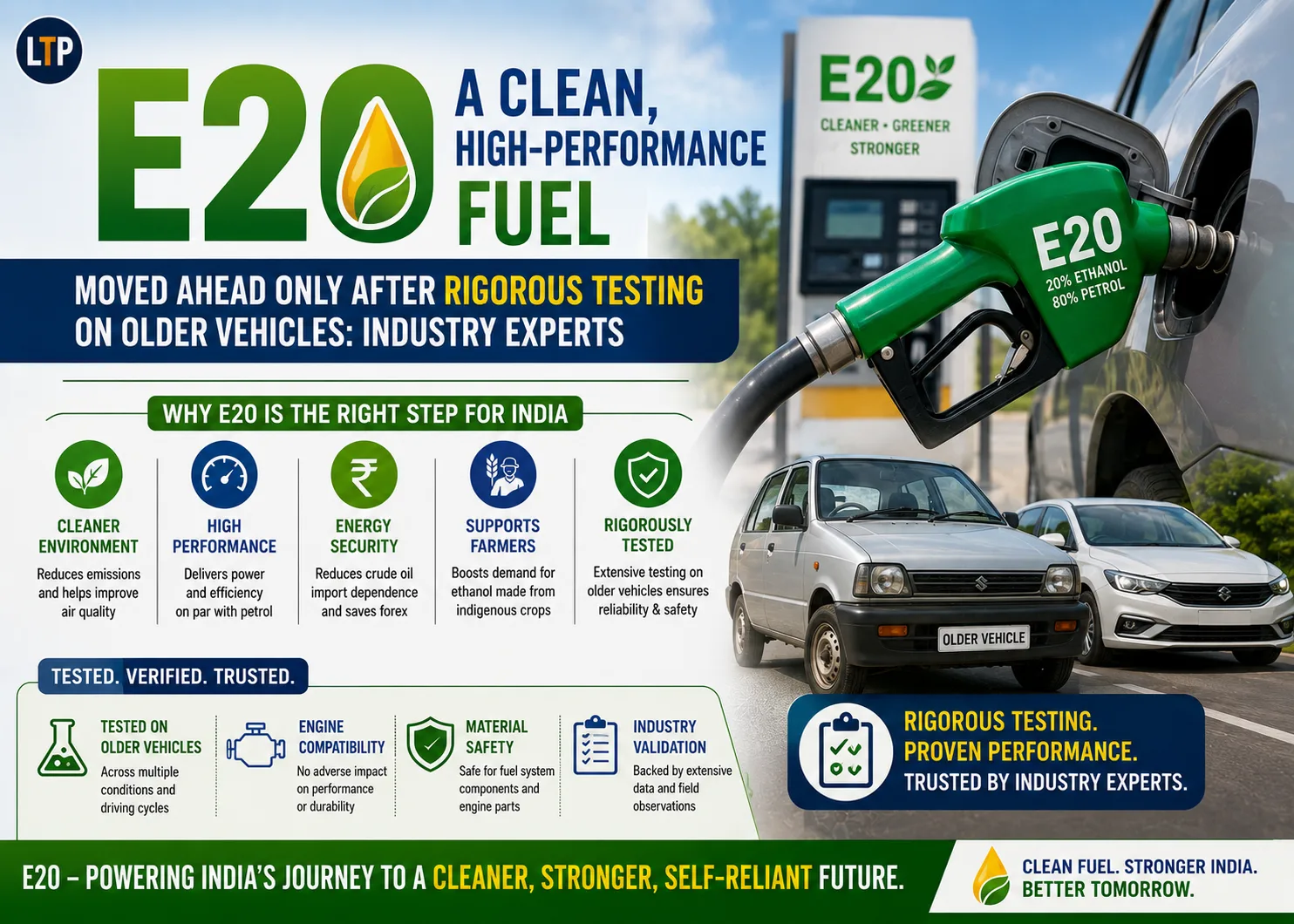
E20 a Clean, High-Performance Fuel; Moved Ahead Only After Rigorous Testing on Older Vehicles: Industry Experts
New · District CollectorCan you hold the district for 72 hours?Floods, a heatwave, an outbreak, a grievance queue. Take the decisions, see the consequences.Play →In this note
1. At a Glance
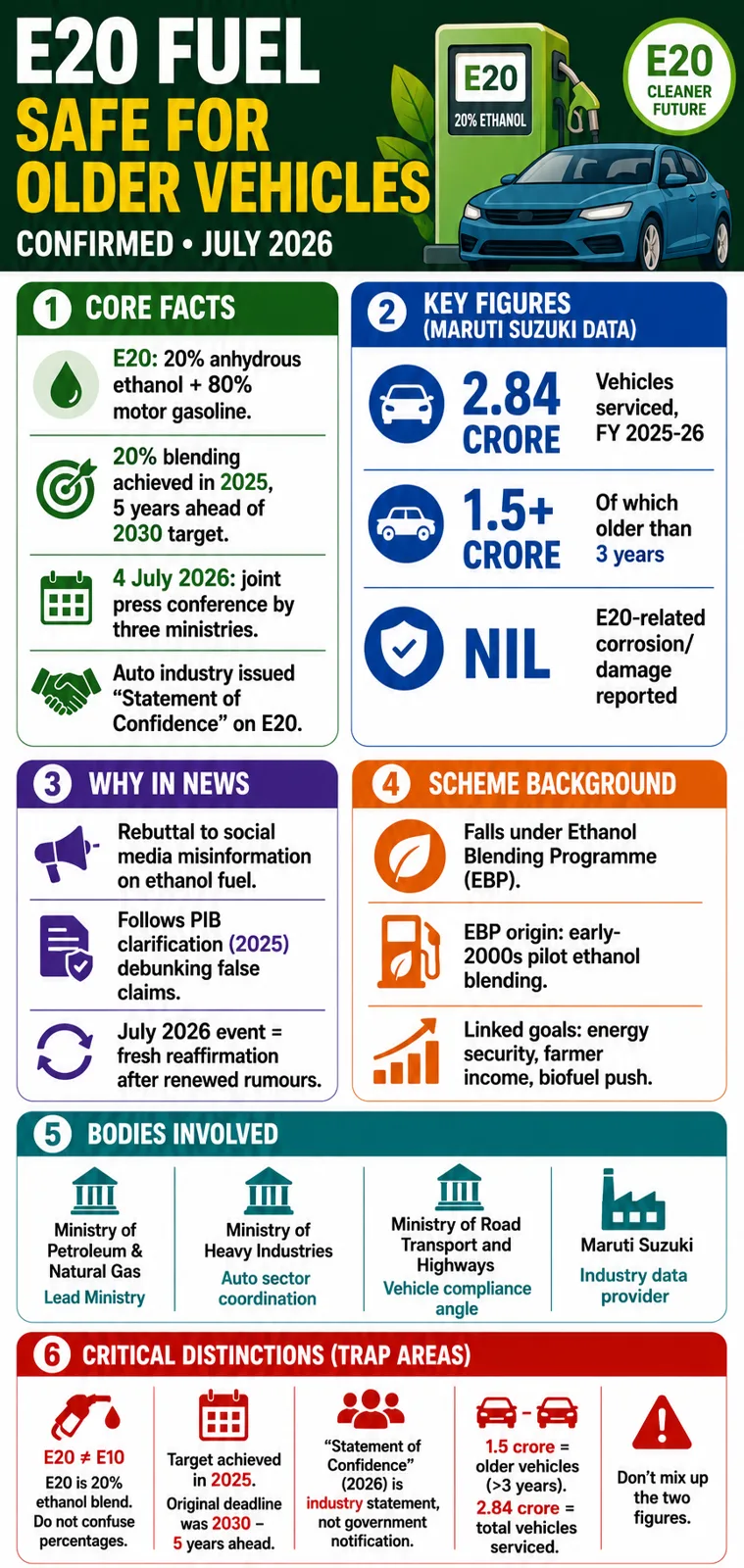
- E20 is petrol blended with 20% anhydrous ethanol and 80% motor gasoline; India achieved this blending level nationally in 2025, five years ahead of the original 2030 target [1][3].
- Relevant for Prelims (blending %, target years, launching PM event) and Mains GS-III (energy security, biofuels, farmer income) and GS-II (Centre-industry coordination, consumer protection communication).
- A July 2026 industry press conference reaffirmed E20's safety for older vehicles after concerns spread on social media — testable as a "why in news" static-plus-current hybrid topic [2][4].
2. Why in the News
- On 4 July 2026, the Ministry of Petroleum & Natural Gas, jointly with the Ministry of Heavy Industries and the Ministry of Road Transport and Highways, held a press conference in New Delhi where auto-industry executives issued a "Statement of Confidence" on E20 [4].
- Maruti Suzuki stated it serviced 2.84 crore vehicles in FY 2025-26, of which over 1.5 crore were more than three years old, with no E20-related corrosion or component damage reported [4].
- This followed an earlier PIB clarification (2025) rebutting "misleading claims and old images" circulated on social media about ethanol-blended fuel damaging engines [2].
3. Background & Evolution
- Ethanol Blending Programme (EBP) origins trace to early-2000s pilot blending; ethanol as motor fuel has been used since the early 1900s [4].
- 2014: ethanol blending stood at just 1.53% [3].
- 2022: 10% blending (E10) achieved, five months ahead of schedule [3].
- ESY (Ethanol Supply Year) progression: 12.06% (2022-23) → 14.60% (2023-24) → 17.98% (up to 28 Feb 2025) [3].
- 6 February 2023: Public Sector OMCs began retail sale of E20 petrol [1].
- PM launched E20 Fuel and flagged off a Green Mobility Rally in Bengaluru (2023) [PIB PRID 1896729].
- Original target: 20% blending by 2030; advanced and achieved in 2025 (current ESY) [1].
- July 2026: Industry-wide reaffirmation press conference amid public concern about impact on older vehicles [4].
4. Core Static Facts
| Item | Detail |
|---|---|
| Fuel definition | 20% anhydrous ethanol + 80% petrol (v/v) [1] |
| Nodal ministry | Ministry of Petroleum & Natural Gas (with Heavy Industries, Road Transport & Highways) [4] |
| Original target year | 2030 → advanced to 2025 [1] |
| Retail rollout start | 6 February 2023 [1] |
| Retail outlets selling E20 | 1,900+ across India [1] |
| Octane number | Ethanol ~108.5 vs petrol 84.4 [1] |
| Calorific value | 3–3.5% lower than E10 [4] |
| Mileage impact | ~0.6 km/litre reduction on 20 km/l vehicles [4] |
| Emission benefit | ~30% lower carbon emissions vs E10 [1] |
| Forex savings | ₹1.40 lakh crore saved via reduced crude imports (11 years) [1][3] |
| Farmer income | ₹1.21 lakh crore from ethanol procurement (11 years) [3] |
| Crude import reduction | 238.68 lakh metric tonnes [3] |
| Standards compliance | BIS standards, BS-VI emission norms [4] |
5. Multi-Dimensional Analysis
Economic
- Reduces crude oil import bill — ₹1.40 lakh crore forex savings cited [1][3].
- Boosts farm income (sugarcane, foodgrain-based ethanol) — ₹1.21 lakh crore to farmers [3].
- Marginal mileage trade-off (~0.6 km/l) offset by claimed performance gains [4].
Environmental
- ~30% lower carbon emissions relative to E10 [1].
- Higher octane supports cleaner combustion, "far lesser pollution" per industry statement [4].
Scientific/Technological
- Higher octane number (108.5) suits high-compression modern engines [1].
- Requires vehicle material compatibility (rubber/plastic components) — testing focus for older vehicles [4].
Administrative/Governance
- Tri-ministerial coordination (Petroleum, Heavy Industries, Road Transport) for rollout and consumer messaging [4].
- Public sector OMCs used as delivery/retail vehicle [1].
- Government actively countering misinformation via PIB fact-checks [2].
Social
- Consumer confidence and vehicle-owner concerns central to the 2026 press conference; industry issued reassurance to protect owners of older (3+ year) vehicles [4].
6. Recent Developments (last 12-18 months)
- 2025: PIB fact-check countering "misleading claims and old images" about ethanol fuel damage circulating on social media [2].
- 2025 (ESY): 20% ethanol blending target achieved nationally, ahead of the 2030 deadline [1].
- 4 July 2026: Joint press conference by three ministries with OEMs (Maruti Suzuki, Toyota Kirloskar, Hero MotoCorp, TVS, Hyundai, Bajaj Auto) affirming E20 safety; Maruti Suzuki's "Statement of Confidence" cited servicing data on 1.5 crore+ older vehicles with no issues [4].
7. Prelims Hooks
- E20 = 20% anhydrous ethanol + 80% petrol by volume [1].
- Original E20 target year was 2030; advanced and achieved in 2025 [1].
- 10% ethanol blending (E10) achieved in 2022, five months ahead of schedule [3].
- In 2014, blending was only 1.53% [3].
- Public Sector OMCs began E20 retail sales from 6 February 2023 [1].
- E20 currently sold at 1,900+ retail outlets [1].
- Ethanol's octane number is ~108.5, compared to petrol's 84.4 [1].
- E20 emits ~30% less carbon than E10 [1].
- Calorific value of E20 is 3–3.5% lower than E10 [4].
- Mileage drop from E20 estimated at ~0.6 km/litre on 20 km/l-rated vehicles [4].
- Ethanol Blending Programme has saved ₹1.40 lakh crore in forex over 11 years [1][3].
- Farmers earned ₹1.21 lakh crore from ethanol procurement over the same period [3].
- Crude oil imports reduced by 238.68 lakh metric tonnes due to blending [3].
- The 4 July 2026 press conference was jointly organised by Ministry of Petroleum & Natural Gas, Ministry of Heavy Industries, and Ministry of Road Transport and Highways [4].
- Maruti Suzuki serviced 2.84 crore vehicles in FY 2025-26, of which 1.5 crore+ were over 3 years old, with zero E20-related corrosion/damage reports [4].
8. Mains Relevance
- GS-III: Infrastructure/Energy — biofuels, energy security, import substitution; Environment — emission reduction, sustainable fuels.
- GS-II: Government policies/interventions — inter-ministerial coordination, consumer protection, combating misinformation.
- Possible question stems: 1. "Discuss the significance of India's Ethanol Blending Programme in achieving energy security and reducing carbon emissions. Examine associated concerns and their scientific basis." (GS-III) 2. "Ethanol blending is often cited as a triple-win for farmers, environment, and energy security. Critically evaluate this claim in the context of the E20 rollout." (GS-III) 3. "How should government agencies manage public misinformation around scientifically validated policy interventions? Discuss with reference to the E20 fuel controversy." (GS-II/GS-IV ethics angle)
9. Related Topics to Study Next
- National Policy on Biofuels (2018, amended 2022) — the overarching legal/policy framework for ethanol blending.
- Pradhan Mantri JI-VAN Yojana — 2G ethanol production support scheme.
- Sugar sector reforms/FRP-SAP — feedstock economics for ethanol.
- Flex-Fuel Vehicles (FFVs) — next stage beyond E20 (E85/E100).
- BS-VI emission norms — regulatory baseline referenced for E20 compliance.
- India's crude oil import dependency & energy security strategy — macro rationale for blending push.
- Green Hydrogen Mission — parallel clean-fuel/energy-transition initiative for comparison.
10. Common Errors / Trap Areas
- Confusing E20 (20% ethanol) with E10 or E27/E85 — know exact blending percentages and which is current mainstream fuel.
- Assuming MoEFCC implements the Ethanol Blending Programme — it is led by Ministry of Petroleum & Natural Gas, with Heavy Industries and Road Transport as co-partners, and Food/PDS Ministry for procurement.
- Mixing up target achievement year (2025) with the original target (2030) — the achievement was ahead of schedule, a frequently tested nuance.
- Believing E20 is a 2026 launch — retail rollout began February 2023; the 2026 event was a reaffirmation/clarification press conference, not a launch.
- Overstating mileage loss — official figure is a modest ~0.6 km/litre, not a large performance penalty.
Sources
- 1E20 Petrol / RESPONSE TO CONCERNS ON 20% BLENDING OF ETHANOL IN PETROL AND BEYONDpib.gov.in · tier 1
- 2Ethanol blending programme is scientifically validated and closely monitored by the government; misleading claims and old images being circulated on social mediapib.gov.in · tier 1
- 3India's Ethanol Journey is Unstoppable: Shri Hardeep Singh Puripib.gov.in · tier 1
- 4E20 a Clean, High-Performance Fuel; Moved Ahead Only After Rigorous Testing on Older Vehicles: Industry Expertspib.gov.in · tier 1