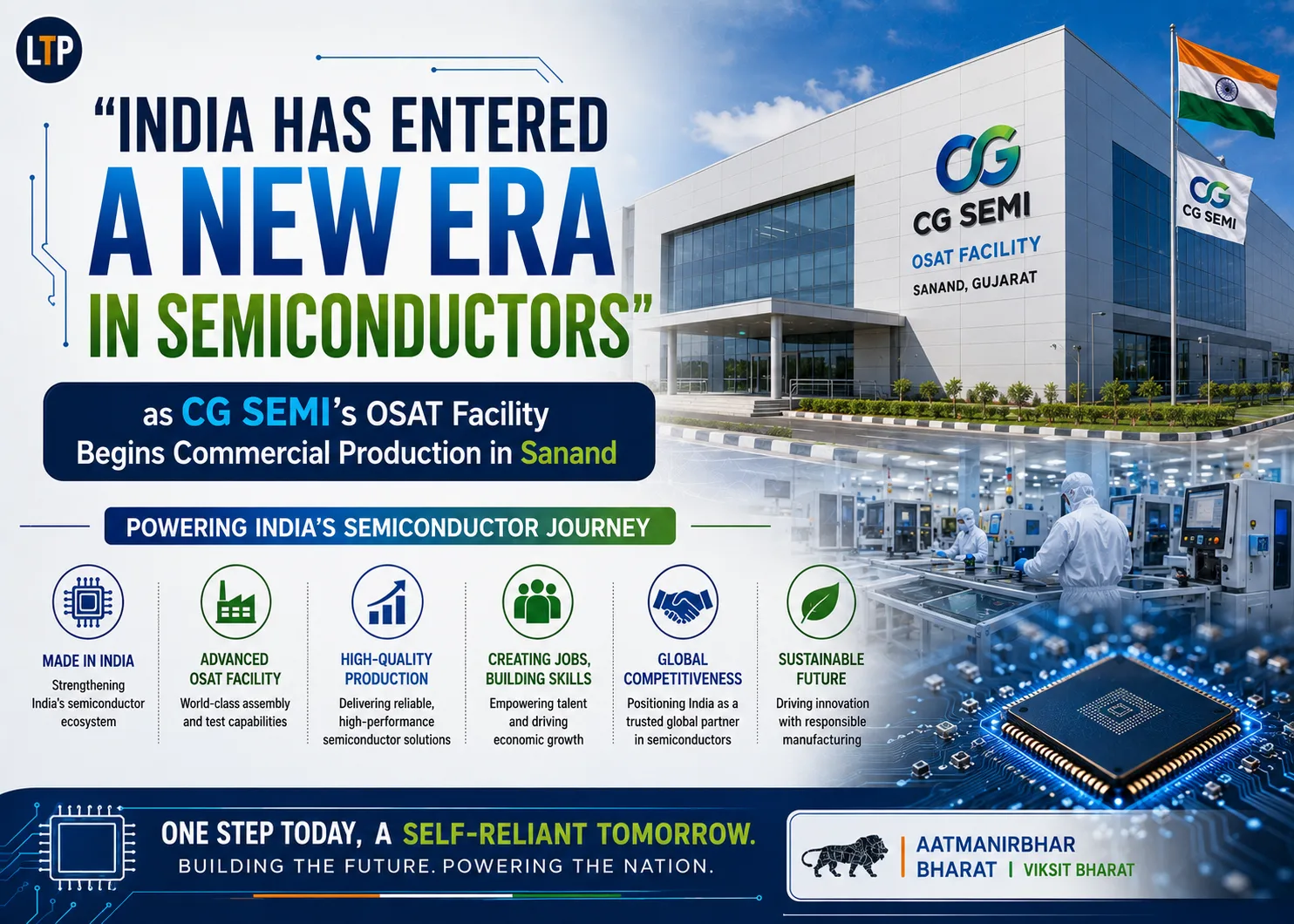
"India Has Entered a New Era in Semiconductors" Says Union Minister Ashwini Vaishnaw as CG SEMI's OSAT Facility Begins Commercial Production in Sanand
New · District CollectorCan you hold the district for 72 hours?Floods, a heatwave, an outbreak, a grievance queue. Take the decisions, see the consequences.Play →In this note
Practice
12 questions on this item
Check the answer for each question, or reveal all at once.
1. At a Glance
- India's Outsourced Semiconductor Assembly and Test (OSAT) ecosystem reached a landmark on 04 July 2026 when CG SEMI's Sanand, Gujarat facility began commercial production — a key deliverable under the India Semiconductor Mission (ISM). [1]
- Marks progress toward Atmanirbhar Bharat in a strategically critical, import-dependent technology sector (chips underpin electronics, defence, telecom, AI). [1]
- Demonstrates the social dimension of tech manufacturing — women from seven states (several tribal/hill states) employed at the facility. [1]
- High-yield UPSC topic: bridges GS-III (economy/S&T) with GS-I (social issues) and GS-II (governance/schemes).
2. Why in the News
- 04 July 2026: Union Minister for Railways and Information & Broadcasting (MeitY) Ashwini Vaishnaw announced commencement of commercial production at CG SEMI's OSAT facility in Sanand, calling it the start of a "new era" for Indian semiconductors. [1]
- Minister stated five semiconductor plants are expected to start production in India by end of 2026. [1]
- Framed as both a technical and social achievement, citing women workers from Jharkhand, Chhattisgarh, Madhya Pradesh, Bihar, Jammu & Kashmir, Kerala, and Gujarat. [1]
3. Background & Evolution
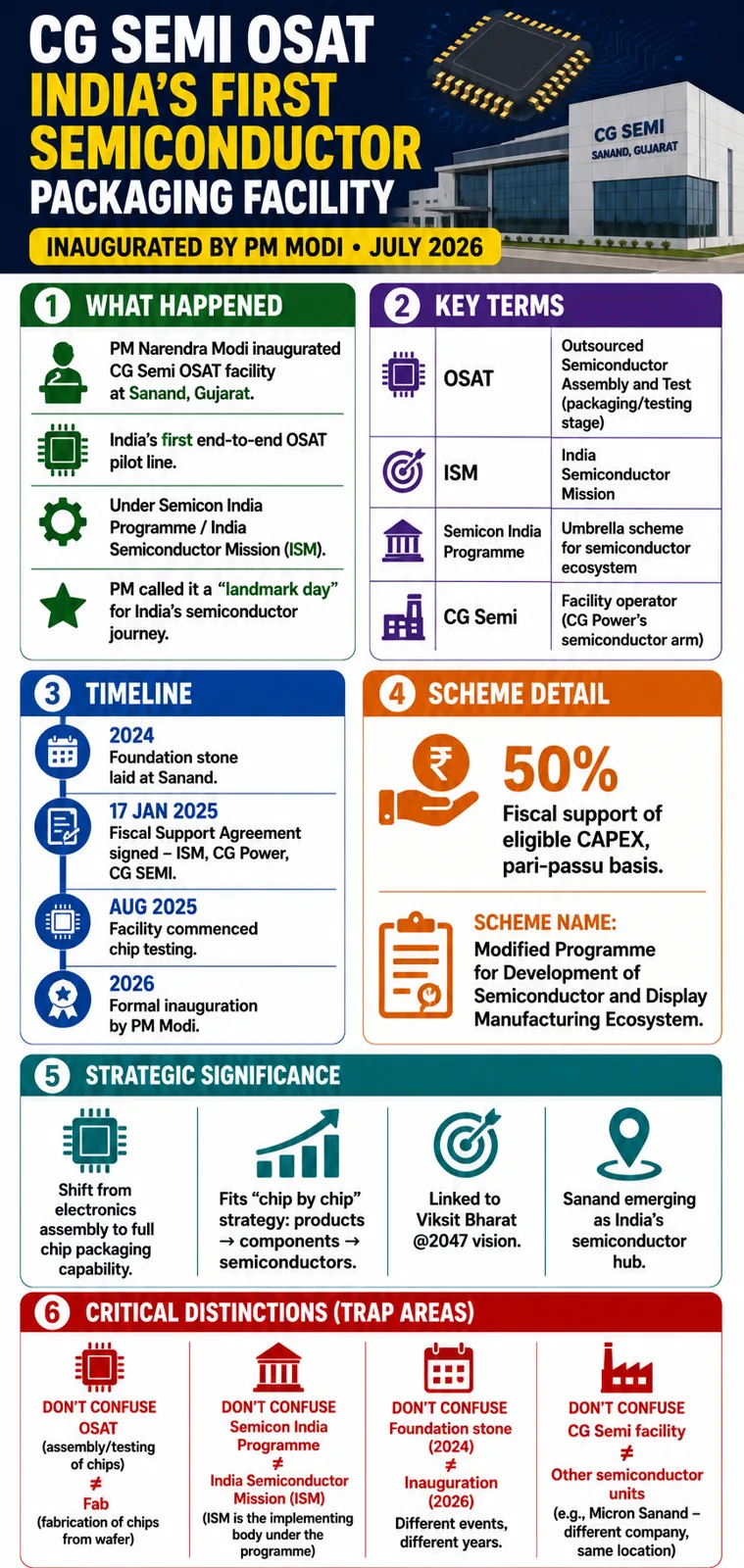
- 15 December 2021: Union Cabinet approved the Semicon India Programme with an outlay of ₹76,000 crore, launching the India Semiconductor Mission (ISM). [3]
- 13 March 2024: Groundbreaking of the CG SEMI (then CG Power) OSAT facility at Sanand. [1]
- 28 August 2025: Inauguration of one of India's first end-to-end OSAT Pilot Line Facilities (G1 unit) at Sanand — handling assembly, packaging, testing, and post-test services. [2]
- 28 February 2026 and 31 March 2026: First and second semiconductor plants under ISM began production (precursors to the Sanand OSAT going commercial). [1]
- 04 July 2026: CG SEMI's Sanand facility begins commercial production, becoming the 3rd plant in commercial production under ISM, out of 12 approved projects. [1]
- Budget 2026-27 announced India Semiconductor Mission (ISM) 2.0 with a provision of ₹1,000 crore for FY2026-27, focused on equipment/materials manufacturing, indigenous chip IP design, and supply-chain resilience — building on ISM 1.0's 10 approved projects worth ₹1.60 lakh crore across 6 states (as of December 2025). [5]
4. Core Static Facts
| Item | Detail |
|---|---|
| Nodal Ministry | Ministry of Electronics & Information Technology (MeitY) [1] |
| Implementing body | India Semiconductor Mission (ISM), under MeitY [3] |
| Parent scheme | Semicon India Programme, Cabinet-approved 15.12.2021, outlay ₹76,000 crore [3] |
| Facility in news | CG SEMI OSAT plant, Sanand, Gujarat [1] |
| Ownership | Joint venture — CG Power and Industrial Solutions Ltd. (Murugappa Group), Renesas Electronics Corp. (Japan), Stars Microelectronics (Thailand) [2] |
| Facility type | OSAT — Outsourced Semiconductor Assembly and Test (packaging/testing, not wafer fabrication) [2] |
| Investment | Over ₹7,600 crore for two facilities (G1 and G2) over five years [2] |
| Capacity | G1: ~0.5 million units/day (commercial 2026); G2 (under construction): up to 14.5 million units/day [2] |
| Jobs | G2 alone expected to generate over 5,000 jobs; ISM-linked ecosystem supports 25+ lakh jobs economy-wide [1] |
| Skilling | 70,000+ trained in chip design; 315 universities offer semiconductor design courses [1] |
| ISM approvals | 12 projects approved; 3 in commercial production (as of the news date); 10 projects worth ₹1.60 lakh crore across 6 states as of Dec 2025 [1][5] |
| First fab (wafer) location | Dholera, Gujarat (Tata Electronics) [1] |
| ISM 2.0 | Announced in Union Budget 2026-27; ₹1,000 crore provision for FY2026-27; focus — equipment/materials, indigenous IP, supply chains [5] |
| Electronics manufacturing sector size | Close to ₹13 lakh crore [1] |
5. Multi-Dimensional Analysis
Economic
- Signals India moving up the electronics value chain from assembly-only to chip packaging/testing, reducing import dependence on East/Southeast Asia. [1][2]
- ₹7,600 crore single-project investment reflects scale of FDI/JV capital being drawn into ESDM (Electronics System Design & Manufacturing). [2]
- Feeds into the broader ₹13 lakh crore electronics manufacturing ecosystem and Atmanirbhar Bharat's import-substitution goals. [1]
Social
- Employment of women from tribal/hill and conflict-sensitive states (Jharkhand, Chhattisgarh, J&K) highlighted as a social equity outcome of high-tech manufacturing decentralisation. [1]
- Skilling pipeline (70,000+ trained, 315 universities) targets youth employability in a frontier sector. [1]
Geopolitical/Strategic
- Reduces India's reliance on Taiwan/China/South Korea-dominated global semiconductor supply chains — a strategic autonomy concern post-COVID and amid US-China chip tensions. [1][2]
- International joint venture (Japan's Renesas, Thailand's Stars Microelectronics) reflects "China+1" supply-chain diversification benefiting India. [2]
- Export orientation toward Japan, US, and Europe strengthens India's role in friend-shoring of critical tech supply chains. [1]
Scientific/Technological
- OSAT is a downstream node (assembly/packaging/testing) distinct from fabrication (fab) — India's first fab is coming up separately in Dholera; distinguishing OSAT vs. fab is a key trap area. [1][2]
- Marks progress toward indigenous chip design IP (via ISM 2.0) rather than just assembly — a move up the tech-sovereignty ladder. [5]
Administrative/Governance
- Demonstrates Centre-state coordination: Gujarat government (CM Bhupendra Patel, Deputy CM Harsh Sanghavi) facilitated land/infrastructure alongside central fiscal support via ISM. [1]
- Fiscal Support Agreement model (Centre + company, e.g., CG Power/CG SEMI) is the administrative mechanism used to disburse the 50% central capital support under Semicon India Programme. [4]
6. Recent Developments (last 12-18 months)
- 28 Aug 2025: G1 OSAT pilot line at Sanand inaugurated (pre-commercial). [2]
- Dec 2025: ISM 1.0 tally reaches 10 approved projects, ₹1.60 lakh crore cumulative investment across 6 states. [5]
- Feb-Mar 2026: Union Budget 2026-27 announces ISM 2.0 (₹1,000 crore, FY2026-27); first two ISM plants begin production (28 Feb and 31 Mar 2026). [1][5]
- 04 Jul 2026: CG SEMI Sanand OSAT facility begins commercial production; Minister Vaishnaw projects five plants operational by end-2026. [1]
7. Prelims Hooks
- CG SEMI's Sanand OSAT facility is India's third plant to reach commercial production under the India Semiconductor Mission. [1]
- OSAT stands for Outsourced Semiconductor Assembly and Test — covers packaging/testing, NOT wafer fabrication. [2]
- CG SEMI is a joint venture of CG Power (Murugappa Group), Renesas Electronics (Japan), and Stars Microelectronics (Thailand). [2]
- Semicon India Programme was approved by the Union Cabinet on 15 December 2021 with an outlay of ₹76,000 crore. [3]
- Nodal ministry for semiconductors is MeitY (Ministry of Electronics & Information Technology), not the Ministry of Commerce. [1]
- India's first semiconductor fab (wafer fabrication) is coming up at Dholera, Gujarat, distinct from OSAT plants like Sanand. [1]
- 12 semiconductor projects approved so far under ISM (as of July 2026 news); 10 projects/₹1.60 lakh crore reported as of December 2025. [1][5]
- India Semiconductor Mission 2.0 was announced in the Union Budget 2026-27 with a ₹1,000 crore provision for FY2026-27. [5]
- CG SEMI's total investment for its Sanand facilities (G1+G2) exceeds ₹7,600 crore. [2]
- G1 unit capacity: ~0.5 million units/day; G2 (under construction) will scale to 14.5 million units/day. [2]
- Over 70,000 youth trained in chip design; 315 universities offer semiconductor courses in India. [1]
- Ashwini Vaishnaw holds the portfolios of Railways and Information & Broadcasting (also handles MeitY-related semiconductor announcements). [1]
8. Mains Relevance
- GS-III: Indigenization of technology, industrial policy, infrastructure, employment generation, science & tech developments and applications.
- GS-II: Government policies/interventions for development in tech sectors; Centre-state cooperation in industrial development.
- GS-I (tangential): Role of women in the economy/social change through employment.
- Possible question stems: 1. "Discuss the strategic and economic significance of India's OSAT ecosystem in reducing dependence on global semiconductor supply chains." (GS-III) 2. "Examine the difference between semiconductor 'fabrication' and 'OSAT' facilities and their respective roles in India's semiconductor value chain strategy." (GS-III) 3. "How can high-tech manufacturing initiatives like the Semiconductor Mission be leveraged as instruments of regional and gender-inclusive employment generation in India?" (GS-I/III)
9. Related Topics to Study Next
- India Semiconductor Mission (ISM) & ISM 2.0 — the parent scheme and its evolving focus areas. [5]
- Semicon India Programme, 2021 — the original ₹76,000 crore Cabinet approval. [3]
- Production Linked Incentive (PLI) Schemes for electronics — related industrial policy instrument.
- Atmanirbhar Bharat Abhiyan — overarching self-reliance framework this initiative feeds into.
- Global semiconductor supply chain & Taiwan-China tensions — geopolitical backdrop driving India's push.
- Tata Electronics Dholera Fab — India's first wafer fabrication unit, complements OSAT capacity.
- Digital India / Electronics System Design & Manufacturing (ESDM) sector — broader policy umbrella.
- Skill India / chip-design skilling initiatives — links to the 70,000-trained figure cited here.
10. Common Errors / Trap Areas
- Confusing OSAT (assembly, packaging, testing) with a fab (actual wafer fabrication) — Sanand is OSAT; Dholera is the fab. [1][2]
- Misattributing the nodal ministry — it is MeitY, not Ministry of Commerce & Industry or DPIIT.
- Confusing ISM 1.0 (₹76,000 crore, 2021) outlay with ISM 2.0 (₹1,000 crore FY2026-27 provision) — different scales and different focus (fabs/OSAT vs. equipment/materials/IP). [3][5]
- Mixing up company ownership — CG SEMI is a JV (CG Power/Murugappa Group + Renesas Japan + Stars Microelectronics Thailand), not a wholly Indian or wholly foreign entity. [2]
- Conflating the number of approved projects (12) with number in commercial production (3) — these are frequently tested as distractors. [1]
Sources
- 1"India Has Entered a New Era in Semiconductors" Says Union Minister Ashwini Vaishnaw as CG SEMI's OSAT Facility Begins Commercial Production in Sanandpib.gov.in · tier 1
- 2Major Milestone in India's Semiconductor Journey as one of India's first end-to-end OSAT Pilot Line Facility Launched in Sanand, Gujaratpib.gov.in · tier 1
- 3India Semiconductor Missionpib.gov.in · tier 1
- 4India Semiconductor Mission, CG Power and CG SEMI Sign Fiscal Support Agreementpib.gov.in · tier 1
- 5India Semiconductor Mission 2.0pib.gov.in · tier 1
At the end · practice MCQs
12 questions on this item
Check the answer for each question, or reveal all at once.