India to host BRICS Heads of Anti-Drug Agencies meeting on 6–7 July 2026 in Guwahati
New · District CollectorCan you hold the district for 72 hours?Floods, a heatwave, an outbreak, a grievance queue. Take the decisions, see the consequences.Play →In this note
Practice
10 questions on this item
Check the answer for each question, or reveal all at once.
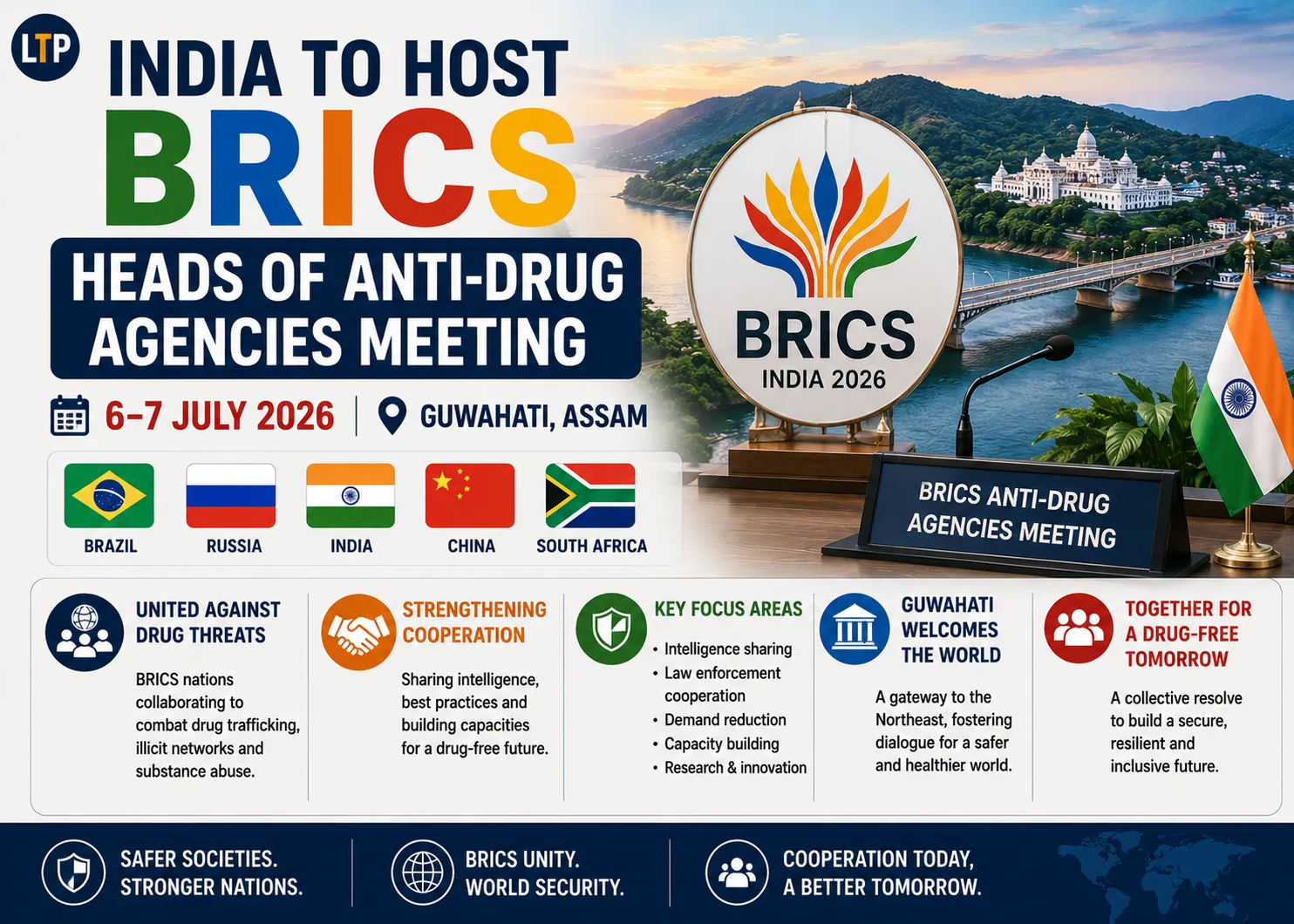
1. At a Glance
- India, as BRICS Chair for 2026, is hosting the first-ever BRICS Heads of Anti-Drug Agencies Meeting on 6–7 July 2026 in Guwahati, Assam [1].
- Hosted by the Narcotics Control Bureau (NCB) under the Ministry of Home Affairs (MHA) [1].
- Marks a shift from the earlier dialogue-based BRICS Anti-Drug Working Group format toward "structured, action-oriented collaboration" against synthetic drugs, NPS, darknet trafficking, and crypto-financed trafficking [1].
- Relevant for Prelims (BRICS composition, NCB, Guwahati as venue) and Mains GS-II/III (international cooperation, internal security, narco-terrorism).
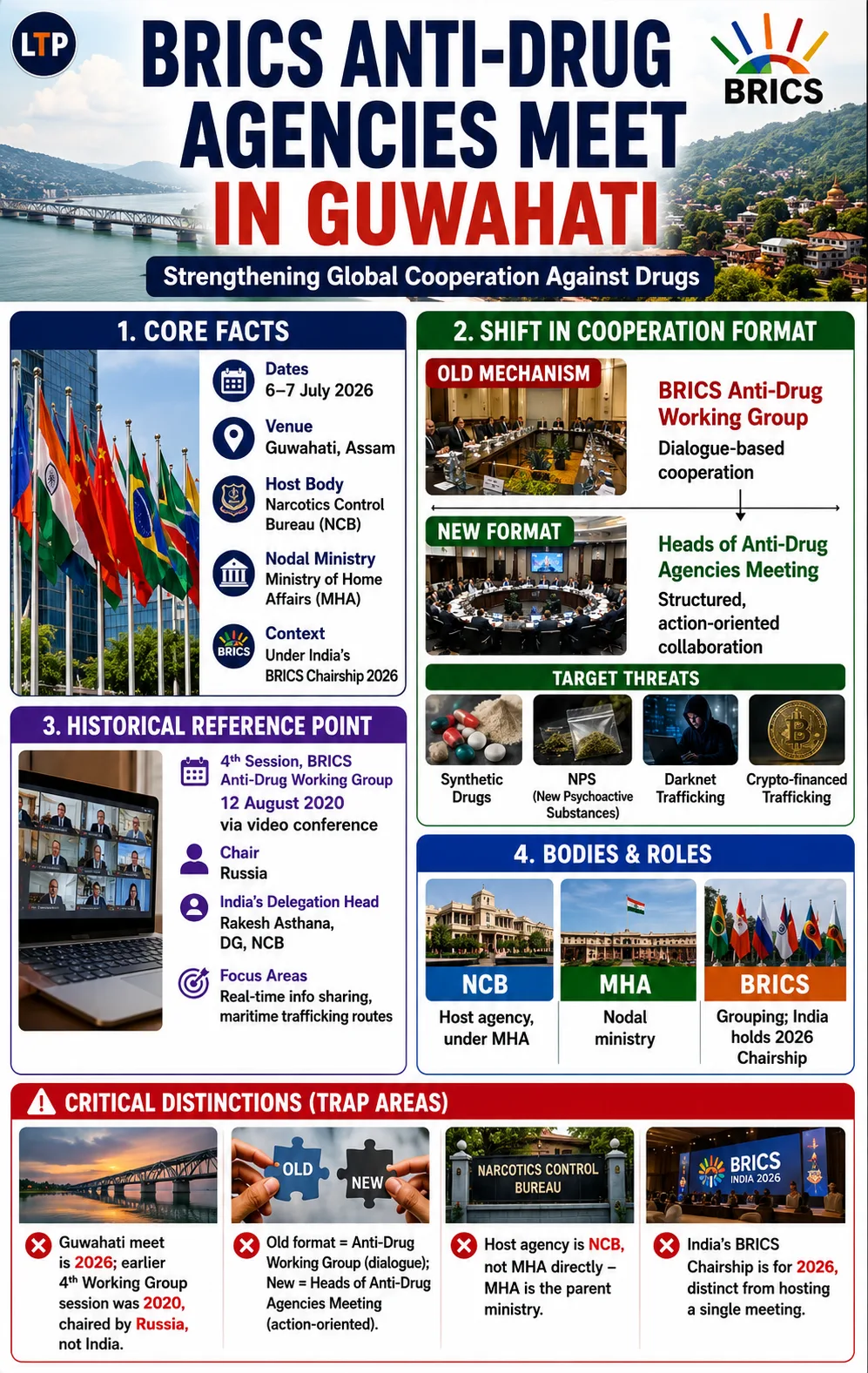
2. Why in the News
- MHA/NCB announced India will host the BRICS Heads of Anti-Drug Agencies Meeting on 6–7 July 2026 in Guwahati — a high-level meeting bringing together heads of anti-drug agencies and senior officials of BRICS member states [1].
3. Background & Evolution
- BRICS Anti-Drug Working Group (predecessor mechanism) has held periodic sessions among member drug-control agencies; the 4th Session was held on 12 August 2020 via video conference, chaired by Russia, with India's delegation led by NCB Director General Shri Rakesh Asthana [2].
- That working group focused on real-time information sharing, maritime trafficking routes, and darknet misuse, culminating in a joint communiqué reaffirming commitment to international anti-drug conventions [2].
- The 2026 Guwahati meeting elevates this engagement to the Heads of Agencies level (from working-group/official level), reflecting deeper institutionalisation [1].
- Held under India's 2026 BRICS Chairmanship, themed "Building for Resilience, Innovation, Cooperation and Sustainability" [1].
4. Core Static Facts
| Item | Detail |
|---|---|
| Event | BRICS Heads of Anti-Drug Agencies Meeting |
| Dates | 6–7 July 2026 [1] |
| Venue | Guwahati, Assam [1] |
| Host agency | Narcotics Control Bureau (NCB) [1] |
| Nodal ministry | Ministry of Home Affairs [1] |
| BRICS members (11) | Brazil, China, Egypt, Ethiopia, India, Indonesia, Iran, Russia, Saudi Arabia, South Africa, UAE [1] |
| India's 2026 BRICS theme | "Building for Resilience, Innovation, Cooperation and Sustainability" [1] |
| Predecessor mechanism | BRICS Anti-Drug Working Group (4th session: 12 Aug 2020, video conference) [2] |
| Expected outcome | Joint Declaration [1] |
5. Multi-Dimensional Analysis
- Geopolitical/Strategic: Positions India as a norm-setter in BRICS counter-narcotics cooperation during its chairmanship year; strengthens South-South security cooperation distinct from Western-led frameworks like UNODC [1].
- Legal/Institutional: Aims to align national legislations and enforcement practices across BRICS states; expected Joint Declaration is a soft-law instrument, not binding treaty [1].
- Scientific/Technological: Sessions on digital technology for real-time interdiction, darknet trafficking, and NPS reflect growing tech-security interface in drug control [1].
- Administrative: Choice of Guwahati (Northeast India, proximate to Golden Triangle trafficking routes) signals operational focus on regional trafficking corridors [1].
- Economic: Precursor chemical diversion and supply-chain leakage are financial-crime-adjacent concerns tied to trafficking economics [1].
- Social: Drug demand reduction sessions address substance abuse as a public health/social issue, not purely enforcement [1].
6. Recent Developments (last 12–18 months)
- MHA/NCB press release (5 July 2026) confirming the Guwahati meeting dates, host, priority areas and thematic sessions [1].
7. Prelims Hooks
- BRICS Heads of Anti-Drug Agencies Meeting: 6–7 July 2026, Guwahati, Assam [1].
- Hosting/nodal agency: Narcotics Control Bureau (NCB), under Ministry of Home Affairs [1].
- Current BRICS membership (11 nations): Brazil, Russia, India, China, South Africa, Egypt, Ethiopia, Indonesia, Iran, Saudi Arabia, UAE [1].
- India's 2026 BRICS Chairmanship theme: "Building for Resilience, Innovation, Cooperation and Sustainability" [1].
- Three priority areas: synthetic drugs/precursor diversion, intelligence sharing/operational coordination, capacity building [1].
- Expected outcome document: Joint Declaration [1].
- Predecessor: BRICS Anti-Drug Working Group, 4th session held 12 August 2020 (video conference, chaired by Russia) [2].
- India's NCB delegation to the 2020 working group was led by DG Rakesh Asthana [2].
- NPS = New Psychoactive Substances — a recurring theme in drug-control discourse [1].
- BRICS originally an acronym for Brazil, Russia, India, China, South Africa before 2024 expansion [2].
8. Mains Relevance
- GS-II: International relations — India's role in multilateral groupings (BRICS); bilateral/multilateral security cooperation.
- GS-III: Internal security — narco-terrorism, drug trafficking as security challenge, role of NCB, linkages with organised crime and terror financing.
- Possible question stems: 1. "Discuss the significance of India hosting the BRICS Heads of Anti-Drug Agencies Meeting in the context of evolving transnational drug trafficking challenges." (GS-III) 2. "Examine how synthetic drugs and darknet-enabled trafficking have altered the global narcotics threat landscape and India's institutional response." (GS-III) 3. "How does India leverage its BRICS chairmanship to advance security cooperation among member states?" (GS-II)
9. Related Topics to Study Next
- Narcotics Control Bureau (NCB) — mandate, NDPS Act 1985, structure — direct institutional link.
- NDPS Act, 1985 — India's core anti-drug legislation, relevant for legal dimension.
- Golden Triangle/Golden Crescent trafficking routes — geographic context for Northeast India's drug security concerns.
- BRICS expansion (2024) — new members Egypt, Ethiopia, Iran, UAE, Saudi Arabia — institutional evolution.
- UNODC and international drug conventions (Single Convention on Narcotic Drugs 1961, etc.) — comparative multilateral framework.
- Darknet and cryptocurrency-based crime — cross-cutting tech-security theme.
- India's Act East Policy — Northeast India's strategic role, relevant to Guwahati as venue.
10. Common Errors / Trap Areas
- Confusing host agency: it is NCB under MHA, not the Ministry of External Affairs (despite being a multilateral/international event) [1].
- Assuming BRICS still means only 5 nations — post-2024 expansion it has 11 members; aspirants often miss added members [1].
- Confusing this Heads of Agencies meeting with the older, lower-level BRICS Anti-Drug Working Group sessions (e.g., 4th session, 2020) — different tier of engagement [1][2].
- Mixing up venue: Guwahati (Assam), not Delhi or another BRICS Summit city.
- Assuming a binding treaty will result — the expected outcome is a Joint Declaration (non-binding), not a convention.
Sources
- 1Press Release Page | Press Information Bureaupib.gov.in · tier 1
- 24th Meeting of the BRICS Anti-Drug Working Group heldpib.gov.in · tier 1
At the end · practice MCQs
10 questions on this item
Check the answer for each question, or reveal all at once.