Ethanol Blending in India
New · District CollectorCan you hold the district for 72 hours?Floods, a heatwave, an outbreak, a grievance queue. Take the decisions, see the consequences.Play →In this note
Practice
11 questions on this item
Check the answer for each question, or reveal all at once.
1. At a Glance
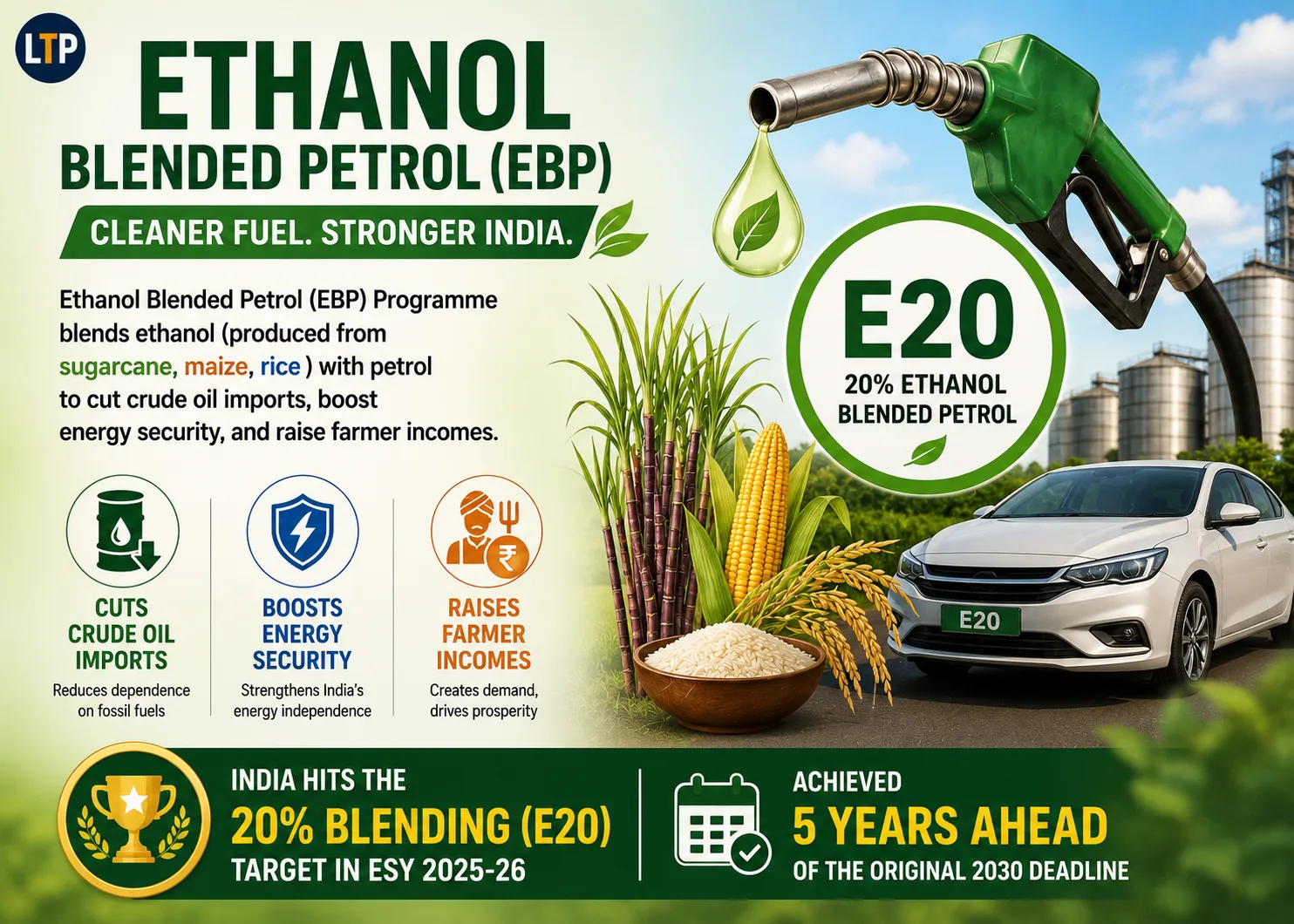
- Ethanol Blended Petrol (EBP) Programme blends ethanol (produced from sugarcane, maize, rice) with petrol to cut crude oil imports, boost energy security, and raise farmer incomes [1].
- India hit the 20% blending (E20) target in ESY 2025-26, five years ahead of the original 2030 deadline [1].
- A flagship example of biofuel policy intersecting agriculture, energy security, and climate commitments — recurrently tested in Prelims (targets/years) and Mains (GS-III energy/agriculture linkages) [1].
2. Why in the News
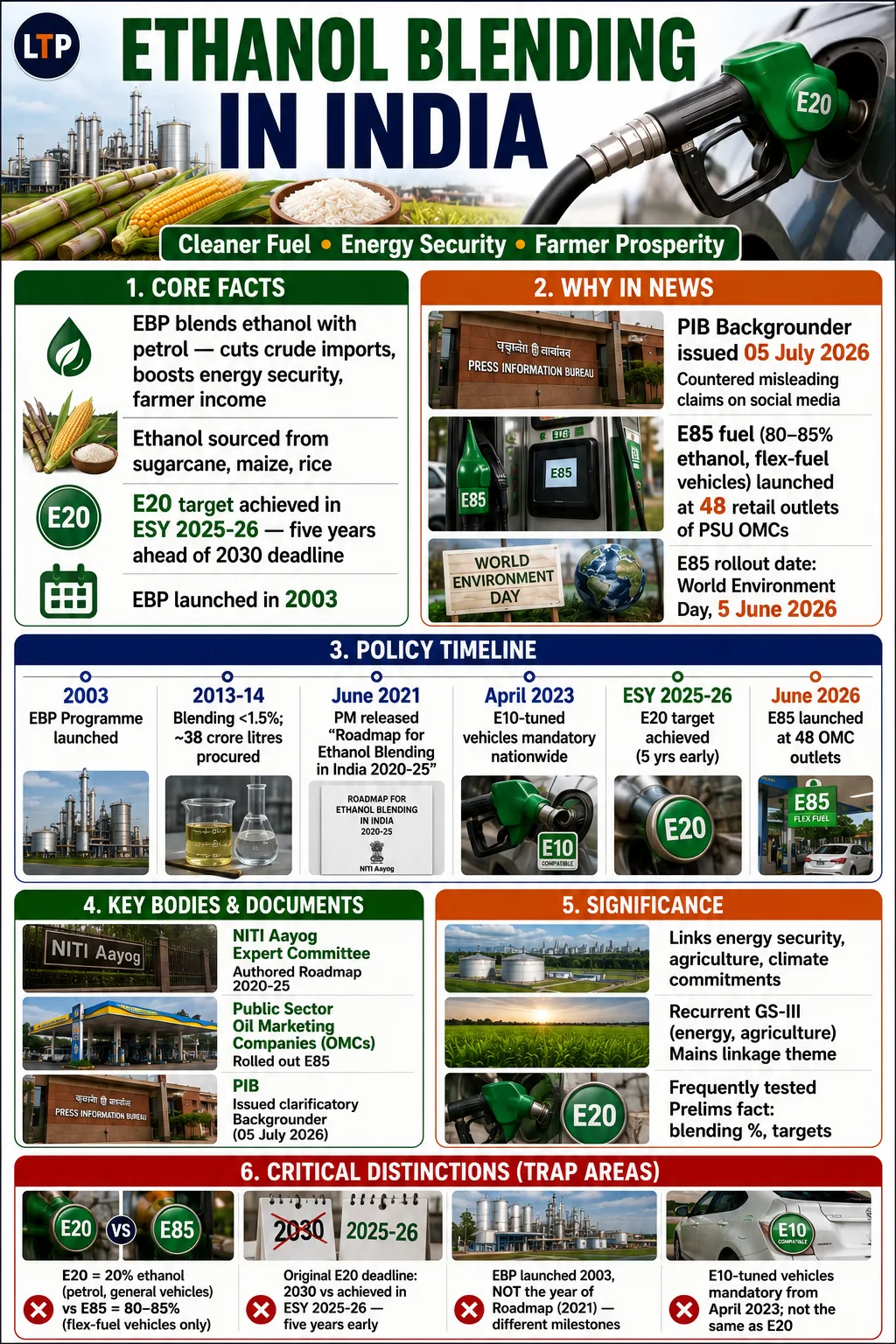
- PIB issued a dedicated "Backgrounder" on 05 July 2026 defending the programme against "misleading claims and old images" circulating on social media, and clarifying frequently raised technical concerns [1][2].
- E85 fuel (80–85% ethanol blend for flex-fuel vehicles) was rolled out across 48 retail outlets of Public Sector Oil Marketing Companies (OMCs) on World Environment Day 2026 (5 June 2026) [4][6].
3. Background & Evolution
- EBP Programme launched in 2003 to reduce crude oil imports and enhance energy security [6].
- 2013-14: Blending level below 1.5%; ethanol procurement ~38 crore litres [1].
- June 2021: PM released the "Roadmap for Ethanol Blending in India 2020-25" (NITI Aayog Expert Committee report), prescribing E20 by 2025, phased vehicle compliance (E10-tuned vehicles nationwide from April 2023; E20-tuned vehicles from April 2025) [3].
- 2022: India achieved the 10% blending target five months ahead of schedule [7].
- 2025-26: 20% blending target achieved, five years ahead of the original 2030 schedule [1].
- Production capacity expanded nearly fivefold: 421 crore litres (2014) → ~2,000 crore litres (2026) [1].
4. Core Static Facts
| Parameter | Detail |
|---|---|
| Programme | Ethanol Blended Petrol (EBP) Programme, launched 2003 [6] |
| Nodal Ministry | Ministry of Petroleum & Natural Gas [1] |
| Roadmap document | NITI Aayog "Roadmap for Ethanol Blending in India 2020-25" (released June 2021) [3] |
| Blending level 2013-14 | <1.5% [1] |
| Blending level 2025-26 | 20% (E20), achieved 5 years early [1] |
| Ethanol procurement, ESY 2013-14 | ~38 crore litres [1] |
| Ethanol procurement, ESY 2025-26 (projected) | 1,200+ crore litres [1] |
| Production capacity, 2014 | 421 crore litres [1] |
| Production capacity, 2026 | ~2,000 crore litres [1] |
| Primary feedstocks | Sugarcane, maize, rice [1] |
| Forex saved (since ESY 2014-15 to May 2026) | ₹1.90+ lakh crore [1] |
| Additional farmer earnings | ₹1.60+ lakh crore [1] |
| Crude oil substituted | 310+ lakh metric tonnes [1] |
| CO2 emissions avoided | ~930 lakh metric tonnes [1] |
| Crude import dependency | 88.5% of consumption [1] |
| E85 rollout | 48 retail outlets of PSU OMCs, launched 5 June 2026 (World Environment Day) [4] |
| Testing/validation agencies | SIAM, ARAI, IOCL [1] |
5. Multi-Dimensional Analysis
Economic
- Forex savings of ₹1.90+ lakh crore directly reduce the oil import bill amid 88.5% crude import dependency [1].
- Farmer income diversification: sugarcane/maize/rice growers gain an alternative market beyond food/sugar sales, contributing ₹1.60+ lakh crore in additional earnings [1].
- Rapid capacity build-out (fivefold since 2014) signals significant private investment in distilleries [1].
Environmental
- 930 lakh MT of CO2 emissions reduction claimed, supporting India's climate/net-zero commitments [1].
- Concerns persist over water intensity of distilleries (3-5 litres of water per litre of ethanol) and feedstock diversion (foodgrain/sugarcane) [1].
Scientific/Technological
- Ethanol's high octane rating (~108.5 RON) raises effective fuel octane to ~95 in E20 blends, improving combustion efficiency [1].
- Vehicle compliance required phased engine re-tuning: E10-tuned from April 2023, E20-tuned from April 2025 per the NITI Aayog roadmap [3].
- E85 flex-fuel technology introduced for a further leap in blending ratio [4].
Administrative/Governance
- Implementation spans multiple ministries — Petroleum & Natural Gas (fuel policy), and coordination with Agriculture (feedstock) and Law and Justice (litigation clarifications) [1].
- PIB proactively countering misinformation indicates a governance challenge of public communication/perception management around blending safety [2].
Legal
- Reference to an Attorney General clarification (30 June 2026) in an E20-related Supreme Court matter indicates ongoing judicial scrutiny of the mandate's rollout [1].
6. Recent Developments (last 12-18 months)
- 5 June 2026: E85 fuel launched at 48 PSU OMC retail outlets on World Environment Day [4].
- 30 June 2026: Attorney General's office issued clarification in a Supreme Court case concerning E20 [1].
- 5 July 2026: PIB Backgrounder released rebutting misleading social media claims/old images about the ethanol blending programme and addressing FAQs [1][2].
- Government has flagged measures to increase blending beyond 20%, indicating the next policy phase [5].
7. Prelims Hooks
- EBP Programme launched in 2003 [6].
- 20% ethanol blending (E20) target achieved in ESY 2025-26, five years ahead of the original 2030 deadline [1].
- 10% blending target achieved 5 months ahead of schedule (2022) [7].
- "Roadmap for Ethanol Blending in India 2020-25" released by the PM in June 2021, prepared by a NITI Aayog Expert Committee [3].
- Blending rose from <1.5% (2013-14) to 20% (2025-26) [1].
- Ethanol procurement rose from ~38 crore litres (ESY 2013-14) to 1,200+ crore litres (ESY 2025-26, projected) [1].
- Production capacity: 421 crore litres (2014) → ~2,000 crore litres (2026) — nearly fivefold [1].
- Nodal ministry: Ministry of Petroleum & Natural Gas (not Agriculture, not MNRE) [1].
- Primary feedstocks: sugarcane, maize, and rice [1].
- E85 = 80-85% ethanol + 14-19% petrol, for flex-fuel vehicles; launched 5 June 2026 across 48 PSU OMC outlets [4].
- Water use: 3-5 litres of water per litre of ethanol produced (modern distilleries) [1].
- Ethanol octane rating ~108.5 RON; E20 raises effective octane to ~95 [1].
- Forex savings since ESY 2014-15 (to May 2026): ₹1.90+ lakh crore [1].
- Additional farmer earnings: ₹1.60+ lakh crore [1].
- Vehicle compliance timeline: E10-tuned vehicles nationwide from April 2023; E20-tuned vehicles from April 2025 [3].
8. Mains Relevance
- GS-III: Infrastructure/Energy — "Conservation" & "Growth, Development and Employment"; also links to Agriculture (cropping pattern, farmer income) and Environment (climate change mitigation).
- GS-II angle possible if discussing Centre-state coordination and governance of the programme.
- Sample question stems:
- "Discuss the economic and environmental rationale behind India's Ethanol Blended Petrol Programme. Examine the concerns associated with feedstock diversion and water use." (GS-III)
- "India achieved its 20% ethanol blending target five years ahead of schedule. Critically evaluate the policy instruments that enabled this and the challenges that remain for blending beyond E20." (GS-III)
- "Examine how the ethanol blending programme exemplifies convergence between energy security, farmer welfare, and climate goals in India's policy framework." (GS-III/GS-I)
9. Related Topics to Study Next
- National Biofuel Policy, 2018 (amended 2022) — parent policy framework governing ethanol blending targets.
- Pradhan Mantri JI-VAN Yojana — scheme for 2G ethanol (lignocellulosic biomass) plants, complements 1G ethanol from EBP.
- Sugar sector reforms & minimum support price for sugarcane (FRP/SAP) — feedstock economics link.
- Flex-Fuel Vehicles (FFVs) policy — links to E85/E100 rollout and automobile sector transition.
- India's Nationally Determined Contributions (NDC) / net-zero by 2070 pledge — climate policy linkage.
- Crude oil import dependency & strategic petroleum reserves — energy security angle.
- Food security vs biofuel feedstock debate — using foodgrain (maize/rice) for ethanol raises PDS/food security trade-off questions.
- GM maize/seed policy debates — since maize is a key ethanol feedstock, linked to agri-biotech discourse.
10. Common Errors / Trap Areas
- Confusing the nodal ministry: it is Ministry of Petroleum & Natural Gas, not Ministry of New and Renewable Energy (MNRE) or Ministry of Agriculture, though these are coordinating stakeholders.
- Mixing up target achievement years: 10% target achieved in 2022 (ahead of 2022 original deadline by 5 months); 20% target achieved in 2025-26 (5 years ahead of original 2030 deadline) — do not conflate the two milestones or their "ahead of schedule" margins.
- Confusing E20 (20% ethanol blend for regular petrol/flex-tuned engines) with E85/E100 (high-ethanol blends for dedicated flex-fuel vehicles) — different vehicle compliance requirements.
- Assuming EBP Programme originated with the 2018 National Biofuel Policy — it actually dates to 2003; the 2018 policy revised targets and expanded scope.
- Overlooking that the NITI Aayog roadmap (2021) was prepared by an Expert Committee, not by NITI Aayog as an executive body — it is a policy recommendation document, not binding law/statute.
Sources
- 1Ethanol Blending in India (PIB Backgrounder, 05 Jul 2026)pib.gov.in · tier 1
- 2Ethanol blending programme is scientifically validated and closely monitoredpib.gov.in · tier 1
- 3Report of the Expert Committee — Roadmap for Ethanol Blending in India 2020-25 (NITI Aayog)niti.gov.in · tier 1
- 4E85 rollout commences across 48 retail outlets of Public Sector OMCspib.gov.in · tier 1
- 5Government measures to increase Ethanol Blending beyond 20%pib.gov.in · tier 1
- 6India's Ethanol Push: A Path to Energy Security (PIB Press Note)pib.gov.in · tier 1
- 7India has achieved the target of 10 percent ethanol blending, 5 months ahead of schedulepib.gov.in · tier 1
At the end · practice MCQs
11 questions on this item
Check the answer for each question, or reveal all at once.