Kamarajar Port Becomes India's Second Major Port with 18-Metre Draft Capability, Boosting India’s Maritime Competitiveness
New · District CollectorCan you hold the district for 72 hours?Floods, a heatwave, an outbreak, a grievance queue. Take the decisions, see the consequences.Play →In this note
Practice
12 questions on this item
Check the answer for each question, or reveal all at once.
1. At a Glance
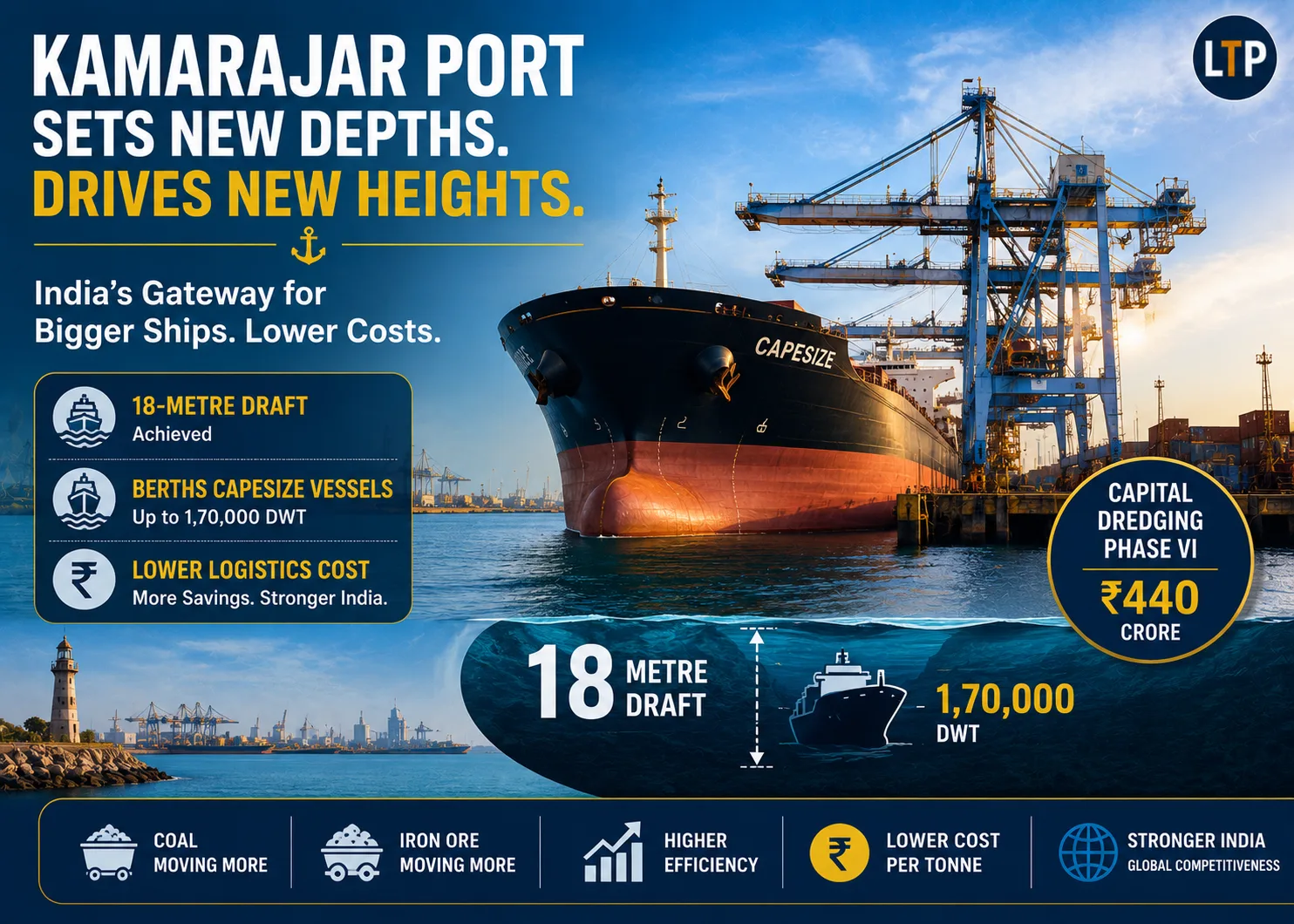
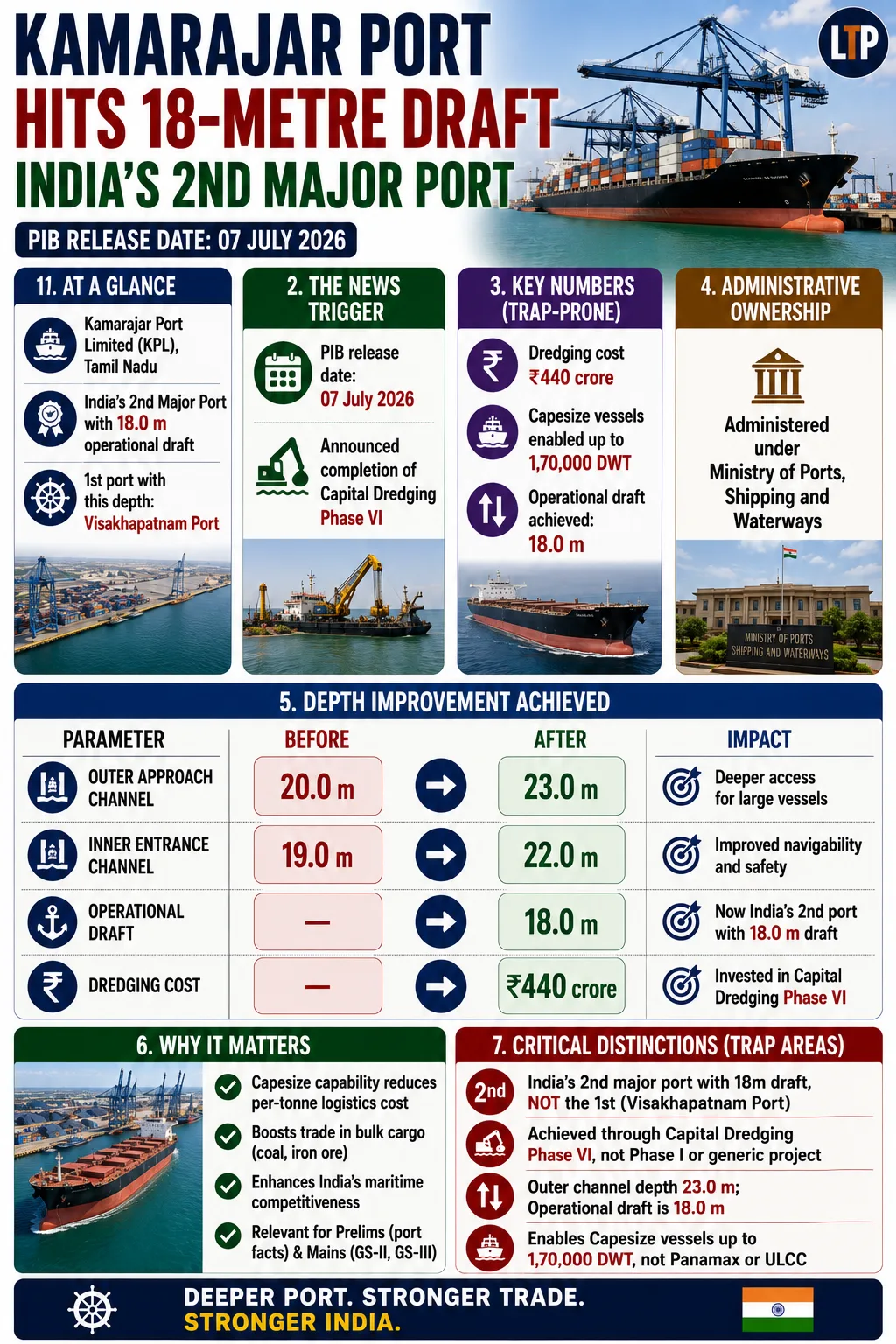
- Kamarajar Port Limited (KPL), Tamil Nadu, has become India's second Major Port (after Visakhapatnam Port) to achieve an 18.0-metre operational draft. [1]
- Achieved via completion of Capital Dredging Phase VI, costing ₹440 crore. [1]
- Port can now berth fully laden Capesize vessels of up to 1,70,000 DWT, cutting per-tonne logistics cost for bulk cargo (coal, iron ore). [1]
- Relevant for Prelims (port infrastructure facts) and Mains GS-III (infrastructure/logistics) and GS-II (maritime governance schemes). [1]
2. Why in the News
- PIB release dated 07 July 2026 announced completion of Kamarajar Port's Capital Dredging Phase VI, making it India's second Major Port with 18-metre draft capability. [1]
3. Background & Evolution
- Kamarajar Port is administered under the Ministry of Ports, Shipping and Waterways. [1]
- Dredging under Phase VI deepened the outer approach channel from 20.0 m to 23.0 m and the inner entrance channel from 19.0 m to 22.0 m, enabling the 18.0 m operational draft. [1]
- This links to the government's broader maritime vision documents — Maritime India Vision 2030 and Maritime Amrit Kaal Vision 2047 — cited in the same release as the policy umbrella for such capacity upgrades. [1]
- Prior to this, Visakhapatnam Port was the only Major Port with 18-metre draft capability; Kamarajar Port is now the second. [1]
4. Core Static Facts
| Parameter | Detail | Source |
|---|---|---|
| Port | Kamarajar Port Limited (KPL) | [1] |
| Rank achieved | 2nd Major Port with 18 m draft (after Visakhapatnam) | [1] |
| Project | Capital Dredging Phase VI | [1] |
| Investment | ₹440 crore | [1] |
| Operational draft | 18.0 metres | [1] |
| Outer approach channel depth | 20.0 m → 23.0 m | [1] |
| Inner entrance channel depth | 19.0 m → 22.0 m | [1] |
| Max vessel type handled | Fully laden Capesize vessels | [1] |
| Max cargo parcel size | 1,70,000 DWT (Deadweight Tonnage) | [1] |
| Administering Ministry | Ministry of Ports, Shipping and Waterways | [1] |
| Minister quoted | Shri Sarbananda Sonowal | [1] |
| Policy frameworks referenced | Maritime India Vision 2030; Maritime Amrit Kaal Vision 2047 | [1] |
5. Multi-Dimensional Analysis
Economic
- Deeper draft allows larger Capesize bulk carriers (up to 1,70,000 DWT), lowering per-unit freight cost via economies of scale — directly reduces logistics cost, a stated objective of the release. [1]
- Enhances India's competitiveness in bulk commodity trade (coal, iron ore, limestone) by avoiding transshipment/lightering costs previously needed for large vessels. [1]
Administrative
- Achievement delivered through a dredging project under the Ministry of Ports, Shipping and Waterways, indicating direct central execution rather than state-level port administration. [1]
Geopolitical / Strategic
- Draft-depth parity with Visakhapatnam Port strengthens India's position among global deep-draft ports capable of servicing Capesize vessels, relevant to global maritime trade routes and supply-chain resilience. [1]
Scientific / Technological
- Capital dredging (channel deepening) is the core engineering intervention — outer channel deepened by 3 m and inner channel by 3 m to attain the 18 m operational draft. [1]
6. Recent Developments (last 12-18 months)
- 07 July 2026: PIB announces completion of Capital Dredging Phase VI at Kamarajar Port, confirming 18-metre draft and Capesize-vessel capability. [1]
7. Prelims Hooks
- Kamarajar Port is India's second Major Port with an 18-metre draft. [1]
- The first Major Port with 18-metre draft is Visakhapatnam Port. [1]
- Kamarajar Port's draft upgrade came via Capital Dredging Phase VI. [1]
- Investment in Capital Dredging Phase VI: ₹440 crore. [1]
- Kamarajar Port can now handle vessels up to 1,70,000 DWT (Capesize class). [1]
- Outer approach channel deepened from 20.0 m to 23.0 m. [1]
- Inner entrance channel deepened from 19.0 m to 22.0 m. [1]
- Administering ministry: Ministry of Ports, Shipping and Waterways. [1]
- Union Minister associated with the announcement: Sarbananda Sonowal. [1]
- Policy frameworks cited: Maritime India Vision 2030 and Maritime Amrit Kaal Vision 2047. [1]
- "Capesize" vessels are the largest dry-bulk carrier class, generally too large for the Panama or Suez Canal (hence the name), typically used for iron ore/coal. [1]
8. Mains Relevance
- GS-III: Infrastructure — Ports, Waterways; also Effects of liberalization on the economy, changes in industrial policy and their effects on industrial growth (logistics cost reduction angle). [1]
- GS-II: Government policies and interventions for development in various sectors (maritime/shipping governance).
- Possible question stems: 1. "Discuss how deep-draft capability at Major Ports contributes to India's maritime competitiveness and logistics cost reduction." (GS-III) 2. "Examine the role of capital dredging projects in enhancing India's port infrastructure under the Maritime India Vision 2030." (GS-III) 3. "Analyse the strategic significance of India possessing Capesize-vessel-compatible ports in the context of global bulk trade." (GS-II/III)
9. Related Topics to Study Next
- Sagarmala Programme — umbrella port-led development initiative under which such dredging/capacity projects are typically framed.
- Maritime India Vision 2030 / Maritime Amrit Kaal Vision 2047 — the policy documents explicitly referenced in this release. [1]
- Major vs. Minor Ports classification in India — constitutional/administrative distinction (Union vs. State subject).
- Visakhapatnam Port — the only other 18-metre-draft Major Port; useful comparative case. [1]
- Capesize/Panamax/Handymax vessel classification — shipping terminology frequently tested.
- Major Port Authorities Act, 2021 — governs administration of Major Ports.
- Chennai Port and Kamarajar Port complementarity — Kamarajar Port was developed partly to decongest Chennai Port.
10. Common Errors / Trap Areas
- Do not confuse Kamarajar Port with Chennai Port — they are distinct, separately administered Major Ports in Tamil Nadu.
- Do not assume Kamarajar Port is the first 18-metre draft port — Visakhapatnam Port holds that distinction. [1]
- Draft capability (18 m) is an operational, not maximum theoretical, figure — don't conflate with channel depth figures (23 m outer/22 m inner), which are different metrics. [1]
- Administering ministry is Ministry of Ports, Shipping and Waterways, not Ministry of Commerce or a state maritime board. [1]
- Vessel capacity figure (1,70,000 DWT) refers to Capesize ships specifically — don't generalize to all vessel classes. [1]
Sources
At the end · practice MCQs
12 questions on this item
Check the answer for each question, or reveal all at once.