Prime Minister visits the UNESCO World Heritage Prambanan Temple Complex
New · District CollectorCan you hold the district for 72 hours?Floods, a heatwave, an outbreak, a grievance queue. Take the decisions, see the consequences.Play →In this note
1. At a Glance
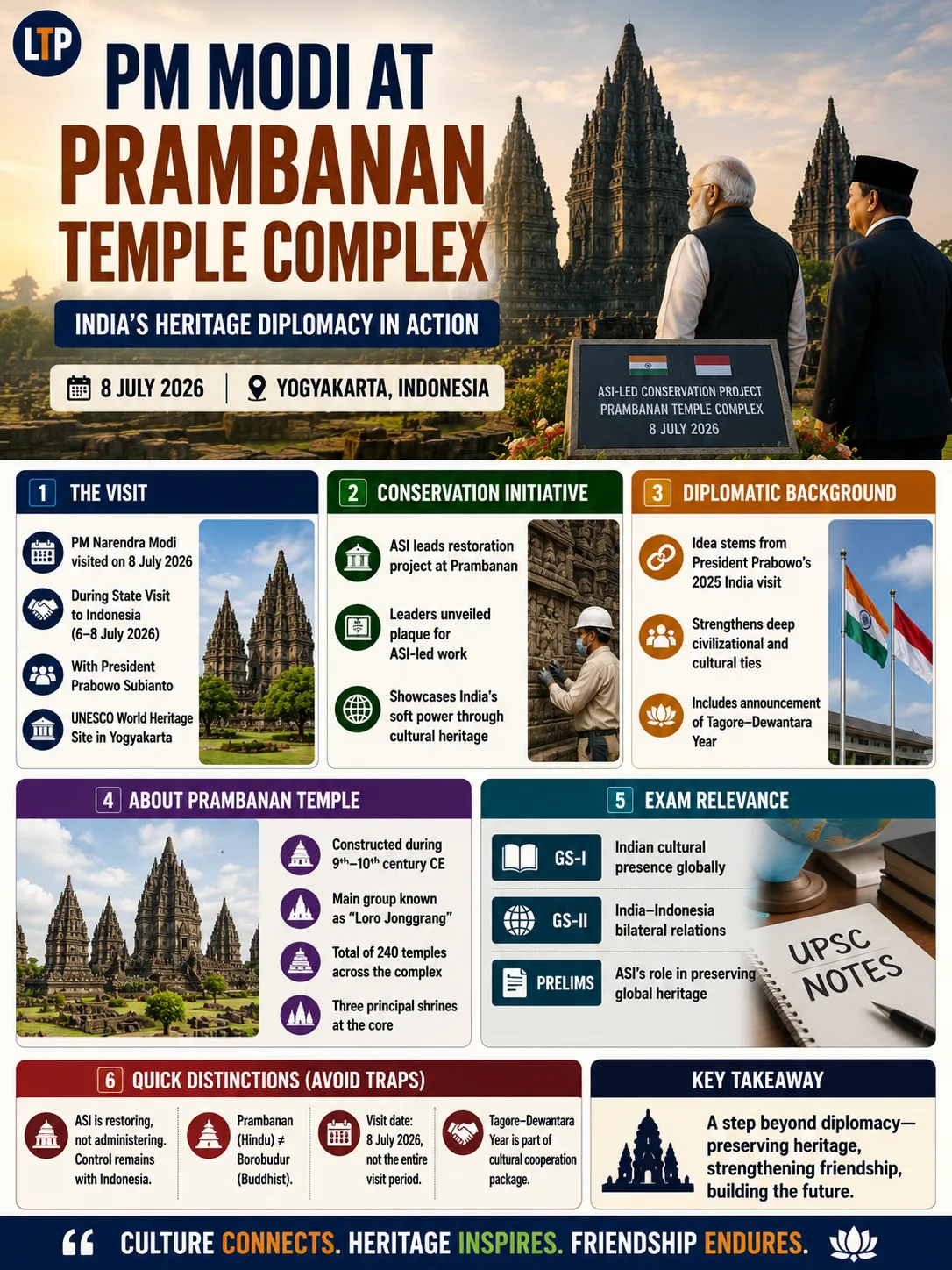
- PM Narendra Modi, during his State Visit to Indonesia (6–8 July 2026), visited the Prambanan Temple Complex, a UNESCO World Heritage Site in Yogyakarta, accompanied by Indonesian President Prabowo Subianto [1].
- The two leaders unveiled a plaque marking the start of an Archaeological Survey of India (ASI)-led conservation and restoration project at the complex [1].
- Tests India's cultural diplomacy toolkit (heritage conservation as soft power) — relevant for GS-I (Indian culture abroad) and GS-II (India-Indonesia bilateral relations) [1][2].
- Part of a wider package of India-Indonesia cultural cooperation announced during the visit, including a "Tagore–Dewantara Year" [2].
2. Why in the News
- PM Modi visited Prambanan Temple Complex on 8 July 2026 during his State Visit to Indonesia (6–8 July 2026) [1].
- India and Indonesia formally inaugurated the ASI-led restoration project at Prambanan via a joint plaque unveiling by PM Modi and President Prabowo [1][2].
- This follows up on an "understanding reached between the two leaders" during President Prabowo's 2025 State Visit to India [1].
3. Background & Evolution
- 9th–10th century: Prambanan Temple Compounds built; the main complex ("Loro Jonggrang") comprises 240 temples, with three main shrines dedicated to the Trimurti—Brahma, Vishnu, Shiva [1][3].
- 1991: Prambanan Temple Compounds inscribed as a UNESCO World Heritage Site [3].
- 2006: Site placed under UNESCO State of Conservation monitoring (post-earthquake damage review) [3].
- 2007–2008: Indonesian government issued a law (2007) and government regulation (2008) on national spatial planning prioritizing the Prambanan World Heritage area as a "strategic national area" [3].
- 2025: President Prabowo's State Visit to India — leaders agreed in principle on ASI's involvement in Prambanan conservation [1].
- 7–8 July 2026: During PM Modi's reciprocal State Visit, bilateral talks (7 July, Istana Merdeka, Jakarta) and joint statement formalize the ASI project; plaque unveiled at the site (8 July) [1][2].
4. Core Static Facts
| Fact | Detail |
|---|---|
| Site | Prambanan Temple Compounds, Yogyakarta, Indonesia [1] |
| Built | 9th–10th century [1][3] |
| Dedication | Trimurti — Brahma, Vishnu, Shiva [1] |
| Composition | Prambanan (Loro Jonggrang, 240 temples), Sewu, Bubrah, Lumbung Temples [3] |
| UNESCO status | Inscribed 1991 [3] |
| Implementing agency (India side) | Archaeological Survey of India (ASI), under Ministry of Culture [1] |
| Nature of project | Restoration and conservation works [1][2] |
| Trigger event | Joint plaque unveiling by PM Modi and President Prabowo Subianto, 8 July 2026 [1] |
| Related announcement | "Tagore–Dewantara Year of India–Indonesia Cultural and Educational Diplomacy" (2026–2027), marking centenary of Tagore's 1927 Indonesia visit [2] |
| Related artifact exchange | Replica of an ancient copper plate (~860 CE, Sanskrit/Devanagari script) from India's National Museum, displayed at Muara Jambi, Indonesia [2] |
5. Multi-Dimensional Analysis
Geopolitical / Strategic
- Reinforces India's Act East Policy and civilizational-linkage diplomacy with ASEAN's largest economy, Indonesia [1][2].
- Heritage conservation used as a soft-power instrument to deepen bilateral ties, paralleling India's diplomatic templates in Cambodia (Angkor Wat) and Vietnam (Cham temples).
Historical
- Reflects the historic Indianization of Southeast Asia — spread of Hindu-Buddhist civilizational influence via trade and cultural exchange, of which Prambanan is a monumental example [1][3].
- The Tagore-Dewantara Year commemorates a documented 20th-century cultural link (Tagore's 1927 visit), showing continuity of India-Indonesia cultural exchange [2].
Administrative
- ASI, India's premier heritage conservation body (under Ministry of Culture), undertakes the technical restoration work — reflects India's growing profile as a heritage-conservation exporter [1].
- Indonesia's own regulatory framework (2007 law, 2008 regulation) designates Prambanan a "strategic national area" for spatial planning, indicating domestic institutional backing for the site [3].
Social / Cultural
- Exchange of a replica inscribed copper plate (~860 CE) underscores shared ancient scriptural and linguistic (Sanskrit-Devanagari) heritage between India and Indonesia [2].
6. Recent Developments (last 12–18 months)
- 2025: President Prabowo Subianto's State Visit to India — initial understanding reached on ASI's Prambanan role [1].
- 6–8 July 2026: PM Modi's State Visit to Indonesia; bilateral talks at Istana Merdeka, Jakarta (7 July) [1][2].
- 8 July 2026: Joint visit to Prambanan Temple Complex; plaque unveiled marking commencement of ASI conservation project [1].
- 2026 (visit): Announcement of "Tagore–Dewantara Year 2026–2027" and copper-plate replica gift to Muara Jambi [2].
7. Prelims Hooks
- Prambanan Temple Complex is located in Yogyakarta, Indonesia [1].
- Built in the 9th century (per PIB release) [1].
- Dedicated to the Trimurti: Brahma, Vishnu, Shiva [1].
- It is the largest temple complex in Indonesia dedicated to the Trimurti [1].
- Indonesian President accompanying PM Modi: H.E. Mr. Prabowo Subianto [1].
- Conservation/restoration project led by: Archaeological Survey of India (ASI) [1].
- Understanding for the project originated during Prabowo's 2025 State Visit to India [1].
- Prambanan Temple Compounds inscribed as UNESCO World Heritage Site in 1991 [3].
- The main Prambanan complex (Loro Jonggrang) consists of 240 temples [3].
- Prambanan Temple Compounds also include Sewu, Bubrah, and Lumbung Temples [3].
- 2026–2027 declared the "Tagore–Dewantara Year of India–Indonesia Cultural and Educational Diplomacy" [2].
- The Tagore-Dewantara Year marks the centenary of Rabindranath Tagore's 1927 visit to Indonesia [2].
- India gifted Indonesia a replica of a copper plate (~860 CE) inscribed in Sanskrit and Devanagari, displayed at Muara Jambi [2].
- PM Modi's State Visit to Indonesia (bilateral talks) took place at Istana Merdeka, Jakarta [2].
8. Mains Relevance
- GS-I: Indian Culture — spread of Indian culture in Southeast Asia; salient features of Indian art forms, literature and architecture from ancient to modern times.
- GS-II: India and its neighborhood; bilateral, regional, and global groupings involving India; Act East Policy.
- Possible question stems: 1. "Discuss the role of heritage conservation diplomacy in strengthening India's Act East Policy, with reference to the ASI's involvement in the Prambanan Temple restoration." (GS-II) 2. "Trace the historical process of 'Indianization' of Southeast Asia and examine its contemporary relevance in India's cultural diplomacy." (GS-I) 3. "Examine how heritage and cultural exchange programs serve as instruments of India's soft power in its extended neighborhood." (GS-II)
9. Related Topics to Study Next
- Archaeological Survey of India (ASI) — mandate, past international conservation projects (e.g., Angkor Wat, Cambodia).
- Act East Policy — India's strategic and economic engagement framework with ASEAN.
- Indianization of Southeast Asia — historical spread of Hindu-Buddhist culture (Champa, Srivijaya, Majapahit kingdoms).
- India-ASEAN relations — summits, connectivity initiatives, trade agreements.
- UNESCO World Heritage Sites in India — comparative study of listing criteria and India's own conservation challenges.
- Nalanda University revival — another India-led civilizational/education diplomacy initiative in Asia.
- Borobudur Temple — nearby Buddhist UNESCO site in Indonesia, useful comparative/contrast case.
- Cultural diplomacy instruments — ICCR, Indian Council for Cultural Relations's role in soft power projection.
10. Common Errors / Trap Areas
- Do not confuse Prambanan (Hindu, Trimurti-dedicated) with Borobudur (Buddhist stupa complex) — both are in Yogyakarta but are distinct UNESCO sites.
- Note the implementing agency is ASI (Ministry of Culture), not the Ministry of External Affairs or ICCR, even though the visit is diplomatic in nature.
- Aspirants may wrongly attribute the "understanding" on conservation to the 2026 visit itself — it actually originated during President Prabowo's 2025 visit to India.
- Do not mix up Prambanan's dedication (Trimurti — Brahma, Vishnu, Shiva) with sites dedicated solely to Shiva or Vishnu.
- The "Tagore-Dewantara Year" and the copper-plate gift are separate initiatives from the Prambanan ASI project — avoid conflating all cultural announcements from the visit into one scheme.
Sources
- 1Prime Minister visits the UNESCO World Heritage Prambanan Temple Complexpib.gov.in · tier 1
- 2India-Indonesia Joint Statement on the State Visit by Prime Minister of India to Indonesiapib.gov.in · tier 1
- 3Prambanan Temple Compounds — UNESCO World Heritage Centre — State of Conservation recordwhc.unesco.org · tier 2