India Showcases Women-led Panchayati Raj as a Global Model for Inclusive Grassroots Governance at BRICS Women Ministerial Meeting
New · District CollectorCan you hold the district for 72 hours?Floods, a heatwave, an outbreak, a grievance queue. Take the decisions, see the consequences.Play →In this note
1. At a Glance
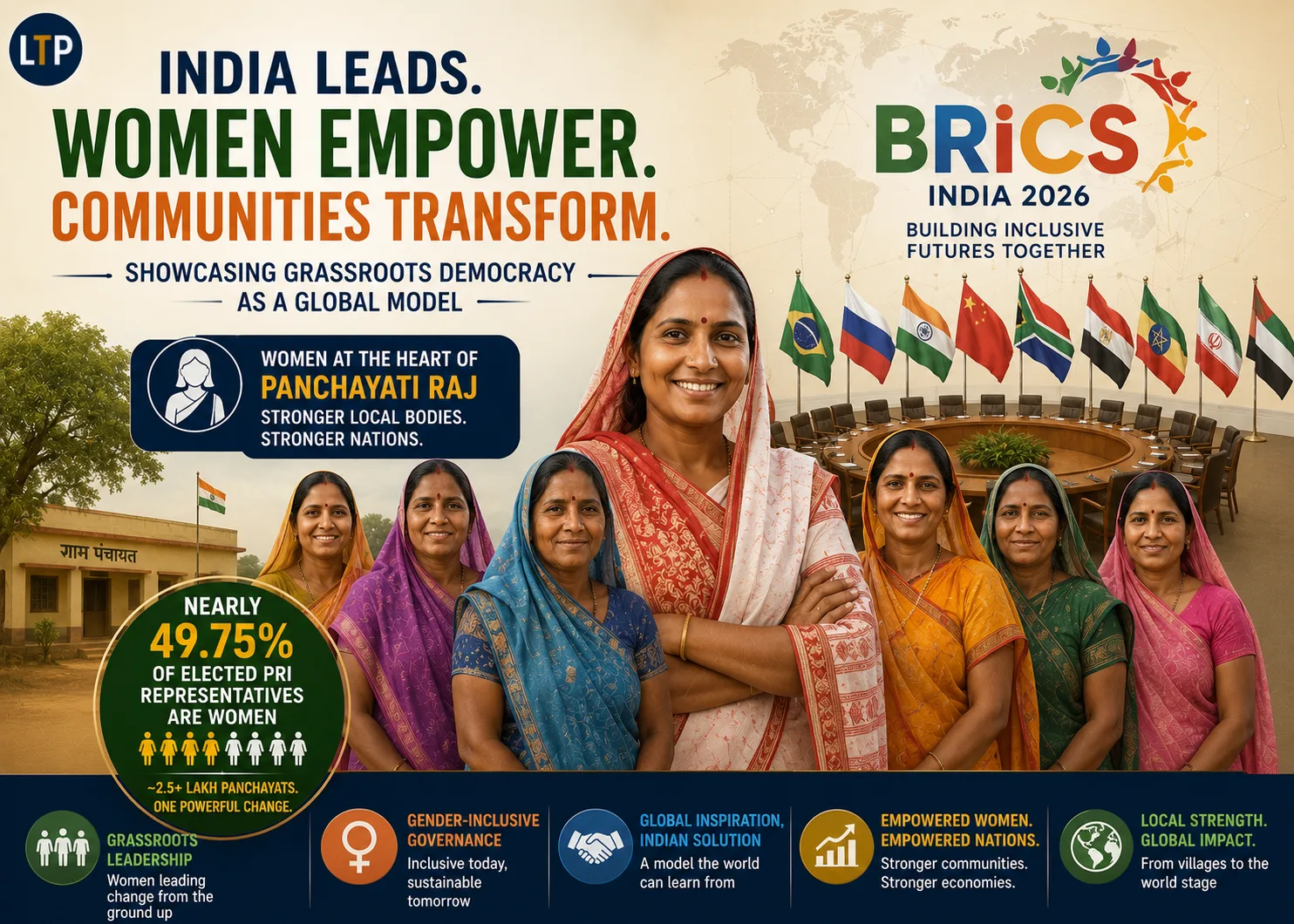
- India used its BRICS Chairship 2026 to project women-led Panchayati Raj Institutions (PRIs) as a global template for grassroots gender-inclusive governance. [1]
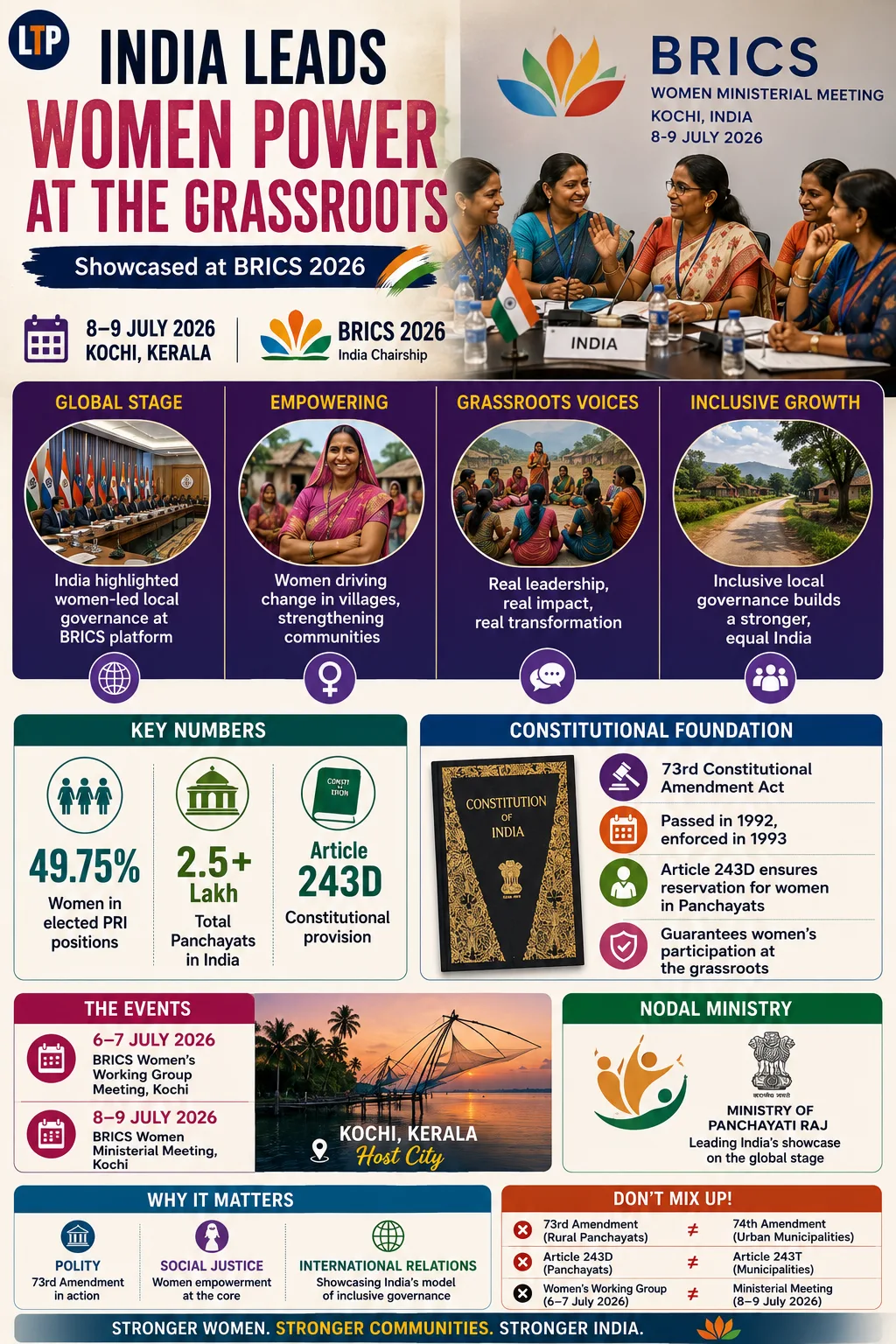
- Nearly 49.75% of elected PRI representatives across India's 2.5+ lakh Panchayats are women — one of the largest pools of elected women leaders in the world. [3]
- Constitutional guarantee (Article 243D, 73rd Amendment) underpins this, making it a rare case of constitutionally mandated gender parity in local government. [3]
- High-value topic linking Polity (73rd Amendment), Social Justice (women's empowerment), and International Relations (BRICS) — a favourite UPSC intersection.
2. Why in the News
- Under India's BRICS Chairship 2026, the Ministry of Panchayati Raj showcased women-led decentralisation at a panel — "Advancing Women's Leadership at the Grassroots" — during the BRICS Women Ministerial Meeting, held in Kochi, Kerala, on 8 July 2026. [1]
- Panel chaired by Shri Vivek Bharadwaj, Secretary, Ministry of Panchayati Raj. [1]
- The Ministerial Meeting (8–9 July 2026) followed the BRICS Women's Working Group Meeting held on 6–7 July 2026, also in Kochi. [2]
3. Background & Evolution
- 1992 — 73rd Constitutional Amendment Act passed; came into force 1993, granting constitutional status to Panchayati Raj Institutions. [3]
- Article 243D mandates not less than one-third reservation for women in total seats and chairperson offices in Panchayats. [3]
- Subsequently, 21 States and 2 Union Territories enhanced this to 50% reservation for women in their respective State Panchayati Raj Acts (e.g., Andhra Pradesh, Bihar, Kerala, Madhya Pradesh, Rajasthan, Tamil Nadu, West Bengal, etc.). [3][4]
- March 2025 — Ministry launched Sashakt Panchayat Netri Abhiyan, a capacity-building program for elected women representatives. [1]
- Ministry rolled out Model Women-Friendly Gram Panchayat Initiative (one per district, with UNFPA support) covering health, nutrition, education, skilling, safety and inclusive service delivery. [1]
- 744 Gram Panchayats developed as gender-responsive governance models; 1.5 lakh elected women representatives trained under Ministry programmes. [1]
- India's BRICS Chairship in 2026 provided the international platform to present these as replicable models to BRICS partner nations. [1][2]
4. Core Static Facts
| Item | Detail |
|---|---|
| Nodal Ministry | Ministry of Panchayati Raj, Government of India [1] |
| Enabling constitutional provision | Article 243D, 73rd Constitutional Amendment Act, 1992 (in force 1993) [3] |
| Minimum reservation | 1/3rd of seats & chairperson posts for women [3] |
| Enhanced state reservation | 50%, in 21 States + 2 UTs [3][4] |
| Current women representation | ~49.75% of elected representatives across 2.5+ lakh Panchayats [3] |
| Award data cited | 25 of 42 award-winning Gram Panchayats (National Panchayat Awards) led by women [1] |
| Capacity building | 1.5 lakh elected women representatives trained [1] |
| Model villages | 744 Gram Panchayats as gender-responsive models [1] |
| Flagship scheme (2025) | Sashakt Panchayat Netri Abhiyan [1] |
| International partner | UNFPA (Model Women-Friendly Gram Panchayat Initiative) [1] |
| Measurement tool | Panchayat Advancement Index — ~150 indicators [1] |
| Event | BRICS Women Ministerial Meeting, Kochi, Kerala, 8–9 July 2026, under India's BRICS Chairship 2026 [1][2] |
| Preceding event | BRICS Women's Working Group Meeting, Kochi, 6–7 July 2026 [2] |
| Panel chair | Shri Vivek Bharadwaj, Secretary, Ministry of Panchayati Raj [1] |
| Other speakers | Sharmila Mary Joseph (Kerala Principal Secretary), Neeru Yadav (Sarpanch, Rajasthan), Bhakti Sharma (former Sarpanch, Madhya Pradesh) [1] |
| BRICS Women Track priority areas | Governance & leadership; digital/financial inclusion; entrepreneurship & skilling; climate action, food security & nutrition [2] |
5. Multi-Dimensional Analysis
Social
- Reservation-driven representation has produced a critical mass of women in local decision-making — moving beyond tokenism toward substantive leadership (e.g., Sarpanches cited as case studies). [1]
- Model Women-Friendly Gram Panchayats target intersecting social needs — health, nutrition, education, safety. [1]
Legal / Constitutional
- Rests on Article 243D — a rare constitutionally entrenched gender quota, distinguishing India's model from voluntary/administrative quotas elsewhere. [3]
- State-level enhancement to 50% reservation shows cooperative federalism operationalising a constitutional floor into a higher state-level ceiling. [3][4]
Geopolitical / Strategic
- Showcasing at BRICS reflects India's use of soft power/development diplomacy — projecting a domestic governance success as an exportable "Global South" model during its BRICS Chairship 2026. [1][2]
- Aligns with India's broader positioning on South-South cooperation and women-led development narratives ("Nari Shakti") in multilateral fora. [2]
Administrative / Governance
- Panchayat Advancement Index (~150 indicators) institutionalises monitoring of decentralised governance performance, including gender indicators. [1]
- Implementation gap flagged historically: reservation ensures numbers, but capacity-building schemes (Sashakt Panchayat Netri Abhiyan) address the "proxy representation" (sarpanch-pati) problem indirectly. [1]
Ethical
- Debate persists on whether formal reservation translates into effective decision-making autonomy for women, or whether patriarchal proxy control undermines it — the training/capacity focus responds to this criticism. [1]
6. Recent Developments (last 12-18 months)
- March 2025: Sashakt Panchayat Netri Abhiyan launched. [1]
- 2025–26: Rollout of Model Women-Friendly Gram Panchayat Initiative with UNFPA support. [1]
- 6–7 July 2026: BRICS Women's Working Group Meeting held in Kochi. [2]
- 8 July 2026: Panel "Advancing Women's Leadership at the Grassroots" held during BRICS Women Ministerial Meeting, Kochi. [1]
- 8–9 July 2026: BRICS Women Ministerial Meeting hosted by India under its BRICS Chairship 2026. [2]
7. Prelims Hooks
- BRICS Women Ministerial Meeting 2026 held in Kochi, Kerala, on 8–9 July 2026. [1][2]
- Nodal ministry for the panel: Ministry of Panchayati Raj (not Ministry of Women & Child Development). [1]
- Panel chaired by Shri Vivek Bharadwaj, Secretary, Ministry of Panchayati Raj. [1]
- Panel theme: "Advancing Women's Leadership at the Grassroots." [1]
- Constitutional basis for women's reservation in Panchayats: Article 243D, inserted by the 73rd Constitutional Amendment Act, 1992 (effective 1993). [3]
- Minimum constitutional reservation for women in Panchayats: one-third (1/3). [3]
- 21 States + 2 UTs provide 50% reservation for women in PRIs. [3][4]
- Women constitute approximately 49.75% of elected Panchayat representatives nationally. [3]
- Sashakt Panchayat Netri Abhiyan launched in March 2025. [1]
- 744 Gram Panchayats developed as gender-responsive governance models. [1]
- 1.5 lakh elected women representatives trained under Ministry capacity-building programmes. [1]
- International partner for Model Women-Friendly Gram Panchayat Initiative: UNFPA (United Nations Population Fund). [1]
- Panchayat Advancement Index uses nearly 150 measurable indicators. [1]
- 25 of 42 award-winning Gram Panchayats (National Panchayat Awards) are women-led. [1]
- The BRICS Women's Working Group Meeting preceded the Ministerial Meeting, held 6–7 July 2026 in Kochi. [2]
- India holds the BRICS Chairship in 2026. [1][2]
8. Mains Relevance
- GS-II: Polity & Governance — "Devolution of powers and finances up to local levels and challenges therein"; "Welfare schemes for vulnerable sections"; also India's role in international/regional groupings (BRICS) affecting India's interests.
- GS-I: Social empowerment issues — role of women and women's organisation.
- Possible Mains stems: 1. "Discuss how constitutional reservation for women under Article 243D has transformed grassroots governance in India. What structural challenges limit its full potential?" (GS-II) 2. "Examine India's use of Panchayati Raj as a 'soft power' instrument in multilateral platforms such as BRICS." (GS-II) 3. "'Numerical representation does not automatically translate into substantive empowerment.' Critically analyse this statement in the context of women in Panchayati Raj Institutions." (GS-I/GS-II)
9. Related Topics to Study Next
- 73rd & 74th Constitutional Amendment Acts — foundational legal architecture for PRIs and urban local bodies.
- Nari Shakti Vandan Adhiniyam, 2023 — parallel reservation for women in Parliament/State Assemblies; useful comparative angle. [2]
- Sarpanch-Pati phenomenon — critical governance issue undermining substantive women's participation.
- BRICS grouping and India's 2026 Chairship — broader mandate, other working groups (MSME, trade), summit outcomes.
- National Panchayat Awards / Panchayat Advancement Index — Ministry of Panchayati Raj's flagship monitoring tools.
- SDG Localization in India — NITI Aayog's Localizing SDGs framework, linked to Panchayat-level indicators.
- Gender Budgeting in India — fiscal policy angle complementing representational empowerment.
- UNFPA's role in India — international agency partnerships in domestic governance schemes.
10. Common Errors / Trap Areas
- Confusing Ministry of Panchayati Raj with Ministry of Women & Child Development as the nodal ministry for this event — it is the former. [1]
- Mixing up 73rd Amendment (Panchayats/rural) with 74th Amendment (Municipalities/urban) — Article 243D applies to Panchayats; the analogous urban provision is Article 243T.
- Assuming the one-third reservation is uniform nationwide — many states have gone further to 50% by state legislation, not by constitutional mandate. [3][4]
- Confusing the BRICS Women's Working Group Meeting (6–7 July) with the BRICS Women Ministerial Meeting (8–9 July) — the former is officials-level, latter is ministerial. [2]
- Conflating the Nari Shakti Vandan Adhiniyam, 2023 (women's reservation in Parliament/Assemblies) with the much older 73rd Amendment provisions for Panchayats — different laws, different tiers of governance. [2]
Sources
- 1India Showcases Women-led Panchayati Raj as a Global Model for Inclusive Grassroots Governance at BRICS Women Ministerial Meetingpib.gov.in · tier 1
- 2India to host BRICS Women Ministerial Meeting in Kochi on July 8 — DD News (govt broadcaster reporting on official schedule; corroborating tier-1 event details)ddnews.gov.in · tier 1
- 3Participation of Women in Panchayats — PIBpib.gov.in · tier 1
- 4Women Reservation in Panchayats — PIBpib.gov.in · tier 1