Union Ministry for Education Releases Reports of the All India Survey on Higher Education (AISHE): 2022-23 & 2023-24
New · District CollectorCan you hold the district for 72 hours?Floods, a heatwave, an outbreak, a grievance queue. Take the decisions, see the consequences.Play →In this note
Practice
7 questions on this item
Check the answer for each question, or reveal all at once.
1. At a Glance
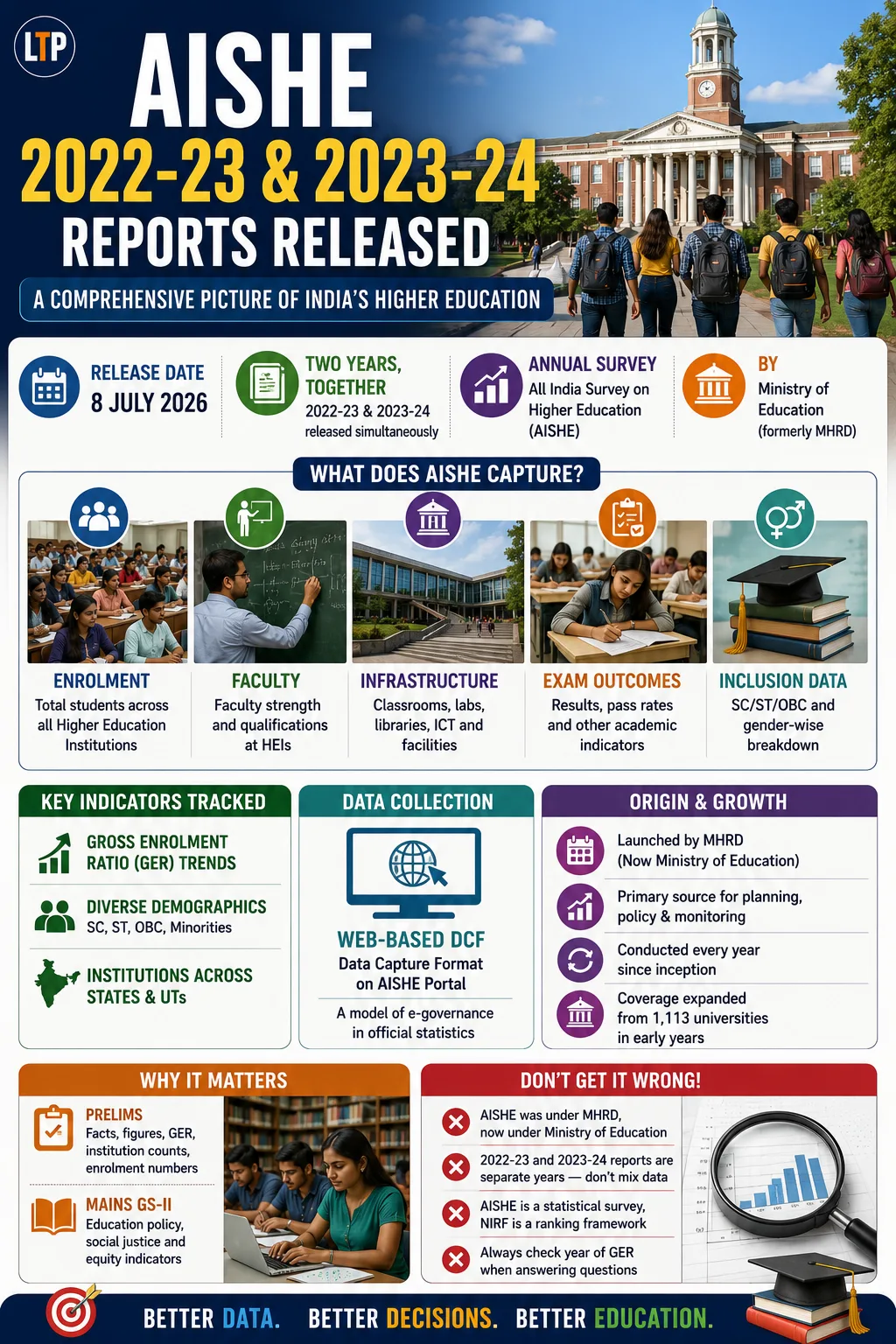
- AISHE (All India Survey on Higher Education) is India's primary official statistical exercise on higher education, conducted annually by the Ministry of Education. [1]
- On 08 July 2026, the Ministry released two consolidated reports simultaneously — AISHE 2022-23 and AISHE 2023-24 — covering enrolment, faculty, infrastructure, and examination outcomes of Higher Education Institutions (HEIs). [1]
- Relevant for Prelims (facts/figures) and Mains GS-II (education policy, social justice indicators via SC/ST/OBC and gender data). [1]
- Data is collected via a web-based Data Capture Format (DCF) on the AISHE portal, making it a key example of e-governance in statistics collection. [1]
2. Why in the News
- Union Ministry of Education released the AISHE Reports for 2022-23 and 2023-24 on 08 July 2026, disclosing HEI participation rates, GER trends, enrolment figures, and faculty data for both years together. [1]
3. Background & Evolution
- AISHE was launched by the Ministry of Education (then MHRD) to serve as the primary source of official higher-education statistics in India, used for policy formulation, planning, and monitoring. [1]
- The survey has been conducted annually since its inception, with successive editions (e.g., 2018-19, 2019-20, 2020-21, 2021-22) progressively expanding institutional coverage — from 1,113 universities (2020-21) to 1,168 universities (2021-22). [1]
- Predecessor comparative baseline year commonly used for trend analysis in government releases is 2014-15. [1]
4. Core Static Facts
| Parameter | 2022-23 | 2023-24 |
|---|---|---|
| Registered HEIs | 60,380 | 64,756 |
| Participating HEIs | 56,180 | 59,533 |
| Participation rate | >90% | >90% |
| Overall GER | 29.5 | 30 |
| Female GER | — | 31.2 |
| SC GER | — | 27.8 |
| ST GER | — | 22.8 |
| Gender Parity Index (GPI) | — | 1.08 |
| Total enrolment | — | 4.50 crore |
| Female enrolment | — | 2.24 crore |
- Implementing body: Ministry of Education, via the AISHE web portal (DCF-based self-reporting by HEIs). [1]
- Baseline year for growth comparisons: 2014-15 (overall GER 23.7; female GER 22.9; SC GER 18.9; ST GER 13.5). [1]
5. Multi-Dimensional Analysis
Social
- GPI of 1.08 in 2023-24 marks the seventh consecutive year GPI has stayed above 1.0, signalling sustained higher relative enrolment of women in higher education. [1]
- SC enrolment rose to 69.72 lakh (+51.4% since 2014-15) and ST enrolment to 28.83 lakh (+75.7% since 2014-15), indicating improved access for marginalised groups. [1]
- OBC enrolment reached 1.80 crore, a 60.2% increase over the 2014-15 baseline. [1]
Administrative
- Participation of HEIs (self-reporting via DCF) exceeded 90% in both years, reflecting improved compliance/data-capture mechanisms on the AISHE portal. [1]
- Registered HEIs grew from 60,380 (2022-23) to 64,756 (2023-24), showing continued expansion of the institutional base within a single year. [1]
Economic
- Rising STEM enrolment (91.5 lakh in 2014-15 to 1.02 crore in 2023-24) is directly linked to skilling and employability priorities under national education policy goals. [1]
- Female participation in STEM rose from 38.4% to 44%, relevant to workforce diversification in technical sectors. [1]
Governance
- Data-driven policymaking: AISHE's DCF-based digital collection model is cited as a template for governance-through-statistics, feeding into planning and monitoring of higher education schemes. [1]
6. Recent Developments (last 12-18 months)
- 08 July 2026: Simultaneous release of AISHE 2022-23 and AISHE 2023-24 reports by the Union Ministry of Education, an unusual joint release of two survey years together. [1]
7. Prelims Hooks
- AISHE is conducted by the Ministry of Education (not MoSPI), despite being a statistical survey. [1]
- Data collected through a web-based Data Capture Format (DCF) on the AISHE portal. [1]
- 2022-23: 56,180 of 60,380 registered HEIs participated (>90%). [1]
- 2023-24: 59,533 of 64,756 registered HEIs participated (>90%). [1]
- Overall GER rose from 23.7 (2014-15) to 30 (2023-24). [1]
- Female GER in 2023-24: 31.2, up from 22.9 in 2014-15. [1]
- SC GER in 2023-24: 27.8; ST GER: 22.8. [1]
- Gender Parity Index (GPI) = 1.08 in 2023-24 — above 1.0 for 7 consecutive years. [1]
- Total higher education enrolment in 2023-24: 4.50 crore (+31.5% vs 2014-15). [1]
- Female enrolment 2023-24: 2.24 crore (+42.2% since 2014-15). [1]
- SC student enrolment: 69.72 lakh (+51.4%); ST: 28.83 lakh (+75.7%); OBC: 1.80 crore (+60.2%). [1]
- STEM enrolment grew from 91.5 lakh (2014-15) to 1.02 crore (2023-24); female share in STEM rose from 38.4% to 44%. [1]
- Total faculty in 2023-24: 17.32 lakh (55.1% male, 44.9% female); female faculty grew from 5.69 lakh to 7.78 lakh since 2014-15. [1]
- AISHE 2021-22 (previous edition) recorded 1,168 universities, 45,473 colleges, 12,002 standalone institutions. [1]
8. Mains Relevance
- GS-II — Government Policies & Interventions for Development in Education Sector; Issues Relating to Development and Management of Social Sector/Services relating to Education.
- GS-I — Social Empowerment (relevant to SC/ST/OBC and gender enrolment trends).
- Possible question stems:
- "Discuss the significance of the Gross Enrolment Ratio and Gender Parity Index as indicators of the state of higher education in India, with reference to recent AISHE findings."
- "Examine the trends in access to higher education among SC, ST and OBC communities in India over the last decade, using recent survey data."
- "AISHE data collection through digital self-reporting exemplifies data-driven governance. Discuss its strengths and limitations in capturing the true state of higher education in India."
9. Related Topics to Study Next
- National Education Policy (NEP) 2020 — sets the GER target (50% by 2035) against which AISHE data is benchmarked.
- RUSA (Rashtriya Uchchatar Shiksha Abhiyan) — centrally sponsored scheme for state higher-education institutions, tracked partly via AISHE data.
- Gender Parity Index & UNESCO education indicators — comparative international benchmarking of GPI.
- UDISE+ — analogous survey for school education, useful for contrast in methodology/scope.
- Digital India / e-governance in statistics — DCF-based data collection as a case study.
- Reservation policy in higher education — context for SC/ST/OBC enrolment growth.
- PM-USHA / HESPIS (Higher Education Statistics and Public Information System) — central sector schemes linked to AISHE infrastructure.
10. Common Errors / Trap Areas
- Do not confuse implementing ministry: AISHE is under Ministry of Education, not MoSPI (which handles most national surveys like NSS/PLFS). [1]
- Do not conflate GER (Gross Enrolment Ratio) with GPI (Gender Parity Index) — GER measures overall enrolment coverage; GPI measures the female-to-male enrolment ratio.
- Note this release is unusual in covering two survey years (2022-23 and 2023-24) jointly — don't assume only one year's data was released.
- Baseline comparisons in official releases use 2014-15, not the immediately preceding survey year — check which baseline a stated percentage growth refers to.
- Registered HEIs ≠ Participating HEIs — participation rate (~90%+) is a distinct figure from the total registered count.
Sources
- 1Press Release Page | Press Information Bureaupib.gov.in · tier 1
At the end · practice MCQs
7 questions on this item
Check the answer for each question, or reveal all at once.