India-Australia Joint Statement on Energy Security
New · District CollectorCan you hold the district for 72 hours?Floods, a heatwave, an outbreak, a grievance queue. Take the decisions, see the consequences.Play →In this note
1. At a Glance
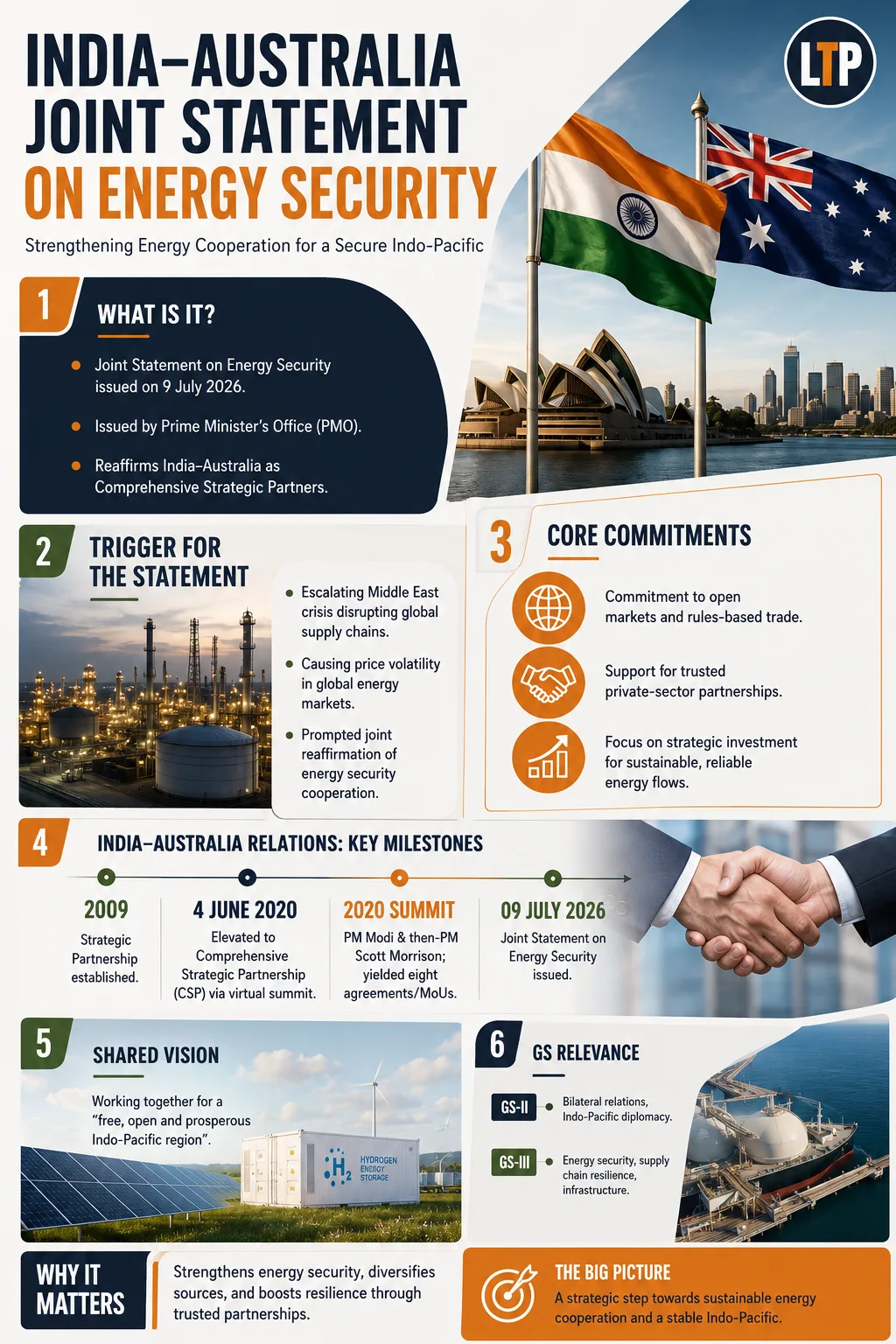
- A Joint Statement on Energy Security was issued by India and Australia, reaffirming their status as Comprehensive Strategic Partners with a shared vision for a "free, open and prosperous Indo-Pacific region" [1].
- Issued against the backdrop of the Middle East crisis disrupting global energy, resources and commodity supply chains and prices [1].
- Reaffirms commitment to open markets and rules-based trade, and to trusted private-sector partnerships and strategic investment for sustainable, reliable energy flows [1].
- Relevant for GS-II (bilateral relations) and GS-III (energy security, infrastructure) — tests India's Indo-Pacific energy diplomacy amid West Asia instability.
2. Why in the News
- The statement was released by PIB, Prime Minister's Office, on 09 July 2026 [1].
- Trigger: escalating Middle East situation causing disruption to global energy/resource/commodity supply chains and price volatility, prompting India and Australia to jointly reaffirm energy-security cooperation [1].
3. Background & Evolution
- India–Australia relations were elevated from a Strategic Partnership (2009) to a Comprehensive Strategic Partnership (CSP) on 4 June 2020, via a virtual summit between PM Modi and then-PM Scott Morrison [2].
- The 2020 CSP-elevation summit also yielded eight agreements/MoUs, spanning Maritime Cooperation in the Indo-Pacific, Defence, Cyber Security, Education, Mining, and Water Resource Management [2].
- The 2026 Joint Statement on Energy Security builds on this CSP framework, applying it specifically to the energy domain amid a live geopolitical shock [1].
4. Core Static Facts
| Aspect | Detail |
|---|---|
| Instrument | Joint Statement on Energy Security (India–Australia) [1] |
| Issuing body | Prime Minister's Office, via PIB Delhi [1] |
| Date of release | 09 July 2026 [1] |
| Relationship status | Comprehensive Strategic Partners [1] |
| CSP established | 4 June 2020 (elevated from 2009 Strategic Partnership) [2] |
| Core theme | Energy security amid Middle East-driven supply-chain disruption [1] |
| Stated principles | Open markets, rules-based trade, private-sector-led investment [1] |
5. Multi-Dimensional Analysis
Geopolitical / Strategic
- Signals India–Australia alignment on a free, open, prosperous Indo-Pacific, consistent with the Quad framework logic [1].
- Reflects a shared threat perception of Middle East instability as a driver of regional insecurity, not just an economic issue [1].
Economic
- Emphasis on open markets and rules-based trade as the basis of "prosperity and economic security" — ties energy security directly to trade-order stability [1].
- Prioritises private-sector partnerships and strategic investment over state-to-state trading arrangements as the delivery mechanism for energy flows [1].
Administrative / Diplomatic
- Continuation of institutionalised bilateral engagement under the CSP architecture built since 2020, showing sectoral (energy) deepening of a broader strategic relationship [2].
6. Recent Developments (last 12-18 months)
- 09 July 2026: India-Australia Joint Statement on Energy Security issued, PIB Delhi [1].
- Statement explicitly references the ongoing Middle East situation as a live, current disruptive factor on energy/commodity markets [1].
7. Prelims Hooks
- India and Australia are termed "Comprehensive Strategic Partners" in the 2026 Joint Statement on Energy Security [1].
- The India-Australia Joint Statement on Energy Security was released by PIB Delhi, PMO, on 09 July 2026 [1].
- The Joint Statement cites the Middle East situation as the proximate cause of energy/commodity supply-chain disruption [1].
- India-Australia relations were upgraded to a Comprehensive Strategic Partnership on 4 June 2020 [2].
- Before 2020, the bilateral relationship was termed a Strategic Partnership, dating to 2009 [2].
- The 2020 CSP summit was virtual, held between PM Modi and PM Scott Morrison [2].
- The 2020 CSP package included eight agreements/MoUs covering Maritime Cooperation, Defence, Cyber Security, Education, Mining, and Water Resource Management [2].
- The 2026 statement stresses "trusted private sector partnerships" as central to sustainable/reliable energy flows [1].
- Shared vision articulated: a "free, open and prosperous Indo-Pacific region" [1].
8. Mains Relevance
- GS-II: Bilateral, regional and global groupings/agreements involving India — India's Indo-Pacific partnerships.
- GS-III: Infrastructure — Energy; Security challenges and their management — external state and non-state actors' impact on economic security.
- Possible question stems:
- "Discuss how instability in the Middle East is reshaping India's energy-security diplomacy with Indo-Pacific partners like Australia." (GS-III)
- "Trace the evolution of India-Australia relations from a Strategic Partnership to a Comprehensive Strategic Partnership, and assess its significance for India's energy security." (GS-II)
- "Examine the role of private-sector partnerships in ensuring resilient energy supply chains for India." (GS-III)
9. Related Topics to Study Next
- Quad (India, US, Japan, Australia) — the broader Indo-Pacific security/economic grouping Australia belongs to.
- India-Australia Economic Cooperation and Trade Agreement (ECTA) — the trade dimension underpinning "open markets" commitments.
- India's crude oil import diversification strategy — context for why Middle East disruption matters to India.
- Indo-Pacific Oceans Initiative (IPOI) — India's broader Indo-Pacific engagement architecture.
- India's Strategic Petroleum Reserves (SPR) — domestic energy-security buffer relevant to the same theme.
- Civil Nuclear Cooperation Agreements (India-Australia, India-US) — related bilateral energy-technology track.
- G20 New Delhi Leaders' Declaration on energy transition — multilateral parallel on energy security/transition commitments.
10. Common Errors / Trap Areas
- Do not confuse the 2020 Comprehensive Strategic Partnership (relationship upgrade) with the 2026 Joint Statement on Energy Security (a sector-specific document) — they are distinct instruments issued six years apart [1][2].
- Do not misattribute the 2009-to-2020 upgrade timeline — the original Strategic Partnership dates to 2009, elevated to CSP in 2020, not vice versa [2].
- Avoid assuming this is a Quad document — it is a bilateral India-Australia statement, not a Quad joint statement [1].
- Do not overstate specifics (e.g., numeric trade/investment targets) not present in the PIB text — the excerpt reaffirms commitments in principle without disclosed figures [1].