Australia-India Partnership on Cyber, Critical Technologies and Supply Chains (PACTS)
New · District CollectorCan you hold the district for 72 hours?Floods, a heatwave, an outbreak, a grievance queue. Take the decisions, see the consequences.Play →In this note
Practice
9 questions on this item
Check the answer for each question, or reveal all at once.
1. At a Glance
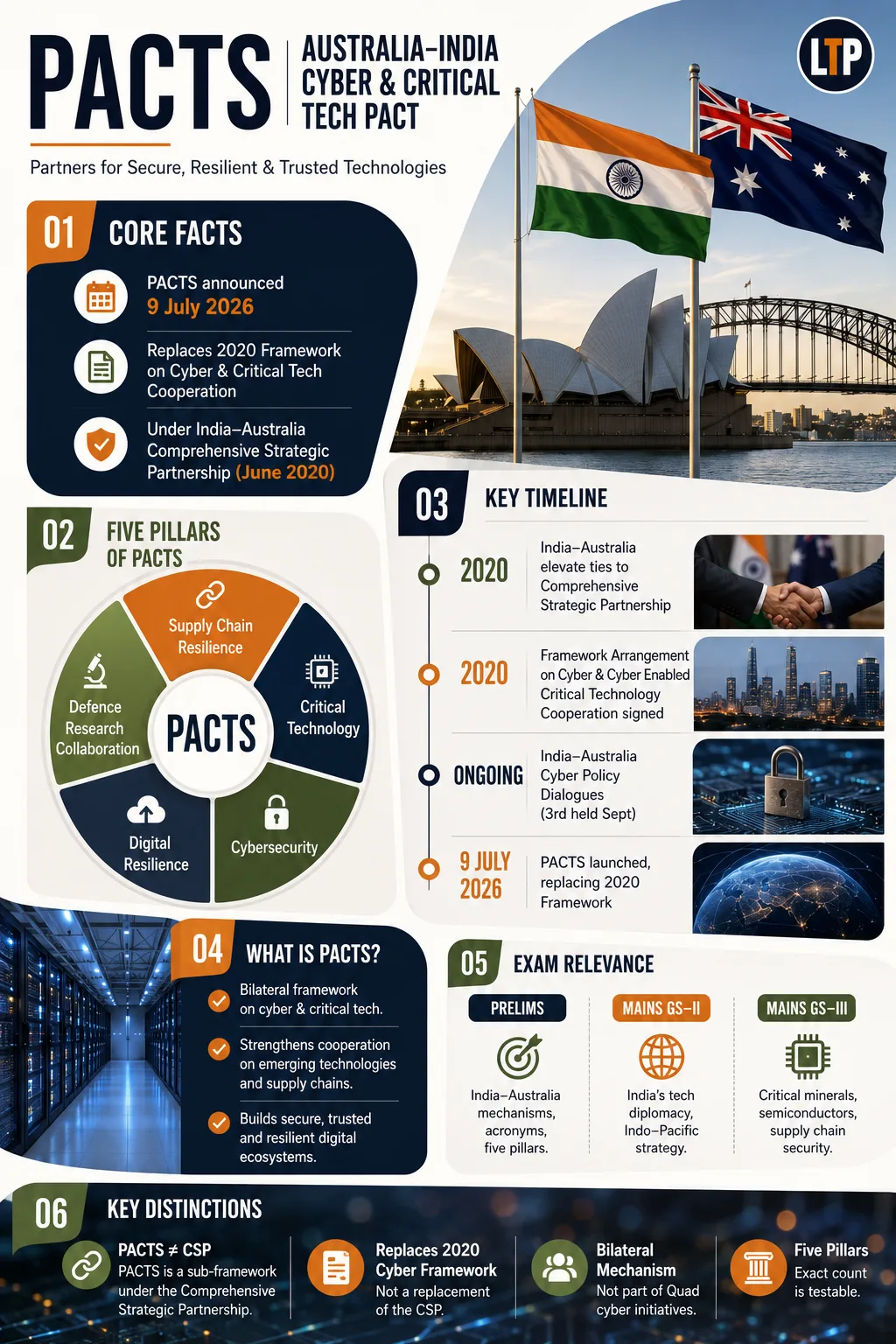
- PACTS (Australia-India Partnership on Cyber, Critical Technologies and Supply Chains) is a new bilateral strategic framework announced on 9 July 2026, succeeding and replacing the 2020 Framework Arrangement on Cyber and Cyber Enabled Critical Technology Cooperation [1].
- Sits under the umbrella of the India-Australia Comprehensive Strategic Partnership (CSP), established in June 2020 [1][2].
- Structured around five pillars: supply chain resilience, critical technology, cybersecurity, digital resilience, and defence research collaboration [1].
- Relevant for Prelims (India-Australia bilateral mechanisms) and Mains GS-II/GS-III (India's tech diplomacy, Indo-Pacific strategy, critical minerals/semiconductors).
2. Why in the News
- Issued as a PMO press release via PIB Delhi on 9 July 2026, formally launching PACTS as an upgrade of the 2020 Cyber Framework Arrangement [1].
3. Background & Evolution
- 2020: India-Australia elevate ties to a Comprehensive Strategic Partnership; the 2020 Framework Arrangement on Cyber and Cyber Enabled Critical Technology Cooperation is signed as one component [1][2].
- Two decades of prior collaborative research, operational coordination, and policy engagement preceded PACTS, including periodic India-Australia Cyber Policy Dialogues (3rd dialogue held 4 September 2019, New Delhi) [1][2].
- 9 July 2026: PACTS announced, succeeding and replacing the 2020 Framework, elevating bilateral ambition on cyber, critical technology, and supply chains [1].
4. Core Static Facts
| Item | Detail |
|---|---|
| Full name | Australia-India Partnership on Cyber, Critical Technologies and Supply Chains (PACTS) [1] |
| Predecessor instrument | 2020 Framework Arrangement on Cyber and Cyber Enabled Critical Technology Cooperation [1] |
| Parent umbrella | India-Australia Comprehensive Strategic Partnership (2020) [1][2] |
| Announced | 9 July 2026, via PMO/PIB Delhi press release [1] |
| Number of pillars | Five [1] |
| India co-chair | Deputy National Security Advisor (India) [1] |
| Australia co-chair | Deputy Secretary (International and Security), Australia [1] |
| Lead agency, Pillars 1–2 (Supply Chain, Critical Tech) | National Security Council Secretariat (India); Ambassador for Cyber Affairs (Australia) [1] |
| Lead agency, Pillar 3 (Cybersecurity) | Ministry of External Affairs (India); Ambassador for Cyber Affairs (Australia) [1] |
| Lead agency, Pillar 4 (Digital Resilience) | Ministry of External Affairs (India); Ambassador for Cyber Affairs (Australia) [1] |
| Lead agency, Pillar 5 (Defence Research) | Ministry of Defence (both nations) [1] |
5. Multi-Dimensional Analysis
Geopolitical / Strategic
- Positions India and Australia as partners in shaping "values and global norms" in tech and cyber space, an implicit response to China's influence in the Indo-Pacific [1].
- Extends Digital Public Infrastructure (DPI) solutions across the Indo-Pacific under Pillar 4, projecting India's DPI (Aadhaar/UPI-style) diplomacy regionally [1].
Economic
- Pillar 1 addresses supply chain resilience: trusted vendor frameworks, undersea cable infrastructure protection, semiconductor supply security, and critical minerals coordination — key given both countries' interest in reducing China-dependency [1].
Scientific / Technological
- Pillar 2 covers AI standards-setting, space cooperation, telecommunications, biotechnology, and advanced materials research [1].
- Pillar 5 adds maritime science and defence-technology innovation ecosystems [1].
Legal / Administrative
- Governance is dispersed across multiple lead agencies per pillar rather than a single nodal body — India splits leads between NSCS, MEA, and MoD depending on pillar [1].
- Co-chair structure (Deputy NSA-level from India, Deputy Secretary-level from Australia) signals a security-establishment-driven partnership rather than a purely diplomatic one [1].
Ethical / Governance
- Explicit framing around "responsible technology leadership grounded in democratic values" signals a values-based tech alliance model, distinguishing it from purely commercial tech pacts [1].
6. Recent Developments (last 12-18 months)
- 9 July 2026: PACTS formally announced by PMO, replacing the 2020 Cyber Framework Arrangement [1].
- Announcement builds on prior engagement including the 5th anniversary observance of the India-Australia Comprehensive Strategic Partnership, marked by EAM Dr. S. Jaishankar [2].
7. Prelims Hooks
- PACTS stands for Australia-India Partnership on Cyber, Critical Technologies and Supply Chains [1].
- PACTS was announced on 9 July 2026 [1].
- PACTS succeeds and replaces the 2020 Framework Arrangement on Cyber and Cyber Enabled Critical Technology Cooperation [1].
- PACTS operates under the India-Australia Comprehensive Strategic Partnership, established in 2020 [1][2].
- PACTS has five pillars: Supply Chain Resilience & Diversification; Critical Technology; Cybersecurity; Digital Resilience; Defence Research Collaboration [1].
- India's co-chair for PACTS is the Deputy National Security Advisor; Australia's is the Deputy Secretary (International and Security) [1].
- India's lead agency for Pillars 1 and 2 is the National Security Council Secretariat (NSCS), NOT MEA [1].
- India's lead agency for Cybersecurity (Pillar 3) and Digital Resilience (Pillar 4) is the Ministry of External Affairs [1].
- Pillar 5 (Defence Research Collaboration) is led by the Ministry of Defence on both sides [1].
- Australia's counterpart lead role across most pillars is held by its Ambassador for Cyber Affairs [1].
- Pillar 4 focuses on extending Digital Public Infrastructure (DPI) solutions across the Indo-Pacific [1].
- The 3rd India-Australia Cyber Policy Dialogue was held in New Delhi on 4 September 2019 [2].
- The India-Australia Comprehensive Strategic Partnership was accompanied by eight landmark agreements/MoUs at its 2020 launch (covering maritime cooperation, defence, cyber security, education, mining, water resource management, etc.) [2].
8. Mains Relevance
- GS-II: Bilateral, regional and global groupings and agreements involving India and/or affecting India's interests; India's neighbourhood/Indo-Pacific diplomacy.
- GS-III: Science and technology developments and their applications/effects in everyday life; awareness in IT, space, cyber security; issues relating to critical minerals and supply chain security.
- Plausible question stems:
- "Discuss how PACTS marks a shift in India-Australia technology cooperation from the 2020 Cyber Framework Arrangement. What are its implications for India's Indo-Pacific strategy?" (GS-II)
- "Examine the significance of supply chain resilience and critical minerals cooperation in India's bilateral technology partnerships, with reference to PACTS." (GS-III)
- "Digital Public Infrastructure has become a tool of India's foreign policy. Discuss with reference to recent bilateral initiatives." (GS-II/III)
9. Related Topics to Study Next
- India-Australia Comprehensive Strategic Partnership (2020) — the parent framework PACTS operates under.
- Quad (Australia, India, Japan, US) — overlapping critical-tech and supply chain cooperation in the Indo-Pacific.
- India's semiconductor mission (ISM) — relevant to Pillar 1's semiconductor supply chain protection.
- Critical Minerals Mission / India's critical minerals diplomacy — direct overlap with Pillar 1.
- Digital Public Infrastructure (DPI) diplomacy (India Stack, UPI internationalisation) — core to Pillar 4.
- National Security Council Secretariat (NSCS) — nodal India body for Pillars 1-2 of PACTS.
- India-Australia 2+2 Ministerial Dialogue — broader defence-foreign policy mechanism PACTS complements.
- Bilateral Cyber Dialogues (India-US Cyber Framework, India-Australia Cyber Policy Dialogue) — comparative study of India's cyber diplomacy architecture.
10. Common Errors / Trap Areas
- Do not confuse PACTS with the Quad — PACTS is strictly bilateral (India-Australia), not a four-nation grouping.
- Do not assume MEA leads all five pillars — NSCS leads Pillars 1 and 2; MEA leads only Pillars 3 and 4; MoD leads Pillar 5.
- Do not date PACTS to 2020 — that year applies to the predecessor Framework Arrangement and the CSP; PACTS itself was announced in 2026.
- Do not call PACTS a treaty ratified by Parliament — it is an executive-level bilateral framework/arrangement, not a legislated instrument.
- Do not conflate the "Framework Arrangement on Cyber and Cyber Enabled Critical Technology Cooperation" (2020, now superseded) with the standalone "Comprehensive Strategic Partnership" (2020, still active umbrella) — PACTS replaces the former, not the latter.
Sources
At the end · practice MCQs
9 questions on this item
Check the answer for each question, or reveal all at once.