Sub-Mission on Agricultural Mechanization
New · District CollectorCan you hold the district for 72 hours?Floods, a heatwave, an outbreak, a grievance queue. Take the decisions, see the consequences.Play →In this note
1. At a Glance
- SMAM is a Centrally Sponsored Scheme launched to raise farm mechanization penetration, especially among small/marginal farmers, women, and disadvantaged groups, and in low-mechanization/underserved regions including the North-East [3].
- It works through subsidised machine purchase, Custom Hiring Centres (CHCs), Farm Machinery Banks (FMBs), and Hi-Tech Hubs rather than only direct ownership, addressing the high capital cost barrier for small holdings [1][3].
- Recently expanded into precision-agriculture technology (Kisan Drones) — a high-yield Prelims/Mains crossover with the AI-in-agriculture and Namo Drone Didi themes [6][7].
- Frequently tested for its parent scheme (RKVY), funding pattern, and CHC/FMB subsidy percentages — common source of factual traps [2][3].
2. Why in the News
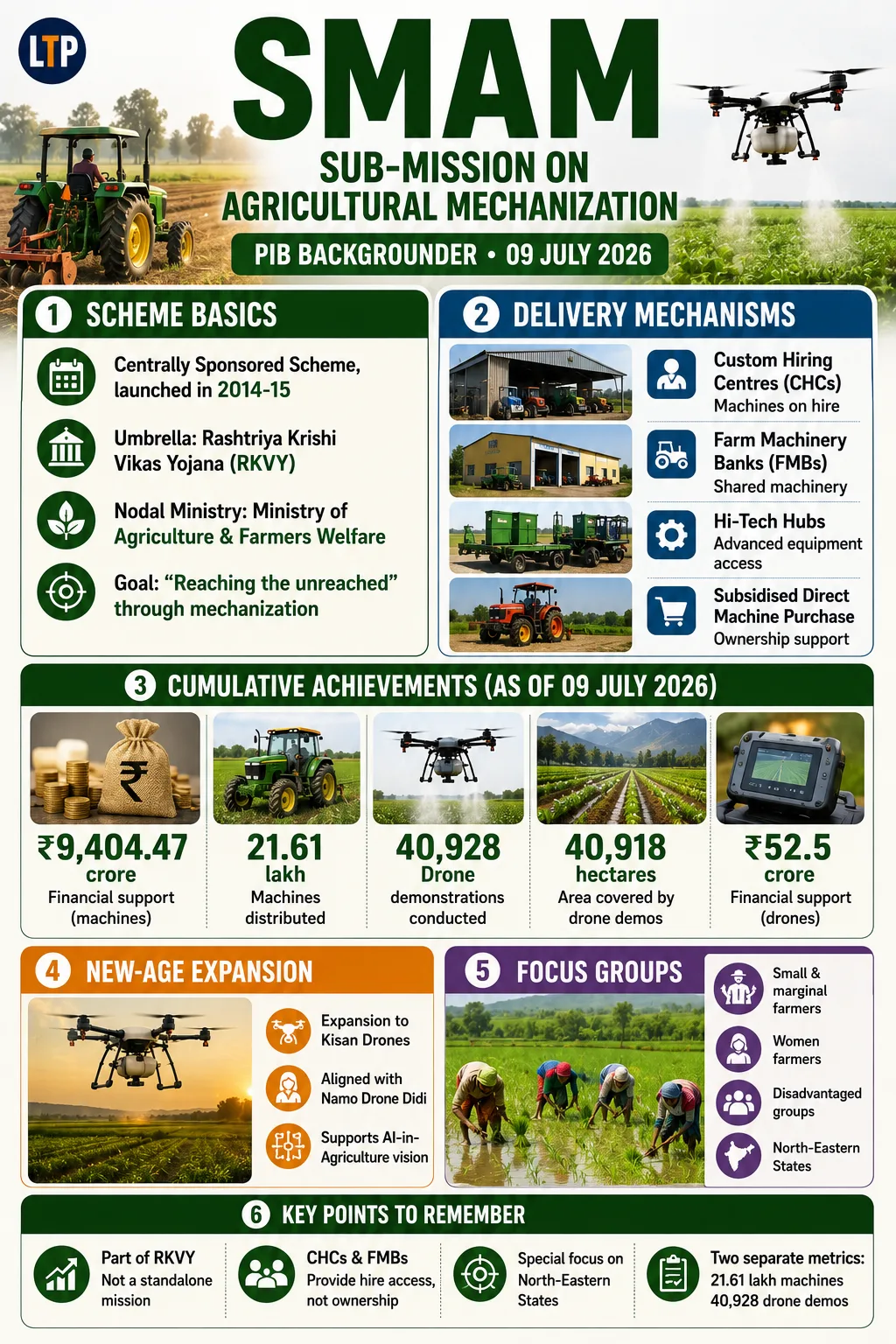
- PIB Backgrounder dated 09 July 2026 reiterated SMAM's cumulative achievements: Rs. 9,404.47 crore support for distribution of 21.61 lakh agricultural machines, and 40,928 drone demonstrations over 40,918 hectares with Rs. 52.5 crore support, with special emphasis on underserved and North-Eastern States [1].
3. Background & Evolution
- Launched in 2014-15 by the Ministry of Agriculture and Farmers Welfare with the objective of "reaching the unreached" — extending mechanization to small/marginal farmers and regions with low farm power availability [2][3].
- SMAM is one of the Centrally Sponsored components of the Rashtriya Krishi Vikas Yojana (RKVY), implemented through State Governments [3][4].
- Cumulative progress reported earlier: Rs. 4,865 crore released 2014-15 to 2021-22, distributing over 13.23 lakh machines and establishing 15,400+ CHCs, 360 Hi-tech Hubs, and 14,200 FMBs [4]; by July 2026 cumulative support had risen to Rs. 9,404.47 crore covering 21.61 lakh machines [1].
- Drone promotion under SMAM added later as a distinct technology component, financially supporting drone purchase, demonstration, and CHC establishment for Kisan Drones [5][6].
4. Core Static Facts
- Scheme type: Centrally Sponsored Scheme, sub-component of RKVY [3].
- Nodal Ministry: Ministry of Agriculture and Farmers Welfare [2][3].
- Year of launch: 2014-15 [2].
- Implementing mechanism: State Governments [3].
- Key components: (i) subsidised individual machine purchase, (ii) CHCs, (iii) FMBs, (iv) Hi-Tech High Productive Equipment Hubs, (v) village-level Farm Mechanisation, (vi) drone demonstrations/CHCs [1][3][4].
- Subsidy — individual machine purchase: 40-50% of cost depending on farmer category [3].
- Subsidy — CHC/Hi-tech hub establishment: 40% of project cost to rural entrepreneurs, Cooperative Societies, Registered Farmer Societies, FPOs, Panchayats [4].
- Subsidy — Farm Machinery Banks: 80% of project cost (for projects up to Rs. 30 lakh) to Cooperative Societies, Registered Farmer Societies, FPOs, SHGs, Panchayats [4].
- Drone subsidy — institutional demonstration: 100% of drone cost up to Rs. 10 lakh per drone for ICAR institutes, FMTTIs, KVKs, SAUs [6].
- Drone subsidy — individual ownership: 50% of cost up to Rs. 5 lakh for Small/Marginal, SC/ST, Women and North-Eastern State farmers [6].
- Cumulative outlay (as of July 2026): Rs. 9,404.47 crore; 21.61 lakh machines distributed [1].
- Drone outreach (as of July 2026): 40,928 demonstrations over 40,918 hectares, Rs. 52.5 crore support [1].
- CHCs/Hi-tech Hubs/FMBs established (cumulative): over 40,900 [2].
5. Multi-Dimensional Analysis
Economic
- Reduces per-farmer capital outlay via CHC/hiring-based access rather than individual ownership, improving efficiency for small holdings [3][4].
- Boosts farm productivity and reduces labour/drudgery costs, indirectly supporting farm incomes [1].
Social
- Explicit targeting of small/marginal farmers, women, SC/ST, and North-Eastern State farmers for higher subsidy slabs signals an equity-driven design [1][6].
- Complements the Namo Drone Didi scheme (Rs. 1,261 crore outlay, target of 15,000 Women SHGs for drone rental services), linking mechanization to women's economic empowerment [7].
Scientific/Technological
- Drone demonstrations mark a shift from mechanical mechanization to precision agriculture and digital farm technology [1][6].
- Institutional demonstration route (ICAR/KVK/SAU) builds a testing-and-extension pipeline before farmer-level diffusion [6].
Administrative
- Centrally Sponsored, State-implemented structure means funding-utilisation and last-mile delivery vary by state capacity — a recurring governance bottleneck for such schemes [3].
- Bundling under RKVY (rather than a standalone Central Sector Scheme) affects funding flexibility and state matching-share requirements [3].
Geographic/Regional
- Special thrust on North-Eastern and underserved states to correct regional disparity in farm-power availability, a longstanding mechanization gap area [1][2].
6. Recent Developments (last 12-18 months)
- PIB Backgrounder (09 July 2026) reported updated cumulative figures: Rs. 9,404.47 crore disbursed, 21.61 lakh machines distributed, and 40,928 drone demonstrations across 40,918 hectares [1].
- Continued government push on AI and drone technologies in agriculture to raise productivity and farmer livelihoods, of which SMAM's drone component is a funding vehicle [8].
7. Prelims Hooks
- SMAM was launched in 2014-15 by the Ministry of Agriculture and Farmers Welfare [2].
- SMAM is a sub-component of the Rashtriya Krishi Vikas Yojana (RKVY), not a standalone Central Sector Scheme [3].
- SMAM is implemented through State Governments (Centrally Sponsored Scheme) [3].
- Subsidy for individual machine purchase under SMAM: 40-50% of cost depending on farmer category [3].
- CHC/Hi-tech Hub establishment subsidy: 40% of project cost [4].
- Farm Machinery Bank establishment subsidy: 80% of project cost (up to Rs. 30 lakh projects) [4].
- Institutional drone demonstration subsidy under SMAM: 100% of cost, capped at Rs. 10 lakh per drone [6].
- Individual drone purchase subsidy for Small/Marginal/SC-ST/Women/NE farmers: 50%, capped at Rs. 5 lakh [6].
- As of July 2026, SMAM has supported distribution of 21.61 lakh agricultural machines with Rs. 9,404.47 crore [1].
- SMAM drone demonstrations (cumulative to July 2026): 40,928 demonstrations covering 40,918 hectares, Rs. 52.5 crore support [1].
- SMAM's stated aim is described as "reaching the unreached" [2].
- Namo Drone Didi, a related but distinct Central Sector Scheme, targets 15,000 Women SHGs with an outlay of Rs. 1,261 crore [7].
- SMAM gives special emphasis to North-Eastern States to reduce regional disparity in mechanization access [1].
8. Mains Relevance
- GS-III: Agriculture — issues relating to direct and indirect farm subsidies; e-technology in aid of farmers; mechanization and its implications for farm labour.
- GS-II (secondary): Government policies and interventions for development in various sectors — issues arising from design and implementation.
- Possible question stems: 1. "Discuss the role of the Sub-Mission on Agricultural Mechanization in addressing the mechanization gap among small and marginal farmers in India. What structural challenges limit its impact?" 2. "Examine how India's Sub-Mission on Agricultural Mechanization is integrating drone technology into precision agriculture. What are the associated risks and regulatory concerns?" 3. "Custom Hiring Centres are often cited as a cost-effective route to mechanization for small farmers over individual ownership subsidies. Critically evaluate."
9. Related Topics to Study Next
- Rashtriya Krishi Vikas Yojana (RKVY) — SMAM's parent umbrella scheme; funding architecture.
- Namo Drone Didi Scheme — parallel women-centric drone scheme, natural comparison point.
- PM-Kisan / PM-KUSUM — other farmer-support DBT-linked schemes for contrast on delivery mechanism.
- Kisan Drones / Drone Rules — regulatory and technology backdrop for agri-drone use.
- Agricultural labour and mechanization-displacement debate — social/economic implications of rapid mechanization.
- North-East regional development schemes — cross-link for the equity/regional-disparity angle.
- FPOs (Farmer Producer Organisations) — key institutional beneficiaries under SMAM's CHC/FMB components.
- Precision agriculture and AI in farming — broader tech-in-agriculture theme SMAM's drone push feeds into.
10. Common Errors / Trap Areas
- Confusing SMAM's nodal status: it is a sub-component of RKVY, not an independent Central Sector Scheme — a frequently misstated fact [3].
- Mixing up subsidy percentages: CHC/Hi-tech Hub (40%) vs Farm Machinery Bank (80%) vs individual machine purchase (40-50%) — these are distinct slabs, not interchangeable [3][4].
- Conflating SMAM's drone component with the separate Namo Drone Didi scheme — both promote agri-drones but have different targets, outlays, and beneficiary groups (SMAM is general/individual + institutional; Namo Drone Didi is specifically for Women SHGs) [6][7].
- Assuming SMAM launch year is post-2015 due to recent news coverage — actual launch was 2014-15 [2].
- Treating cumulative figures (Rs. 9,404.47 crore, 21.61 lakh machines) as annual/yearly figures rather than scheme-inception-to-date totals [1].
Sources
- 1Press Release Page | Press Information Bureau (SMAM Backgrounder, 09 Jul 2026)pib.gov.in · tier 1
- 2Sub-Mission on Agricultural Mechanisation (SMAM) started in 2014-15pib.gov.in · tier 1
- 3Sub-Mission on Agricultural Mechanizationpib.gov.in · tier 1
- 4Initiatives of Government of India to Promote Farm Mechanizationpib.gov.in · tier 1
- 5Government to Promote Drone use in Agriculture – Financial Support Under SMAMpib.gov.in · tier 1
- 6Funds for Kisan Dronespib.gov.in · tier 1
- 7Empowering Women Farmers in Agriculture (Namo Drone Didi)pib.gov.in · tier 1
- 8Government Promotes AI and Drone Technologies to Boost Agricultural Productivity and Farmer Livelihoodspib.gov.in · tier 1