Weaving Sustainability into India’s Textile Future
New · District CollectorCan you hold the district for 72 hours?Floods, a heatwave, an outbreak, a grievance queue. Take the decisions, see the consequences.Play →In this note
1. At a Glance
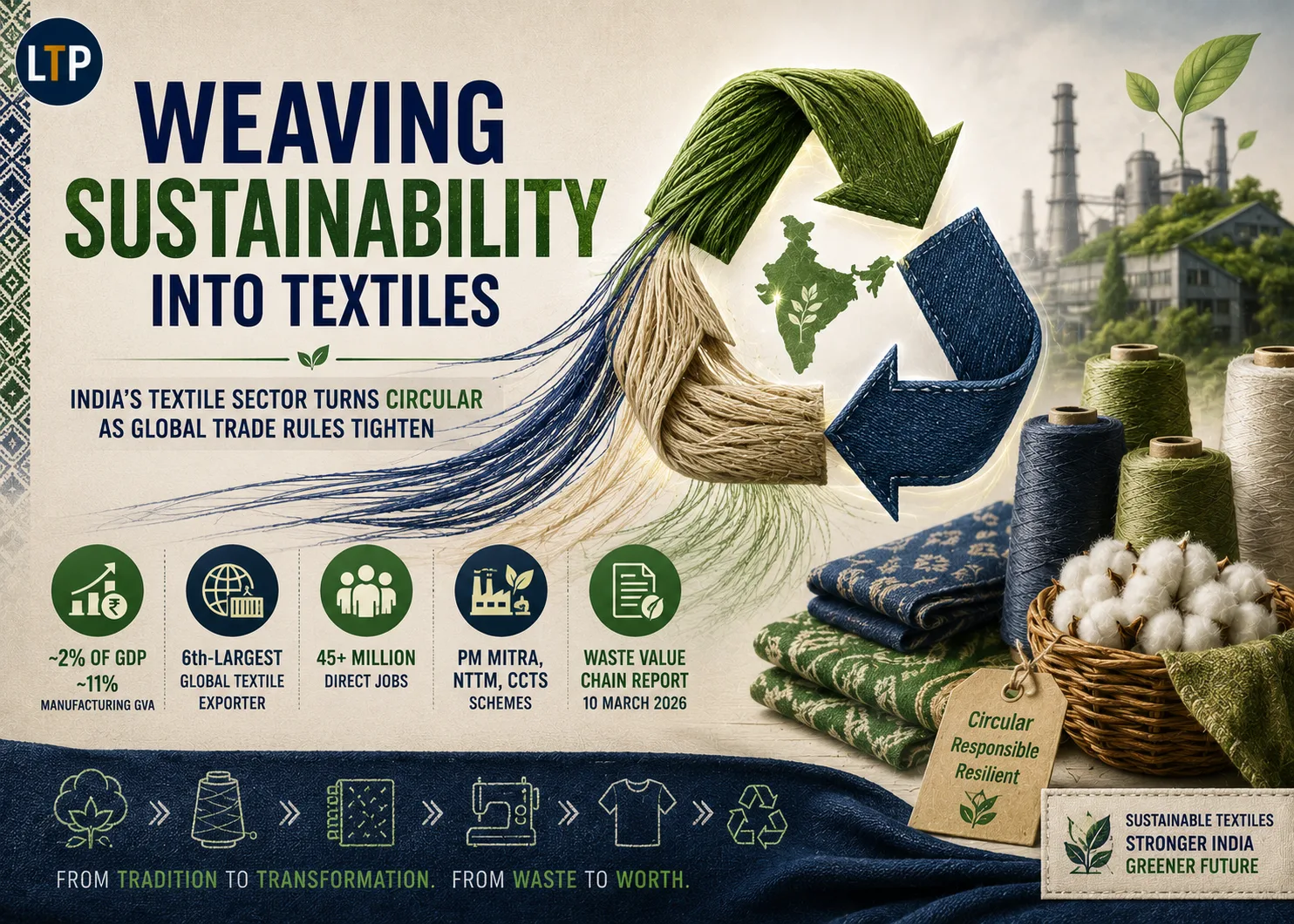
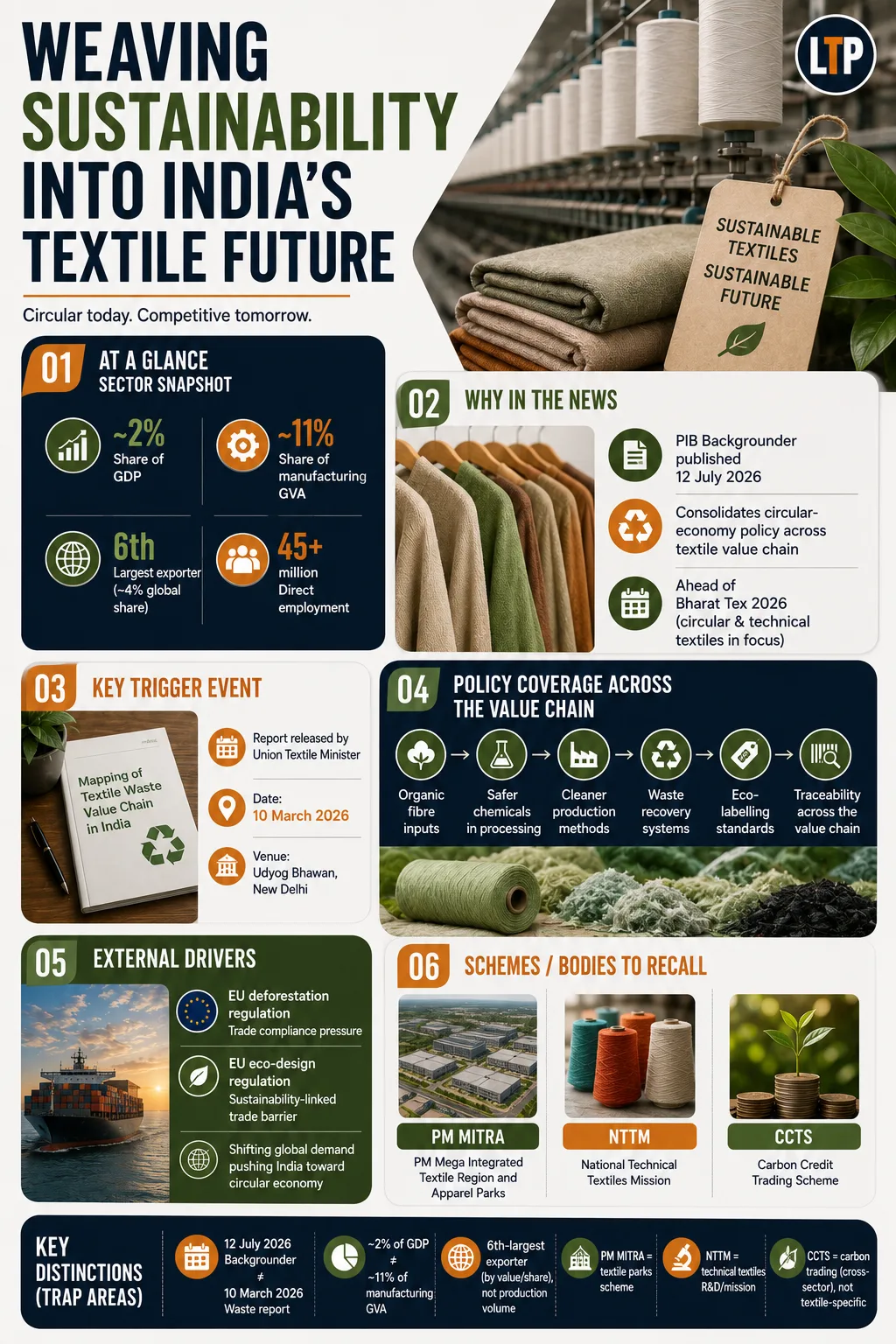
- India's textile/apparel sector — ~2% of GDP, ~11% of manufacturing GVA, 6th-largest global exporter (~4% share), 45+ million direct jobs — is repositioning around circular economy principles amid shifting global demand (EU deforestation/eco-design regulations, sustainability-linked trade barriers) [1].
- Government policy now spans the entire value chain: organic fibre input, safer chemicals, cleaner production, waste recovery, eco-labelling, and traceability [1].
- UPSC relevance: tests both static scheme/ministry recall (PM MITRA, NTTM, CCTS) and dynamic current-affairs hooks (2026 waste-value-chain report, Bharat Tex).
2. Why in the News
- PIB Backgrounder "Weaving Sustainability into India's Textile Future" published 12 July 2026, consolidating circular-economy policy action across the textile value chain [1].
- Preceded by the Union Textile Minister releasing the "Mapping of Textile Waste Value Chain in India" report on 10 March 2026 at Udyog Bhawan, New Delhi [2].
- Timed ahead of Bharat Tex 2026, which foregrounds circular and technical textiles [3].
3. Background & Evolution
- India's textile sector historically labour-intensive, fragmented, and export-oriented; sustainability emerged as an explicit policy priority as export markets (EU, US) tightened environmental/traceability norms.
- 2006: India ratifies the Stockholm Convention (persistent organic pollutants), underpinning later dye/chemical restrictions [1].
- 2015: Jute-ICARE launched — expanded from 130 blocks/7 states to 289 blocks/10 states, coverage from ~1.11 lakh to ~2.15 lakh hectares [1].
- 2023: Carbon Credit Trading Scheme (CCTS) notified, later extending to textiles under the Indian Carbon Market (ICM) [1].
- 2024: PM MITRA Parks approved (7 sites); Eco-Mark Scheme notified for textiles; Public Procurement MoU (Textiles Committee–GeM–SCOPE) for upcycled goods signed [1].
- 10 March 2026: "Mapping of Textile Waste Value Chain in India" report released [2].
- 12 July 2026: PIB circular-economy backgrounder issued [1].
4. Core Static Facts
| Item | Detail |
|---|---|
| Nodal ministry | Ministry of Textiles, with MoEFCC, MSME, Finance, Housing & Urban Affairs [1] |
| PM MITRA Parks | 7 approved: Virudhunagar (TN), Warangal (Telangana), Navsari (Gujarat), Kalaburagi (Karnataka), Dhar (MP), Lucknow (UP), Amravati (Maharashtra); outlay ₹4,445 crore till 2027-28; MoUs worth ₹27,434 crore (Dec 2025) [1] |
| National Technical Textiles Mission (NTTM) | R&D on converting textile waste into carbon fibres/functional textiles [1] |
| Carbon Credit Trading Scheme | Notified 2023; textiles under ICM with Greenhouse Gas Emission Intensity (GEI) targets; Scope 1 & 2 disclosure mandated [1] |
| Eco-Mark Scheme | 2024; 13 Indian Standard titles notified for textiles [1] |
| Chemical restrictions | Benzidine-based dyes restricted; 70 azo dyes prohibited; Stockholm Convention (2006) basis [1] |
| Solid Waste Management Rules | Full effect 1 April 2026; RDF usage mandate rises 5%→15% over six years [1] |
| MSME support (RAMP) | MSE-GIFT: 2% interest subvention on loans up to ₹2 crore, 75% credit guarantee; MSE-SPICE: 25% capital subsidy [1] |
| Annual textile waste generated | 70.73 lakh tonnes (~7.8 million tonnes); pre-consumer 42%, post-consumer 58% [2] |
| Recovery rates | Overall recovery >70%; pre-consumer ~95%; spinning-sector reintegration ~100%; post-consumer landfill diversion 55% [1][2] |
| Livelihoods supported | 40–45 lakh, predominantly women from marginalised communities [2] |
| Recycling market projection | USD 3.5 billion by 2030; ~1 lakh new green jobs [1][2] |
| Local models | Navi Mumbai (Belapur) — India's first municipal textile recovery facility; Panipat — mechanical recycling hub (3,500–5,250 TPD); Mongolpuri (Delhi) — informal sorting feeding Panipat [1][2] |
5. Multi-Dimensional Analysis
Economic
- Recycling/circularity opens a projected USD 3.5 billion market segment by 2030, cushioning the sector against raw-material import dependence [1].
- PM MITRA Parks aim to create integrated "plug-and-play" textile clusters attracting ₹27,434 crore in committed investment, addressing fragmentation across spinning-weaving-processing-garmenting [1].
Environmental
- Chemical management pilot ("Eliminating Hazardous Chemicals from Textile Fashion Supply Chain") across 400 factories/8 clusters/4 fashion houses targets 1,47,000 tCO2eq mitigation and 10,530 tonnes chemical-use reduction [1].
- RDF mandate under 2026 Solid Waste Management Rules diverts non-recyclable textile waste from landfills into energy recovery [1].
Social
- Informal recycling ecosystem (Panipat, Mongolpuri) sustains 40–45 lakh livelihoods, mostly women from marginalised communities — a formalisation challenge as circularity policy tightens standards [2].
Scientific/Technological
- NTTM-backed R&D converts post-consumer textile waste into carbon fibres and functional/technical textiles, moving up the value chain from mechanical recycling [1].
- Traceability and eco-labelling (Eco-Mark, Kasturi Cotton, Silk Mark) integrate certification technology into export competitiveness [1].
Administrative/Governance
- Multi-ministry coordination (Textiles, MoEFCC, MSME, Finance, Housing & Urban Affairs) needed since waste collection is a municipal (urban local body) function while production standards are central subjects — a federal coordination bottleneck [1].
- Public procurement MoU (Textiles Committee–GeM–SCOPE) uses government demand to create market pull for upcycled products [1].
Geopolitical/Trade
- Sustainability compliance (traceability, chemical safety, carbon disclosure) is positioned as a market-access requirement for EU/US export markets, linking circularity policy directly to trade competitiveness [1].
6. Recent Developments (last 12–18 months)
- Dec 2025: PM MITRA Parks MoUs cumulatively reach ₹27,434 crore in committed investment [1].
- 10 March 2026: "Mapping of Textile Waste Value Chain in India" report released by Union Textile Minister Giriraj Singh [2].
- 1 April 2026: Solid Waste Management Rules (2026) come into full effect with graded RDF mandate [1].
- 12 July 2026: PIB backgrounder "Weaving Sustainability into India's Textile Future" issued, consolidating circular-economy measures [1].
- Ongoing: Bharat Tex 2026 preparations emphasising circular and technical textiles [3].
7. Prelims Hooks
- India's textile/apparel sector contributes ~2% of GDP and ~11% of manufacturing GVA [1].
- India is the world's 6th-largest textile/apparel exporter with ~4% global export share [1].
- Annual textile waste generated in India: 70.73 lakh tonnes (~7.8 million tonnes) [2].
- Pre-consumer waste recovery rate is ~95%, spinning-sector reintegration nearly 100% [1][2].
- Post-consumer waste diversion from landfills stands at 55% [1][2].
- India's textile recycling market projected to hit USD 3.5 billion by 2030, generating ~1 lakh green jobs [1].
- Jute-ICARE (launched 2015) expanded from 130 blocks/7 states to 289 blocks/10 states [1].
- 7 PM MITRA Parks approved with a ₹4,445 crore outlay through 2027-28 [1].
- PM MITRA Park states: Tamil Nadu (Virudhunagar), Telangana (Warangal), Gujarat (Navsari), Karnataka (Kalaburagi), Madhya Pradesh (Dhar), Uttar Pradesh (Lucknow), Maharashtra (Amravati) [1].
- Eco-Mark Scheme (2024) notified 13 Indian Standard titles for textiles [1].
- 70 azo dyes are prohibited in Indian textile production; benzidine-based dyes are restricted [1].
- Carbon Credit Trading Scheme (CCTS) notified in 2023; textiles fall under the Indian Carbon Market (ICM) [1].
- Solid Waste Management Rules 2026 take full effect from 1 April 2026, with RDF usage rising from 5% to 15% over six years [1].
- Navi Mumbai's Belapur facility is India's first municipal textile recovery facility [1].
- Panipat handles 3,500–5,250 tonnes per day of textile recycling, making it a major recycling hub [1].
- The "Mapping of Textile Waste Value Chain in India" report was released on 10 March 2026 at Udyog Bhawan, New Delhi [2].
8. Mains Relevance
- GS-III: Indian Economy — industrial policy, infrastructure (textile clusters); Environment — conservation, pollution, circular economy.
- GS-II: Government policies and interventions for development in various sectors.
- Possible question stems:
- "Discuss how circular economy principles are being institutionalised across India's textile value chain. What are the administrative bottlenecks in scaling informal recycling ecosystems into the formal economy?" (GS-III)
- "Examine the role of PM MITRA Parks in addressing fragmentation in India's textile manufacturing base. How do sustainability compliance requirements affect India's textile export competitiveness?" (GS-III)
- "Textile waste management in India straddles environmental regulation, urban governance, and livelihood security. Critically analyse." (GS-III/GS-II)
9. Related Topics to Study Next
- PM MITRA Scheme — core textile-infrastructure policy referenced throughout this note; needs standalone static-fact mastery.
- Carbon Credit Trading Scheme (CCTS) / Indian Carbon Market — cross-sectoral climate policy mechanism now extended to textiles.
- Extended Producer Responsibility (EPR) & Solid Waste Management Rules — parent regulatory framework for textile waste RDF mandates.
- EU Carbon Border Adjustment Mechanism (CBAM) & EU deforestation regulation — external trade drivers pushing India's sustainability compliance.
- Stockholm Convention on POPs — legal basis for chemical/dye restrictions in textiles.
- National Programme for Organic Production (NPOP) — input-stage certification linked to organic cotton/fibre exports.
- MSME sector schemes (RAMP, credit guarantee schemes) — overlaps with MSE-GIFT/MSE-SPICE textile financing.
- Bharat Tex — flagship platform showcasing India's textile diplomacy and circularity branding.
10. Common Errors / Trap Areas
- Confusing PM MITRA (integrated textile parks, Ministry of Textiles) with unrelated "Mitra" schemes in other sectors (e.g., power sector PM-KUSUM or urban schemes) — different ministry, different objective.
- Mixing up Scope 1 vs Scope 2 emissions — Scope 1 is direct (owned/controlled sources), Scope 2 is indirect (purchased electricity/steam/heat) [1].
- Assuming all textile waste in India goes to landfills — official data shows ~70%+ recovery, only ~45% (100−55%) of post-consumer waste is landfilled [1][2].
- Attributing the Eco-Mark Scheme solely to MoEFCC — it is jointly operationalised with the Ministry of Textiles for textile-specific standards.
- Misdating the Solid Waste Management Rules 2026 — full effect is 1 April 2026, not the notification date.
Sources
- 1Weaving Sustainability into India's Textile Future — PIB Backgrounderpib.gov.in · tier 1
- 2Union Minister of Textiles releases Report on Mapping of Textile Waste Value Chain in India — PIBpib.gov.in · tier 1
- 3Countdown Begins for Bharat Tex 2026, India's Largest Global Textiles Expo — PIBpib.gov.in · tier 1