Guardians of India's Maritime Frontiers
New · District CollectorCan you hold the district for 72 hours?Floods, a heatwave, an outbreak, a grievance queue. Take the decisions, see the consequences.Play →In this note
Practice
11 questions on this item
Check the answer for each question, or reveal all at once.
1. At a Glance
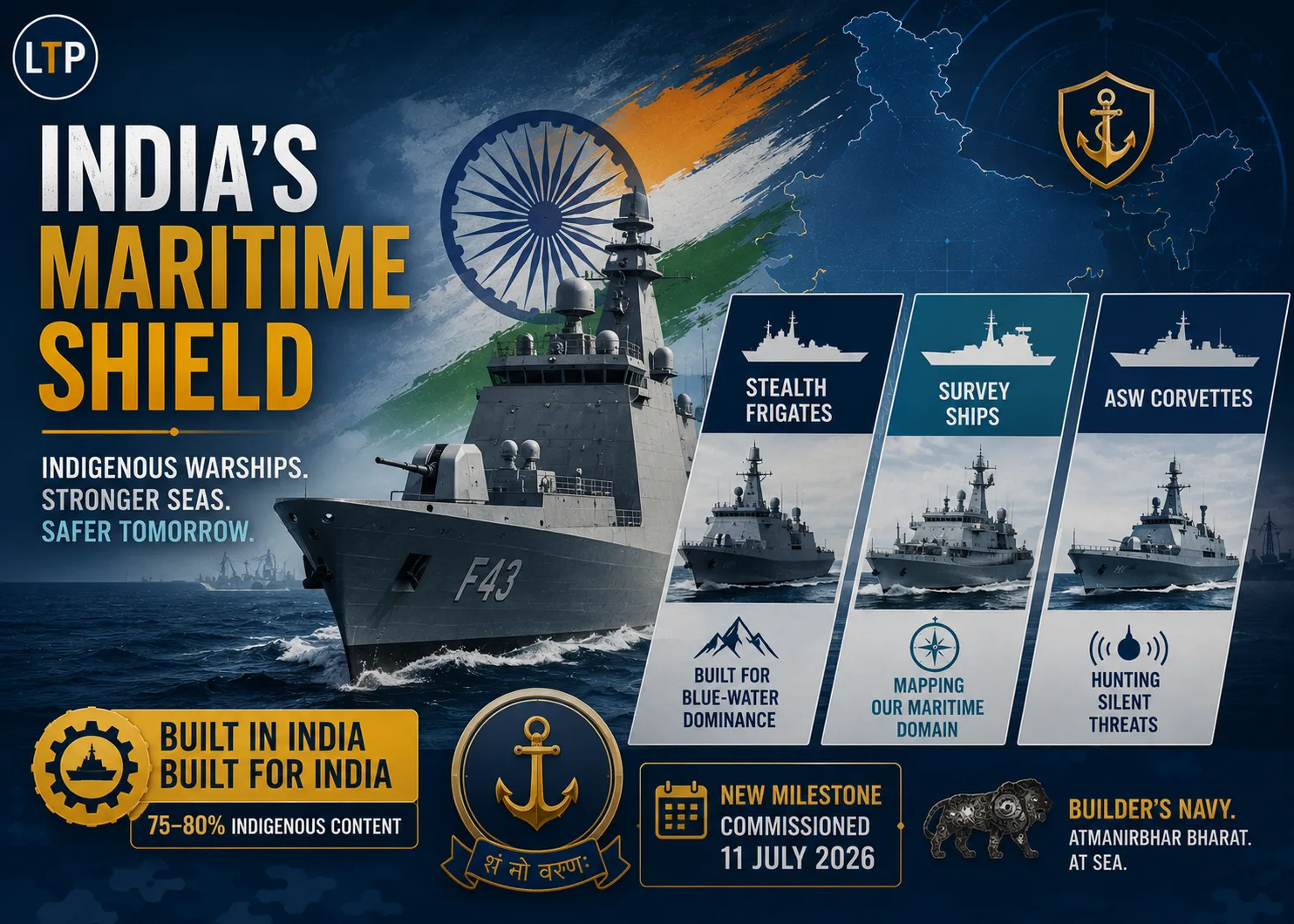
- India's naval strength rests on a balanced fleet spanning combat, hydrographic survey and coastal defence roles — embodied by the Nilgiri, Sandhayak and Arnala classes [1].
- All three classes are designed by the Indian Navy's Warship Design Bureau (WDB) and built in Indian shipyards, reflecting the shift from a "Buyer's Navy" to a "Builder's Navy" [1][4].
- High indigenous content (75–80%+) across classes exemplifies Aatmanirbhar Bharat in defence manufacturing [1][4].
- UPSC relevance: recurring Prelims/Mains theme on indigenisation, Blue Economy, and maritime security architecture.
2. Why in the News
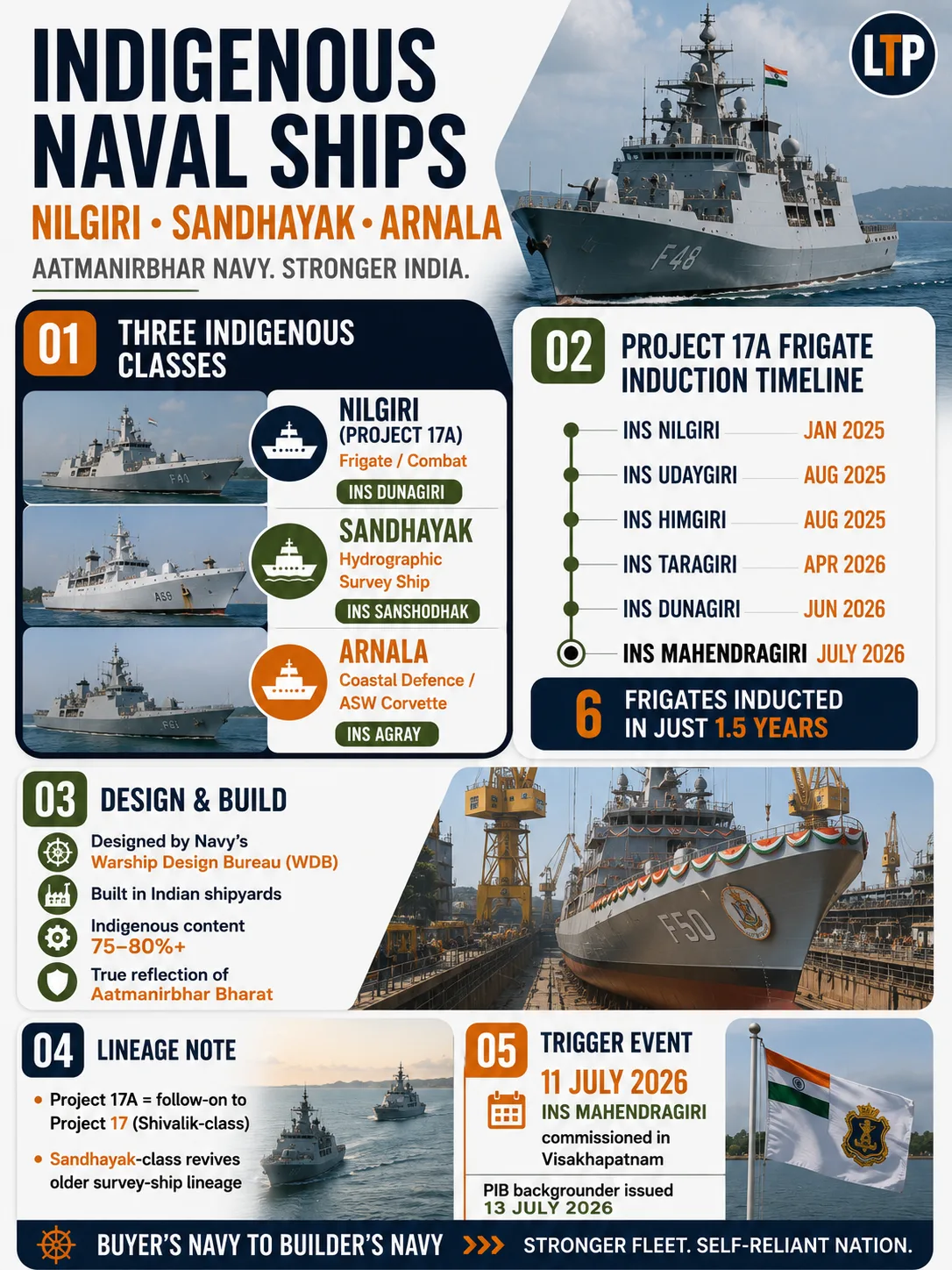
- INS Mahendragiri, sixth Project 17A frigate, commissioned 11 July 2026 at Visakhapatnam, prompting a PIB backgrounder (13 July 2026) on India's layered naval capability [3][1].
- Recent commissionings cited: INS Dunagiri (Nilgiri-class), INS Sanshodhak (Sandhayak-class), INS Agray (Arnala-class) [1].
- Six Project 17A frigates inducted in just 1.5 years — INS Nilgiri (Jan 2025), INS Udaygiri & INS Himgiri (Aug 2025), INS Taragiri (Apr 2026), INS Dunagiri (June 2026), INS Mahendragiri (July 2026) [3].
3. Background & Evolution
- Project 17A (Nilgiri-class): follow-on to Project 17 (Shivalik-class) stealth frigates; first steel cut and construction under indigenous design by WDB [1][3].
- Sandhayak-class: revives India's hydrographic survey capability after ageing Sandhayak-class (original, 1980s vintage) vessels; new-generation ships built by GRSE, Kolkata [1].
- Arnala-class (ASW-SWC): conceived to replace the ageing Abhay-class ASW corvettes; first-of-class INS Arnala delivered 8 May 2025, commissioned with CDS Gen Anil Chauhan present at Naval Dockyard, Visakhapatnam [2][6].
- Milestone chronology: INS Nilgiri commissioned Jan 2025 → INS Udaygiri/Himgiri Aug 2025 → INS Arnala commissioned 2025 → INS Taragiri delivered Apr 2026 → INS Dunagiri June 2026 → INS Mahendragiri commissioned 11 July 2026 [3][5].
4. Core Static Facts
| Class | Role | Builder | Ships | Indigenous Content |
|---|---|---|---|---|
| Nilgiri (Project 17A) | Stealth frigate — fleet air defence, ASW, anti-surface warfare, HADR | Mazagon Dock Shipbuilders Ltd (MDL) & GRSE | Nilgiri, Udaygiri, Himgiri, Taragiri, Dunagiri, Mahendragiri (6 ships) | >75% [3] |
| Sandhayak (Survey Vessel Large) | Hydrographic survey, nautical charting | GRSE, Kolkata | Sandhayak, Nirdeshak, Ikshak, Sanshodhak (4 ships) | High indigenous |
| Arnala (ASW-SWC) | Anti-submarine warfare in littoral/coastal waters, mine-laying, LIMO | GRSE with L&T Shipbuilding | Arnala, Androth, Anjadip, Amini, Abhay, Agray, Akshay, Ajay (8 ships) | >80% [2] |
- Designing authority for all three classes: Indian Navy's Warship Design Bureau (WDB) [1][4].
- INS Mahendragiri specs: ~6,670 tonnes displacement, up to 28 knots, delivered to Navy 30 April 2026 at MDL Mumbai, commissioned 11 July 2026 at Visakhapatnam [3].
- Arnala specs: 77m long, largest Indian naval warship propelled by Diesel-Engine–Waterjet combination [6].
5. Multi-Dimensional Analysis
Economic
- Strengthens domestic defence-manufacturing ecosystem (MDL, GRSE, private L&T Shipbuilding) under Aatmanirbhar Bharat [1].
- Reduces import dependence; boosts ancillary MSME supply chains in shipbuilding.
Geopolitical/Strategic
- Enhances India's power-projection and sea-denial capability in the Indian Ocean Region amid China's naval expansion.
- Supports "Blue Economy" and India's positioning as a leading maritime power [1].
- Coastal/shallow-water ASW capability (Arnala-class) addresses littoral submarine threats near Indian coastline.
Scientific/Technological
- Indigenous stealth design (reduced radar, thermal, acoustic signatures) in Nilgiri-class improves survivability [1].
- Hydrographic survey vessels (Sandhayak-class) feed into indigenous nautical charting, reducing reliance on foreign data.
Administrative
- Multi-yard production model (MDL + GRSE + private L&T) demonstrates capacity-building across public and private shipyards [1][2].
- Six Project 17A ships delivered in 1.5 years shows accelerated execution pace versus historical delays in Indian defence projects [3].
6. Recent Developments (last 12-18 months)
- Jan 2025: INS Nilgiri commissioned (first of Project 17A class) [3].
- Aug 2025: INS Udaygiri and INS Himgiri commissioned [3].
- 8 May 2025: INS Arnala delivered to Navy [6].
- 2025: INS Arnala commissioned at Naval Dockyard, Visakhapatnam, CDS Gen Anil Chauhan present [2].
- April 2026: INS Taragiri delivered — fourth Nilgiri-class ship [PIB PRID=2196229].
- 30 April 2026: INS Mahendragiri delivered to Navy at MDL, Mumbai [3].
- June 2026: INS Dunagiri commissioned [1].
- 11 July 2026: INS Mahendragiri commissioned at Visakhapatnam by Raksha Mantri [3].
- 13 July 2026: PIB Backgrounder "Guardians of India's Maritime Frontiers" released [1].
7. Prelims Hooks
- Nilgiri-class ships are built under Project 17A, follow-on of Project 17 (Shivalik-class) [1].
- INS Mahendragiri is the sixth Project 17A frigate, commissioned 11 July 2026 [3].
- Six Project 17A frigates inducted within 1.5 years [3].
- Sandhayak-class comprises: Sandhayak, Nirdeshak, Ikshak, Sanshodhak — all built by GRSE, Kolkata [1].
- Sandhayak-class role: hydrographic survey and nautical charting, i.e., "Survey Vessel (Large)" [1].
- Arnala-class comprises eight ships: Arnala, Androth, Anjadip, Amini, Abhay, Agray, Akshay, Ajay [1].
- Arnala-class replaces the ageing Abhay-class ASW Corvettes [1][2].
- INS Arnala delivered to Navy on 8 May 2025, built by GRSE with L&T Shipbuilding [6][2].
- Arnala is 77m long, largest Indian naval warship using Diesel Engine-Waterjet propulsion [6].
- Arnala-class indigenous content: over 80% [2].
- Nilgiri-class (Mahendragiri) indigenous content: over 75% [3].
- All three classes designed by the Warship Design Bureau (WDB) of the Indian Navy [1][4].
- INS Mahendragiri displacement: ~6,670 tonnes; top speed 28 knots [3].
- The three classes together are termed "Guardians of India's Maritime Frontiers" in the PIB backgrounder dated 13 July 2026 [1].
- Arnala-class missions include ASW in coastal waters, Low Intensity Maritime Operations (LIMO) and mine-laying [6].
8. Mains Relevance
- GS-III: Science & Technology — indigenization of technology; Security — Role of external state and non-state actors, linkages of organized crime with terrorism; Internal Security — maritime security.
- GS-II: International Relations — India and its neighbourhood, IOR strategic posture.
- Possible question stems: 1. "Discuss the significance of indigenous warship classes such as Nilgiri, Sandhayak and Arnala in strengthening India's maritime security architecture." (GS-III) 2. "Examine how Aatmanirbhar Bharat in defence manufacturing is reshaping India's naval modernisation." (GS-III) 3. "Analyse India's evolving strategic posture in the Indian Ocean Region in the context of a 'balanced fleet' doctrine." (GS-II/III)
9. Related Topics to Study Next
- Aatmanirbhar Bharat in Defence — overarching policy driving indigenous shipbuilding.
- Project 15B (Visakhapatnam-class destroyers) — parallel indigenous combat shipbuilding programme.
- Indian Ocean Region (IOR) Strategy / SAGAR doctrine — geopolitical framing for naval deployment.
- Blue Economy Policy — economic rationale linked to maritime security and survey capability.
- Defence Acquisition Procedure (DAP) 2020 — procurement framework enabling indigenous builds.
- Mazagon Dock Shipbuilders Ltd & GRSE — key public sector shipyards, worth knowing PSU profiles.
- Quad and Indo-Pacific maritime security cooperation — broader strategic context.
- Coastal Security Scheme / Sagar Prahari Bal — complementary coastal defence architecture.
10. Common Errors / Trap Areas
- Confusing Project 17 (Shivalik-class) with Project 17A (Nilgiri-class) — 17A is the newer, more advanced follow-on.
- Mixing up Sandhayak-class (survey vessels) with Himgiri/Nilgiri (combat frigates) — different roles entirely.
- Assuming Arnala-class replaces Kamorta-class corvettes — it actually replaces the Abhay-class ASW corvettes.
- Attributing ship design to shipyards (MDL/GRSE) instead of the actual designing authority, the Warship Design Bureau.
- Confusing builder attribution: Arnala-class is built by GRSE with L&T Shipbuilding as partner, not solely GRSE.
Sources
- 1PIB Backgrounder: Guardians of India's Maritime Frontierspib.gov.in · tier 1
- 2Commissioning of INS Arnala – the 1st ASW Shallow Water Craft for Indian Navypib.gov.in · tier 1
- 3Indian Navy commissions Made-in-India advanced stealth frigate 'INS Mahendragiri'pib.gov.in · tier 1
- 4Sailing Towards Self-Reliance: The Indian Navy's Aatmanirbhar Bharat Journeystatic.pib.gov.in · tier 1
- 5Delivery of 'Taragiri', the Fourth Nilgiri Class (Project 17A) Indigenous Advanced Stealth Frigatepib.gov.in · tier 1
- 6Delivery of 'Arnala' — First Anti Submarine Warfare Shallow Water Craftpib.gov.in · tier 1
At the end · practice MCQs
11 questions on this item
Check the answer for each question, or reveal all at once.