MeitY releases 2ⁿᵈ edition of the Digital Threat Report 2025-26 for India's BFSI Sector in Collaboration with SISA
New · District CollectorCan you hold the district for 72 hours?Floods, a heatwave, an outbreak, a grievance queue. Take the decisions, see the consequences.Play →In this note
1. At a Glance
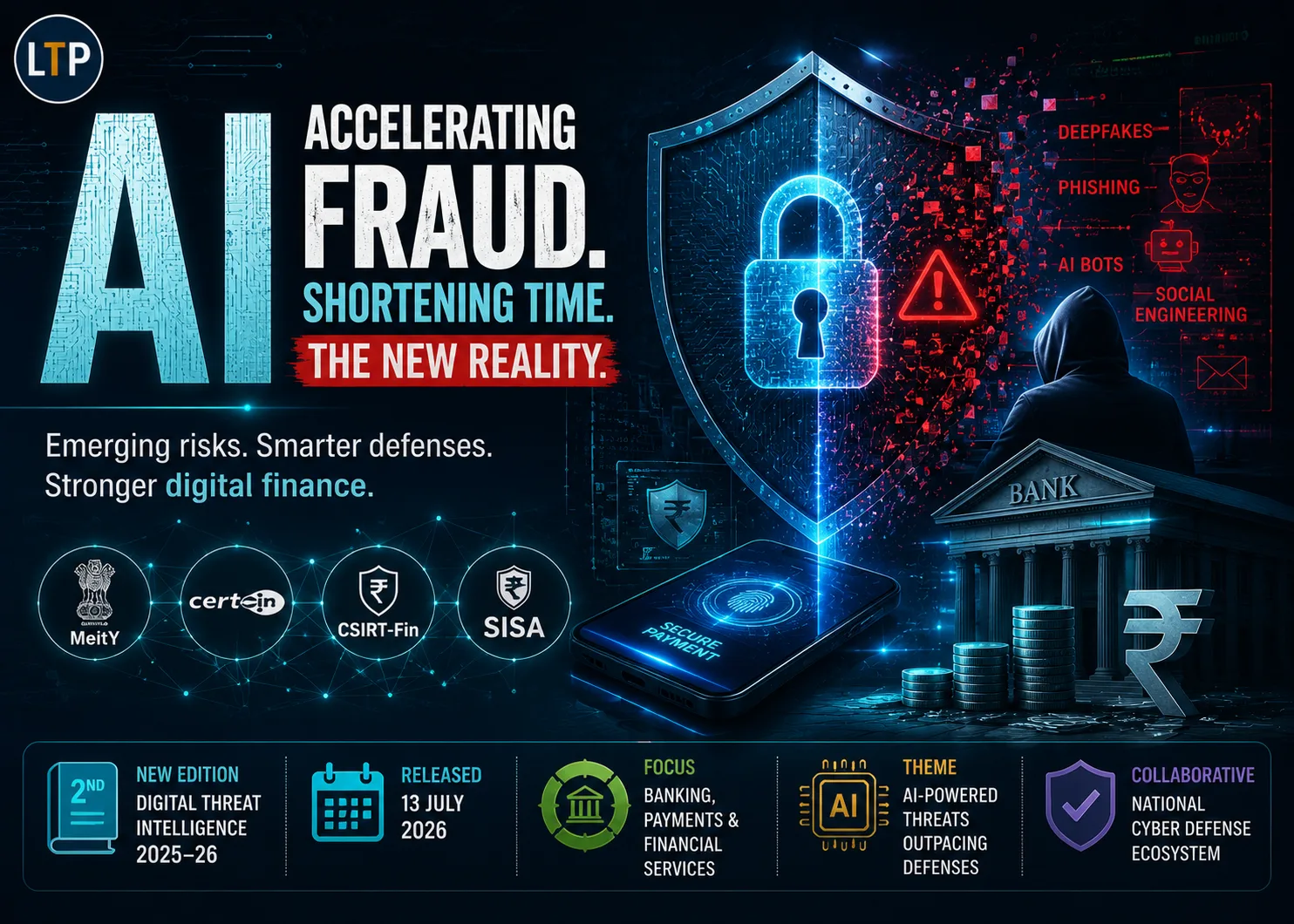
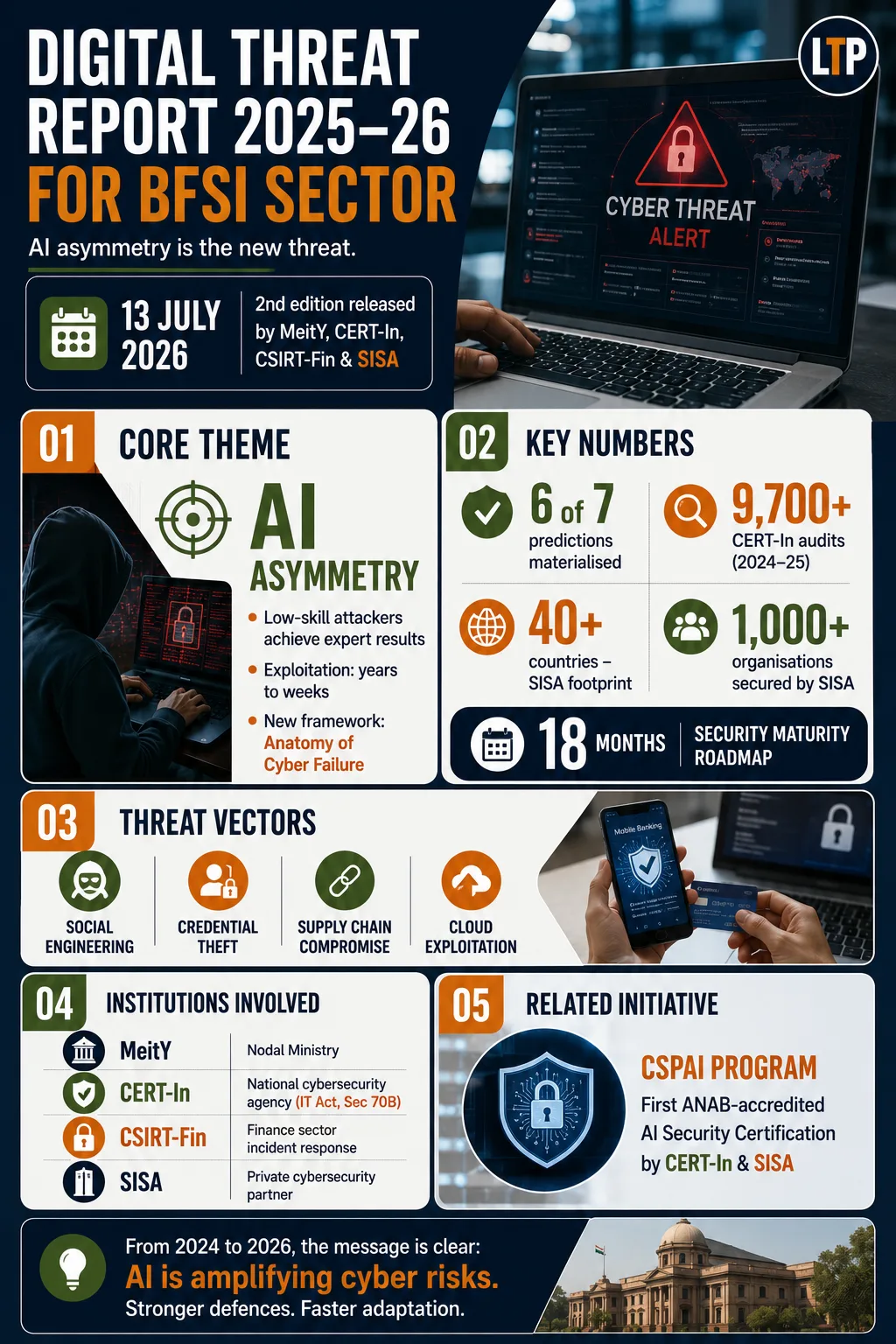
- 2nd edition of the "Digital Threat Report" for India's BFSI (Banking, Financial Services & Insurance) and digital payments ecosystem, released 13 July 2026 [1].
- Joint output of MeitY, CERT-In, CSIRT-Fin (govt side) and SISA (private global cybersecurity firm) — a public-private cybersecurity partnership model [1].
- Central theme: "AI Asymmetry" — AI now lets low-skill attackers achieve outcomes that once needed specialist teams, compressing exploitation timelines from years to weeks [1].
- Relevant for Prelims (institutions/report facts) and Mains GS-III (cybersecurity, financial sector resilience).
2. Why in the News
- Report released on 13 July 2026 at an event addressed by Secretary, MeitY, alongside CERT-In and SISA leadership [1].
- Follows up on the first edition (2024), making this the first sequel/annual-cycle report in this series [2].
3. Background & Evolution
- First edition — Digital Threat Report 2024: launched jointly by CERT-In (MeitY), CSIRT-Fin, and SISA; unveiled by Secretary, Department of Financial Services (Ministry of Finance) Shri M. Nagaraju and Secretary, MeitY, Shri S. Krishnan, along with CERT-In Director General Dr. Sanjay Bahl and SISA CEO Dharshan Shanthamurthy [2].
- First edition focused on integrating SISA's forensic investigation data, CERT-In's cybersecurity oversight, and CSIRT-Fin's financial-sector incident response expertise into one multi-dimensional threat assessment [2].
- Second edition (2025-26) builds on this by tracking prediction accuracy: 6 of 7 prior-year predictions already materialised, and introduces new frameworks (see Section 4) [1].
- Sits within India's broader cybersecurity institutional architecture: CERT-In (est. 2004 under IT Act, 2000, Sec. 70B) is the national nodal agency; CSIRT-Fin is the finance-sector-specific incident response team under this umbrella [1].
4. Core Static Facts
| Item | Detail |
|---|---|
| Report name | Digital Threat Report 2025–26 (BFSI Sector), 2nd edition |
| Release date | 13 July 2026 [1] |
| Nodal ministry | Ministry of Electronics & Information Technology (MeitY) [1] |
| Government partners | CERT-In, CSIRT-Fin [1] |
| Private partner | SISA — global cybersecurity firm specialising in payment ecosystem security, operating in 40+ countries, securing 1,000+ organisations [1] |
| Sector scope | Banking, Financial Services, Insurance (BFSI) + digital payments ecosystem |
| Key finding | "AI Asymmetry" — attackers using AI to act at machine speed with fewer resources [1] |
| New framework | "Anatomy of Cyber Failure" — a 4-Layer Gap Archetype Framework [1] |
| Roadmap proposed | 18-month roadmap from foundational controls to resilient security architecture [1] |
| Threat vectors flagged | Social engineering, credential theft, supply-chain compromise, cloud exploitation [1] |
| Prediction accuracy | 6 of 7 (2024 edition) predictions realised in the following year [1] |
5. Multi-Dimensional Analysis
- Economic: BFSI is systemically critical to financial stability; cyber-attacks on banks/payment systems risk cascading financial and consumer-trust losses; underpins India's digital payments (UPI-led) growth story.
- Scientific/Technological: Highlights AI asymmetry — dual-use nature of AI (used by both defenders and attackers); need for AI-aware detection tools; cloud exploitation as an emerging attack surface [1].
- Governance/Institutional: Model of public-private cybersecurity partnership — govt regulatory/CERT bodies + private forensic-intelligence firms; reflects shift from periodic audits to continuous risk assessment [1].
- Legal/Regulatory: Operates within IT Act, 2000 framework (CERT-In's statutory mandate under Sec. 70B); complements RBI's cybersecurity/IT framework for banks and NBFCs.
- Administrative: CSIRT-Fin as a specialised sectoral CERT — reflects trend toward sector-specific cyber incident response teams (analogous structures possible for power, health sectors).
- Strategic/Security: Frames cybersecurity as national-security-adjacent given BFSI's role in critical information infrastructure (CII) protection.
6. Recent Developments (last 12–18 months)
- April 2025: First Digital Threat Report (2024) publicly archived/referenced on PIB [2].
- 2024–25: Over 9,700 CERT-In audits conducted across critical sectors (govt cybersecurity push) [3].
- 13 July 2026: Second edition of Digital Threat Report released, introducing "Anatomy of Cyber Failure" framework [1].
- CERT-In and SISA earlier launched an ANAB-accredited AI Security Certification (CSPAI) program — a first-of-its-kind AI security certification [4].
7. Prelims Hooks
- Digital Threat Report is a joint publication of MeitY, CERT-In, CSIRT-Fin, and SISA [1].
- Second edition released on 13 July 2026; covers the BFSI and payments ecosystem [1].
- The report's central concept is termed "AI Asymmetry" [1].
- New analytical tool introduced: "Anatomy of Cyber Failure" — a 4-Layer Gap Archetype Framework [1].
- Report proposes an 18-month roadmap for security maturity [1].
- CERT-In = Indian Computer Emergency Response Team, under MeitY.
- CSIRT-Fin = Computer Security Incident Response Team in Finance (sector-specific CERT for BFSI).
- SISA is a private global cybersecurity company operating in 40+ countries, securing 1,000+ organisations [1].
- First edition of the Digital Threat Report was launched in 2024, jointly by CERT-In, CSIRT-Fin and SISA [2].
- First edition was unveiled by Secretary, DFS (Ministry of Finance) M. Nagaraju and Secretary, MeitY S. Krishnan, with CERT-In DG Dr Sanjay Bahl and SISA CEO Dharshan Shanthamurthy [2].
- 6 of 7 predictions from the previous edition were found to have materialised [1].
- CERT-In conducted 9,700+ cybersecurity audits across critical sectors in 2024–25 [3].
- CERT-In & SISA also run the CSPAI program — first ANAB-accredited AI security certification [4].
- Common trap: CSIRT-Fin is NOT the same as CERT-In — it is a finance-sector-specific subordinate/allied body.
8. Mains Relevance
- GS-III: Science & Technology — Cybersecurity; "Awareness in the fields of IT, space, computers"; internal security dimensions of cyber threats to critical infrastructure.
- GS-II: Government policies/interventions — public-private partnerships in governance/regulation.
- Possible question stems: 1. "Discuss the significance of public-private partnerships in strengthening India's cybersecurity architecture for critical financial infrastructure, with reference to the Digital Threat Report on the BFSI sector." (GS-III, 15 marks) 2. "'AI Asymmetry' is emerging as a defining cybersecurity risk in the financial sector. Examine the challenges this poses to regulators and suggest measures for building resilience." (GS-III) 3. "Evaluate the institutional architecture of cyber incident response in India (CERT-In, sectoral CSIRTs) and identify gaps in coordination." (GS-II/III)
9. Related Topics to Study Next
- CERT-In and IT Act, 2000 (Section 70B) — statutory basis and mandate of India's national cyber nodal agency.
- RBI's Cyber Security Framework for banks/NBFCs — regulatory overlap with BFSI cybersecurity.
- Critical Information Infrastructure (CII) protection under NCIIPC — broader national cybersecurity architecture.
- National Cyber Security Policy/Strategy — policy umbrella under which such reports fit.
- UPI and Digital Payments ecosystem — the payments infrastructure this report seeks to secure.
- AI Governance in India (MeitY's AI initiatives) — dual-use AI risk framing links to broader AI regulation debates.
- Quantum-Safe Cybersecurity Whitepaper by MeitY — related MeitY cybersecurity initiative on future-proofing encryption.
10. Common Errors / Trap Areas
- Confusing CERT-In (national-level, statutory, under MeitY) with CSIRT-Fin (sector-specific, finance-focused) — they are distinct but collaborating bodies.
- Assuming SISA is a government body — it is a private global cybersecurity company, not a PSU or statutory body.
- Mixing up the first edition (2024) launch officials (DFS Secretary M. Nagaraju, MeitY Secretary S. Krishnan) with the second edition (2025-26) context — question may test which edition/year a specific official or framework belongs to.
- Treating "Digital Threat Report" as an annual RBI publication — it is not an RBI report; RBI has separate cybersecurity frameworks/reports for banks.
- Assuming the "4-Layer Gap Archetype Framework" is a global/ISO standard — it is a report-specific analytical construct introduced in this edition only.
Sources
- 1MeitY releases 2nd edition of the Digital Threat Report 2025-26 for India's BFSI Sector in Collaboration with SISApib.gov.in · tier 1
- 2India launches first Digital Threat Report 2024 to support cybersecurity in the BFSI sectorpib.gov.in · tier 1
- 3Government Strengthens Cybersecurity Across Critical Sectors; Over 9,700 CERT-In Audits Conducted in 2024–25pib.gov.in · tier 1
- 4CERT-In & SISA Launches First of its kind ANAB-Accredited AI Security Certification (CSPAI) Programpib.gov.in · tier 1