PRESS RELEASE OF CONSUMER PRICE INDEX ON BASE 2024=100 FOR JUNE, 2026
New · District CollectorCan you hold the district for 72 hours?Floods, a heatwave, an outbreak, a grievance queue. Take the decisions, see the consequences.Play →In this note
Practice
11 questions on this item
Check the answer for each question, or reveal all at once.
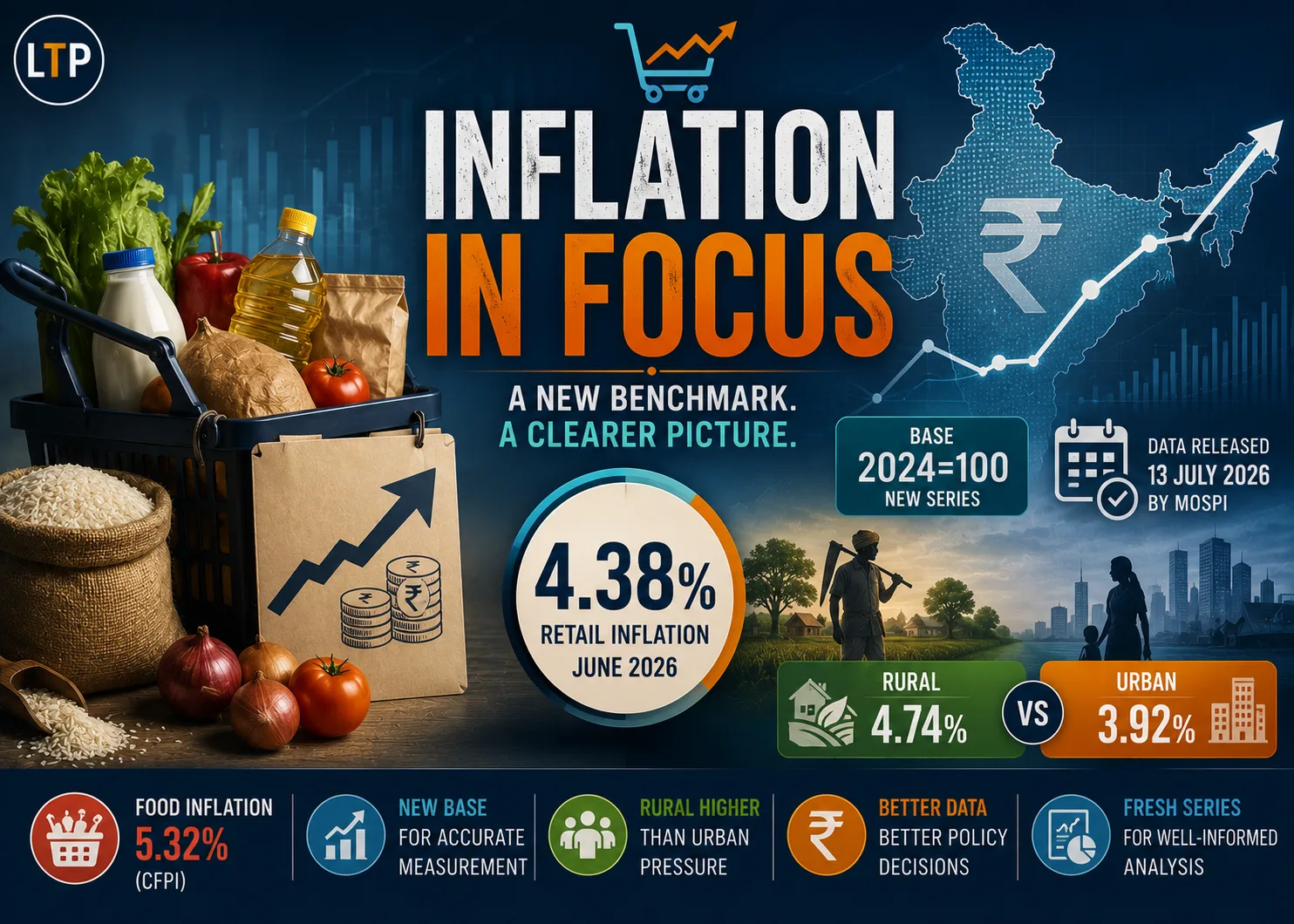
1. At a Glance
- Consumer Price Index (CPI) measures retail/consumer-level inflation, distinct from WPI (wholesale prices); CPI is RBI's key policy anchor for inflation targeting. [1]
- June 2026 release is only the fifth monthly release under the new CPI 2024=100 series, which replaced the 2012=100 series from February 2026. [2][3]
- Retail inflation (CPI-Combined) for June 2026 stood at 4.38%, food inflation (CFPI) at 5.32% — both provisional. [1]
- High examinability: base-year revisions, methodology changes (CAPI, COICOP 2018), and month-wise inflation trends are recurring Prelims/Mains fodder.
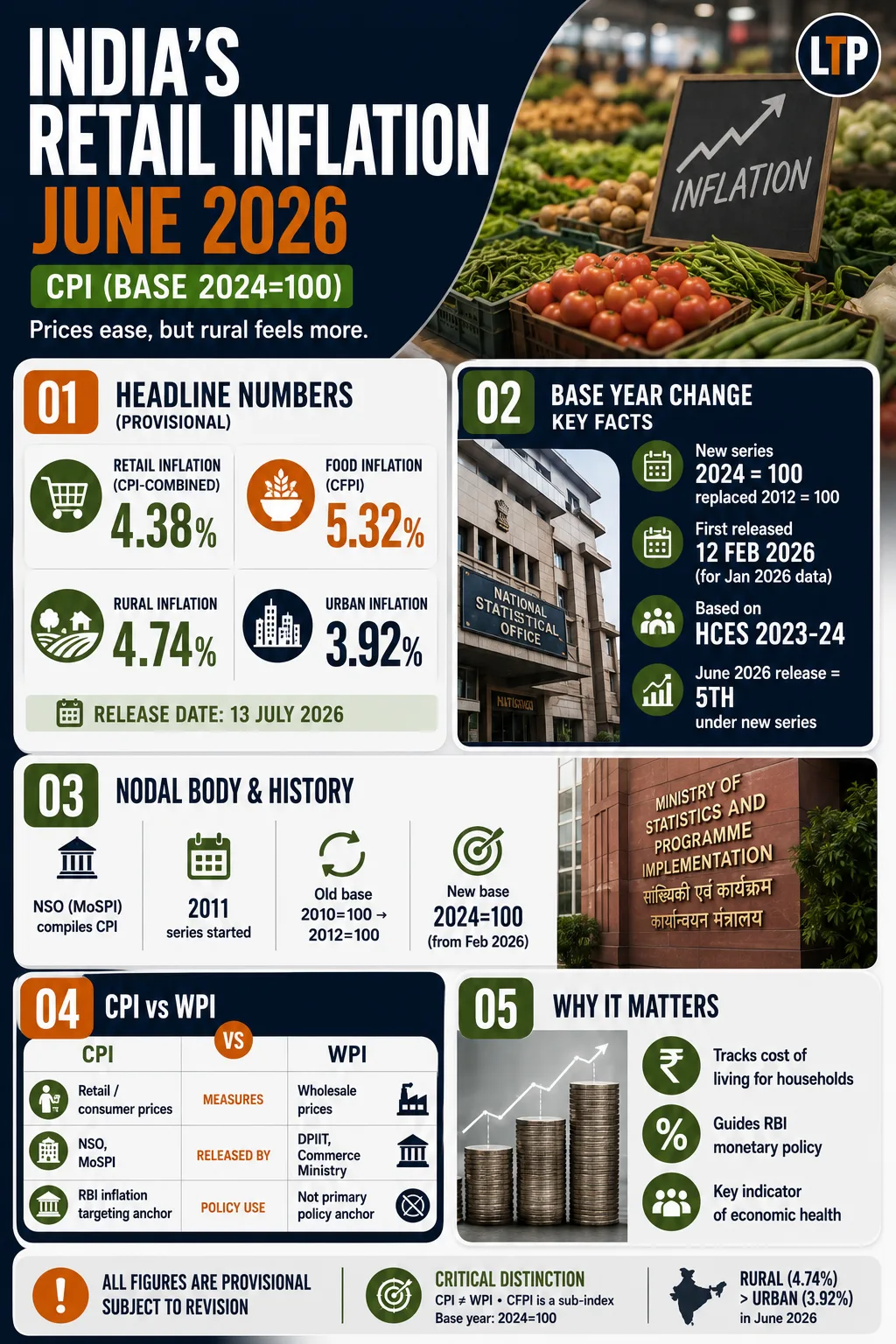
2. Why in the News
- MoSPI released the CPI (Base 2024=100) Press Release for June 2026 on 13 July 2026, showing headline inflation of 4.38% and food inflation of 5.32%, with rural-urban divergence (rural 4.74% vs urban 3.92%). [1]
- This continues the rollout of the new CPI series launched in February 2026, replacing the decade-old 2012 base. [2]
3. Background & Evolution
- CPI (Rural/Urban/Combined) has been compiled by NSO (National Statistical Office), MoSPI since 2011 on base year 2010=100, later revised to 2012=100.
- Base Revision to 2024=100: New series released for the first time on 12 February 2026 (for January 2026 data), based on the Household Consumption Expenditure Survey (HCES) 2023-24. [2][3]
- Preceded by a Pre-release Consultative Workshop on Base Revision of GDP, CPI and IIP held on 23 December 2025 at Bharat Mandapam, New Delhi. [2]
- Chronology of new-series releases: Jan 2026 (first release, Feb 2026) → Feb 2026 → Mar 2026 → Apr 2026 → May 2026 → June 2026 (current, released 13 Jul 2026). [2]
- Next release: CPI for July 2026 due 12 August 2026 (Wednesday). [1]
4. Core Static Facts
| Item | Detail |
|---|---|
| Implementing body | NSO, Ministry of Statistics & Programme Implementation (MoSPI) [1] |
| Base year | 2024=100 (revised from 2012=100) [2] |
| Weight basis | Household Consumption Expenditure Survey (HCES) 2023-24 [3] |
| Classification | COICOP 2018 (Classification of Individual Consumption According to Purpose), replacing earlier 6 broad groups [3] |
| Item basket | Total weighted items up from 299 → 358; goods 259→308; services 40→50 (all-India) [3] |
| Data collection | CAPI (Computer Assisted Personal Interviewing) introduced — handheld devices, real-time monitoring, in-built validation [3] |
| Coverage | 1,407 urban markets (incl. online) and 1,465 villages; 100% response rate in June 2026 [1] |
| June 2026 CPI (Combined) | Index 107.00; inflation 4.38% [1] |
| June 2026 CPI Rural/Urban | 4.74% / 3.92% [1] |
| CFPI (Combined) | Index 107.15; inflation 5.32%; Rural 5.45%, Urban 5.09% [1] |
| Housing inflation | 2.10% combined (Rural 2.66%, Urban 1.90%) — housing measured for urban sector conceptually but reported combined [1] |
| Highest state inflation | Telangana — 6.36% [1] |
| Lowest state inflation | Tripura — 1.65% [1] |
| Extreme item movements | Potatoes -20.34%; Peas -9.67%; Silver Jewellery +133.21%; Ginger +50.41% [1] |
| Release date | 13 July 2026, 4:00 PM, PIB Delhi [1] |
5. Multi-Dimensional Analysis
Economic
- CPI is the primary inflation target metric for RBI's Monetary Policy Committee (flexible inflation targeting, 4% ±2% band under RBI Act amendments). 4.38% keeps June 2026 within the comfort band. [1]
- Divergent rural (4.74%) vs urban (3.92%) inflation signals differing consumption-basket pressures — often food-driven in rural areas.
Administrative
- Base revision requires massive re-basing of price collection infrastructure — CAPI rollout across ~1,400 urban markets and ~1,465 villages reflects a major statistical modernisation exercise. [1][3]
- Transition from a legacy base year sustained "for more than a decade" to a fresh 2024 base reflects periodic recalibration to capture structural economic shifts (urbanisation, services growth, digitalisation). [3]
Social
- Elevated food inflation (CFPI 5.32%) relative to headline CPI (4.38%) disproportionately affects lower-income and rural households, where food forms a larger consumption share.
- Extreme item-level volatility (potato price crash, ginger/silver spike) illustrates vulnerability of specific livelihood groups (farmers, artisans) to price swings. [1]
Scientific / Technological
- Adoption of CAPI and COICOP 2018 international classification standard represents a technological and methodological upgrade aligning India's statistical practice with global norms. [3]
Governance
- Base-year revision exercises (GDP, CPI, IIP) were rolled out in tandem, reflecting a coordinated MoSPI statistical modernisation drive publicised via consultative workshops with stakeholders before rollout. [2]
6. Recent Developments (last 12-18 months)
- 23 Dec 2025: MoSPI Pre-release Consultative Workshop on Base Revision of GDP, CPI, IIP, Bharat Mandapam, New Delhi. [2]
- 12 Feb 2026: First release of CPI 2024=100 series (for January 2026). [2]
- Mar–May 2026: Successive monthly releases under new series (March, April, May 2026 press releases). [2]
- 13 Jul 2026: June 2026 CPI release — headline inflation 4.38%, food inflation 5.32%. [1]
- Next due: 12 Aug 2026 — July 2026 CPI release. [1]
7. Prelims Hooks
- CPI June 2026 (base 2024=100) inflation: 4.38% (combined, provisional). [1]
- CFPI June 2026 inflation: 5.32%. [1]
- Rural CPI inflation June 2026: 4.74%; Urban: 3.92%. [1]
- Housing inflation June 2026: 2.10% (measured only for urban/combined, not separately for rural in classical CPI design — but this release reports rural too). [1]
- CPI 2024 series weights are based on HCES 2023-24, not 2011-12 as in the old series. [3]
- New CPI series adopts COICOP 2018 classification, replacing the earlier 6 broad group structure. [3]
- Total weighted items in new series: 358 (up from 299); goods 308, services 50. [3]
- CAPI (Computer Assisted Personal Interviewing) introduced for the first time in CPI 2024 series data collection. [3]
- Price data collected from 1,407 urban markets and 1,465 villages. [1]
- Highest state-level inflation in June 2026: Telangana (6.36%); lowest: Tripura (1.65%). [1]
- Steepest price fall: Potatoes (-20.34%); steepest rise: Silver Jewellery (+133.21%). [1]
- New CPI base series first released 12 February 2026 for January 2026 data. [2]
- Releasing authority: National Statistical Office (NSO), MoSPI — not CSO or RBI. [1]
- July 2026 CPI scheduled for release on 12 August 2026. [1]
8. Mains Relevance
- GS-III: Indian Economy — Inflation, Indices and Issues Relating to Planning, Mobilization of Resources, Growth, Development; Statistics/Economic Survey linkages.
- GS-II (peripheral): Government policies and interventions — monetary policy transmission via RBI's inflation-targeting framework.
- Possible question stems:
- "Discuss the rationale and methodological changes involved in revising India's CPI base year from 2012 to 2024. How do these changes improve the representativeness of inflation measurement?"
- "Differentiate between CPI and WPI as inflation measures. Examine the implications of divergent rural-urban inflation trends for monetary policy and social equity."
- "Critically analyze the transition to CAPI-based data collection and COICOP classification in India's statistical system. How does it align with international best practices?"
9. Related Topics to Study Next
- WPI (Wholesale Price Index) — contrast with CPI; used for producer-side inflation, no COICOP classification. [1]
- RBI Monetary Policy Committee & Flexible Inflation Targeting — CPI is the anchor metric for repo rate decisions.
- Household Consumption Expenditure Survey (HCES) 2023-24 — the new CPI weight base; also feeds into poverty estimation debates.
- GDP Base Year Revision (2024 series) — parallel MoSPI statistical modernisation exercise. [2]
- IIP (Index of Industrial Production) Base Revision — third pillar of the coordinated base-updation exercise. [2]
- NSO/MoSPI institutional structure — statistical governance architecture in India.
- COICOP classification system — UN Statistics Division standard, relevant to international comparability of consumption statistics.
10. Common Errors / Trap Areas
- Confusing CPI (retail) with WPI (wholesale) — CPI is the RBI's inflation-targeting metric, not WPI.
- Assuming CPI is released by CSO — it is now released by NSO under MoSPI (post-2019 merger of NSSO and CSO into NSO).
- Mixing up base year 2024=100 (new) vs 2012=100 (old) — the new series began only from January 2026 data (released Feb 2026), not from 2024 itself.
- Assuming CFPI and CPI-Combined are the same — CFPI measures only food sub-basket inflation, distinct from headline CPI. [1]
- Overlooking that item basket weights changed (HCES 2023-24 vs earlier 2011-12 survey) — affects comparability of pre- and post-revision inflation figures. [3]
Sources
- 1PRESS RELEASE OF CONSUMER PRICE INDEX ON BASE 2024=100 FOR JUNE, 2026pib.gov.in · tier 1
- 2MoSPI organises Pre-release Consultative Workshop on the Base Revision of GDP, CPI and IIPpib.gov.in · tier 1
- 3Frequently Asked Questions (FAQs) on CPI 2024 Seriesmospi.gov.in · tier 1
At the end · practice MCQs
11 questions on this item
Check the answer for each question, or reveal all at once.