India-Australia Civil Nuclear Cooperation
New · District CollectorCan you hold the district for 72 hours?Floods, a heatwave, an outbreak, a grievance queue. Take the decisions, see the consequences.Play →In this note
Practice
12 questions on this item
Check the answer for each question, or reveal all at once.
1. At a Glance
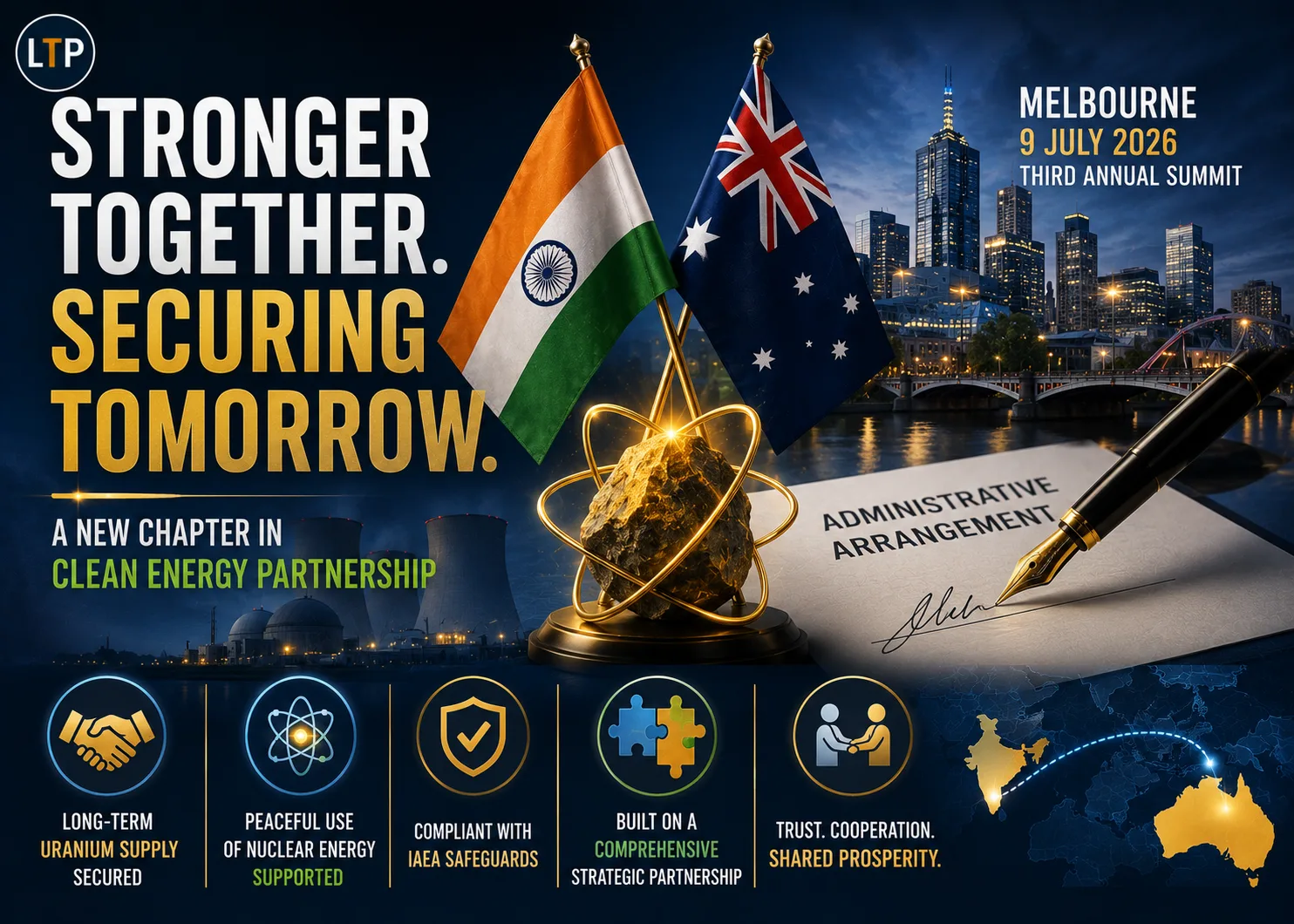
- India–Australia Civil Nuclear Cooperation governs long-term supply of Australian uranium to India for peaceful civil nuclear energy use under IAEA safeguards. [1][3]
- Rooted in the 2014 bilateral Agreement, it has now (July 2026) reached a new operational milestone with a fresh Administrative Arrangement to secure long-term uranium supply. [1][3]
- Relevant for UPSC as it intersects energy security, nuclear diplomacy, IAEA safeguards, and India's clean energy/Net Zero transition. [1]
2. Why in the News
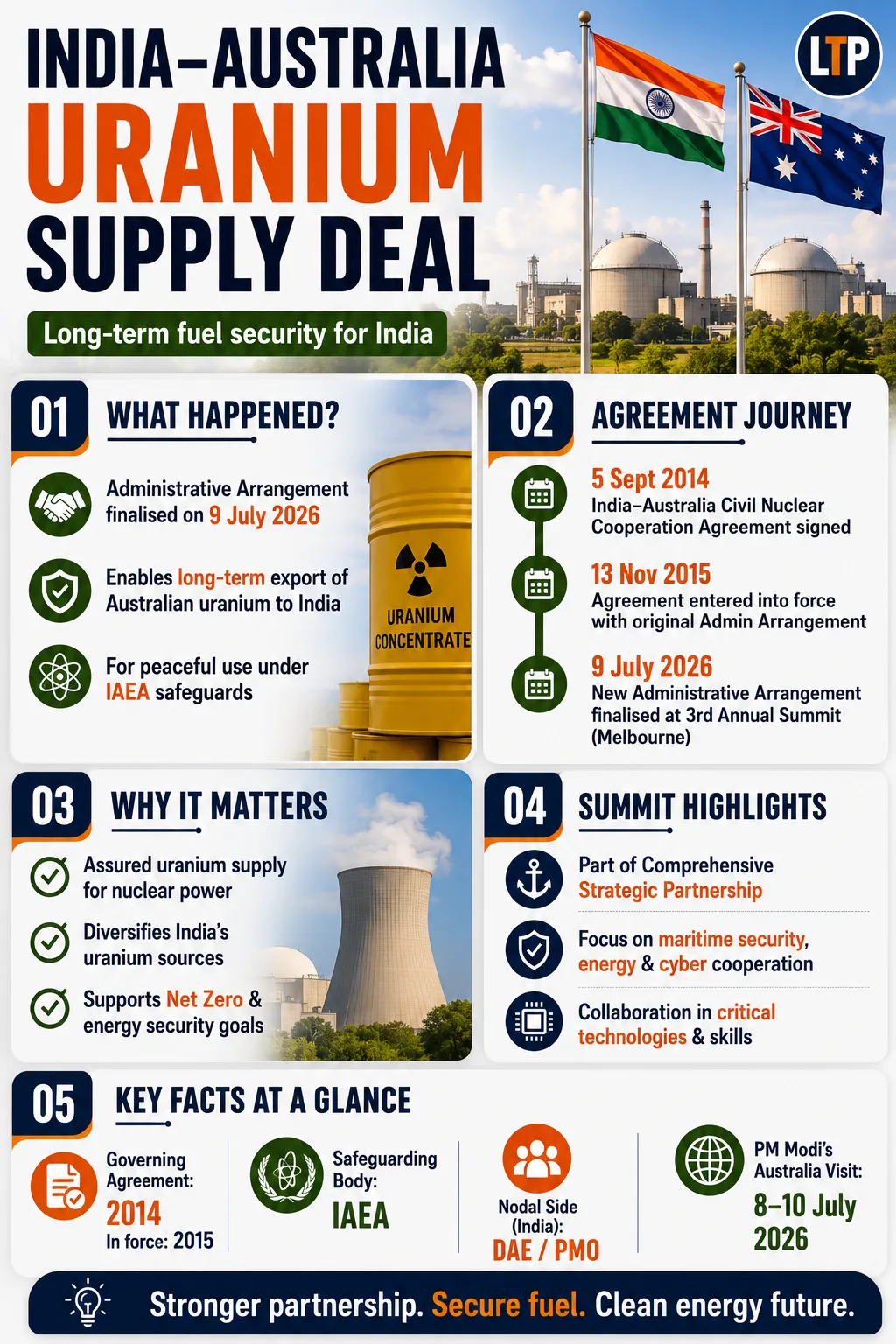
- At the Third India–Australia Annual Summit, held in Melbourne on 9 July 2026, both sides finalised an Administrative Arrangement under the India–Australia Civil Nuclear Cooperation Agreement, enabling long-term exports of Australian uranium to India for peaceful purposes under IAEA safeguards. [1]
- PM Narendra Modi visited Australia from 8–10 July 2026; a "List of Outcomes" document covering this and other bilateral deliverables was released by MEA. [2][3]
- The Summit also produced outcomes in maritime security, energy security, cyber cooperation, critical technologies, skill development and entrepreneurship, reaffirming the Comprehensive Strategic Partnership. [1]
3. Background & Evolution
- 5 September 2014: Agreement between Government of India and Government of Australia on Cooperation in the Peaceful Uses of Nuclear Energy signed. [1]
- 13 November 2015: Agreement entered into force, along with the original Administrative Arrangement for implementation. [1]
- 8 March 2017: MoS (PMO) Dr Jitendra Singh met Australia's Minister for Resources in New Delhi to discuss deepening civil nuclear cooperation. [1]
- 9 July 2026: Third India–Australia Annual Summit (Melbourne) finalises a new/updated Administrative Arrangement securing long-term uranium exports to India. [1]
- This builds on India's broader civil nuclear opening since the 2008 NSG waiver and the India–US civil nuclear deal, which normalised India's global nuclear trade access despite being a non-NPT signatory. [1]
4. Core Static Facts
| Item | Detail |
|---|---|
| Governing Agreement | India–Australia Agreement on Cooperation in the Peaceful Uses of Nuclear Energy (signed 5 Sep 2014, in force 13 Nov 2015) [1] |
| Latest instrument | Administrative Arrangement (finalised 9 July 2026, Melbourne) [1] |
| Purpose | Long-term export of Australian uranium to India for peaceful/civil purposes [1] |
| Safeguarding body | IAEA (International Atomic Energy Agency) [1] |
| Nodal Indian ministry | Department of Atomic Energy / PMO (MoS PMO handles atomic energy portfolio) [1] |
| Forum of announcement | Third India–Australia Annual Summit, Melbourne, 9 July 2026 [1] |
| Bilateral framework | Comprehensive Strategic Partnership (India–Australia) [1] |
| PM visit dates | 8–10 July 2026 (Narendra Modi to Australia) [2][3] |
5. Multi-Dimensional Analysis
Economic
- Assured long-term uranium supply reduces fuel-import uncertainty for India's nuclear power fleet, supporting capacity expansion under India's nuclear mission. [1]
Geopolitical / Strategic
- Deepens the India–Australia Comprehensive Strategic Partnership, complementing Quad-level cooperation on critical minerals and energy security. [1]
- Diversifies India's uranium sources beyond existing suppliers (e.g., Kazakhstan, Russia, Canada, France), reducing single-source dependency. [1]
Environmental
- Supports India's clean/low-carbon energy transition by enabling nuclear capacity addition as a non-fossil baseload source. [1]
Legal / Constitutional
- Operates under the bilateral 2014 Agreement (in force 2015) and its Administrative Arrangement — a treaty-level executive instrument, not requiring separate domestic legislation, implemented consistent with IAEA safeguards obligations. [1]
Scientific / Technological
- Indirectly strengthens India's fuel-cycle security for its indigenous reactor fleet and supports the broader Nuclear Energy Mission goals. [1]
Administrative
- Implementation involves Department of Atomic Energy and PMO on the Indian side, coordinated through Annual Summit-level diplomacy with Australia's Ministry of Resources. [1]
6. Recent Developments (last 12-18 months)
- 9 July 2026: Administrative Arrangement under the India–Australia Civil Nuclear Cooperation Agreement finalised at the Third India–Australia Annual Summit, Melbourne. [1]
- 8–10 July 2026: PM Modi's visit to Australia; MEA released a consolidated "List of Outcomes" document covering nuclear and other sectoral deliverables. [2][3]
- Summit outcomes also spanned maritime security, cyber cooperation, critical technologies, and skill development, indicating a broadening of the bilateral agenda beyond nuclear energy. [1]
7. Prelims Hooks
- India–Australia civil nuclear Agreement signed 5 September 2014. [1]
- Agreement entered into force 13 November 2015. [1]
- New Administrative Arrangement (2026) finalised at the Third India–Australia Annual Summit. [1]
- Third Annual Summit held in Melbourne on 9 July 2026. [1]
- Uranium supply arrangement operates under IAEA safeguards for peaceful use. [1]
- Bilateral relationship framed as a Comprehensive Strategic Partnership. [1]
- PM Modi's Australia visit: 8–10 July 2026. [2][3]
- Summit outcomes covered six areas: maritime security, energy security, cyber cooperation, critical technologies, skill development, entrepreneurship. [1]
- The original 2014 Agreement predates the current 2026 Administrative Arrangement by over a decade. [1]
- India–Australia nuclear cooperation is separate from, but analogous to, the earlier India–US civil nuclear deal model. [1]
8. Mains Relevance
- GS-II: International Relations — India's bilateral relations with Australia; Comprehensive Strategic Partnership; groupings and agreements involving India.
- GS-III: Energy Security — nuclear energy, clean energy transition, science & technology applications.
- Possible question stems: 1. "Discuss the significance of the India–Australia Civil Nuclear Cooperation Agreement for India's energy security and clean energy transition." (GS-III) 2. "Examine how the India–Australia Comprehensive Strategic Partnership has evolved through successive Annual Summits." (GS-II) 3. "Uranium diplomacy is emerging as a key pillar of India's Indo-Pacific strategic partnerships. Discuss with reference to Australia." (GS-II/III)
9. Related Topics to Study Next
- India–US Civil Nuclear Deal (2008) — foundational precedent for India's global nuclear trade normalisation. [1]
- NSG (Nuclear Suppliers Group) waiver, 2008 — enabled India's nuclear trade despite non-NPT status.
- India's Nuclear Energy Mission / Nuclear Power expansion targets — domestic policy context for uranium demand. [1]
- Quad grouping — broader Indo-Pacific strategic framework linking India and Australia.
- India–Australia Comprehensive Economic Cooperation Agreement (ECTA) — trade dimension of the bilateral relationship.
- Critical Minerals cooperation with Australia — parallel resource-security track.
- IAEA Safeguards Agreements and Additional Protocol — the safeguards architecture underpinning such nuclear trade.
10. Common Errors / Trap Areas
- Do not confuse the 2014/2015 original Agreement with the 2026 Administrative Arrangement — the latter is an implementing instrument under the former, not a new treaty. [1]
- Do not conflate this with the India–US 123 Agreement — separate country, separate instrument, though similarly enabled by the 2008 NSG waiver logic.
- Note it is the Third India–Australia Annual Summit (2026), not the first or second — earlier summits were in New Delhi (2023) and a second edition thereafter. [2]
- The nodal announcement ministry is PMO/Department of Atomic Energy, not the Ministry of External Affairs alone, though MEA documents the summit outcomes. [1][2]
- Avoid assuming this is India's first uranium-supply arrangement — India already sources uranium from Kazakhstan, Russia, Canada, and France; Australia is an additional, not sole, supplier. [1]
Sources
- 1PIB Backgrounder — India-Australia Civil Nuclear Cooperationpib.gov.in · tier 1
- 2MEA — List of Outcomes: Visit of PM Narendra Modi to Australia (July 08–10, 2026)mea.gov.in · tier 1
- 3MEA — Press Release: PM meets PM of Australia at 3rd India-Australia Annual Summit (July 09, 2026)mea.gov.in · tier 1
At the end · practice MCQs
12 questions on this item
Check the answer for each question, or reveal all at once.