India's First Hydrogen Fuel Cell Train Set to Redefine Sustainable Rail Mobility with Capacity of Around 2,600 Passengers
New · District CollectorCan you hold the district for 72 hours?Floods, a heatwave, an outbreak, a grievance queue. Take the decisions, see the consequences.Play →In this note
Practice
12 questions on this item
Check the answer for each question, or reveal all at once.
1. At a Glance
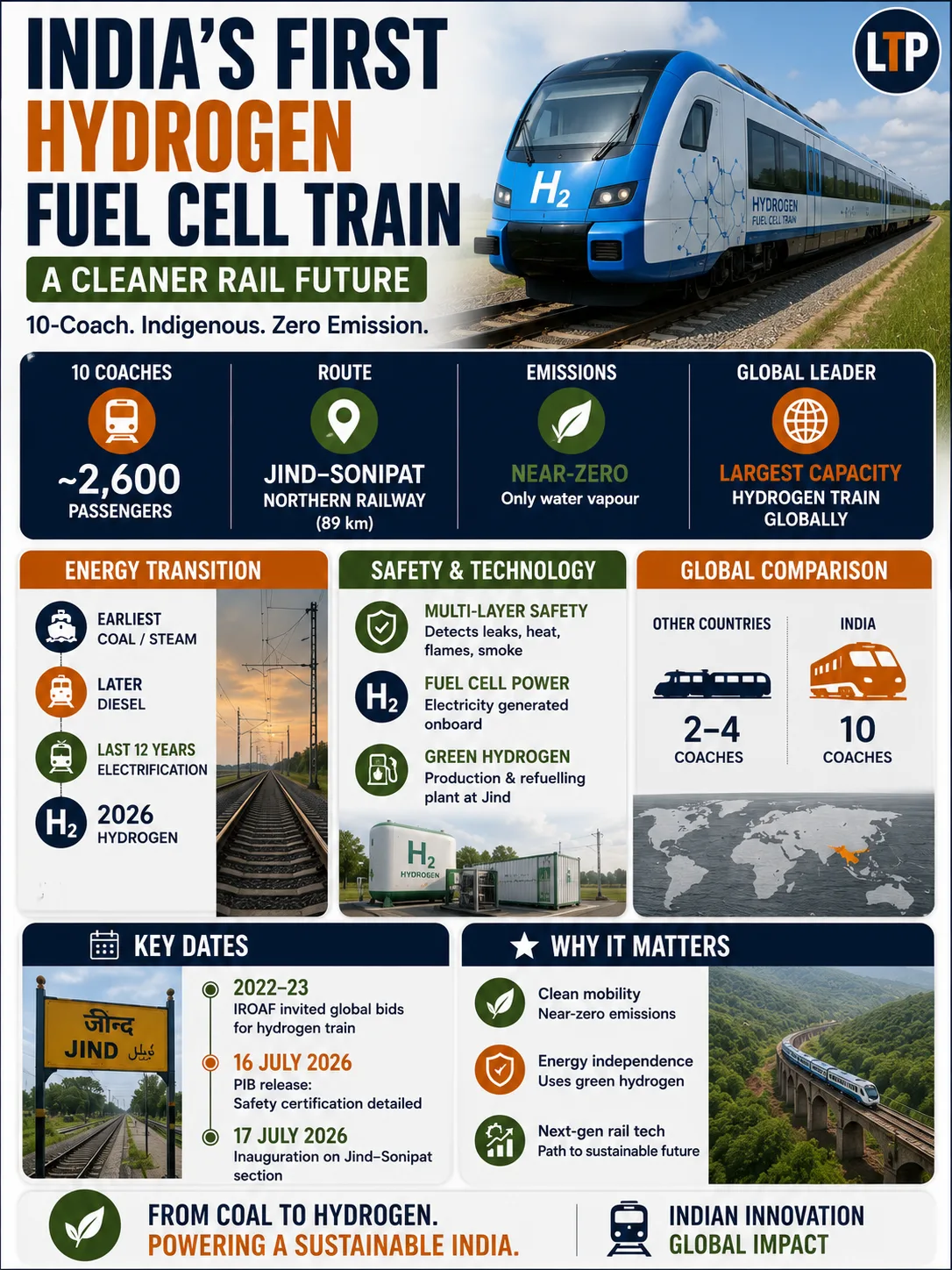
- India's first indigenously designed Hydrogen Fuel Cell Trainset, a 10-coach train generating its own electricity onboard via hydrogen, with near-zero emissions (only water vapour) at point of use [1].
- Marks the next phase of Indian Railways' energy transition — from coal/steam → diesel → electrification (last 12 years) → hydrogen [1].
- Flagged off on the Jind–Sonipat section, Northern Railway (89 km), with capacity of ~2,600 passengers — larger than any hydrogen train globally (existing global hydrogen trains run 2–4 coaches) [1].
- Relevant for Prelims (schemes, ministries, numbers) and Mains GS-III (energy, environment, infrastructure).
2. Why in the News
- 17 July 2026: Inauguration of India's first Hydrogen Fuel Cell Trainset on the Jind–Sonipat section [3].
- Press release (16 July 2026) detailing safety certification — multi-layer systems detecting hydrogen leaks, heat, flames and smoke — ahead of flag-off [1].
- Follows completion of manufacturing of the trainset and establishment of a green hydrogen production/refuelling plant at Jind (reported earlier in 2025-26) [4].
3. Background & Evolution
- 2022–23: Indian Railways Organisation of Alternative Fuels (IROAF) invited global bids for a Hydrogen Fuel Cell-based train on the Indian Railways network [5].
- 2023: Indian Railways announced plans to run 35 hydrogen trains under the "Hydrogen for Heritage" initiative on heritage/hill routes [2].
- Manufacturing completed: India's first hydrogen-powered train-set built; a green hydrogen production plant (electrolysis-based) established at Jind [4].
- 17 July 2026: First trainset inaugurated on Jind–Sonipat commercial route [1][3].
- Builds on India's broader hydrogen push — Green Hydrogen Fuel Cell buses (KPIT-CSIR, Pune) and hydrogen fuel cell vessel programme preceded the train [1].
4. Core Static Facts
| Parameter | Detail |
|---|---|
| Implementing body | Ministry of Railways; design led by Integral Coach Factory (ICF) and RDSO (Research Designs and Standards Organisation); integration by M/s Medha Servo Drives [1] |
| Configuration | 10 coaches — 2 Hydrogen Driving Power Cars (DPCs) + 8 Trailer Coaches [1] |
| Power | Each DPC: 1,200 kW → combined 2,400 kW [3] |
| Capacity | ~2,600 passengers [1][3] |
| Speed | Operational: 75 km/h; Design speed: 110 km/h [1][3] |
| Route | Jind–Sonipat section, Northern Railway (~89 km, 12 stations/halts) [1] |
| Refuelling hub | Jind, Haryana — country's largest railway hydrogen storage/refuelling facility, stores ~3,000 kg hydrogen at a time [1][3] |
| Regulatory clearance | Petroleum and Explosives Safety Organisation (PESO) licence for hydrogen storage/dispensing [3] |
| Standards/certification | NFPA-2, ISO 19880 series; independent safety assessment by TÜV SÜD, Germany [1] |
| Related scheme | "Hydrogen for Heritage" — 35 hydrogen trains planned for heritage/hill routes, at ~₹80 crore/train + ₹70 crore/route ground infrastructure [2] |
| Emission profile | Zero CO2 at point of use; only by-product is water vapour [1][3] |
5. Multi-Dimensional Analysis
Environmental
- Zero tailpipe/point-of-use CO2 emissions; supports India's National Green Hydrogen Mission and Net Zero (2070) commitment [1].
- Reduces reliance on imported diesel, building on gains already made via electrification over the past 12 years [1].
Scientific/Technological
- Indigenous fuel-cell integration (Medha Servo Drives) with ICF coach design and RDSO specifications — reflects "Atmanirbhar Bharat" in critical rail technology [1].
- Novel scale: India's 10-coach configuration exceeds global hydrogen train norms of 2–4 coaches, a genuine engineering differentiator [1].
Economic
- Estimated cost of ₹80 crore per trainset and ₹70 crore per route for ground infrastructure under the wider 35-train rollout — signals a capital-intensive but scalable green-transport investment [2].
- Reduced diesel import dependence has forex/energy-security implications.
Administrative/Governance (Safety & Regulation)
- Multi-layered safety architecture (leak/heat/flame/smoke detection, automatic shutoff, ventilation) with third-party certification (TÜV SÜD) and statutory clearance (PESO) — shows a governance model combining domestic execution with international safety validation [1][3].
Geopolitical/Strategic
- Aligns India with global hydrogen-mobility trends (Germany, other early adopters of 2–4 coach hydrogen trains) while positioning India as a scale leader [1].
6. Recent Developments (last 12-18 months)
- Manufacturing of India's first hydrogen-powered train-set completed; green hydrogen (electrolysis) production plant established at Jind [4].
- 16 July 2026: PIB release detailing safety systems and certification ahead of commercial flag-off [1].
- 17 July 2026: Trainset inaugurated for operations on the Jind–Sonipat section, Northern Railway [3].
7. Prelims Hooks
- India's first Hydrogen Fuel Cell Trainset has a capacity of around 2,600 passengers [1].
- The trainset has 10 coaches: 2 Hydrogen Driving Power Cars + 8 Trailer Coaches [1].
- Each DPC has power output of 1,200 kW; combined 2,400 kW [3].
- Operational speed: 75 km/h; design speed: 110 km/h [1][3].
- Route: Jind–Sonipat section, Northern Railway [1].
- Refuelling facility at Jind, Haryana is the country's largest railway hydrogen storage facility — stores ~3,000 kg hydrogen [1][3].
- Licensing regulator for hydrogen storage/dispensing: Petroleum and Explosives Safety Organisation (PESO) [3].
- Third-party independent safety assessment conducted by TÜV SÜD, Germany [1].
- Complies with NFPA-2 and ISO 19880 series standards [1].
- Design contribution from Integral Coach Factory (ICF); specifications by RDSO; integration by Medha Servo Drives [1].
- Only by-product of the fuel cell reaction is water vapour; near-zero emissions at point of use [1].
- "Hydrogen for Heritage" scheme envisages 35 hydrogen trains on heritage/hill routes [2].
- Estimated cost: ₹80 crore per train, ₹70 crore per route for ground infrastructure [2].
- International hydrogen trains typically run only 2–4 coaches; India's is a 10-coach configuration [1].
- IROAF (Indian Railways Organisation of Alternative Fuels) invited the original global bids for the hydrogen fuel cell train [5].
8. Mains Relevance
- GS-III: Infrastructure (Railways); Environment & Ecology (Green Hydrogen Mission, Net Zero); Science & Technology (indigenous fuel-cell tech, Atmanirbhar Bharat).
- GS-II (tangential): Government policies and interventions for development in transport/energy sectors.
- Possible question stems: 1. "Discuss the significance of hydrogen fuel cell technology in decarbonising India's transport sector, with reference to the Indian Railways' hydrogen trainset initiative." 2. "Examine how the National Green Hydrogen Mission is being operationalised across different modes of transport in India. What are the challenges to scaling such technology?" 3. "India's electrification of railways significantly reduced diesel dependence. How does the hydrogen fuel cell trainset represent the 'next chapter' in this energy transition, and what are its comparative advantages/limitations vis-à-vis full electrification?"
9. Related Topics to Study Next
- National Green Hydrogen Mission — the parent policy framework driving hydrogen adoption across sectors.
- Indian Railways electrification programme — the preceding phase of rail decarbonisation, useful for comparative analysis.
- "Hydrogen for Heritage" scheme — the larger 35-train rollout plan, directly linked.
- Green hydrogen production via electrolysis — technical backbone of the Jind plant.
- PESO (Petroleum and Explosives Safety Organisation) — regulatory body relevant across hydrogen/fuel-cell/LPG safety questions.
- Net Zero 2070 commitment — India's climate pledge context.
- Hydrogen fuel cell buses/vessels (KPIT-CSIR, indigenous vessel programme) — parallel applications of the same technology across transport modes.
- Vande Bharat / semi-high-speed rail programme — for contrasting propulsion technologies in Indian Railways' modernisation drive.
10. Common Errors / Trap Areas
- Confusing Ministry of Railways (implementing ministry for the train) with Ministry of New and Renewable Energy (which anchors the National Green Hydrogen Mission) — both are relevant but distinct.
- Mixing up power figures: each DPC is 1,200 kW; combined is 2,400 kW — aspirants often misstate the "2,400 kW" as per-car output.
- Confusing operational speed (75 km/h) with design speed (110 km/h).
- Assuming the trainset runs on a heritage/hill route — it is actually the Jind–Sonipat section; the heritage/hill routes are for the future 35-train "Hydrogen for Heritage" rollout, a separate but related initiative.
- Attributing the refuelling/storage facility to the wrong state — it is at Jind, Haryana, not Sonipat.
Sources
- 1Press Release Page | Press Information Bureau (India's First Hydrogen Fuel Cell Trainset...)pib.gov.in · tier 1
- 2Indian Railways to run 35 Hydrogen trains under "Hydrogen for Heritage"pib.gov.in · tier 1
- 3Greener & More Energy Efficient; First Indigenous Hydrogen Train All Set to Startpib.gov.in · tier 1
- 4Manufacturing of India's First Hydrogen-Powered Train-Set Completed; Green Hydrogen Production Plant Based on Electrolysis Process Being Established at Jindpib.gov.in · tier 1
- 5Indian Railways Organisation of Alternative Fuels (IROAF) invite bids for Hydrogen Fuel Cell based Trainpib.gov.in · tier 1
At the end · practice MCQs
12 questions on this item
Check the answer for each question, or reveal all at once.