Vikram-1: Charting India’s Cosmic Future
New · District CollectorCan you hold the district for 72 hours?Floods, a heatwave, an outbreak, a grievance queue. Take the decisions, see the consequences.Play →In this note
Practice
11 questions on this item
Check the answer for each question, or reveal all at once.
1. At a Glance
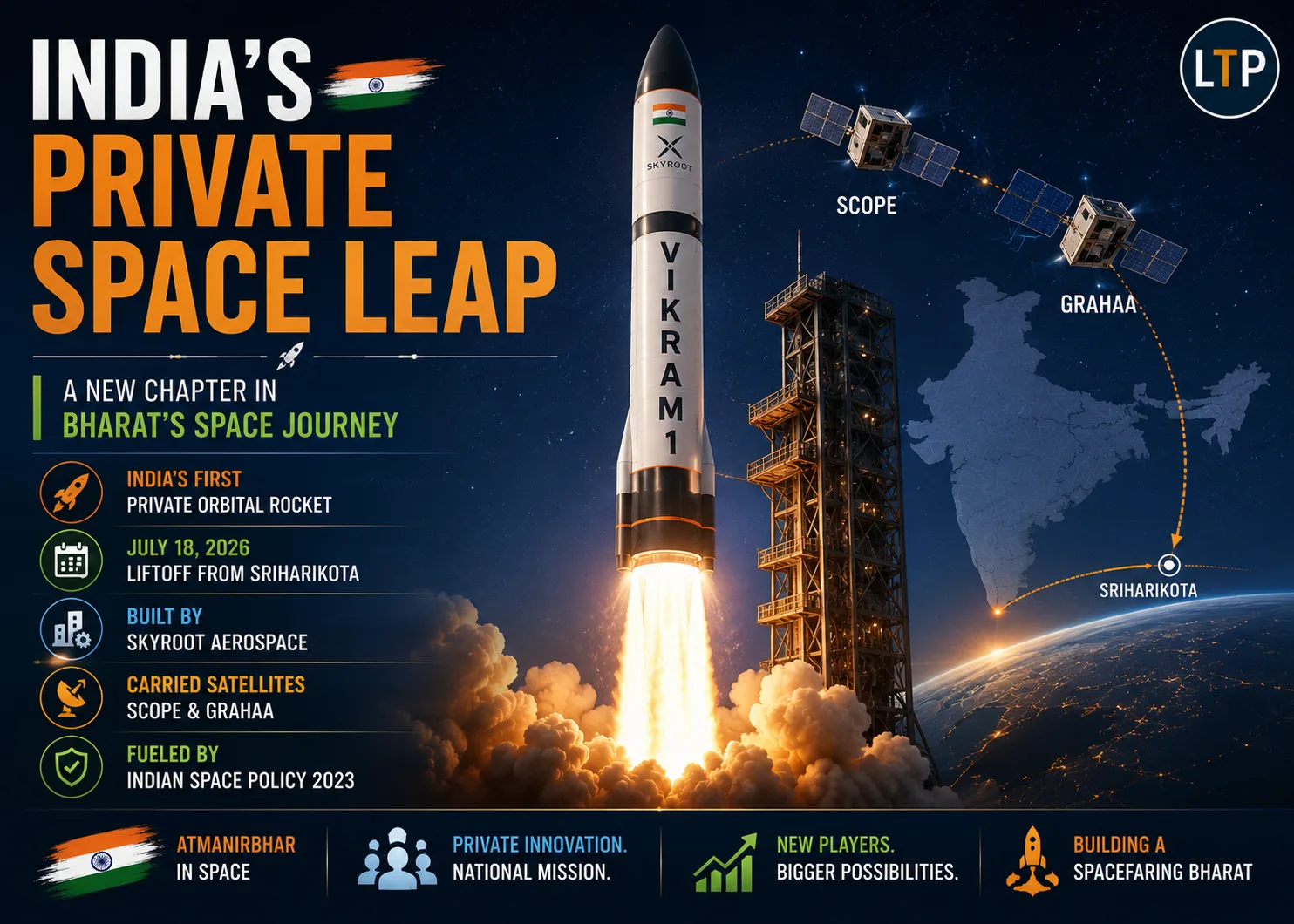
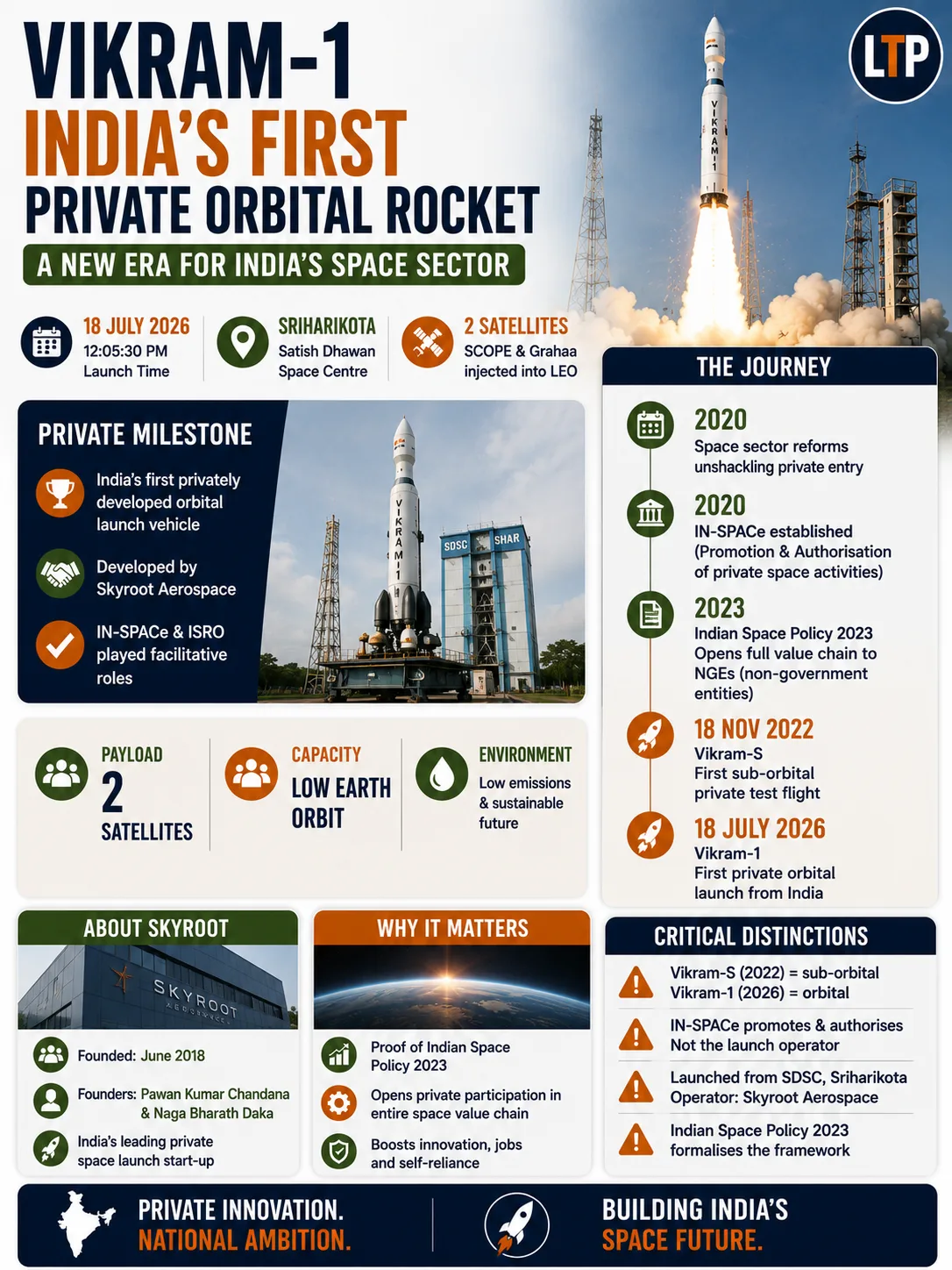
- Vikram-1 is Skyroot Aerospace's small-satellite launch vehicle — India's first privately developed orbital rocket, launched from Satish Dhawan Space Centre (SDSC), Sriharikota on 18 July 2026 at 12:05:30 PM [1].
- Marks the first orbital launch by a private Indian company from Indian soil, following the sub-orbital Vikram-S test flight (18 Nov 2022) [3].
- Illustrates the practical payoff of the Indian Space Policy 2023, which opened the entire space value chain — satellite manufacturing, launch services, applications, downstream services — to private/non-government entities (NGEs) [4].
- High-yield current-affairs + policy-linkage topic: tests both the event (Prelims) and the reform ecosystem (Mains GS-III).
2. Why in the News
- 18 July 2026: Vikram-1 lifted off from SDSC Sriharikota, carrying two satellites — SCOPE and Grahaa — injected into Low Earth Orbit (LEO) [1].
- PIB issued a backgrounder titled "Vikram-1: Charting India's Cosmic Future" on the same day, framing it as proof of the Indian Space Policy 2023 reforms [2].
3. Background & Evolution
- June 2018: Skyroot Aerospace founded by Pawan Kumar Chandana and Naga Bharath Daka [1].
- 2020: Space sector reforms initiated ("unshackling" of the sector), opening it to private participation [4].
- Government set up IN-SPACe (Indian National Space Promotion and Authorisation Centre) as a single-window agency to authorise/promote NGE space activities [4].
- 18 November 2022: Vikram-S, India's first privately developed rocket, launched (sub-orbital) from Sriharikota under Mission Prarambh, with ISRO/IN-SPACe providing facility handholding (solid motor casting, static test facilities at SDSC) [3][5].
- April 2023: Indian Space Policy 2023 notified, delineating roles of IN-SPACe, ISRO, NSIL (NewSpace India Limited) and DOS (Department of Space) [4].
- 18 July 2026: Vikram-1, the first orbital private launch vehicle, launched [1].
4. Core Static Facts
- Developer: Skyroot Aerospace (private startup, Hyderabad-based) [1].
- Vehicle configuration: 4-stage rocket — 3 solid stages + 1 liquid stage — designed for small satellites to LEO [1].
- Launch site: Satish Dhawan Space Centre (SDSC), Sriharikota [1].
- Payloads on maiden orbital flight: SCOPE and Grahaa satellites (LEO) [1].
- Predecessor: Vikram-S (sub-orbital, single-stage test rocket, launched 18 Nov 2022) [3].
- Nodal/enabling framework: Indian Space Policy 2023; single-window authorisation via IN-SPACe [4].
- Institutional roles: DOS (policy), ISRO (R&D, facilities), IN-SPACe (promotion/authorisation of NGEs), NSIL (commercial arm) [4].
- Startup ecosystem growth: Space startups grew from 1 (2014) to ~266 currently (per DPIIT Start-Up India Portal figures cited by Union Minister Dr Jitendra Singh) [4][2].
- Funding: Skyroot Aerospace has raised ₹526 crore to date, cited as India's largest-funded private space startup [1].
- National target: Government aims for a five-fold increase in India's share of the global space economy [4].
5. Multi-Dimensional Analysis
Economic
- Signals maturing private space industry — potential for satellite launch services as an export/commercial revenue stream.
- Attracts FDI and venture funding into deep-tech manufacturing (propulsion, avionics).
Scientific/Technological
- Demonstrates indigenous solid+liquid propulsion staging by a non-PSU entity — technology diffusion from ISRO to private players via IN-SPACe facility-sharing [3].
- Tests India's ability to compete in the small-satellite/LEO launch market dominated globally by players like SpaceX, Rocket Lab.
Governance/Administrative
- Tests the single-window clearance model (IN-SPACe) as a governance innovation reducing regulatory friction for NGEs [4].
- Role delineation among ISRO/IN-SPACe/NSIL/DOS is a live administrative case study in avoiding overlap.
Geopolitical/Strategic
- Strengthens India's position in the global commercial launch market, relevant to Quad space cooperation and Artemis Accords context.
- Reduces dependence on foreign private launchers for Indian small-satellite missions.
Legal/Policy
- Anchored in the Indian Space Policy 2023, the key enabling policy document (not an Act) — important Prelims distinction (policy vs statute).
6. Recent Developments (last 12–18 months)
- 27 November 2025: PM inaugurated Skyroot's Infinity Campus [6].
- 18 July 2026: Vikram-1 maiden orbital launch from SDSC Sriharikota with SCOPE and Grahaa satellites [1][2].
- Continued rise in registered space startups (approaching ~266) under DPIIT Start-Up India Portal tracking [4].
7. Prelims Hooks
- Vikram-1 is India's first privately developed orbital rocket [1].
- Launched on 18 July 2026 from Satish Dhawan Space Centre, Sriharikota [1].
- Developer: Skyroot Aerospace, founded June 2018 by Pawan Kumar Chandana and Naga Bharath Daka [1].
- Predecessor Vikram-S launched 18 November 2022 — India's first privately developed rocket (sub-orbital) under Mission Prarambh [3][5].
- Vikram-1 configuration: 4 stages — 3 solid + 1 liquid [1].
- Maiden payloads: SCOPE and Grahaa satellites into LEO [1].
- Enabling policy: Indian Space Policy 2023 [4].
- Single-window authorisation body: IN-SPACe (Indian National Space Promotion and Authorisation Centre) [4].
- Commercial arm of Department of Space: NSIL (NewSpace India Limited) [4].
- Space startups grew from 1 in 2014 to ~266 currently [4][2].
- Skyroot has raised ₹526 crore — India's largest-funded private space startup [1].
- Government target: five-fold increase in India's share of global space economy [4].
8. Mains Relevance
- GS-III: Science & Technology — indigenization of technology and developing new technology; Awareness in space.
- GS-II (secondary): Government policies and interventions for development in various sectors (Indian Space Policy 2023, IN-SPACe as governance reform).
- Possible question stems: 1. "Discuss how the Indian Space Policy 2023 has transformed the role of private enterprise in India's space economy. Illustrate with recent examples." (GS-III) 2. "Examine the institutional architecture (ISRO, IN-SPACe, NSIL, DOS) created to manage private participation in India's space sector. Does role overlap pose governance challenges?" (GS-II/III) 3. "India's private space sector has grown from one startup in 2014 to over 250 today. Critically evaluate whether this growth translates into global competitiveness." (GS-III)
9. Related Topics to Study Next
- Indian Space Policy 2023 — the core enabling framework behind Vikram-1's launch.
- IN-SPACe — single-window regulator model, relevant for governance/administrative reform questions.
- NSIL (NewSpace India Limited) — DOS's commercial PSU arm, often confused with IN-SPACe.
- Gaganyaan Mission — India's human spaceflight programme, parallel ISRO strategic priority.
- Chandrayaan-3 / Aditya-L1 — recent ISRO scientific missions for comparative context.
- Artemis Accords — India's 2023 signing, geopolitical dimension of space cooperation.
- DPIIT Start-Up India Portal — tracks space startup registration numbers, relevant to economic dimension.
- PSLV/GSLV vs private launch vehicles — comparative technology and cost analysis.
10. Common Errors / Trap Areas
- Confusing Vikram-S (2022, sub-orbital, single-stage) with Vikram-1 (2026, orbital, 4-stage) — dates and mission type are frequently mixed up.
- Attributing the launch authorisation solely to ISRO — the correct single-window authorising body for NGEs is IN-SPACe, not ISRO directly.
- Treating the Indian Space Policy 2023 as an Act of Parliament — it is a policy, not a statute.
- Confusing NSIL (commercial PSU, markets ISRO tech/launches) with IN-SPACe (regulator/promoter for NGEs) — distinct mandates.
- Misattributing the nodal ministry — space sector falls under the Department of Space (DOS), Prime Minister's Office charge (via Union Minister of State), not a separate "Ministry of Space."
Sources
- 1First private orbital launch lifts off from Sriharikotaisro.gov.in · tier 1
- 2Vikram-1: Charting India's Cosmic Futurepib.gov.in · tier 1
- 3Vikram-S, India's first-ever private Launch vehicle to take off from Sriharikota on November 18, 2022pib.gov.in · tier 1
- 4Union Minister Dr Jitendra Singh says, the Indian Space Policy – 2023 opens up the sector for enhanced participation of Non-Government Entities (NGEs)pib.gov.in · tier 1
- 5Mission Prarambhisro.gov.in · tier 1
- 6PM to Inaugurate Skyroot's Infinity Campus on 27th Novemberpib.gov.in · tier 1
At the end · practice MCQs
11 questions on this item
Check the answer for each question, or reveal all at once.