India established as a Serious Global Space Power with Vikram-1 Success; Dr. Jitendra Singh Says, the Historic Mission Vindicates PM Modi’s Landmark Space Reforms
New · District CollectorCan you hold the district for 72 hours?Floods, a heatwave, an outbreak, a grievance queue. Take the decisions, see the consequences.Play →In this note
Practice
12 questions on this item
Check the answer for each question, or reveal all at once.
1. At a Glance
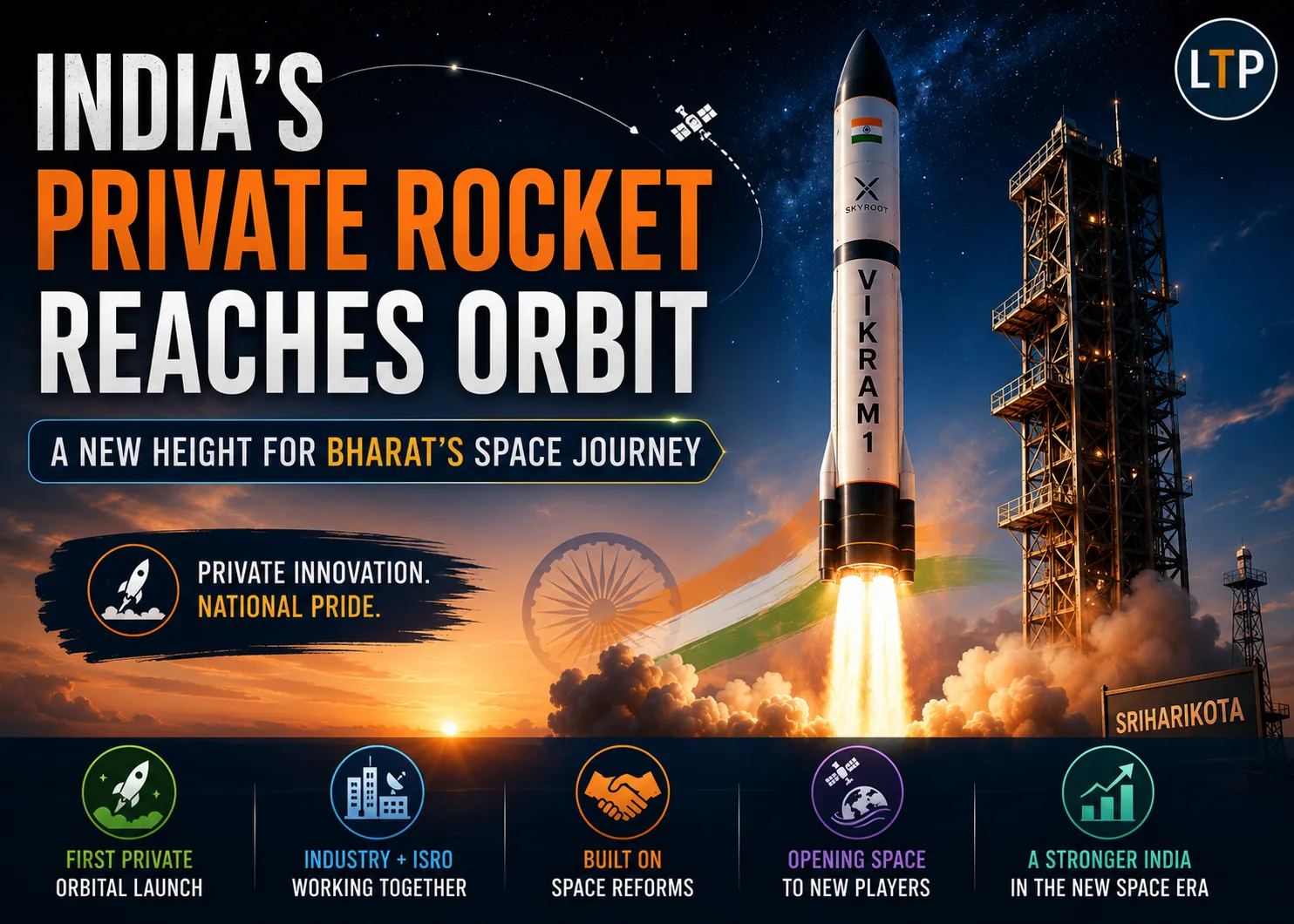
- Vikram-1, India's first privately-developed orbital launch vehicle (built by Skyroot Aerospace), successfully reached orbit from Satish Dhawan Space Centre (SDSC), Sriharikota on 18 July 2026 [1][2].
- Marks India's transition from state-monopoly space launches to a private-sector-led commercial launch capability, positioning India as a serious player in the global commercial space market [1].
- Union Minister Dr. Jitendra Singh (MoS, Department of Space) called it a vindication of PM Modi's 2020 space sector reforms opening the sector to private participation [1].
- Relevant for Prelims (agencies, dates, vehicle specs) and Mains GS-III (S&T, space policy, private participation).
2. Why in the News
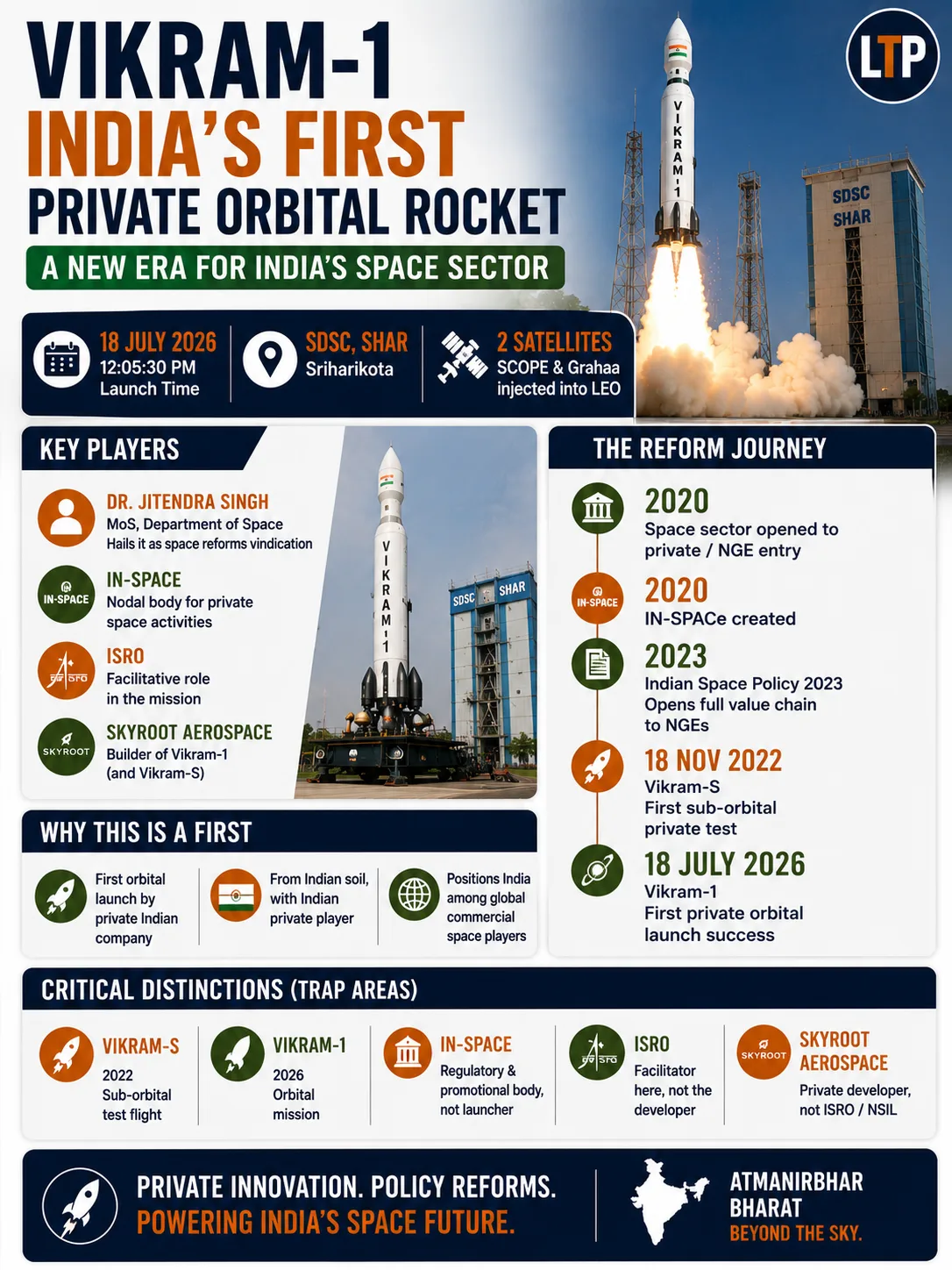
- Vikram-1 lifted off from SDSC Sriharikota on 18 July 2026 at 12:05:30 PM, becoming the first orbital launch by a private Indian company from Indian soil [2].
- PIB press release (PRID=2286087, dated 18 July 2026) quotes Dr. Jitendra Singh terming it proof that "for India, the sky is no longer the limit" [1].
- Follows the earlier sub-orbital Vikram-S test launch (18 November 2022), Skyroot's first rocket [1][3].
3. Background & Evolution
- 2020: Government announces opening of the space sector to private/non-governmental entities (NGEs); IN-SPACe created as the nodal regulatory/promotional body [1].
- June 2018: Skyroot Aerospace founded by Pawan Kumar Chandana and Naga Bharath Daka, IIT alumni and former ISRO scientists [1].
- 18 November 2022: Vikram-S, India's first privately-built sub-orbital rocket, launched from Sriharikota — proof-of-concept mission ("Mission Prarambh") [3].
- 8 August 2025: First static test of the KALAM-1200 motor, the first stage of Vikram-1, conducted successfully by SDSC SHAR/ISRO [1].
- 27 November 2025 (approx.): PM Modi inaugurates Skyroot's "Infinity Campus" in Hyderabad via video conferencing [1].
- 18 July 2026: Vikram-1 achieves full orbital launch success [2].
4. Core Static Facts
- Vehicle: Vikram-1 — 4-stage rocket (3 solid stages + 1 liquid stage), designed to place small satellites into Low Earth Orbit (LEO) [2].
- Developer: Skyroot Aerospace (private Indian space startup, founded 2018) [1].
- Launch site: Satish Dhawan Space Centre (SDSC SHAR), Sriharikota, Andhra Pradesh [2].
- Regulator/facilitator: IN-SPACe (Indian National Space Promotion and Authorisation Centre) — authorised the launch and enabled Skyroot's access to ISRO facilities, technical consultancy, mission readiness reviews, and launch clearances [2].
- Parent ministry: Department of Space (DOS), under PMO/Minister of State Dr. Jitendra Singh [1].
- Predecessor test vehicle: Vikram-S (sub-orbital, Nov 2022) [3].
- Key motor: KALAM-1200 (first stage), static-tested August 2025 [1].
5. Multi-Dimensional Analysis
Economic
- Signals India's entry into the global commercial launch services market, opening revenue streams via small-satellite launch contracts [1].
- Strengthens India's space-startup ecosystem, cited as leading to a broader "startup boom" post-reforms [1].
Scientific/Technological
- Demonstrates indigenous private capability in solid-and-liquid propulsion staging (KALAM-1200 motor) [1].
- Validates India's ability to develop cost-competitive small-lift launch vehicles for LEO payloads [2].
Geopolitical/Strategic
- Enhances India's competitiveness against private global players (e.g., SpaceX, Rocket Lab) in the small-satellite launch segment [1].
Governance/Administrative
- Showcases IN-SPACe's regulatory role as a single-window facilitator bridging private entities and ISRO infrastructure [2].
- Reflects the 2020 policy reform's implementation maturity — from authorization (2022) to orbital success (2026) in under four years [1][2].
6. Recent Developments (last 12-18 months)
- 8 August 2025: KALAM-1200 first-stage motor static test successful [1].
- 27 November 2025: PM Modi inaugurates Skyroot's Infinity Campus, Hyderabad [1].
- 18 July 2026: Vikram-1 orbital launch success from Sriharikota [1][2].
7. Prelims Hooks
- Vikram-1 is India's first privately-developed orbital launch vehicle.
- Developed by Skyroot Aerospace, founded in June 2018.
- Founders: Pawan Kumar Chandana and Naga Bharath Daka (ex-ISRO scientists, IIT alumni).
- Vikram-1 launched from Satish Dhawan Space Centre, Sriharikota, Andhra Pradesh.
- Launch date: 18 July 2026.
- Vikram-1 is a 4-stage vehicle — 3 solid stages + 1 liquid stage.
- Vikram-1's predecessor, Vikram-S, was India's first private sub-orbital rocket (launched 18 November 2022).
- Vikram-S launch mission was codenamed "Mission Prarambh."
- IN-SPACe = Indian National Space Promotion and Authorisation Centre — regulates/promotes private space activity.
- First stage motor of Vikram-1: KALAM-1200.
- Union Minister overseeing Department of Space statements: Dr. Jitendra Singh.
- Space sector opened to private participation in 2020 under PM Modi's government.
- Skyroot's manufacturing facility, "Infinity Campus," is located in Hyderabad.
8. Mains Relevance
- GS-III: Science & Technology — "Awareness in space technology"; Indian space policy and private sector participation.
- GS-II: Governance — role of regulatory bodies (IN-SPACe) in public-private partnership models.
- Possible question stems:
- "Discuss the significance of private sector entry into India's space launch capability, citing the Vikram-1 mission." (GS-III)
- "Examine the role of IN-SPACe in facilitating non-governmental participation in India's space sector." (GS-II)
- "How does India's private space launch ecosystem compare with global trends in commercial spaceflight?" (GS-III)
9. Related Topics to Study Next
- IN-SPACe — regulatory architecture for private space participation.
- NewSpace India Limited (NSIL) — ISRO's commercial arm, contrast with private startups like Skyroot.
- Gaganyaan Mission — India's human spaceflight programme, another DOS flagship.
- Space Activities Bill — pending legislative framework for space sector regulation.
- Chandrayaan-3 / Aditya-L1 — recent ISRO missions showing broader space capability trajectory.
- PSLV/GSLV commercial launches — comparison of state-run vs private launch vehicles.
- Agnikul Cosmos — another private Indian orbital launch startup, useful comparative case.
10. Common Errors / Trap Areas
- Do not confuse Vikram-S (2022, sub-orbital test) with Vikram-1 (2026, full orbital, satellite-capable) — different missions.
- Do not attribute the launch authorization solely to ISRO — IN-SPACe is the authorizing/regulatory body, ISRO provides facilities/technical support.
- Do not confuse Skyroot Aerospace (private startup) with NSIL (ISRO's PSU commercial arm) — both are distinct entities in India's space ecosystem.
- Do not mix up founding year (2018) with the year of space sector reforms (2020).
- The "Vikram" naming honours Dr. Vikram Sarabhai, father of the Indian space programme — not related to Chandrayaan's "Vikram" lander by ownership, though both share the same namesake tribute.
Sources
- 1Press Release Page | Press Information Bureau (Vikram-1 success, Dr. Jitendra Singh statement)pib.gov.in · tier 1
- 2First private orbital launch lifts off from Sriharikotaisro.gov.in · tier 1
- 3ISRO makes history today by successfully launching India's maiden private Vikram-suborbital (VKS) rocketpib.gov.in · tier 1
At the end · practice MCQs
12 questions on this item
Check the answer for each question, or reveal all at once.