Can biogas aid India’s energy security?
New · District CollectorCan you hold the district for 72 hours?Floods, a heatwave, an outbreak, a grievance queue. Take the decisions, see the consequences.Play →In this note
Practice
12 questions on this article
Check the answer for each question, or reveal all at once.
1. At a Glance
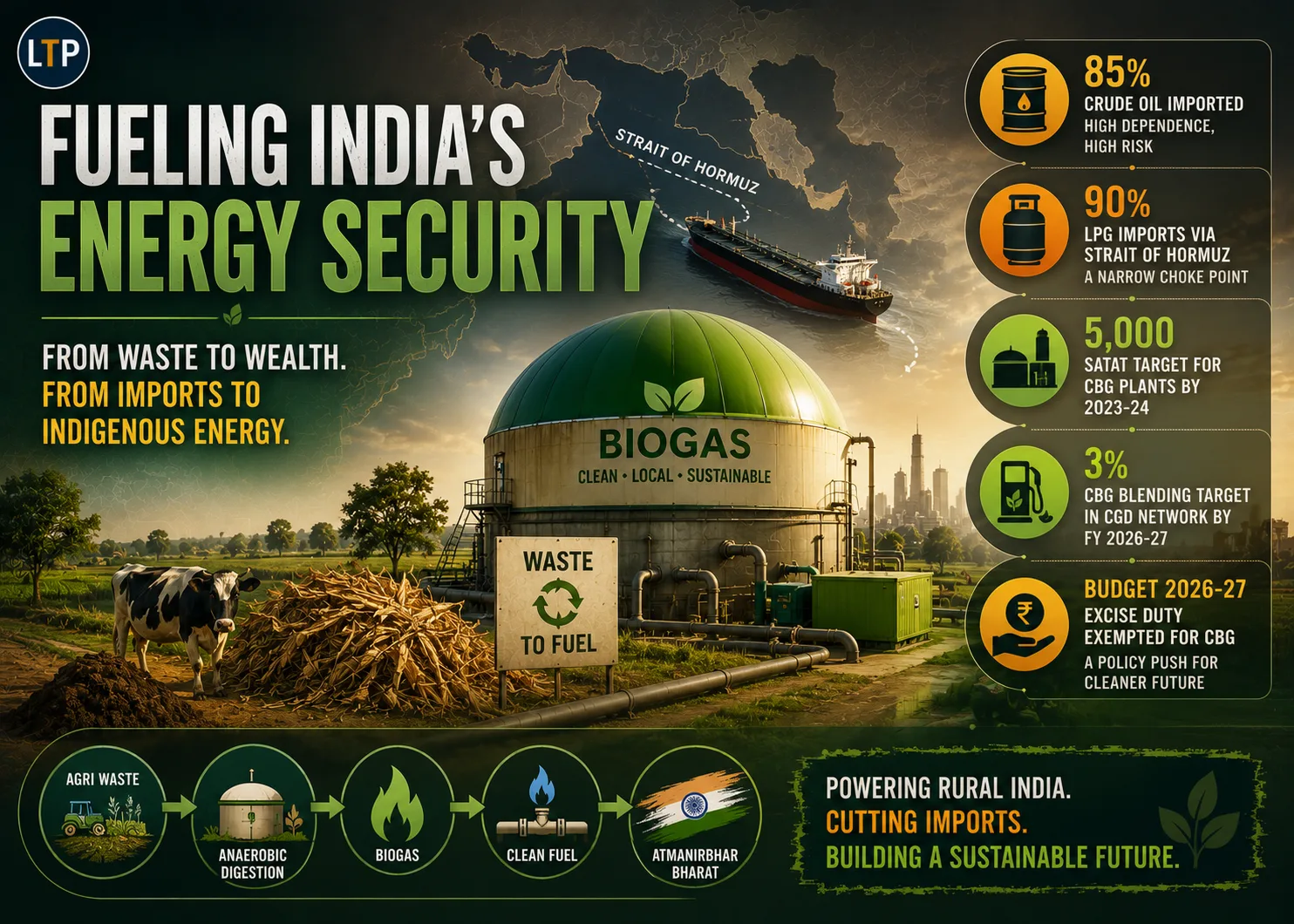
- India imports ~85% of crude oil and ~90% of LPG transits via the Strait of Hormuz, making West Asian instability a direct energy-security risk [5].
- Compressed Biogas (CBG) — chemically identical to CNG, renewable, carbon-neutral, produced from organic/agri waste — is being pushed as an import-substitution fuel [5].
- Despite a decade-old policy push (SATAT, GOBARdhan, CBG-CGD blending mandate), actual CBG output remains far below original targets [1][5].
- High-yield UPSC topic linking energy security + circular economy + rural income + climate mitigation.
2. Why in the News
- Israel–U.S.–Iran conflict (2026) disrupted West Asian energy supply routes, renewing focus on India's import dependence and alternate fuels like CBG [5].
- Government reaffirmed India's ability to meet the 3% CBG blending target in CNG for FY 2026-27 [1].
- Budget 2026-27 exempted central excise duty on the biogas/CBG portion of blended CNG, resolving a double-taxation issue [1].
3. Background & Evolution
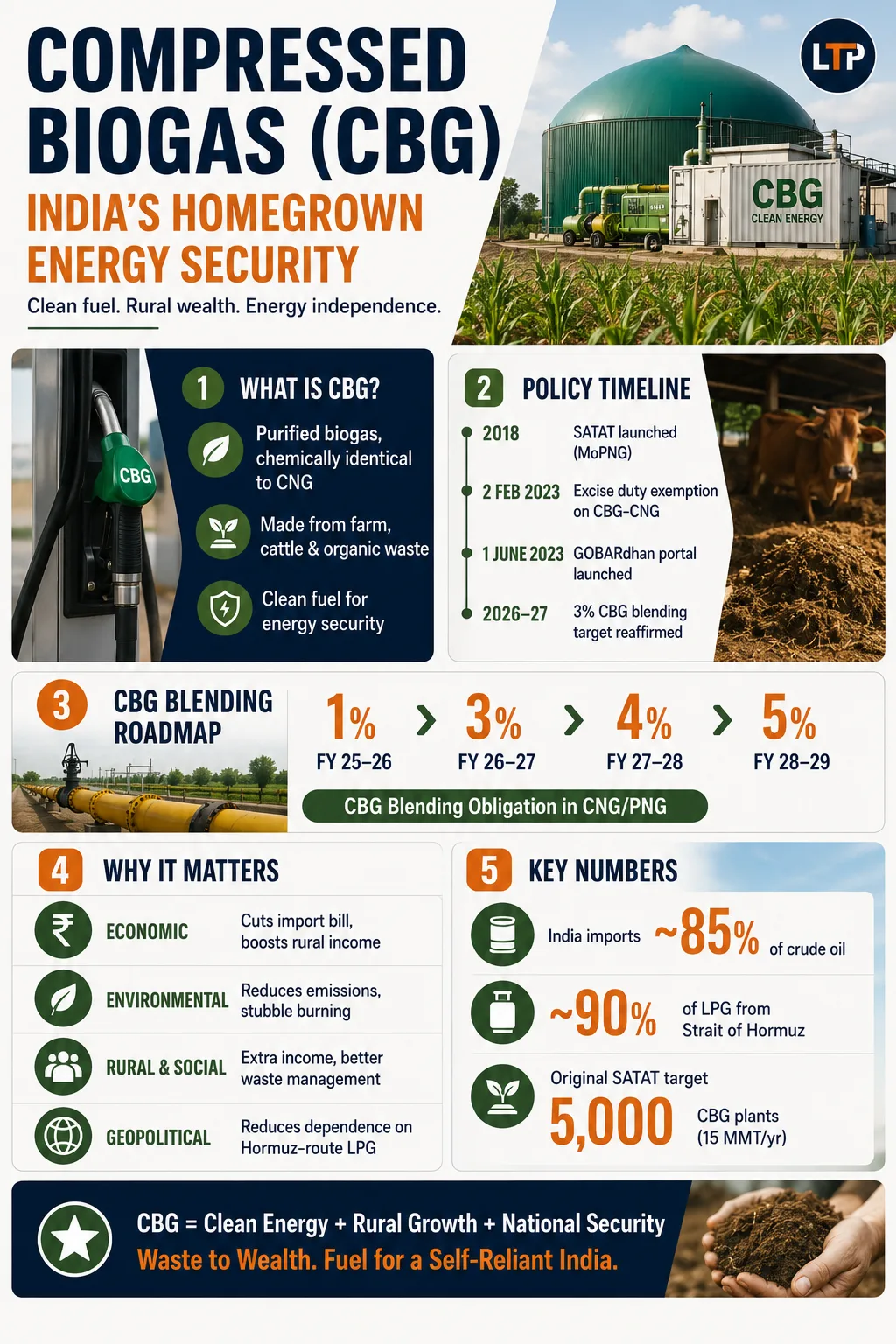
- 2018: SATAT (Sustainable Alternative Towards Affordable Transportation) launched by Ministry of Petroleum & Natural Gas (MoPNG) to promote CBG as a green transport fuel; original target — 5,000 CBG plants producing 15 MMT/annum CBG by 2023-24 [2][4].
- Feb 2, 2023: Central excise duty exemption granted to CNG blended with CBG to prevent double taxation [3].
- June 1, 2023: Unified Registration Portal for GOBARdhan launched by Department of Drinking Water & Sanitation to streamline CBG/biogas plant registration nationwide [3].
- CBG-CGD Synchronisation Scheme of MoPNG extended to strengthen production-consumption linkage [3].
- FY 2025-26 onward: Mandatory CBG Blending Obligation (CBO) introduced — 1% (2025-26) → 3% (2026-27) → 4% (2027-28) → 5% (2028-29) of CNG/PNG consumption [1][3].
- Budget 2026-27: Excise duty fully exempted on biogas/CBG portion of blended CNG [1].
4. Core Static Facts
| Item | Detail |
|---|---|
| Definition | Biogas = mixture of methane + CO₂ + trace gases from anaerobic digestion of organic matter; CBG = purified/compressed biogas, chemically identical to CNG [5] |
| Nodal scheme | SATAT, launched 2018 by MoPNG [2][4] |
| Multi-ministerial umbrella | GOBARdhan — "Waste to Wealth" initiative converting cattle dung, agri-residue, biomass into biogas/CBG/organic manure [3] |
| Registration portal | Unified GOBARdhan Registration Portal — Dept. of Drinking Water & Sanitation, launched 01 June 2023 [3] |
| Original SATAT target | 5,000 plants / 15 MMT CBG per annum by 2023-24 (unmet) [4] |
| CBG Blending Obligation (CBO) | 1% (FY25-26) → 3% (FY26-27) → 4% (FY27-28) → 5% (FY28-29) of CNG/PNG in City Gas Distribution [1][3] |
| Tax incentive | Excise duty exemption on CBG-blended CNG since 2 Feb 2023, expanded fully in Budget 2026-27 [1][3] |
| Import dependence context | ~85% crude oil import dependence; ~90% LPG imports transit Strait of Hormuz [5] |
5. Multi-Dimensional Analysis
Economic
- CBG substitutes imported LPG/CNG, cutting the oil import bill and forex outgo [5].
- Excise exemption (Budget 2026-27) improves CGD company margins and plant viability [1].
- Slow plant commissioning vs. targets indicates weak investor confidence/financing bottlenecks [1][4].
Environmental
- CBG is carbon-neutral, produced from organic waste, cutting stubble/agri-residue burning and methane emissions from open dumping [5].
- Supports circular economy via GOBARdhan's waste-to-wealth model [3].
Social/Rural
- Feedstock (cattle dung, crop residue) sourced from farmers/rural households — additional income stream [5].
- Addresses agricultural waste management alongside fuel supply [5].
Geopolitical/Strategic
- Reduces vulnerability to West Asian supply shocks (Strait of Hormuz chokepoint) amid Israel-US-Iran tensions [5].
- Diversification complements crude oil supplier diversification already underway [5].
Administrative/Governance
- "Whole of Government" multi-ministerial coordination (MoPNG, Dept. of Drinking Water & Sanitation, agri ministries) under GOBARdhan — coordination complexity is a stated implementation challenge [3].
- Mandatory blending obligation (CBO) creates demand-pull, but achievement of the original 2023-24 SATAT target failed, showing supply-side execution gaps [1][4].
6. Recent Developments (last 12-18 months)
- FY 2025-26: CBO mandate takes effect at 1% blending [1][3].
- Government reaffirms 3% CBG blending achievability for FY 2026-27 [1].
- Budget 2026-27: Full central excise exemption on biogas/CBG component of blended CNG [1].
- July 2026: Israel-U.S.-Iran conflict disrupts West Asian energy markets, reviving CBG-as-energy-security discourse [5].
7. Prelims Hooks
- SATAT scheme launched in 2018 by the Ministry of Petroleum & Natural Gas (not MNRE) [2][4].
- SATAT stands for Sustainable Alternative Towards Affordable Transportation [2].
- Original SATAT target: 5,000 CBG plants, 15 MMT/annum by 2023-24 [4].
- CBG is chemically identical to CNG [5].
- GOBARdhan = multi-ministerial "Waste to Wealth" initiative [3].
- GOBARdhan Unified Registration Portal launched 1 June 2023 by Dept. of Drinking Water & Sanitation (not MoPNG) [3].
- CBG Blending Obligation (CBO): 1% FY25-26 → 3% FY26-27 → 4% FY27-28 → 5% FY28-29 [1][3].
- Excise duty exemption on CBG-blended CNG first granted 2 February 2023 [3].
- Budget 2026-27 gave full excise exemption on the biogas/CBG portion of blended CNG [1].
- India imports ~85% of crude oil requirement [5].
- ~90% of India's LPG imports transit the Strait of Hormuz [5].
- Biogas is produced via anaerobic digestion of organic matter [5].
8. Mains Relevance
- GS-III: Infrastructure — Energy; Conservation, environmental pollution and degradation; Achievements of Indians in S&T.
- GS-II (secondary): Government policies and interventions for development in various sectors.
- Sample stems:
- "India's crude oil import dependence exposes it to geopolitical shocks. Examine how compressed biogas can strengthen India's energy security, and discuss the reasons for the shortfall in achieving SATAT targets." (GS-III)
- "Discuss the significance of the GOBARdhan initiative in promoting a circular economy while addressing rural income and agricultural waste management." (GS-III)
- "Critically evaluate the role of fiscal incentives (excise duty exemptions) versus regulatory mandates (blending obligations) in scaling up India's compressed biogas sector." (GS-III)
9. Related Topics to Study Next
- Ethanol Blending Programme (EBP) / E20 — parallel biofuel import-substitution strategy.
- National Bio-Energy Mission — broader biomass energy policy umbrella.
- City Gas Distribution (CGD) network expansion — infrastructure CBG depends on.
- Strait of Hormuz & India's energy chokepoints — strategic geography angle.
- Stubble burning & agricultural residue management — feedstock/environmental link.
- Strategic Petroleum Reserves (SPR) — alternate energy-security tool for comparison.
- National Green Hydrogen Mission — another alternate-fuel pathway to contrast with CBG.
- Swachh Bharat Mission (Rural) & waste-to-energy — institutional overlap with GOBARdhan.
10. Common Errors / Trap Areas
- Confusing SATAT (MoPNG scheme, transport fuel focus) with GOBARdhan (multi-ministerial, broader waste-to-wealth mandate) — different scope and nodal ownership [2][3].
- Assuming GOBARdhan portal is run by MoPNG — it is actually the Department of Drinking Water & Sanitation [3].
- Mixing up CBG with LNG/PNG — CBG is chemically identical to CNG, not LNG [5].
- Misremembering CBO blending percentages/years — sequence is 1%-3%-4%-5% across FY25-26 to FY28-29, not a flat single-year target [1][3].
- Believing the original SATAT 2023-24 target (5,000 plants/15 MMT) was achieved — it was not; progress has been limited, per the article's own framing [4][5].
Sources
- 1Targets under SATAT Scheme — PIBpib.gov.in · tier 1
- 2Petroleum Minister launches SATAT initiative — PIBpib.gov.in · tier 1
- 3Year End Review of GOBARdhan: "Waste to Wealth" initiative — PIBpib.gov.in · tier 1
- 4Compressed Biogas (CBG) under SATAT Scheme — IREDAireda.in · tier 3
- 5"Can biogas aid India's energy security?" by V. Nivedita, The Hindu Business Line, 14 July 2026thehindu.com · tier 4
At the end · practice MCQs
12 questions on this article
Check the answer for each question, or reveal all at once.