ISRO conducts test of key component for Gaganyaan mission
New · District CollectorCan you hold the district for 72 hours?Floods, a heatwave, an outbreak, a grievance queue. Take the decisions, see the consequences.Play →In this note
Practice
6 questions on this article
Check the answer for each question, or reveal all at once.
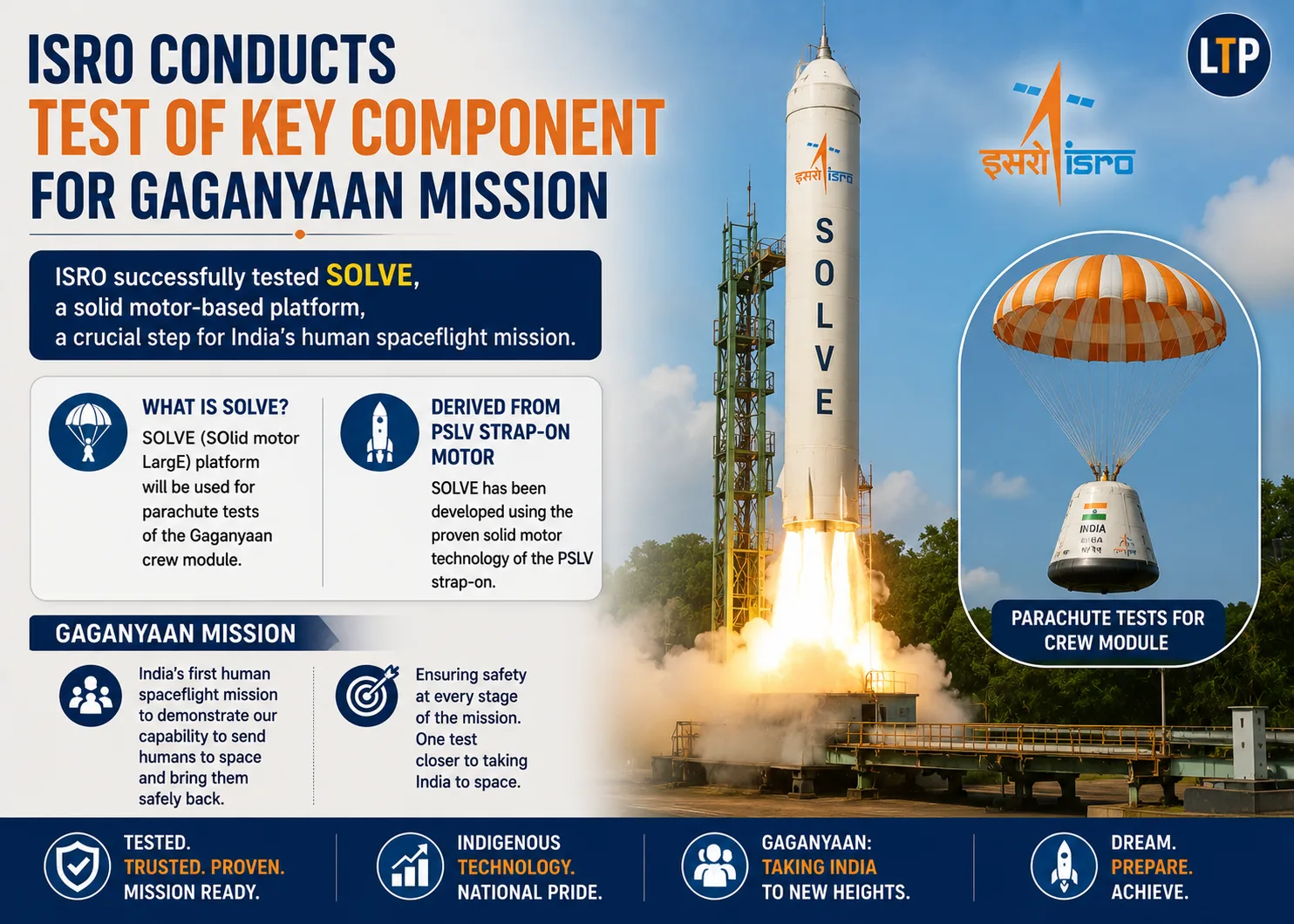
- ISRO conducted the first ground test of SOLVE (Sub-Orbital Launch Vehicle for Experiments), a solid motor-based test platform, on July 3, 2026 at Satish Dhawan Space Centre (SDSC), Sriharikota [1][2].
- SOLVE will be used for Integrated Parachute Tests to validate the deceleration/parachute system of Gaganyaan's Crew Module [1][2].
- Relevant for UPSC as part of India's human spaceflight programme (Gaganyaan), testing methodology, and indigenous propulsion technology derivation from PSLV.
- Tests motor performance parameters — reported "as expected" by ISRO — a key milestone before crewed missions [1].
2. Why in the News
- ISRO successfully carried out the first ground test of the SOLVE solid motor at its Static Test Facility, SDSC Sriharikota, on July 3, 2026 [1][2].
- This is a precursor test for the Integrated Parachute Tests (IPT) validating the Gaganyaan crew module's deceleration system before splashdown [2].
3. Background & Evolution
- Gaganyaan is India's indigenous human spaceflight programme, aiming to send astronauts to low-Earth orbit and return them safely.
- ISRO has previously conducted the TV-D1 (Test Vehicle Demonstration-1) mission to validate the Crew Escape System [1].
- ISRO earlier conducted successful hot tests of the Service Module Propulsion System (SMPS) and CE20 E13 engine hot tests for Gaganyaan qualification, showing a staged testing approach across sub-systems [1].
- SOLVE is the newest addition — a dedicated solid motor-based sub-orbital vehicle purpose-built for parachute-system validation, distinct from the crew-escape-focused TV-D series [2].
4. Core Static Facts
- Full form: SOLVE = Sub-Orbital Launch Vehicle for Experiments.
- Purpose: Platform for Integrated Parachute Tests (IPT) to validate deceleration system of Gaganyaan Crew Module [2].
- Test location: Static Test Facility, Satish Dhawan Space Centre, Sriharikota [1].
- Test date: July 3, 2026, ~10:00 hrs [1].
- Origin of solid stage: Derived from PSLV Strap-on Motor, modified with slow burn-rate propellant and straight nozzle with secondary injection thrust vector control (SITVC) [2].
- Test profile: Crew module carried to 10–17 km altitude, separated from vehicle, then a sequence of 10 parachutes deployed to reduce velocity before splashdown in sea [2].
- Implementing agency: Indian Space Research Organisation (ISRO), under Department of Space (DoS).
5. Multi-Dimensional Analysis
- Scientific/Technological: Demonstrates indigenous adaptation of existing PSLV strap-on motor technology for a new test role (propellant and nozzle modification), reflecting cost-efficient reuse of proven hardware [2].
- Strategic: Crew safety validation is a non-negotiable gate before any crewed launch; parachute deceleration systems are safety-critical for splashdown recovery, akin to systems used by NASA/Roscosmos capsules.
- Administrative: Reflects ISRO's staged/incremental test philosophy — SMPS hot tests, CE20 engine tests, TV-D1 crew escape test, and now SOLVE parachute tests — each validating a discrete Gaganyaan subsystem [1].
- Governance: Test outcomes are publicly disclosed via ISRO's official press releases, aiding transparency in a high-visibility national mission.
6. Recent Developments (last 12-18 months)
- July 3, 2026: First ground test of SOLVE solid motor conducted successfully at SDSC Sriharikota [1][2].
- Prior: ISRO conducted hot tests of Gaganyaan Service Module Propulsion System (SMPS) [1].
- Prior: CE20 E13 Engine Hot Test conducted for Gaganyaan and 22-tonne thrust qualification [1].
- ISRO is scheduled to conduct the first uncrewed demonstrator mission of Gaganyaan later in 2026 [2].
7. Prelims Hooks
- SOLVE stands for Sub-Orbital Launch Vehicle for Experiments.
- SOLVE's first ground test was conducted on July 3, 2026.
- Test facility: Static Test Facility, Satish Dhawan Space Centre, Sriharikota.
- SOLVE's solid stage is derived from the PSLV Strap-on Motor.
- Modifications to the motor include slow burn rate propellant and a straight nozzle with secondary injection thrust vector control.
- SOLVE will conduct Integrated Parachute Tests (IPT) for Gaganyaan's Crew Module.
- Crew module test altitude range: 10 km to 17 km.
- A total of 10 parachutes will be deployed to decelerate the crew module.
- Recovery method: splashdown in the sea.
- Gaganyaan's crew escape system was earlier validated via the TV-D1 mission.
- Gaganyaan's propulsion subsystems validated include Service Module Propulsion System (SMPS) and CE20 E13 engine.
- Implementing agency for Gaganyaan: ISRO, under the Department of Space.
8. Mains Relevance
- GS-III: Science and Technology — indigenization of technology, space programme, achievements of Indians in science.
- Syllabus heading: "Achievements of Indians in Science & Technology; indigenization of technology."
- Possible question stems: 1. "Discuss the significance of incremental sub-system testing (propulsion, crew escape, parachute deceleration) in India's Gaganyaan human spaceflight programme." 2. "How does ISRO's practice of technology reuse (e.g., PSLV strap-on motor adapted for SOLVE) reflect cost-efficient innovation in India's space programme?" 3. "Examine the significance of the Gaganyaan mission for India's strategic and scientific standing in human spaceflight."
9. Related Topics to Study Next
- Gaganyaan TV-D1 Mission — validates crew escape system, complements parachute test milestone.
- PSLV (Polar Satellite Launch Vehicle) — source technology for SOLVE's solid motor.
- CE20 Engine / Cryogenic technology — propulsion validation for Gaganyaan.
- Department of Space & ISRO organisational structure — administrative context.
- NASA/Roscosmos crewed spaceflight recovery systems — comparative angle for Mains answers.
- India's Human Spaceflight Programme timeline — sequencing of uncrewed and crewed missions.
- Vyommitra (humanoid robot for Gaganyaan uncrewed test) — related payload for demonstrator missions.
10. Common Errors / Trap Areas
- Do not confuse SOLVE (parachute deceleration test vehicle) with TV-D1 (crew escape system test vehicle) — different subsystems, different vehicles.
- SOLVE is not a crewed or orbital vehicle — it is a sub-orbital, uncrewed ground/test vehicle.
- The solid motor is derived from PSLV's strap-on motor, not from GSLV or LVM3 boosters.
- Do not misattribute the test facility — it is the Static Test Facility at SDSC Sriharikota, not the Vikram Sarabhai Space Centre (VSSC) or Liquid Propulsion Systems Centre (LPSC).
- Gaganyaan's implementing body is ISRO/Department of Space, not DRDO (though DRDO contributes ancillary systems like space food/crew equipment).
Sources
- 1ISRO conducts ground test for new sub-orbital solid motor-based test vehicleisro.gov.in · tier 1
- 2ISRO Conducts Ground Trial For New Sub-Orbital Solid Motor-Based Test Vehicle To Validate Gaganyaan Parachute Systemsswarajyamag.com · tier 4
- 3ISRO conducts test of key component for Gaganyaan mission — The Hindu (article excerpt)thehindu.com · tier 4
At the end · practice MCQs
6 questions on this article
Check the answer for each question, or reveal all at once.