West Bengal govt. will table Uniform Civil Code Bill soon
New · District CollectorCan you hold the district for 72 hours?Floods, a heatwave, an outbreak, a grievance queue. Take the decisions, see the consequences.Play →In this note
Practice
12 questions on this article
Check the answer for each question, or reveal all at once.
1. At a Glance
- The Uniform Civil Code (UCC) aims to replace religion-specific personal laws (governing marriage, divorce, inheritance, adoption) with a single secular code applicable to all citizens. [1]
- Article 44 of the Indian Constitution lists UCC as a Directive Principle of State Policy (DPSP) — non-justiciable but constitutionally aspirational. [4]
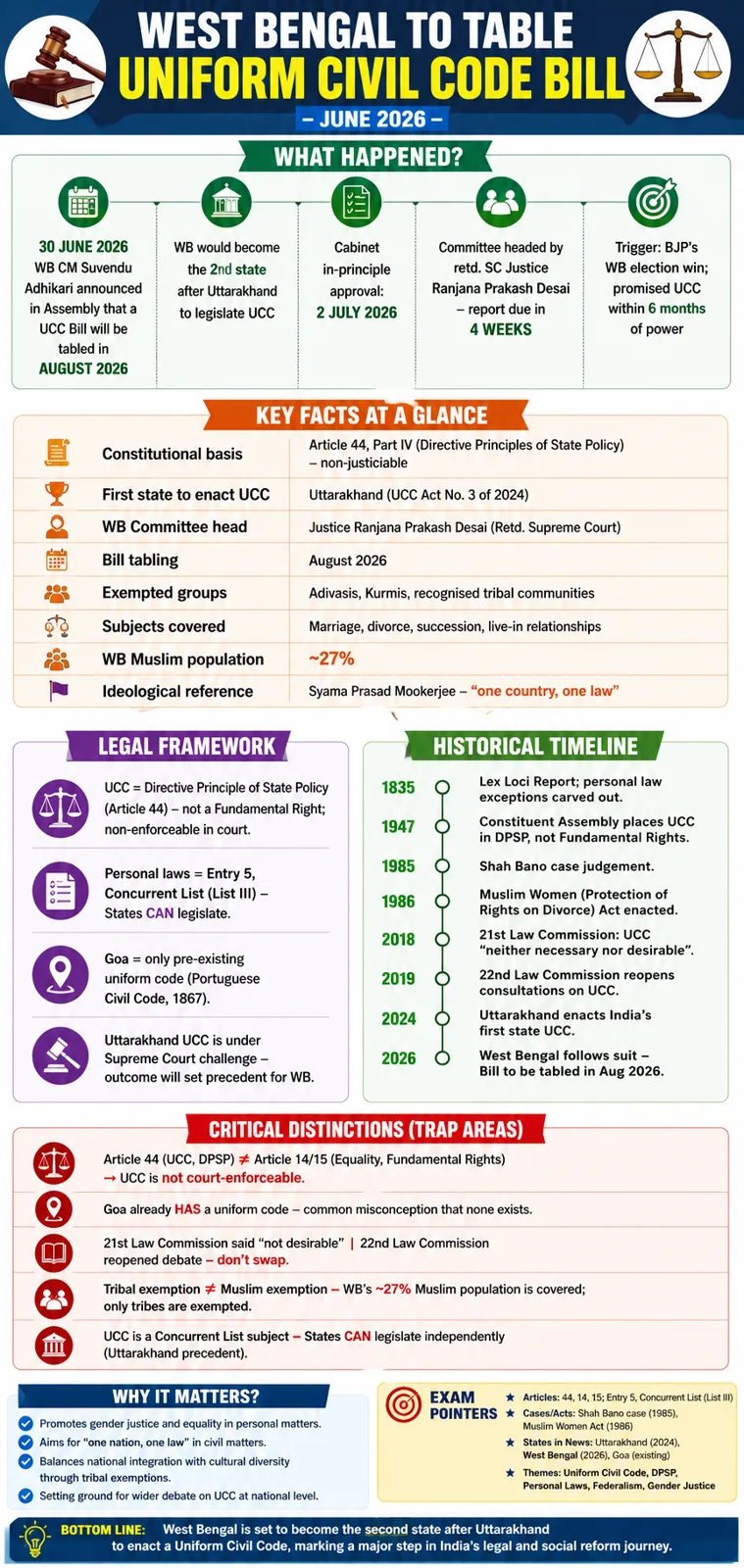
- West Bengal CM Suvendu Adhikari announced in the State Assembly on 30 June 2026 that a UCC Bill will be tabled in August 2026, making West Bengal the second state after Uttarakhand to legislate on UCC. [1][2]
- Critical for GS-II (Polity, Governance, Social Justice) and GS-I (Indian Society); also touches federal tensions central to Mains essays.
2. Why in the News
- On 29–30 June 2026, West Bengal CM Suvendu Adhikari announced in the Assembly that the State Cabinet would give in-principle approval to UCC on 2 July 2026. [2][3]
- The Bill is to be introduced in the Assembly in August 2026. [1]
- A committee under retired Supreme Court Justice Ranjana Prakash Desai has been constituted to study family laws; it will submit a report in four weeks. [1]
- The West Bengal Assembly also passed the West Bengal Public Safety and Control of Anti-Social Activities Bill, 2026 in the same session. [3]
- Trigger: BJP's victory in West Bengal elections; the party had promised UCC within six months of coming to power. [1]
3. Background & Evolution
- 1835: First Law Commission (Lex Loci Report) recommended uniform laws for all Indians — exception carved for personal laws of Hindus and Muslims.
- 1947: Constituent Assembly debated UCC; ultimately placed in Part IV (DPSPs) as Article 44 rather than fundamental rights, owing to religious plurality concerns.
- 1985: Shah Bano case (SC) — SC upheld Muslim woman's right to maintenance under CrPC Section 125; Parliament reversed via Muslim Women (Protection of Rights on Divorce) Act, 1986 — reignited UCC debate.
- 2019: 22nd Law Commission reopened UCC consultations (after 21st Law Commission in 2018 had said UCC is "neither necessary nor desirable at this stage"). [4]
- 2024: Uttarakhand became the first state to enact UCC — Uniform Civil Code of Uttarakhand, 2024 (Act No. 3 of 2024); covers marriage, divorce, succession, live-in relationships. [4][5]
- 2026: West Bengal (BJP-governed after state elections) announces intention to follow Uttarakhand's model. [1][2]
4. Core Static Facts
| Parameter | Detail |
|---|---|
| Constitutional Provision | Article 44, Part IV (DPSP) |
| Nature of DPSP | Non-justiciable; state shall endeavour to secure UCC |
| First state to enact UCC | Uttarakhand — Act No. 3 of 2024 |
| WB Committee head | Retd. SC Justice Ranjana Prakash Desai |
| Committee composition | 1 retd. IAS officer + 1 legal expert + 1 educationist + 1 social worker + 1 addl. secretary, WB govt. |
| Cabinet approval date | 2 July 2026 (in-principle) |
| Bill tabling (expected) | August 2026, West Bengal Legislative Assembly |
| Report submission timeline | 4 weeks from constitution of committee |
| Exempted communities | Adivasis, indigenous peoples, Kurmis, and other recognised ancient tribal communities |
| Subjects covered | Marriage, divorce, succession/inheritance, live-in relationships |
| WB Muslim population | ~27% (as per last Census) |
| Ideological reference | CM cited Syama Prasad Mookerjee ("one country, one law") |
| Implementing authority | State Government (concurrent-list subject overlap; family law under Entry 5, List III) |
5. Multi-Dimensional Analysis
Legal / Constitutional
- UCC falls under DPSP (Article 44) — not enforceable in court, but courts have repeatedly asked Parliament to enact it (Sarla Mudgal v. Union of India, 1995; Shayara Bano v. Union of India, 2017 on triple talaq).
- Personal laws derive from Entry 5, Concurrent List (List III, Seventh Schedule) — both Parliament and State Legislatures can legislate, giving states constitutional space to enact state-level UCC.
- Uttarakhand UCC 2024 is under judicial scrutiny — Supreme Court tagged petitions challenging its validity; outcome will precedent West Bengal's law. [5]
- Tribal exemption is constitutionally grounded — Fifth Schedule (for listed tribal areas) and Sixth Schedule areas are protected; also consistent with Uttarakhand UCC which exempts Scheduled Tribes. [4]
Social
- West Bengal's ~27% Muslim population (one of the highest in any BJP-governed state) makes this politically and demographically significant. [1]
- Christians in WB will also be affected — they currently follow the Indian Divorce Act, 1869 and Indian Christian Marriage Act, 1872.
- Women's rights groups broadly support UCC for gender parity in inheritance and divorce rights; minority groups raise cultural autonomy concerns.
- Live-in relationships covered — Uttarakhand UCC model mandates registration of live-in relationships, drawing controversy.
Ethical / Governance
- Federalism dimension: States legislating UCC independently creates patchwork uniformity — citizens in one state governed by different civil code than citizens in another.
- Risk of UCC becoming an instrument of majoritarian assimilation rather than gender justice if it imports Hindu personal law norms rather than truly secular standards.
- Transparency concern: Expert committee with tight 4-week deadline raises questions about depth of stakeholder consultation with minority communities.
Historical
- Goa is the only region with a functioning uniform civil code — the Goa Family Law (Portuguese Civil Code, 1867) applies to all residents regardless of religion, predating the Constitution.
- Goa model is cited as proof of concept; however, it too has some religion-specific exceptions (e.g., Hindu men could have two wives under certain conditions, now largely reformed).
Administrative
- Implementation challenge: civil registration infrastructure (births, deaths, marriages) must be strengthened for UCC compliance — currently weak in rural WB.
- Overlap with central personal law statutes (Hindu Marriage Act 1955, Muslim Personal Law Application Act 1937, Indian Succession Act 1925) requires careful drafting to avoid conflict under Article 254 (repugnancy clause).
6. Recent Developments (Last 12–18 Months)
- 2024: Uttarakhand enacted India's first state UCC (Act No. 3 of 2024); rules notified subsequently. [5]
- 2024–25: 22nd Law Commission continued consultations on central UCC; no central bill introduced in Parliament as of mid-2026. [4]
- June 29–30, 2026: West Bengal CM Suvendu Adhikari makes statement in Assembly; reveals UCC roadmap and Desai Committee constitution. [2][3]
- 2 July 2026: Cabinet to give in-principle approval (announced). [1]
- August 2026: UCC Bill expected to be tabled in WB Assembly. [1]
7. Prelims Hooks
- Article 44 of the Constitution directs the State to endeavour to secure a Uniform Civil Code for citizens.
- UCC is placed under Part IV (Directive Principles of State Policy), not Part III (Fundamental Rights).
- Uttarakhand is the first and (as of June 2026) only state to have enacted a UCC — Act No. 3 of 2024.
- The committee constituted by West Bengal government for UCC study is headed by retired SC Justice Ranjana Prakash Desai.
- West Bengal's proposed UCC will exempt Adivasis, Kurmis, and other recognised ancient tribal communities.
- West Bengal has a Muslim population of approximately 27% as per the last Census — among the highest of any state.
- Goa is the only Indian state/UT with a pre-existing uniform civil code (Portuguese Civil Code, 1867) applicable to all residents irrespective of religion.
- The Shah Bano case (1985) and subsequent Muslim Women (Protection of Rights on Divorce) Act, 1986 are the landmark legislative events in the UCC debate.
- Family law falls under Entry 5, List III (Concurrent List) of the Seventh Schedule — states have legislative competence.
- UCC's scope in WB will include live-in relationships — mirroring the Uttarakhand model.
- Syama Prasad Mookerjee's principle of "one country, one law" was cited by CM Adhikari as ideological basis for WB UCC.
- The 22nd Law Commission (not the 21st) is handling current UCC consultations at the central level.
- The 21st Law Commission (2018) had concluded UCC is "neither necessary nor desirable at this stage."
8. Mains Relevance
GS Paper Mapping:
- GS-II: Indian Polity & Governance — Directive Principles, Fundamental Rights, federalism, judiciary; Minority issues, social justice
- GS-I: Indian Society — Secularism, communalism, diversity, women's issues, social reform
Specific Syllabus Headings:
- Significant provisions of the Indian Constitution and related issues
- Welfare schemes for vulnerable sections; mechanisms for protection of vulnerable groups
- Role of women and women's organisations; social empowerment
Plausible Mains Questions:
- "The Uniform Civil Code is as much a question of gender justice as it is of national unity. Critically examine this statement in light of recent state-level initiatives." (GS-II / Essay)
- "Can state-level Uniform Civil Codes achieve the constitutional objective of Article 44, or does the very idea of patchwork uniformity undermine the goal? Discuss with reference to Uttarakhand and West Bengal." (GS-II)
- "Tribal exemption in UCC proposals reflects the tension between the right to equality and the right to cultural identity. Analyse the constitutional dimensions of this tension." (GS-II / GS-I)
9. Related Topics to Study Next
| Topic | Connection |
|---|---|
| Directive Principles of State Policy (Part IV) | UCC is a DPSP; understand enforceability, relationship with Fundamental Rights |
| Uttarakhand UCC, 2024 | First enacted state UCC; template for WB Bill; its provisions and SC challenges |
| Goa Civil Code (Portuguese Civil Code, 1867) | Only existing uniform civil code in India; often cited as proof of concept |
| Shah Bano Case (1985) & Muslim Women Act, 1986 | Most important judicial-legislative flashpoint on personal law reform |
| Fifth & Sixth Schedules of the Constitution | Basis for tribal exemptions in UCC proposals |
| Concurrent List (List III, Seventh Schedule) | Defines legislative competence of states to enact personal law legislation |
| Article 25–28 (Freedom of Religion) | Core tension between UCC and religious freedom; SC's balancing jurisprudence |
| Triple Talaq Judgment (Shayara Bano, 2017) | Recent SC ruling on personal law reform; sets precedent for UCC debate |
10. Common Errors / Trap Areas
- Confusing Article 44 with Article 14/15: Article 44 (UCC) is a DPSP — not enforceable by courts. Equality provisions (Art. 14/15) are Fundamental Rights. Do not conflate these.
- Goa is NOT exempt from UCC: It already has a uniform civil code — aspirants often assume no state has one. Goa is the counterexample.
- 21st vs. 22nd Law Commission: The 21st LC (2018) said UCC is "not desirable"; the 22nd LC was tasked with fresh consultations. Don't attribute the wrong position to the wrong Commission.
- Tribal exemption ≠ Muslim exemption: WB's proposed UCC exempts tribal communities, NOT Muslims or Christians as a whole. WB's Muslim population (~27%) will be covered — a common misread of the announcement.
- UCC is a concurrent-list subject area, NOT purely a Union List matter: States can legislate — Uttarakhand did. Aspirants often assume only Parliament can enact UCC.
Sources
- 1"West Bengal govt. will table Uniform Civil Code Bill soon" — The Hindu, 30 June 2026thehindu.com · tier 4
- 2"West Bengal CM Suvendu Adhikari to make statement on UCC bill in assembly today" — ANI News, 29 June 2026aninews.in · tier 4
- 3"West Bengal Assembly passes Public Safety Bill; Chief Minister Suvendu Adhikari unveils UCC roadmap" — ANI News, 30 June 2026aninews.in · tier 4
- 4"Uniform Civil Code private bill: All noise, no outcome" — PRS Legislative Researchprsindia.org · tier 1
- 5"The Uniform Civil Code of Uttarakhand, 2024 — Act No. 3 of 2024" — PRS Indiaprsindia.org · tier 1
At the end · practice MCQs
12 questions on this article
Check the answer for each question, or reveal all at once.