Has RBI changed the rules for scam compensation?
New · District CollectorCan you hold the district for 72 hours?Floods, a heatwave, an outbreak, a grievance queue. Take the decisions, see the consequences.Play →In this note
Practice
11 questions on this article
Check the answer for each question, or reveal all at once.
Has RBI Changed the Rules for Scam Compensation?
UPSC Prelims + Mains Study Note
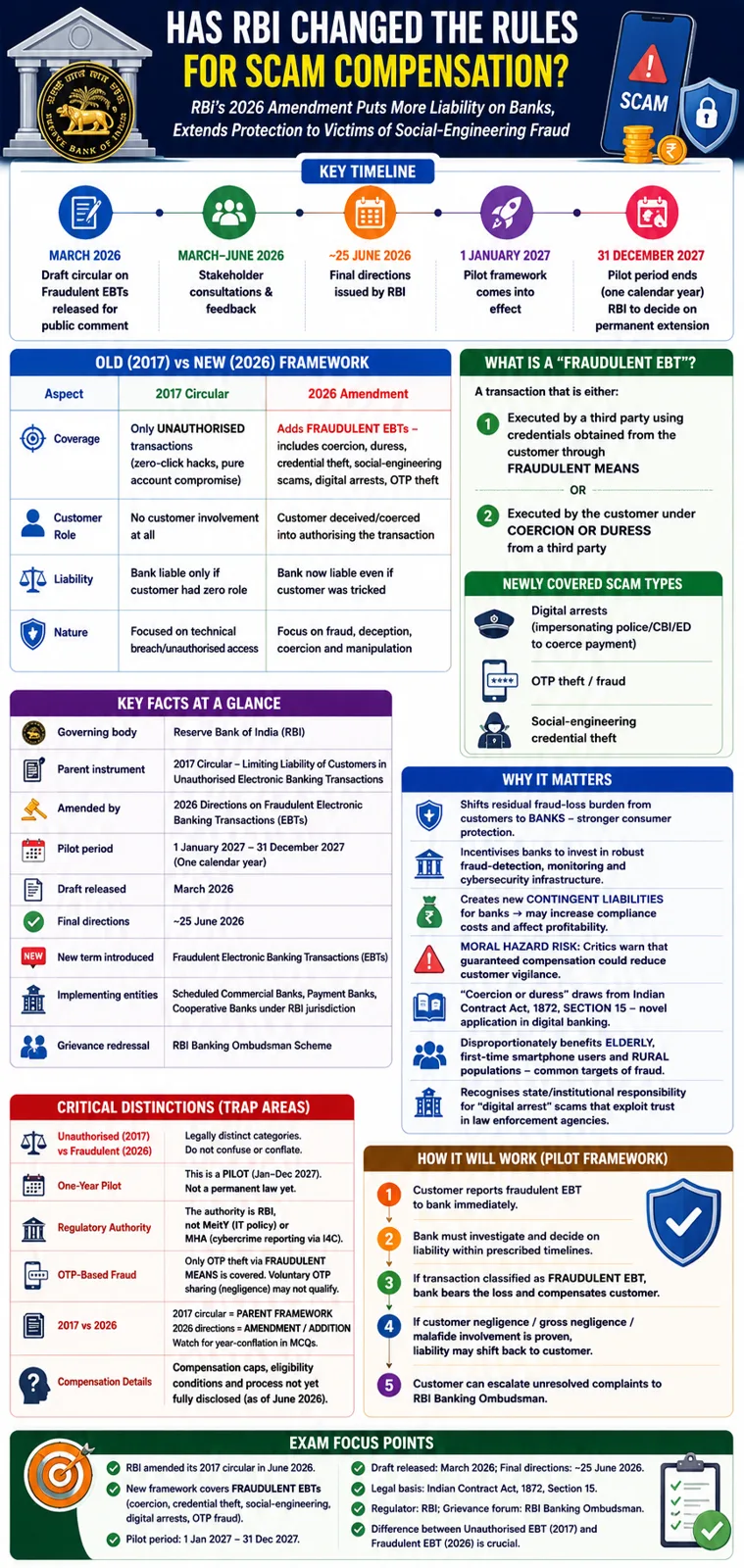
1. At a Glance
- The Reserve Bank of India (RBI) has amended its 2017 circular on "Limiting Liability of Customers in Unauthorised Electronic Banking Transactions" to now cover a wider class of fraud — including social-engineering scams. [1]
- The previous framework only obligated banks to compensate customers when transactions were not authorised by the customer at all (e.g., pure hacking); the new rules extend liability to transactions arising from coercion, duress, or credential theft via fraud. [1]
- This is a pilot framework, effective 1 January 2027, lasting for one calendar year, after which the RBI will decide on permanent extension. [1]
- UPSC relevance: touches GS-III (Economy — banking regulation, consumer protection) and GS-II (Governance — regulatory policy, digital rights); directly connects to India's surging cybercrime/financial fraud challenge.
2. Why in the News
- June 2026: RBI issued fresh directions (Wednesday, ~25 June 2026) amending its 2017 circular to cover fraudulent electronic banking transactions (EBTs), including digital-arrest scams and OTP theft. [1]
- A draft circular was released for public comment in March 2026, following which the finalised directions were issued. [1]
- Rising incidence of cyber financial fraud, digital arrests, and social-engineering attacks against bank customers has made the existing framework inadequate.
3. Background & Evolution
- 2017: RBI issued its landmark circular — "Limiting Liability of Customers in Unauthorised Electronic Banking Transactions" — the foundational framework for customer protection in digital banking fraud. [1]
- Under this circular, banks were liable to compensate customers only when a transaction was unauthorised (i.e., initiated without any customer involvement, such as in a successful hacking/account takeover incident).
-
Transactions where the customer was deceived into authorising a payment (social engineering) were not covered — the loss fell on the customer.
-
2016 (Global precedent): Reserve Bank of India's broader push toward digital payments post-demonetisation created the policy urgency for such consumer-protection frameworks.
- March 2026: RBI released a draft amendment for public consultation, introducing the concept of Fraudulent EBTs. [1]
- June 2026: Final directions issued; pilot effective 1 January 2027 – 31 December 2027. [1]
4. Core Static Facts
| Parameter | Detail |
|---|---|
| Governing body | Reserve Bank of India (RBI) |
| Parent instrument | RBI Circular 2017 — "Limiting Liability of Customers in Unauthorised Electronic Banking Transactions" |
| Amended by | 2026 Directions on Fraudulent Electronic Banking Transactions |
| Pilot period | 1 January 2027 – 31 December 2027 |
| Draft for comment released | March 2026 |
| Final directions issued | ~June 2026 (Wednesday) |
| Key new term | Fraudulent Electronic Banking Transactions (EBTs) |
| Definition of Fraudulent EBT | Transactions (a) executed by a third party using credentials obtained from the customer through fraudulent means, OR (b) executed by the customer under coercion or duress from a third party |
| Scam types now covered | Digital arrests; OTP theft/fraud; social-engineering credential theft |
| Earlier coverage | Only unauthorised transactions (zero-click hacks, pure account compromise) |
| Regulatory domain | Banking Regulation Act + RBI Act (RBI's general regulatory/supervisory powers) |
| Implementing entities | Scheduled commercial banks, payment banks, cooperative banks under RBI jurisdiction |
5. Multi-Dimensional Analysis
Economic
- Consumer financial protection: Millions of Indians lose money annually to UPI/NEFT/IMPS-based social-engineering fraud; the new rules shift some of the residual loss burden onto banks, incentivising banks to invest in anti-fraud infrastructure. [1]
- Bank cost exposure: Banks will face new contingent liabilities for compensating defrauded customers even when core banking systems were not breached — this may raise compliance costs and product-pricing.
- Moral hazard risk: Economists note customer vigilance may decline if compensation is guaranteed, potentially increasing fraud attempts overall.
Legal / Constitutional
- The 2017 circular established the zero-liability / limited-liability spectrum based on whose fault a breach was; the 2026 amendment introduces a third category — fraudulent EBTs — blurring the line between "authorised" and "unauthorised." [1]
- "Coercion or duress" is a concept drawn from contract law (Indian Contract Act, 1872, Section 15); its application to digital banking creates novel adjudicative challenges.
- Customer eligibility conditions and compensation caps have not yet been publicly disclosed in detail — these will be critical for the pilot's legal operationalisation.
Ethical / Governance
- Digital arrests — where fraudsters impersonate police/CBI/ED officers and coerce victims to transfer money — represent a major ethical failure at the intersection of impersonation fraud and state-institution trust. Covering such cases recognises state responsibility. [1]
- The pilot design (one year, then review) reflects evidence-based policymaking; outcome data will inform permanent rule-making — an accountable regulatory approach.
- OTP-based fraud persists partly because banks do not adequately warn customers; extending liability incentivises banks to improve real-time alerts and friction in high-risk transactions.
Administrative
- Banks must build detection, documentation, and grievance-redressal pipelines to handle Fraudulent EBT claims — a significant operational challenge.
- The RBI Banking Ombudsman mechanism will likely be the first appellate forum for disputed claims.
- Defining "fraudulent means" operationally (as distinct from customer negligence) will require clear bank-level policies and RBI guidance notes to avoid arbitrary claim rejection.
Social
- Elderly, first-time smartphone users, and rural populations are disproportionately targeted by social-engineering fraud; the new rules have an implicit equity dimension.
- Digital arrests disproportionately target middle-class and senior citizens — the new compensatory framework offers them meaningful relief for the first time.
6. Recent Developments (Last 12–18 Months)
- March 2026: RBI released draft directions on Fraudulent EBTs for public comment. [1]
- June 2026 (~25 June): RBI issued final amended directions, introducing compensability for Fraudulent EBTs. [1]
- Effective date announced: 1 January 2027 — pilot for one year. [1]
- Coverage of digital arrests: Explicitly named in RBI communication as a compensable fraud category — first time such coercive cyber-fraud is acknowledged in RBI's compensatory framework. [1]
- OTP fraud coverage: Fraudulently obtained OTPs leading to authorised-looking transactions now bring banks into the compensation equation. [1]
7. Prelims Hooks
- The 2017 RBI circular on "Limiting Liability of Customers in Unauthorised Electronic Banking Transactions" is the baseline framework for bank-customer liability in digital fraud. [1]
- The 2026 amendment introduces a new category: Fraudulent Electronic Banking Transactions (EBTs). [1]
- A Fraudulent EBT includes transactions made under coercion or duress, not just hacking — a significant conceptual expansion. [1]
- The new directions are a pilot, effective 1 January 2027, and run for one calendar year. [1]
- The draft was open for public comment in March 2026 before finalisation. [1]
- Digital arrests (impersonation of law-enforcement officers to coerce payments) are explicitly named as a covered fraud type. [1]
- OTP theft through fraudulent means is now a compensable category — previously, any customer-side credential compromise voided bank liability. [1]
- Most financial fraud in India operates via social engineering, not zero-click hacks; the 2017 framework was thus inadequate. [1]
- "Zero-click" hacks (where the customer plays no role at all) were the only type clearly covered under the 2017 circular. [1]
- The implementing/regulating authority is the Reserve Bank of India (RBI) — not SEBI, not MeitY, not UIDAI. [1]
- Eligibility conditions and compensation quantum are subject to the pilot's detailed operational guidelines — not yet publicly finalised as of June 2026. [1]
- The Banking Ombudsman Scheme under RBI is the grievance redressal mechanism for consumer banking disputes, including fraud compensation. [1]
8. Mains Relevance
GS Paper(s):
- GS-III: Indian Economy — Banking sector regulation; cybercrime and digital financial security; consumer protection in financial services.
- GS-II: Governance — Regulatory reforms; citizen-centric administration; e-governance challenges.
Specific Syllabus Headings:
- GS-III: "Role of RBI and its functions; banking sector reforms."
- GS-II: "Government policies and interventions for development in various sectors; issues arising out of design and implementation."
Plausible Mains Question Stems:
- "The RBI's 2026 directions on Fraudulent Electronic Banking Transactions mark a paradigm shift in customer liability norms. Critically examine the implications for banks, customers, and the broader digital payments ecosystem."
- "Social-engineering fraud has exposed the limits of India's existing banking consumer-protection framework. Discuss the regulatory gaps and suggest a comprehensive policy response."
- "With reference to the rise of 'digital arrests' and OTP-based fraud in India, evaluate the adequacy of the RBI's pilot framework for compensating scam victims."
9. Related Topics to Study Next
| Topic | Connection |
|---|---|
| Banking Ombudsman Scheme (RBI) | Primary grievance mechanism for fraud compensation claims |
| IT Act 2000 & Amendments | Legal framework governing cybercrime; jurisdictional overlap with RBI rules |
| Prevention of Money Laundering Act (PMLA) | Proceeds of fraud transactions trigger AML obligations for banks |
| Unified Payments Interface (UPI) fraud trends | Most social-engineering fraud executes via UPI; NPCI's role in fraud prevention |
| Cyber Crime Reporting Portal (I4C / MHA) | Government's parallel administrative response to the same fraud epidemic |
| Digital Personal Data Protection Act 2023 | Credential theft constitutes a data breach; DPDP liability overlaps with RBI rules |
| RBI's Master Direction on KYC | KYC gaps are often exploited in social-engineering fraud |
| SEBI's Investor Protection Fund | Analogous consumer-protection mechanism in the securities market |
10. Common Errors / Trap Areas
- Confusing "unauthorised" with "fraudulent" EBTs: The 2017 circular covered only unauthorised transactions (no customer involvement at all). The 2026 rules add fraudulent EBTs (customer was deceived/coerced into participating). These are legally distinct — do not conflate them.
- Treating the new rules as permanent law: They are a one-year pilot starting 1 January 2027 — not a permanent statutory amendment. Questions may specifically probe the pilot nature.
- Attributing this to MeitY or MHA: This is an RBI regulatory action, not a government ministry directive. MeitY oversees IT infrastructure policy; MHA handles cybercrime reporting (I4C). Compensation rules are RBI's domain.
- Assuming all OTP-based fraud is now covered: Only OTP theft via fraudulent means qualifies; customers who voluntarily share OTPs with strangers (negligence) may not qualify — eligibility conditions matter.
- Confusing the 2017 circular with the 2026 amendment: The 2017 circular is the parent framework; 2026 is an amendment/addition. In MCQs, year conflation is a common distractor.
Sources
- 1"Has RBI changed the rules for scam compensation?" — The Hindu, 30 June 2026, Page 10 (International Print Edition), by Aroon Deep — Article excerpt provided as primary sourcetier 4
At the end · practice MCQs
11 questions on this article
Check the answer for each question, or reveal all at once.