NSE is a public authority under RTI Act, says Delhi HC
New · District CollectorCan you hold the district for 72 hours?Floods, a heatwave, an outbreak, a grievance queue. Take the decisions, see the consequences.Play →In this note
Practice
12 questions on this article
Check the answer for each question, or reveal all at once.
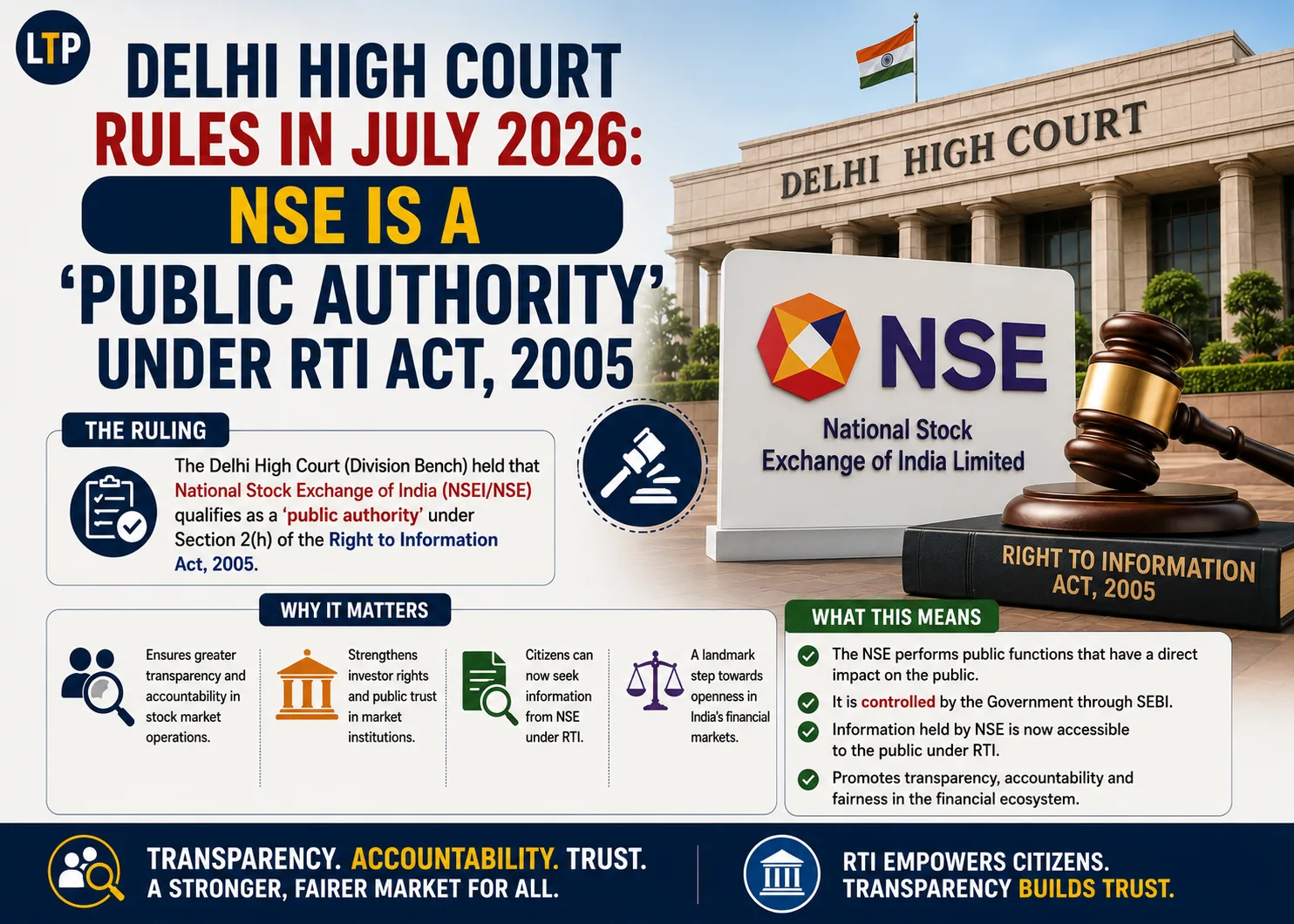
NSE is a Public Authority under RTI Act — Delhi HC
UPSC Study Note | GS-II: Governance, Transparency, Statutory Bodies
1. At a Glance
- The Delhi High Court (Division Bench) ruled in July 2026 that the National Stock Exchange of India (NSEI/NSE) qualifies as a 'public authority' under Section 2(h) of the Right to Information Act, 2005. [2]
- The ruling means the public can now seek information from NSE under RTI, placing it on par with government bodies for transparency purposes. [2]
- This is significant because NSE is incorporated as a private limited company yet exercises quasi-public functions in regulating capital markets. [3]
- UPSC relevance: intersects RTI Act provisions, SEBI's regulatory architecture, judicial interpretation of public authority, and accountability of market intermediaries. [1]
2. Why in the News
- July 2, 2026: Delhi HC Division Bench dismissed NSE's appeal against a single judge's earlier ruling that had declared NSE a 'public authority' under Section 2(h) of the RTI Act. [1][2]
- The Division Bench upheld the single judge's 2010 ruling, finally settling a long-pending question about NSE's RTI obligations. [3]
- The court's reasoning — that SEBI's statutory recognition is indispensable for NSE to function — is a significant expansion of how 'establishment by government' is interpreted. [2][4]
3. Background & Evolution
- 1992: SEBI (Securities and Exchange Board of India) established by statute; gains power to recognize and regulate stock exchanges under the Securities Contracts (Regulation) Act, 1956 (SCRA). [1]
- 1992: NSE incorporated as a private limited company under the Companies Act; however, it required SEBI recognition to operate as a stock exchange. [2]
- 1993: NSE granted recognition by SEBI; commences trading operations.
- 2005: RTI Act, 2005 enacted; defines 'public authority' under Section 2(h) — includes bodies owned, controlled, or substantially financed by the government, or established by an order/notification issued by the government. [5]
- 2010: Single judge of Delhi HC rules NSE is a 'public authority' under RTI Act; NSE challenges this ruling. [3]
- 2026 (July): Division Bench dismisses NSE's appeal, affirming the 2010 ruling. [1][2]
4. Core Static Facts
| Parameter | Detail |
|---|---|
| Full Name | National Stock Exchange of India Ltd. (NSEI) |
| Incorporation | Private limited company under Companies Act |
| Established | 1992; commenced trading 1994 |
| Regulatory body | SEBI (Securities and Exchange Board of India) |
| Parent legislation | Securities Contracts (Regulation) Act, 1956 (SCRA) |
| RTI Act provision | Section 2(h) — definition of 'public authority' |
| Key court | Delhi High Court (Division Bench) |
| Operative ruling | NSE is public authority on two grounds (see §5) |
| Original single-judge ruling | 2010, Delhi HC |
| Appellate ruling | July 2026, Delhi HC Division Bench |
Section 2(h) RTI Act — Two Limbs:
- First Limb: Body established or constituted by or under the Constitution, or by any other law made by Parliament/State Legislature, or by notification/order issued by Government. [5]
- Second Limb: Body owned, controlled, or substantially financed directly or indirectly by funds provided by the Government. [5]
Two grounds on which NSE qualifies (per Delhi HC):
- SEBI's statutory recognition is indispensable for NSE to function → treated as "established by government order" (First Limb). [2]
- Government exercises deep and pervasive control over NSE through SEBI → qualifies under Second Limb (control). [2][4]
5. Multi-Dimensional Analysis
Legal / Constitutional
- The ruling broadens the interpretive scope of Section 2(h) — a private company incorporated under Companies Act can still be a 'public authority' if it cannot function without statutory recognition from a government body. [2]
- Delhi HC distinguished this case from situations where an entity was "established as a private company and regulated by statute later" — NSE's very existence as a stock exchange is contingent on SEBI recognition. [1]
- Raises question of whether BSE (Bombay Stock Exchange) and other SEBI-recognized exchanges would similarly qualify; jurisprudence likely to expand. [3]
- Consistent with Supreme Court jurisprudence on 'public authority' — courts have held that functional test (public duties, government control) overrides formal incorporation status. [4]
Governance / Ethical
- NSE has been embroiled in past controversies — the co-location scam (2015–2019) raised serious questions about insider access and opaque governance. [3]
- RTI applicability could serve as a structural check: market participants, journalists, and researchers can now demand information on NSE's operations, governance, and decisions. [2]
- Raises the broader question of accountability of market infrastructure institutions (MIIs) — entities that have public interest mandates but private ownership structures. [1]
Economic
- NSE is India's largest stock exchange by volume; its governance directly impacts price discovery, market integrity, and investor confidence. [2]
- RTI applicability could increase compliance burden on NSE but also enhance investor trust — a net positive for capital market deepening. [3]
- May set precedent for other self-regulatory organisations (SROs) and financial market infrastructure entities to be brought under RTI. [4]
Administrative
- NSE will now need to appoint Public Information Officers (PIOs) and Appellate Authorities under RTI Act. [5]
- RTI requests must be responded to within 30 days (or 48 hours for life/liberty matters) under the Act. [5]
- Central Information Commission (CIC) would be the appellate body for second appeals against NSE's RTI responses. [5]
6. Recent Developments (last 12–18 months)
- July 2, 2026: Delhi HC Division Bench dismisses NSE's appeal; upholds 2010 ruling declaring NSE a 'public authority'. [1][2]
- The court's ruling specifically noted NSE cannot function as a stock exchange without SEBI recognition, making statutory recognition equivalent to government establishment. [2]
- The ruling distinguished NSE's case from purely private companies that are merely regulated — NSE's functional existence depends on government (SEBI) sanction. [1]
7. Prelims Hooks
- Section 2(h) of the RTI Act, 2005 defines 'public authority'. [5]
- RTI Act was enacted in 2005, replacing the earlier Freedom of Information Act, 2002. [5]
- The Delhi High Court (Division Bench) — not the Supreme Court — ruled NSE a public authority in July 2026. [1]
- NSE qualifies as public authority on two grounds: (1) established by government order (via SEBI recognition) and (2) subject to deep and pervasive government control. [2]
- NSE is incorporated as a private limited company under the Companies Act — yet is treated as a public authority under RTI. [2]
- The original single-judge ruling declaring NSE a public authority was from 2010; Division Bench affirmed it in 2026. [3]
- Under RTI Act, a public authority must respond within 30 days; 48 hours if the matter involves life or liberty. [5]
- The appellate body for second RTI appeals against NSE decisions would be the Central Information Commission (CIC). [5]
- SEBI regulates stock exchanges under the Securities Contracts (Regulation) Act, 1956. [1]
- NSE is regulated as a Market Infrastructure Institution (MII) under SEBI's framework. [2]
- The court held NSE is not a case of a private company "regulated by statute later" — its very functioning is contingent on SEBI recognition. [1]
8. Mains Relevance
GS Paper: GS-II (Governance, Constitution, Polity, Social Justice)
Syllabus Headings:
- Important aspects of governance — transparency and accountability
- Statutory, regulatory and quasi-judicial bodies
- RTI Act and its implementation
Plausible Mains Question Stems:
- The Delhi High Court's ruling that NSE is a 'public authority' under the RTI Act raises fundamental questions about the boundaries of state control over private market institutions. Critically analyse. (GS-II, 250 words)
- What are the criteria for classifying an entity as a 'public authority' under Section 2(h) of the RTI Act? In light of the NSE judgment, examine whether Self-Regulatory Organisations (SROs) in India should be brought under RTI. (GS-II, 250 words)
- Discuss how the RTI Act can serve as an instrument of investor protection and market integrity in India's capital markets. (GS-II/GS-III, 150 words)
9. Related Topics to Study Next
| Topic | Connection |
|---|---|
| RTI Act, 2005 — full provisions | Core statute; understand all sections especially 2(h), 8, 19, 20 |
| SEBI — composition, powers, functions | Regulatory authority whose control over NSE was the basis of the ruling |
| Securities Contracts (Regulation) Act, 1956 | Parent law enabling SEBI to recognise stock exchanges |
| Central Information Commission (CIC) | Appellate authority for RTI second appeals; now relevant for NSE |
| Market Infrastructure Institutions (MIIs) | NSE, BSE, depositories — similar RTI implications may follow |
| Co-location Scam (NSE, 2015–19) | Context for why NSE transparency matters; governance failure case study |
| Judicial interpretation of 'State' under Article 12 | Parallel jurisprudence on when private bodies are treated as state actors |
| Self-Regulatory Organisations (SROs) in India | NSE ruling could extend to SROs; important for governance questions |
10. Common Errors / Trap Areas
- Wrong court level: The 2026 ruling is by Delhi HC Division Bench, not the Supreme Court. The original ruling was by a single judge in 2010 — don't conflate the two.
- RTI applies only to government departments: A common misconception. Section 2(h) explicitly covers bodies substantially financed or controlled by government — private incorporation is not a shield.
- Confusing NSE with SEBI: SEBI is already a statutory public authority. NSE is a stock exchange regulated by SEBI — a distinct entity now separately held to be a public authority.
- Wrong Act cited: The operative legislation is RTI Act, 2005, Section 2(h). Do not confuse with the Securities Contracts (Regulation) Act, 1956 or the SEBI Act, 1992 (though both are contextually relevant).
- Assuming all SEBI-regulated entities are now public authorities: The ruling is specific to NSE's situation — that SEBI recognition is indispensable for it to function. Other regulated entities (mutual funds, brokers) have a different relationship with SEBI and may not meet the same threshold.
Sources
- 1NSE is a public authority under RTI Act, says Delhi HC — The Hindu (July 2, 2026)thehindu.com · tier 4
- 2Delhi HC rules National Stock Exchange a public authority under RTI — Business Standardbusiness-standard.com · tier 4
- 3RTI Act applies to National Stock Exchange: Delhi High Court — Bar and Benchbarandbench.com · tier 4
- 4Delhi HC upholds ruling declaring NSE a 'public authority' under RTI Act — The Hawkthehawk.in · tier 4
- 5RTI Act, 2005 — Sections 2(h), 7, 19 — India Code / Legislative Departmentindiacode.nic.in · tier 1
At the end · practice MCQs
12 questions on this article
Check the answer for each question, or reveal all at once.