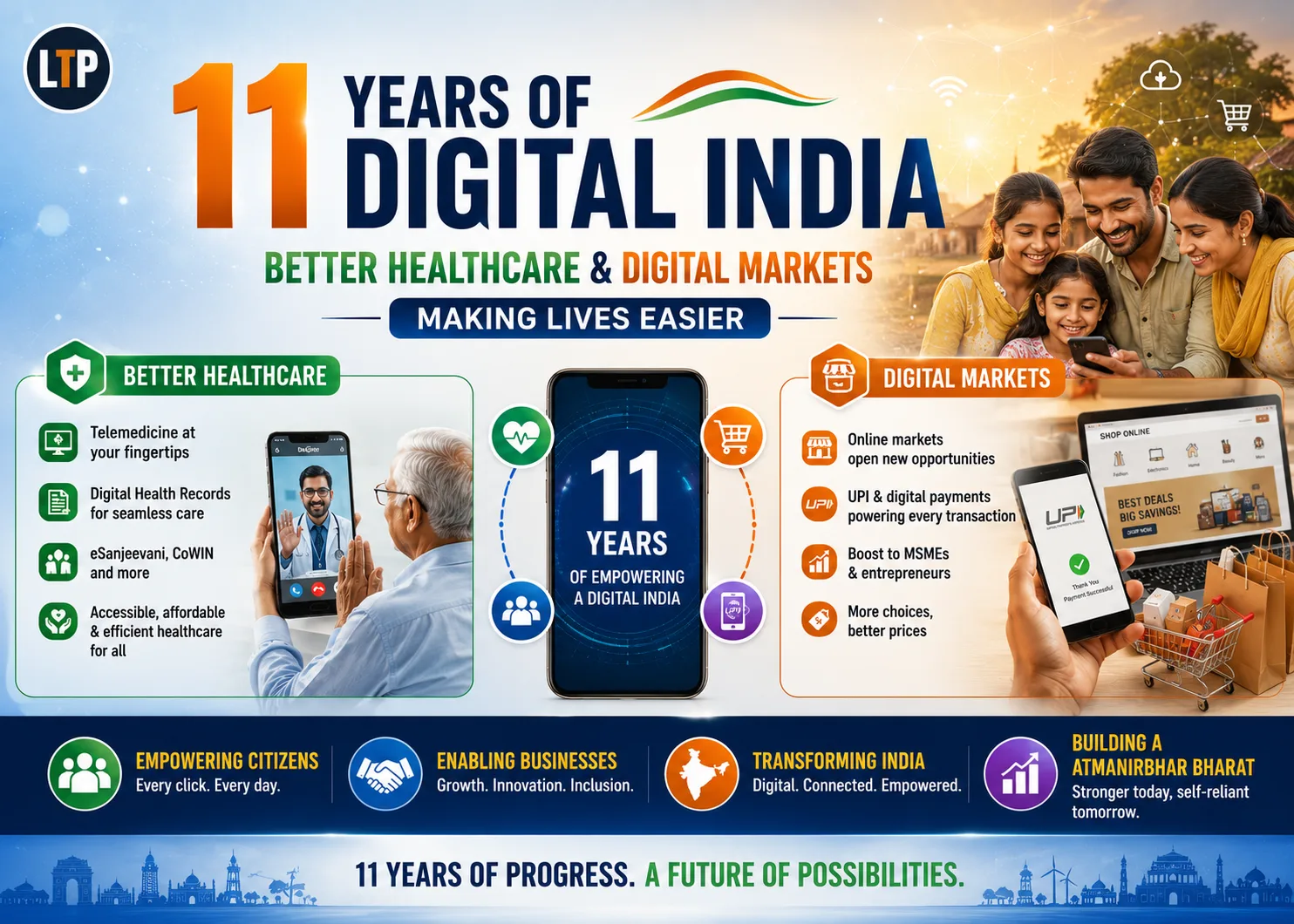
11 Years of Digital India: Better Healthcare & Digital Markets Making Lives Easier
New · District CollectorCan you hold the district for 72 hours?Floods, a heatwave, an outbreak, a grievance queue. Take the decisions, see the consequences.Play →In this note
Practice
8 questions on this item
Check the answer for each question, or reveal all at once.
1. At a Glance
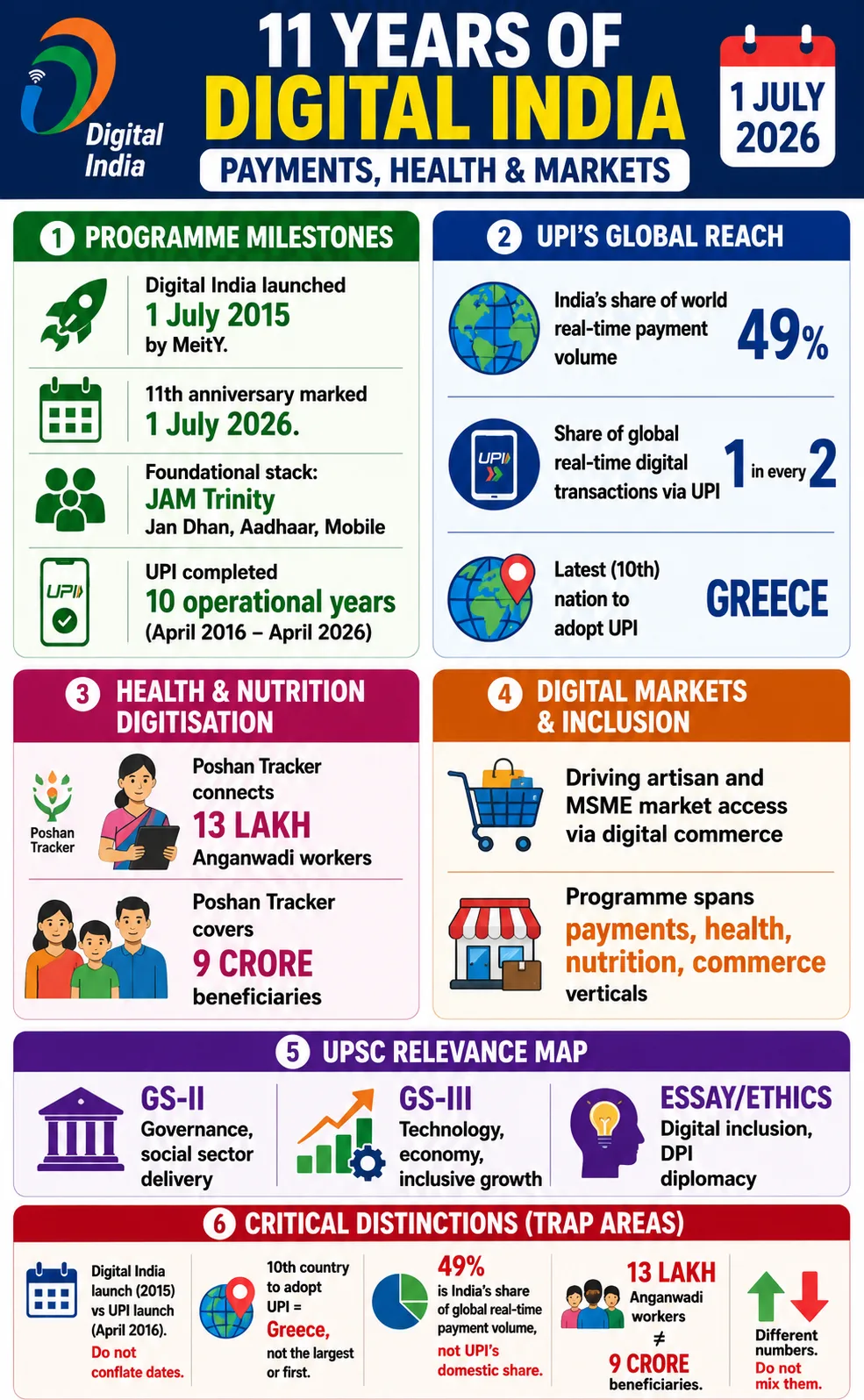
- Digital India Programme was launched on 1 July 2015 by the Ministry of Electronics & IT (MeitY); its 11th anniversary (1 July 2026) marks a comprehensive audit of achievements across payments, health, nutrition, and commerce. [1]
- India now accounts for 49% of the world's real-time payment transaction volume through UPI, making it the single most influential digital payments infrastructure globally. [2][3]
- The programme operationalises the JAM Trinity (Jan Dhan – Aadhaar – Mobile) as the foundational stack for delivering welfare, commerce, and health services digitally. [3]
- UPSC relevance: spans GS-II (governance, social sector), GS-III (technology, economy, inclusive growth), and essay/ethics papers; it is a perennial source of Prelims MCQs and Mains analytical questions.
2. Why in the News
- 1 July 2026 — Press Information Bureau (PIB) released a comprehensive 11-year milestone report, highlighting healthcare digitisation, UPI's global dominance, and digital market expansion for artisans. [1]
- Greece became the 10th nation to adopt UPI, reinforcing India's DPI diplomacy (exact date: mid-2026). [1]
- UPI completed 10 operational years (April 2016 → April 2026), commemorated with a dedicated PIB release noting 24,161.69 crore transactions in FY 2025-26. [2]
- IMF designated UPI as the "world's largest retail fast payment system by transaction volume" in June 2025. [3]
3. Background & Evolution
- Pre-2015 context: India was predominantly cash-dependent; welfare delivery was paper-based, health records were manual, and artisan markets were intermediary-dominated.
- 1 July 2015 — Digital India Programme launched; nine pillars defined (broadband highways, universal phone access, public internet access, e-governance, e-Kranti, information for all, electronics manufacturing, IT for jobs, early harvest programmes). [1]
- 2014 — Jan Dhan Yojana launched as National Mission for Financial Inclusion (foundation for DBT and UPI). [3]
- April 11, 2016 — UPI launched by NPCI with 21 banks. [2]
- 2015 — DigiLocker and ORS (Online Registration System) portal launched. [3]
- 2017 — DIKSHA and UMANG launched. [3]
- November 2019 — eSanjeevani (telemedicine) launched. [3]
- April 2, 2020 — Aarogya Setu launched; later evolved into National Health App under Ayushman Bharat Digital Mission. [3]
- January 16, 2021 — CoWIN launched to manage COVID-19 vaccination. [3]
- March 1, 2021 — Poshan Tracker launched under MoWCD. [3]
- 2022 — ONDC (Open Network for Digital Commerce) launched. [3]
- 2023 — Skill India Digital Hub integrated. [3]
- FY 2025-26 — UPI processes ₹314 lakh crore in value; 703 banks on platform. [2]
4. Core Static Facts
UPI
| Parameter | Value |
|---|---|
| Launch Date | April 11, 2016 |
| Operator | National Payments Corporation of India (NPCI) |
| Regulator | Reserve Bank of India (RBI) |
| Banks at launch | 21 |
| Banks live (March 2026) | 703 |
| FY 2025-26 transactions | 24,161.69 crore |
| FY 2025-26 value | ₹314 lakh crore |
| Global real-time payment share | 49% |
| P2M share of volume (FY2026) | 63% |
| Micro-payments (<₹500) in P2M | 86% |
| Countries operational | 8 (UAE, Singapore, France, Bhutan, Nepal, Sri Lanka, Mauritius, Qatar) [2] |
| Nations adopting UPI (total, 2026) | 10 (Greece = 10th) [1] |
Poshan Tracker
| Parameter | Value |
|---|---|
| Launch Date | March 1, 2021 |
| Ministry | Women & Child Development (under Mission Poshan 2.0 / Saksham Anganwadi) |
| Anganwadi Workers registered | 13.30 lakh (May 2026) [1] |
| Anganwadi Centres onboard | 14.03 lakh (January 2026) [3] |
| Beneficiaries | 8.90–8.93 crore [1][3] |
| Aadhaar verification rate | 99.89% [1] |
| Daily transactions (2026) | 22 crore (up from 1 crore in 2021) [1] |
| Children monitored monthly | 77 million (nutrition indicators) [1] |
| Coverage | All 36 States and UTs [1] |
| Previous system | 11 manual registers per worker [1] |
Indiahandmade
| Parameter | Value |
|---|---|
| Developer | Digital India Corporation |
| Parent Ministry | Ministry of Textiles |
| Artisans/Weavers onboarded | Over 3,900 [1] |
| Products listed | 21,000+ handcrafted/handloom items [1] |
| Key feature | Direct bank credits, zero middlemen [1] |
Other Key Platforms [3]
- DigiLocker: 67.63 crore users; 950 crore documents issued; launched 2015.
- eSanjeevani: 45.42 crore patients served; 2.3 lakh healthcare providers onboard.
- ORS portal: 1.37 crore online appointments (as of 24 June 2026).
- CoWIN: 220 crore vaccine doses managed.
- Aadhaar: 144 crore numbers generated; 2,707 crore authentications in 2024-25.
- Jan Dhan accounts: 57.71 crore (March 2026); ₹2.94 lakh crore deposits.
- PFMS/DBT: ₹49.09 lakh crore transferred (January 2026); savings ₹4.31 lakh crore (2015–March 2024).
- ONDC: 1.16 lakh+ retail sellers; 630+ cities.
- NCD Platform: 74.97 crore enrolled; 8.64 crore under treatment (hypertension/diabetes).
5. Multi-Dimensional Analysis
Economic
- UPI's ₹314 lakh crore transaction value in FY 2025-26 (20.59% YoY growth) represents a structural shift of India's informal economy into the formal, taxable digital economy. [2]
- GeM (Government eMarketplace): ₹16.41 lakh crore cumulative GMV; 24 lakh sellers; MSEs contribute 44.8% of order value — a major public procurement democratisation. [3]
- Indiahandmade eliminates middlemen for 3,900+ weavers and artisans, improving income realisation through direct bank credits. [1]
- ONDC creates an open interoperable commerce layer (akin to UPI for e-commerce), with 1.16 lakh sellers across 630+ cities. [3]
Social
- Poshan Tracker connects 13.30 lakh Anganwadi workers to real-time data, replacing 11 manual registers per worker — directly impacting maternal and child nutrition monitoring for ~9 crore beneficiaries including pregnant women, lactating mothers, and 0–6 year children. [1][3]
- eSanjeevani's 45.42 crore telemedicine consultations have extended healthcare access to rural and underserved populations without requiring physical hospital visits. [3]
- NCD platform's 74.97 crore enrollments address India's non-communicable disease burden (hypertension, diabetes) through digital screening. [3]
- Jan Dhan: Women account for a significant share of 57.71 crore accounts; RuPay debit cards (39.98 crore) enable financial autonomy. [3]
Geopolitical / Strategic
- India has signed MoUs with 24 countries for DPI/India Stack cooperation; MOSIP being adopted by 25+ nations for digital identity. [3]
- Greece's adoption of UPI makes it the 10th nation and marks UPI's entry into the European Union's regulatory space — a significant geoeconomic achievement. [1]
- UPI's live presence across 8 countries (including France in Europe) positions India's DPI as a genuine "global public good" alternative to Western-dominated payment rails (SWIFT, Visa/Mastercard). [2]
- CoWIN offered as open-source to other countries at zero cost — a form of digital health diplomacy. [3]
Scientific / Technological
- JAM Trinity (Jan Dhan + Aadhaar + Mobile) is the architectural backbone: biometric identity → financial inclusion → mobile delivery → digital services. [3]
- API Setu: 8,036 APIs hosted, enabling interoperable government services across 10,530 organisations — the plumbing of DPI. [3]
- UPI's architecture: open, interoperable, NPCI-governed; supports P2P, P2M, recurring payments, and cross-border remittances through a single protocol. [2]
- 5G rollout: 5.18 lakh base transceiver stations; coverage in 85% of population — enabling real-time platforms like Poshan Tracker at scale. [3]
Ethical / Governance
- Aadhaar verification rate of 99.89% in Poshan Tracker ensures deduplication and prevents ghost beneficiaries in nutrition programmes — addressing a historic leakage problem in Indian welfare delivery. [1]
- PFMS-driven DBT saved ₹4.31 lakh crore (2015–2024) by eliminating intermediaries — a transparency dividend. [3]
- Risk of digital exclusion: those without smartphones (14.5% of households), connectivity, or digital literacy remain outside DPI benefits.
- Privacy concerns: Aadhaar-linked biometric data aggregation raises questions under the Digital Personal Data Protection Act, 2023; consent frameworks in DigiLocker address some concerns. [3]
Administrative
- Poshan Tracker's transition from 11 manual registers to a unified digital platform exemplifies administrative simplification at the last mile. [1]
- MeitY is the nodal ministry for Digital India; health platforms are implemented by respective sectoral ministries (MoHFW for eSanjeevani, MoWCD for Poshan Tracker, Ministry of Textiles for Indiahandmade). [1][3]
- Federated implementation: DPI platforms are designed as open layers with state-level customisation — e-Courts Phase III (₹7,210 crore) and DIKSHA both allow state variations. [3]
- Bottleneck: last-mile connectivity and digital literacy gaps persist, particularly in aspirational districts. [3]
6. Recent Developments (last 12–18 months)
- April 2026 — UPI completes 10 years; peak monthly transactions of 2,264 crore recorded in March 2026. [2]
- June 2025 — IMF formally designates UPI as "world's largest retail fast payment system by transaction volume." [3]
- Mid-2026 — Greece becomes the 10th country to adopt UPI, first EU-member to operationalise it. [1]
- May 2026 — Poshan Tracker daily transactions reach 22 crore (from 1 crore in 2021); 13.30 lakh Anganwadi workers registered. [1]
- March 2026 — Aadhaar authentications cross 2,707 crore in FY 2024-25; 144 crore Aadhaar numbers generated. [3]
- March 2026 — DigiLocker reaches 67.63 crore users and 950 crore documents. [3]
- March 2026 — eSanjeevani crosses 45.42 crore patient consultations. [3]
- January 2026 — Cumulative DBT transfers reach ₹49.09 lakh crore via PFMS. [3]
- 24 June 2026 — ORS crosses 1.37 crore online hospital appointments. [1]
- February 2026 — India's DPI MoUs reach 24 countries; India Stack Global Platform operationalised. [3]
7. Prelims Hooks (high-density factual bullets)
- Digital India Programme was launched on 1 July 2015 under the Ministry of Electronics & Information Technology (MeitY). [1]
- UPI was launched on April 11, 2016 by the National Payments Corporation of India (NPCI), regulated by the RBI. [2]
- UPI processed 24,161.69 crore transactions worth ₹314 lakh crore in FY 2025-26 — a nearly 12,000-fold volume increase since launch. [2]
- India accounts for 49% of global real-time payment transaction volume through UPI. [2][3]
- Greece is the 10th nation to adopt UPI (2026); UPI is operationally live in 8 countries (UAE, Singapore, France, Bhutan, Nepal, Sri Lanka, Mauritius, Qatar). [1][2]
- Poshan Tracker was launched on March 1, 2021 under Mission Poshan 2.0 / Saksham Anganwadi (Ministry of Women & Child Development). [3]
- Poshan Tracker replaced 11 manual registers per Anganwadi worker and now covers all 36 States and UTs. [1]
- Poshan Tracker's Aadhaar verification rate is 99.89% (as of May 2026). [1]
- Indiahandmade is developed by Digital India Corporation under the Ministry of Textiles; lists 21,000+ products from 3,900+ artisans/weavers. [1]
- eSanjeevani (telemedicine) was launched in November 2019 and has served 45.42 crore patients with 2.3 lakh healthcare providers onboard. [3]
- CoWIN was launched on January 16, 2021 and managed 220 crore vaccine doses. [3]
- DigiLocker was launched in 2015; it had 67.63 crore users and 950 crore documents issued as of March 2026. [3]
- IMF designated UPI as "world's largest retail fast payment system by transaction volume" in June 2025. [3]
- The NCD Platform has enrolled 74.97 crore beneficiaries and covers hypertension and diabetes management across 31 States/UTs. [3]
- PFMS/DBT savings from 2015 to March 2024 amount to ₹4.31 lakh crore, eliminating leakages in welfare delivery. [3]
8. Mains Relevance
GS Papers:
- GS-II: Government policies and interventions; welfare schemes; digital governance; health and nutrition; e-governance.
- GS-III: Technology and innovation; digital economy; inclusive growth; digital payments infrastructure.
- Essay Paper: "Digital India: From aspiration to transformation" — technology as an equity enabler.
Specific Syllabus Headings:
- GS-II: Important aspects of governance, transparency, and accountability; social sector/health.
- GS-III: Indigenization of technology; role of technology in development; digital economy.
Plausible Mains Question Stems:
- "India's UPI is often cited as the most successful Digital Public Infrastructure in the world. Critically examine the factors behind its success and the challenges to sustaining it in a multipolar digital economy." (GS-III)
- "The Poshan Tracker has transformed last-mile nutrition monitoring in India. Assess its impact on the goal of eliminating malnutrition and the challenges that remain." (GS-II)
- "Digital India has democratised commerce for artisans and weavers through platforms like Indiahandmade. Evaluate the role of digital public infrastructure in bridging the rural-urban economic divide." (GS-II/GS-III)
9. Related Topics to Study Next
- Digital Personal Data Protection Act, 2023 — governs privacy of data collected by Aadhaar, DigiLocker, and all DPI platforms; essential legal counterpart to Digital India.
- Ayushman Bharat Digital Mission (ABDM) — creates unique Health IDs (ABHA); integrates eSanjeevani, ORS, and Aarogya Setu into one health data ecosystem.
- India Stack and DPI Diplomacy — India's global export of digital identity, payment, and health infrastructure; links to G20 DPI Framework agreed under India's presidency.
- NPCI and Payment Systems Regulation — covers UPI, RuPay, Bharat Bill Payment System, and FASTag; essential for understanding India's payment sovereignty.
- Mission Poshan 2.0 / Saksham Anganwadi — parent programme of Poshan Tracker; connects to PM POSHAN (midday meals), ICDS reform, and India's nutrition strategy.
- ONDC (Open Network for Digital Commerce) — UPI's structural analogue for e-commerce; disrupts platform monopolies (Flipkart, Amazon) through protocol-level interoperability.
- Jan Dhan–Aadhaar–Mobile (JAM) Trinity — foundational architecture for DBT, financial inclusion, and all welfare delivery; frequently tested in context of leakage elimination.
- 5G Rollout and BharatNet — physical connectivity infrastructure enabling real-time platforms like Poshan Tracker and eSanjeevani; links to telecom policy and rural connectivity.
10. Common Errors / Trap Areas
- UPI countries count confusion: UPI is operationally live in 8 countries but 10 nations have adopted/agreed to integrate it (Greece = 10th adopter, not necessarily live yet). Treat these as different figures. [1][2]
- Ministry misattribution — Indiahandmade: Aspirants often assume it is under MeitY or Ministry of Commerce. It is under the Ministry of Textiles, developed by Digital India Corporation. [1]
- Poshan Tracker vs. ICDS: Poshan Tracker is the digital platform; it operates under Mission Poshan 2.0 / Saksham Anganwadi, not the old ICDS scheme (which it replaced/reformed). Ministry is MoWCD, not MoHFW.
- UPI operator vs. regulator: NPCI operates UPI; RBI regulates it. These are frequently swapped in MCQs.
- CoWIN launch date: CoWIN was launched January 16, 2021 (not 2020 — COVID-19 lockdown began in March 2020 but CoWIN came later). Aarogya Setu was the 2020 app (April 2, 2020). Do not conflate the two.
Sources
- 1"11 Years of Digital India: Better Healthcare & Digital Markets Making Lives Easier" — PIB Press Release (PRID 2280068), dated 1 July 2026pib.gov.in · tier 1
- 2"UPI Completes 10 Glorious Years, Emerges as World's Largest Real-Time Payments Platform" — PIB Press Release (PRID 2257087)pib.gov.in · tier 1
- 3"India's Digital Public Infrastructure" — PIB Press Release (PRID 2235812)pib.gov.in · tier 1
At the end · practice MCQs
8 questions on this item
Check the answer for each question, or reveal all at once.